Winter War
- Dates:
- 30 November 1939 – 13 March 1940
- Front:
- Scandinavia
- Location:
- Finland, along the whole border with the Soviet Union from the Gulf of Finland to the Barents Sea; the main fighting on the Karelian Isthmus and in Ladoga Karelia, and also at Kuhmo and Suomussalmi, at Salla and at Petsamo; air raids on towns in the interiorOn the battle map →
- Sides:
- Soviet UnionKliment Voroshilov, Kirill Meretskov, Semyon TimoshenkoFinlandCarl Gustaf Emil Mannerheim
- Result:
- Soviet victory bought at enormous cost. In the Peace of Moscow Finland ceded about a tenth of its territory, including Viipuri, and leased Hanko, but kept its independence.
- Author:
- Łukasz
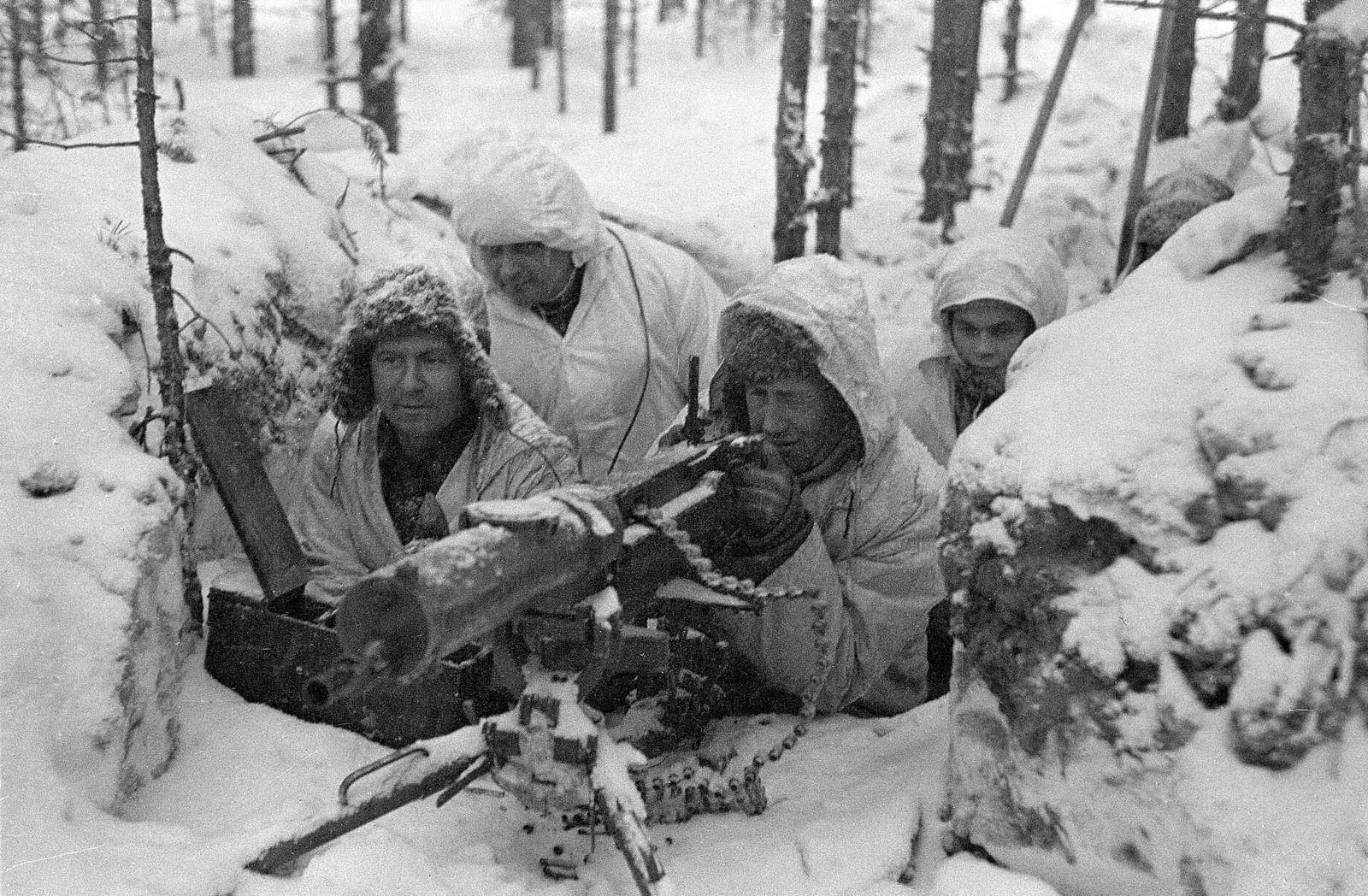
The Winter War was the Soviet Union’s attack on Finland, which had refused the territorial concessions and bases that Joseph Stalin demanded of it in the autumn of 1939. On 30 November 1939 the Red Army crossed the border along its entire length, from the Gulf of Finland to the Arctic Ocean, without a declaration of war, and Soviet aircraft bombed Helsinki. The Kremlin expected the campaign to last a few weeks at most. Instead, the small Finnish army under Field Marshal Carl Gustaf Emil Mannerheim stopped the invader on the fortifications of the Karelian Isthmus, while in the forests north of Lake Ladoga it encircled and destroyed entire Soviet divisions. Only in February 1940, after a reorganisation of its command and the concentration of enormous forces, did the Red Army break through the Mannerheim Line and reach the approaches to Viipuri (Vyborg). On 13 March 1940 the Peace of Moscow came into force: Finland lost about a tenth of its territory, but it was the only one of the states to which Stalin had presented demands in 1939 that kept its independence.
Name and dates
The name “Winter War” (Finnish talvisota, Swedish vinterkriget) became universally accepted because the fighting took place during one of the coldest winters of the century. Soviet historiography spoke of the “Soviet–Finnish War of 1939–1940” or of an “armed conflict”, and in the first weeks official propaganda presented it as assistance to the “people’s government” of the Finnish Democratic Republic rather than as a war against the Finnish state.
The war began on the morning of 30 November 1939, when Soviet artillery opened fire and the troops crossed the border. It is taken to have ended on 13 March 1940. The peace treaty was signed in Moscow on the evening of 12 March, but the guns fell silent only at 11 a.m. Finnish time (noon Leningrad time) the following day. The war thus lasted 105 days.
Background
Finland, for more than a century a grand duchy within the Russian Empire, declared its independence in December 1917. After the bloody civil war of 1918, won by the Whites under Mannerheim, the border with Soviet Russia was fixed by the Treaty of Tartu in 1920. On the Karelian Isthmus it ran a mere 32 kilometres or so from Leningrad. In 1932 the two states concluded a non-aggression pact, extended in 1934 for ten years, and in the same year the Soviet Union joined the League of Nations, undertaking to settle disputes peacefully.
The secret protocol to the Molotov–Ribbentrop Pact of 23 August 1939 assigned Finland to the Soviet sphere of influence. After the invasion of Poland Moscow forced mutual assistance pacts, with the right to military bases, on Estonia, Latvia and Lithuania, and on 5 October it invited the Finns to talks. On 12 and 14 October Stalin and Vyacheslav Molotov presented their demands to a delegation led by Juho Kusti Paasikivi: the lease of the port of Hanko as a base, islands in the Gulf of Finland and a shift of the border on the Karelian Isthmus deeper into Finland, in exchange for a larger but worthless area of Soviet Karelia. The Finns agreed to some of the concessions but rejected the base at Hanko and the surrender of their line of fortifications. On 13 November the talks broke down, and on 26 November Soviet artillery shelled its own positions near the village of Mainila, for which Moscow blamed the Finns. The Mainila incident served as a pretext: on 28 November the USSR renounced the non-aggression pact, and on 29 November it broke off diplomatic relations.
Historians disagree on whether Stalin wanted only to push the border back from Leningrad or to subjugate the whole of Finland. In favour of the latter view is the fact that as early as 1 December, in the occupied border town of Terijoki, the creation was announced of the puppet government of the Finnish Democratic Republic, headed by the communist Otto Kuusinen, with which the USSR concluded a “treaty of mutual assistance and friendship” the next day, and that the operational plans provided for a march all the way to the Swedish border.
Forces and plans
The war plan was drawn up by the staff of the Leningrad Military District, commanded by Komandarm 2nd Rank Kirill Meretskov, under the supervision of the Leningrad party secretary Andrei Zhdanov and the People’s Commissar for Defence, Kliment Voroshilov. The Chief of the General Staff, Boris Shaposhnikov, proposed a more carefully prepared attack with the best forces on the Karelian Isthmus, but Stalin chose the quicker option. The war was supposed to last about two weeks. Soldiers were warned not to cross the Swedish border by mistake, and some divisions took bands with them for the victory parade.
Four armies were assigned to the attack, some 450,000 men in all in more than 20 divisions, supported by about 2,000 tanks and 2,500 aircraft (estimates vary from source to source):
- the 7th Army on the Karelian Isthmus was to break through the Finnish fortifications, take Viipuri and advance on Helsinki;
- the 8th Army north of Lake Ladoga was to outflank the Mannerheim Line from the rear;
- the 9th Army in central Finland was to advance through Suomussalmi to Oulu on the Gulf of Bothnia and cut the country in two at its narrowest point;
- the 14th Army from Murmansk was to seize the Arctic port of Petsamo and push on towards Rovaniemi.
Finland, with a population of just under 3.7 million, had already mobilised some 300,000 men in October under the guise of “extraordinary reserve exercises”. It lacked almost everything except men: it had a few dozen obsolete tanks, about 114 serviceable combat aircraft, a handful of anti-tank guns and enough artillery ammunition for a few weeks. Many reservists fought in their own clothes, with only a cockade sewn on. The Finnish soldiers, however, were excellent skiers, knew the terrain and could survive in the forests at forty degrees below zero. The Karelian Isthmus was defended by General Hugo Österman’s Army of the Isthmus with the II and III Corps, the area north of Lake Ladoga by the IV Corps, and the country further north by weak covering groups under General Wiljo Tuompo. On 30 November Field Marshal Mannerheim, the chairman of the Defence Council, who had been warning the government for months that the army could not withstand a long war with the USSR, became Commander-in-Chief.
The Mannerheim Line, which acquired that name only during the war, ran across the Karelian Isthmus at a distance of 30 to 75 kilometres from the border, from the Gulf of Finland to Lake Ladoga. Soviet propaganda compared it to the Maginot Line, but in reality it was above all a network of trenches, barbed-wire entanglements, anti-tank ditches and earth-and-timber shelters, with more than two hundred strongpoints, most of them light. The more modern concrete bunkers were concentrated mainly in the Summa sector, on the road to Viipuri. Its strength lay in its defenders and in well-prepared artillery fire.
Course: the December offensive on the Karelian Isthmus
On the first day of the war Soviet aircraft bombed Helsinki, killing nearly a hundred people, and several other towns. Molotov assured the world that the aircraft were dropping bread for the starving Finns, to which the Finns responded by calling the cluster bombs “Molotov bread baskets” and the petrol bombs they used to destroy Soviet tanks “Molotov cocktails”. In Helsinki the government of Aimo Cajander gave way on 1 December to a cabinet under Risto Ryti, in which Väinö Tanner became foreign minister. The new government tried to open talks, but Moscow replied that it recognised only the “people’s government” in Terijoki.
On the Karelian Isthmus Finnish covering units delayed the advance of the 7th Army for several days, destroying tanks and burning villages behind them, and by 6 December they had withdrawn to the Mannerheim Line. The first blow fell on its eastern end on the Taipale river, where Soviet divisions advancing across open ground and ice were decimated by well-registered Finnish artillery. The attacks were repeated throughout December, to no avail. On 9 December the direction of operations was taken over in Moscow by the Stavka of the Main Military Council, comprising Stalin, Voroshilov, Shaposhnikov and the People’s Commissar for the Navy, Nikolai Kuznetsov, and Meretskov took direct command of the 7th Army in place of Komandarm Vsevolod Yakovlev (PL).
Meretskov directed his main attack against the Summa sector on the road to Viipuri. In the First Battle of Summa, from 17 to 22 December, Soviet tanks broke through the Finnish line several times, but the infantry that was supposed to follow them was left behind at the wire under machine-gun and artillery fire. Deprived of cover, the tanks circled behind the Finnish trenches until they were destroyed with bundles of grenades and petrol bombs. The attack collapsed with heavy losses. A Finnish counter-offensive launched on 23 December by the II Corps under General Harald Öhquist, who wanted to encircle the weakened Soviet divisions, also failed. Stalemate set in on the Isthmus, and the Soviet command realised that frontal attacks without preparation led nowhere.
Course: from Lake Ladoga to the Barents Sea
The Finnish command had not expected the Red Army to send entire divisions, often motorised, into the trackless forests north of Lake Ladoga and in central Finland. Here the first days brought retreat and moments of panic as the 8th Army pressed forward along the northern shore of Lake Ladoga and through Suojärvi. On 4 December the commander of the IV Corps, Juho Heiskanen, was replaced by General Woldemar Hägglund. On 13 December command of the 8th Army passed to Komandarm Grigory Shtern, known from the fighting at Khalkhin Gol. From 7 December the Finns held a line on the small Kollaa river, and they kept these positions until the end of the war. The slogan “Kollaa holds” (Kollaa kestää) became one of the symbols of the war, as did the sniper Simo Häyhä, who was credited with several hundred kills.
The Finns won their first clear victory on 12 December at Tolvajärvi, where a group commanded by Colonel Paavo Talvela, with Lieutenant Colonel Aaro Pajari leading the attack, routed the Soviet 139th Rifle Division, which was threatening to reach the rear of the defenders on Lake Ladoga. On the shore of Lake Ladoga, Finnish counter-attacks in January cut the Soviet columns into isolated pockets at Kitelä and Lemetti. The Finns called them motti, from the word for a stack of firewood cut and ready for burning. The encircled Red Army men, meagrely supplied from the air, dug in, buried their tanks as bunkers and held out for weeks, suffering from hunger and frost. In February the Lemetti pocket was destroyed, and with it most of the Soviet 18th Rifle Division and 34th Tank Brigade.
The most famous victory came in the fighting in Kainuu. On 7 December the Soviet 163rd Rifle Division took the village of Suomussalmi, which the Finns had burned, intending to advance from there on Oulu. Colonel Hjalmar Siilasvuo, whose improvised brigade was soon turned into the 9th Division, cut it off from its rear and destroyed it in the last days of December in the Battle of Suomussalmi. The Soviet 44th Rifle Division, which was coming to its relief along the road from Raate and with its supporting units numbered more than ten thousand men, got stuck in the forest in a column many kilometres long. In the Battle of the Raate Road, from 1 to 7 January 1940, the Finns cut it into pockets and destroyed it. Soviet losses in the two battles are estimated at many thousands killed, frozen to death and taken prisoner, Finnish losses at a few hundred dead. The Finns captured dozens of tanks and guns, hundreds of lorries and nearly 2,000 horses. The commander of the 44th Division, Kombrig Alexei Vinogradov, and his closest subordinates were shot on the sentence of a court martial in front of the remnants of the division. Command of the 9th Army was taken over by Komkor Vasily Chuikov, later the defender of Stalingrad. Further south, at Kuhmo, the Soviet 54th Division was encircled and fought on in pockets until the end of the war.
In the far north the Soviet 122nd and 88th Divisions advanced through Salla towards Kemijärvi, but in mid-December they were thrown back and stood still until the end of the war. From 11 December the Lapland Group was commanded by General Kurt Wallenius. The Finns had to give up Arctic Petsamo, attacked from land and sea by the 14th Army, but small units fighting in the unbroken polar night halted the advance southwards.
Soviet aircraft held command of the air throughout the war. They bombed railway lines, ports and towns, including Viipuri, Tampere and Turku several times. According to Finnish figures the raids killed 957 civilians. The few Finnish fighters, fighting against many times their number, shot down, by various counts, from over a hundred to about two hundred enemy aircraft, and the anti-aircraft artillery accounted for more. At sea, which froze in January, there was little activity. On 1 December Finnish coastal artillery near Hanko damaged the Soviet cruiser Kirov with near misses and forced her to withdraw.
The political war: the League of Nations, volunteers and plans for intervention
Finland appealed to the League of Nations, and on 14 December 1939 the League Assembly declared the USSR an aggressor and the League Council expelled it from the organisation, calling on member states to help the Finns. It was the League’s last significant act. The struggle of “the Finnish David against the Soviet Goliath” stirred public opinion in Europe and America. Money and arms were sent by Sweden, Britain, France, Italy and the United States, although most of the deliveries arrived late. Some 12,000 volunteers came from abroad, the largest number, about 8,000, from Sweden. General Ernst Linder’s Swedish Volunteer Corps took over a sector of the front at Salla at the end of February. The Swedish government, however, refused to send regular troops, and King Gustaf V confirmed this publicly on 19 February. Germany, bound by its pact with Stalin, kept a cool distance from Finland and advised it to give way.
Britain and France saw the war as an opportunity not only to help the Finns but also to cut Germany off from Swedish iron ore from the Kiruna area, which in winter was shipped out through the Norwegian port of Narvik. The French Prime Minister, Édouard Daladier, pressed for action, and the First Lord of the Admiralty, Winston Churchill, had been calling for operations in Scandinavia since the autumn. On 5 February 1940 the Allied Supreme War Council decided to send an expeditionary force to Finland by way of Narvik and the Swedish mines. It was to include the Polish Independent Podhale Rifle Brigade, then being formed in France, and General Władysław Sikorski declared his readiness to send airmen and warships. The French even considered bombing the Soviet oilfields at Baku. Norway and Sweden, however, consistently refused to allow troops to pass through, and the Finns feared that a small corps arriving late would drag them into a great war without saving their front. The war was over before the first transports had put to sea.
Course: the February offensive
The defeats of December led Stalin to change his plans. At the end of December the frontal attacks were halted, and on 7 January 1940 the forces on the Karelian Isthmus were formed into the North-Western Front, commanded by Komandarm 1st Rank Semyon Timoshenko, with Zhdanov as a member of its military council. The Isthmus was divided between Meretskov’s 7th Army in the west and the new 13th Army under Komkor Vladimir Grendal in the east. The number of divisions on the Isthmus was raised from about ten to more than twenty, and heavy artillery, including 203 mm howitzers, new tanks and aircraft were brought up. The troops practised storming fortifications on mock-ups, received white overalls and skis, and the infantry learned to cooperate with tanks and artillery. By mid-February, according to Finnish estimates, the Red Army had about 460,000 men on the Isthmus. It was defended by some 150,000 increasingly exhausted Finns.
On 1 February a bombardment lasting many days began, combined with air raids and reconnaissance attacks. On the morning of 11 February, after a massive artillery preparation, the general offensive began. That same day the Soviet 123rd Rifle Division broke through the Finnish defences in the Lähde sector near Summa. Finnish counter-attacks failed because the defenders had run short of ammunition, reserves and anti-tank weapons, and this time the Soviet infantry covered its tanks. On 15 February Mannerheim allowed the II Corps to fall back to the intermediate line and, when that too was broken, at the end of February to the rear line in front of Viipuri. The commander of the Army of the Isthmus, Österman, was replaced by General Erik Heinrichs. At the eastern end of the Isthmus, on the Taipale, the Finns beat off the attacks of the 13th Army and held their positions until the end of the war.
Course: Viipuri and the end of the fighting
On 26 February Timoshenko ordered the capture of Viipuri (Russian Vyborg), one of Finland’s largest cities, already ruined by air raids. The 7th Army was to strike directly at the city and to outflank it on both sides, including across the frozen Bay of Viipuri. At the beginning of March Soviet divisions crossed the ice of the bay and seized bridgeheads on its western shore, and on 9 March they cut the road from Viipuri to Helsinki. Bloody fighting raged in the suburbs of Viipuri and on the Tali isthmus, and the 13th Army forced a crossing of the Vuoksi river. The Finnish front was still holding, but men and shells were running out, and Mannerheim warned the government that the army might soon collapse.
The Peace of Moscow
Peace feelers had begun as early as January through an unofficial channel in Stockholm, where the Finnish writer Hella Wuolijoki met the Soviet envoy Alexandra Kollontai. On 29 January Molotov let it be known through the Swedes that Moscow was ready to talk to the Ryti government. With that, Kuusinen’s “government” was abandoned. The Soviet terms, however, grew as the offensive progressed. On 23 February Moscow demanded the whole of the Karelian Isthmus with Viipuri and the lands around Lake Ladoga. On 29 February the Finnish government agreed to open negotiations. A delegation including Prime Minister Ryti and Paasikivi arrived in Moscow on 7 March, where instead of Stalin it found Molotov and terms dictated without negotiation.
The peace treaty was signed on the evening of 12 March 1940. Finland ceded the Karelian Isthmus with Viipuri, the whole shore of Lake Ladoga with Sortavala, parts of the municipalities of Salla and Kuusamo, the western part of the Rybachy Peninsula and islands in the Gulf of Finland, together about a tenth of the country’s territory. It had to lease the Hanko peninsula to the USSR for 30 years and build a railway line to Salla. Petsamo, which the Red Army had occupied, was returned to Finland. Some 420,000–430,000 people, roughly one in eight of the country’s inhabitants, were evacuated from the lost lands. President Kyösti Kallio, on signing his assent to the treaty, is said to have declared: “May the hand that signs such a document wither.” At 11 a.m. on 13 March the guns fell silent, although Soviet artillery shelled the Finnish positions until the very last moment.
Losses
According to the findings of Finnish historians published in 2005, Finland lost 25,904 soldiers killed and missing and 43,557 wounded. Some thousand Finns were taken prisoner. Air raids killed 957 civilians.
Soviet losses are disputed. At the end of March 1940, at a session of the Supreme Soviet, the Soviet government gave figures of 48,745 killed and died of wounds and 158,863 wounded and sick. In the 1990s a team of Russian military historians led by Grigori Krivosheev established a figure of 126,875 killed, died of wounds and missing, and about 265,000 wounded, sick and frostbitten. More recent archival research gives even higher figures, of about 135,000–168,000 killed and missing. The Red Army also lost between about 1,200 and more than 3,000 tanks destroyed and damaged, and several hundred aircraft. More than 5,500 Red Army soldiers were taken prisoner by the Finns. On their return to the USSR most of them were sent to the Gulag, and some were shot.
Significance
Militarily the Soviet Union won the war: it broke the Finnish defences and took more land than it had demanded in October. Politically, however, it was a defeat for Stalin. Finland was not subjugated, and Kuusinen’s “people’s government” was dissolved. The USSR lost what remained of its prestige in the West, was expelled from the League of Nations and came close to war with Britain and France. Lessons were quickly drawn from the humiliating defeats. In May 1940 Timoshenko replaced Voroshilov as People’s Commissar for Defence, general officer ranks were restored, the role of the political commissars was curtailed and training was reformed. The reforms were still incomplete, however, when Operation Barbarossa came in June 1941.
The course of the war confirmed Adolf Hitler and the German generals in their conviction that the Red Army, weakened by the Great Purge, was a colossus with feet of clay that could be defeated in a single short campaign. Allied plans to help Finland turned the attention of London, Paris and Berlin to Norway and Swedish ore, which in April 1940 led to the German invasion of Denmark and Norway and to the Norwegian campaign, in which the Podhale riflemen originally intended for Finland also fought. The Allies’ helplessness in the face of Finland’s fate contributed to the fall of Daladier’s government in March 1940.
For the Finns the Winter War became a founding myth: the “spirit of the Winter War” united a nation that had been divided since 1918. Bitterness at an unjust peace and fear of another Soviet attack, fed during the fifteen months of the fragile “Interim Peace”, pushed Helsinki towards Germany. In June 1941 Finland entered the Continuation War alongside the Reich in order to regain its lost lands, and it took part in the siege of Leningrad. It emerged from that war in 1944 defeated, with even heavier losses, but once again an independent state.