Soviet Union
Kirill Meretskov
Commander of the Leningrad Military District and the 7th Army in the Winter War (1939–1940), Chief of the General Staff of the Red Army (1940–1941), commander of the Volkhov, Karelian and 1st Far Eastern Fronts (1941–1945), Marshal of the Soviet Union (from 1944)
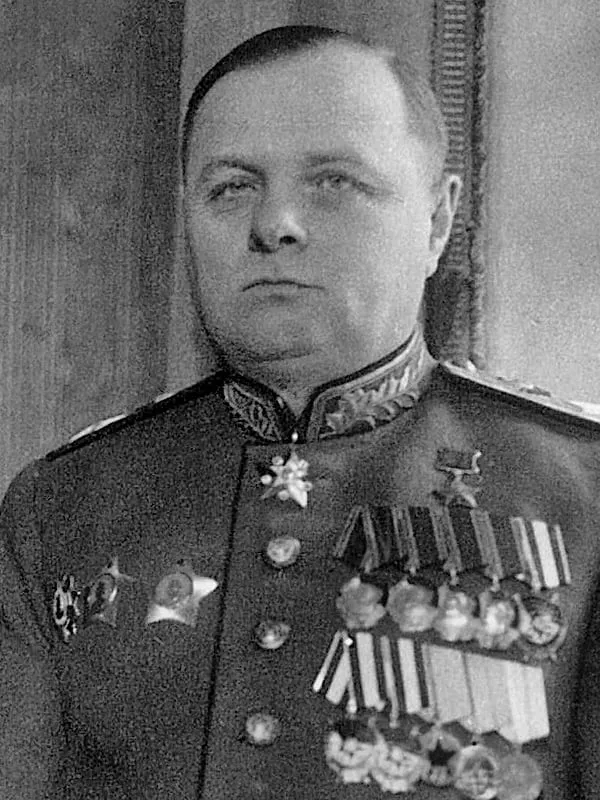
- Born:
- 7 June 1897, Nazaryevo, Ryazan Governorate (Russian Empire)
- Died:
- 30 December 1968, Moscow (USSR)
- Author:
- Łukasz
- Photo:
- autor nieznany, CC BY 4.0, Wikimedia Commons

Kirill Meretskov was a Soviet commander whose career contains almost the entire history of the Red Army in the era of Joseph Stalin. The son of a peasant from near Moscow, a fitter and a Bolshevik from 1917, he fought in the Civil War and the Polish–Soviet War, served as a military adviser in Spain in the 1930s and survived the Great Purge, which claimed most of his superiors. As commander of the Leningrad Military District he drew up the plan for war with Finland and on 30 November 1939 led into the attack the troops that were supposed to defeat it within a fortnight. The defeats of December 1939 are largely the fault of his plan, but it was his 7th Army that broke through the Mannerheim Line in February 1940. Shortly afterwards he became Chief of the General Staff, and in June 1941, on the second day of the war with Germany, he was arrested and tortured by the NKVD. Released after two and a half months, he commanded fronts near Leningrad and in Karelia, and ended the war in Manchuria as a Marshal of the Soviet Union and one of the holders of the highest Soviet military order.
Fitter and Bolshevik
He was born on 7 June 1897 (26 May by the Julian calendar) in the village of Nazaryevo in the Zaraysk district of Ryazan Governorate, today in Moscow Oblast, the eldest child of a peasant family, Afanasy and Anna Meretskov. After four years at a zemstvo school he left for Moscow at the age of twelve, where he worked as a fitter and came into contact with the revolutionary underground. Working in a factory that filled military orders kept him from being conscripted into the Tsarist army during the First World War.
In 1915, at the urging of a Bolshevik acquaintance, he moved to the small town of Sudogda in Vladimir Governorate, where he worked as a mechanic in a factory. After the February Revolution he helped to set up a Bolshevik party cell there and became secretary of its district committee. At the end of 1917 he became chief of staff of the local Red Guard detachment, and after the October coup he took part in seizing power in the town.
Civil War and the academy
From August 1918 he served in the Red Army. His unit fought in the Kazan operation against the troops of the anti-Bolshevik Komuch. Meretskov was shot twice there. In February 1919 he was sent to the Military Academy of the Red Army, but his studies were constantly interrupted by spells at the front. He served as assistant chief of staff of the 14th Rifle Division and in 1920 as assistant chief of staff for reconnaissance in the 4th and 6th Cavalry Divisions of Semyon Budyonny’s 1st Cavalry Army, with which he fought against the Poles in Ukraine. In the Civil War he fought on the eastern, southern and western fronts and was seriously wounded several times.
In 1921 he graduated from the academy, later renamed the Frunze Military Academy, and began a long career as a staff officer. He was chief of staff of cavalry and infantry divisions, and from 1924 served for eight years in the Moscow Military District, rising to district chief of staff and commanding the 14th Rifle Division along the way. In 1931, during the period of secret cooperation between the Red Army and the Reichswehr, he underwent several months of training in Germany.
Chief of staff to Uborevich and Blyukher
In April 1932 he became chief of staff of the Belorussian Military District, commanded by Ieronim Uborevich, one of the ablest Soviet commanders and a close associate of Mikhail Tukhachevsky. At the turn of 1934 and 1935 Meretskov moved to the post of chief of staff of Marshal Vasily Blyukher’s Special Red Banner Far Eastern Army, which guarded the border with Manchukuo against the Kwantung Army. In November 1935, after personal ranks were introduced, he received the rank of Komdiv.
Spain and the purge
From September 1936 to May 1937 he was in Spain under the pseudonym “Petrovich” as military adviser to the Republican command during the Civil War. He advised during the defence of Madrid and was wounded. In January 1937 he received the first of his seven Orders of Lenin.
He returned home at the height of the Great Purge. In June 1937 Tukhachevsky, Uborevich and other commanders with whom Meretskov had worked for years were sentenced and shot, and in 1938 Blyukher died. Meretskov’s name appeared in the interrogation records of many of them, and Uborevich testified during the investigation that he had personally recruited him into the “military conspiracy”. Even so, Meretskov escaped arrest and was promoted: in June 1937 he became deputy to the Chief of the General Staff, Boris Shaposhnikov; in September 1938 commander of the Volga Military District; and in January 1939 commander of the Leningrad Military District. In February 1939 he received the rank of Komandarm 2nd Rank, and in March the 18th Party Congress elected him a candidate member of the Central Committee.
The Winter War
The Leningrad Military District covered the border with Estonia and Finland. At the beginning of October 1939 Meretskov headed the Soviet delegation on the joint military commission that settled in Tallinn the details of stationing Soviet bases under the mutual assistance pact imposed on Estonia. According to his memoirs, Stalin had instructed him as early as the summer of 1939 to prepare a plan in case of war with Finland. When the Finns rejected the Soviet demands in the autumn, the district staff presented the People’s Commissar for Defence, Kliment Voroshilov, with a plan for crushing the Finnish army. In his reports he admitted that terrain criss-crossed by lakes, rivers, swamps and forests would hamper operations, but his plan, like Stalin’s expectations, assumed a quick victory within two or three weeks. Reconnaissance of the Finnish fortifications on the Karelian Isthmus was superficial, and the enemy’s strength was underestimated.
After the Mainila incident, on 30 November 1939 four armies of the Leningrad Military District attacked Finland. The Winter War went badly from its very first days. On the Karelian Isthmus the 7th Army stalled in front of the fortifications named the Mannerheim Line after the Finnish Commander-in-Chief, Carl Gustaf Emil Mannerheim, while in the north Finnish units encircled and destroyed Soviet divisions. On 9 December direction of the war was taken over by a headquarters in Moscow made up of Stalin, Voroshilov and Shaposhnikov, and Meretskov took command of the 7th Army alone. In the second half of December his assault on the fortifications at Summa collapsed with heavy losses. In January 1940 the North-Western Front under Semyon Timoshenko was set up over the troops on the Isthmus, and the 7th Army, reinforced with heavy artillery and fresh divisions, was carefully prepared for a second assault.
On 11 February 1940 the 7th Army broke through the Mannerheim Line at Summa, in the Lähde sector, and forced the Finns to fall back to further lines of defence. At the beginning of March its troops crossed the ice of the Bay of Viipuri and were fighting in the outskirts of Viipuri (Vyborg) when the Moscow Peace came into force on 13 March. On 21 March 1940 Meretskov was made a Hero of the Soviet Union for breaking through the main fortifications of the Mannerheim Line. The victory, however, cost the Red Army more than 126,000 killed and missing, and as the author of the original plan Meretskov bore a large share of the responsibility for the weaknesses it had exposed.
Chief of the General Staff
Even so, he rose further. On 4 June 1940, when general’s ranks were reintroduced, he was one of the first three commanders, together with Georgy Zhukov and Ivan Tyulenev, to receive the rank of General of the Army. He was Deputy People’s Commissar for Defence, and in August 1940 he succeeded Shaposhnikov as Chief of the General Staff. In January 1941, after map war games in which Zhukov defeated the defenders, and after a stormy meeting in the Kremlin, Stalin removed Meretskov. Zhukov became Chief of the General Staff, and Meretskov Deputy People’s Commissar for Defence responsible for combat training.
In an NKVD cell
On 23 June 1941, the second day of the German invasion, he was recalled from Leningrad, where he had been sent two days earlier as a representative of the High Command, and arrested by the NKVD as an alleged member of an anti-Soviet military conspiracy, on the basis of testimony extracted in 1937–1938 from commanders who had since been shot. The investigation was conducted by, among others, Lev Shvartsman and Boris Rodos, and Lavrentiy Beria’s deputy Vsevolod Merkulov took part in the interrogations. Meretskov was beaten with rubber truncheons and tortured until he confessed his guilt and incriminated other prisoners. Some of the commanders held with him, among them Grigory Shtern, an army commander in the Winter War, were shot without trial near Kuybyshev on 28 October 1941.
On 28 August Meretskov wrote to Stalin from prison asking to be sent to the front. On 6 September 1941 he was released “on the basis of instructions from the directive bodies”, which probably meant a verbal decision by Stalin himself. In 1955 the files of his case were destroyed. In his memoirs Meretskov wrote only that “for reasons beyond his control” he had been kept away from his work for two months.
Near Leningrad
From 24 September 1941 he commanded the 7th Independent Army, which halted the Finns on the Svir river, and from 9 November the 4th Independent Army, which retook Tikhvin on 9 December in the Tikhvin offensive. It was one of the first Soviet successes of the war: it wrecked the German plan to link up with the Finns east of Lake Ladoga. On 17 December 1941 Meretskov took command of the new Volkhov Front, which he led, with a short break, until February 1944.
The front’s first major operation, the Lyuban offensive of early 1942, was meant to break the siege of Leningrad, but it ended in disaster. The 2nd Shock Army drove deep into the German defences, was cut off and in the summer of 1942 was destroyed in the swamps along the Volkhov. Its commander, Andrei Vlasov, whom Meretskov himself had earlier recommended, was taken prisoner and went over to the Germans. In his post-war memoirs Meretskov put the blame on Vlasov, but historians point out that the front command was primarily responsible for planning and conducting the operation. In the autumn of 1942 the Sinyavino offensive also failed to break the siege.
Success came in January 1943. In Operation Iskra troops of the Volkhov Front and of General Leonid Govorov’s Leningrad Front met on 18 January south of Lake Ladoga and opened a narrow land corridor to the city. In January 1944 the two fronts launched the Leningrad–Novgorod offensive, which finally ended the siege, and on 20 January Meretskov’s troops liberated Veliky Novgorod.
From Karelia to Manchuria
On 22 February 1944 Meretskov took command of the Karelian Front and once again faced the Finns. In the summer of 1944 his troops drove the Finns out of East Karelia in the Svir–Petrozavodsk offensive (PL) and took Petrozavodsk on 28 June. This offensive, together with the Leningrad Front’s blow on the Karelian Isthmus, led Finland to conclude the Moscow Armistice in September 1944. In October Meretskov conducted the Petsamo–Kirkenes offensive in the Arctic: his troops drove the Germans out of Petsamo – the same Petsamo the Red Army had taken in the Winter War – and on 25 October entered Kirkenes in Norway. On 26 October 1944 he was made a Marshal of the Soviet Union, and Norway later awarded him the Grand Cross of the Order of St Olav.
In April 1945, in secret from the Japanese, he was transferred to the Far East, where he took over the Maritime Group of Forces, which on 5 August became the 1st Far Eastern Front (PL). In the Soviet–Japanese War, under the overall command of Marshal Aleksandr Vasilevsky, Meretskov’s front struck from the Primorye region into eastern Manchuria on 9 August. The attack went in under torrential rain without an artillery preparation, broke through the border fortifications and, after heavy fighting at Mudanjiang, reached Harbin and Kirin (Jilin). One of his armies occupied northern Korea, where in the Soviet occupation zone Moscow raised Kim Il Sung to power. In September 1945 Meretskov received the Order of Victory, the highest Soviet military decoration, awarded to fewer than twenty commanders in all.
Last years
After the war he commanded in turn the Maritime, Moscow, White Sea and Northern Military Districts. In 1955–1964 he was Assistant Minister of Defence of the USSR for higher military education institutions, and then one of the ministry’s inspectors general. He sat for five terms in the Supreme Soviet of the USSR. In 1968 he published his memoirs, Serving the People, translated into Polish as Pół wieku w mundurze (1971). He died in Moscow on 30 December 1968. The urn with his ashes was placed in the Kremlin Wall.
Significance
Meretskov was not one of the great commanders of the war, like Zhukov or Vasilevsky. He was above all a meticulous staff officer who, according to his colleagues, preferred to clear every decision with the “highest authority”. Yet his life speaks volumes about the history of the Second World War. The plan he prepared for Stalin in 1939, with its contempt for the enemy and its faith in an easy victory, led to the Red Army’s humiliation in Finland, which Adolf Hitler took as proof of Soviet weakness. That same war, however, taught him how to break through fortified positions, a lesson he put to use near Leningrad, in Karelia and in Manchuria. And his arrest in June 1941, just when the army most needed experienced commanders, shows how deeply terror had penetrated the Soviet armed forces, even at a moment of mortal danger.
Sources
Commanded in battles
(06)- 30 November 1939 – 13 March 1940Winter WarScandinavia
- 1–17 February 1940Breaking of the Mannerheim LineScandinavia
- 28 February – 13 March 1940Battle of Viipuri (1940)Scandinavia
- 25 June 1941 – 19 September 1944Continuation WarScandinavia
- 9 June – 9 August 1944Vyborg–Petrozavodsk offensiveScandinavia
- 9–20 August 1945The Soviet invasion of ManchuriaFar East
Mentioned in battles
(02)Often appears with
People who appear in the same events.