Soviet Union
Joseph Stalin
People's Commissar for Nationalities (1917–1923), General Secretary of the Communist Party (from 1922), Chairman of the Council of People's Commissars of the USSR (from 1941)
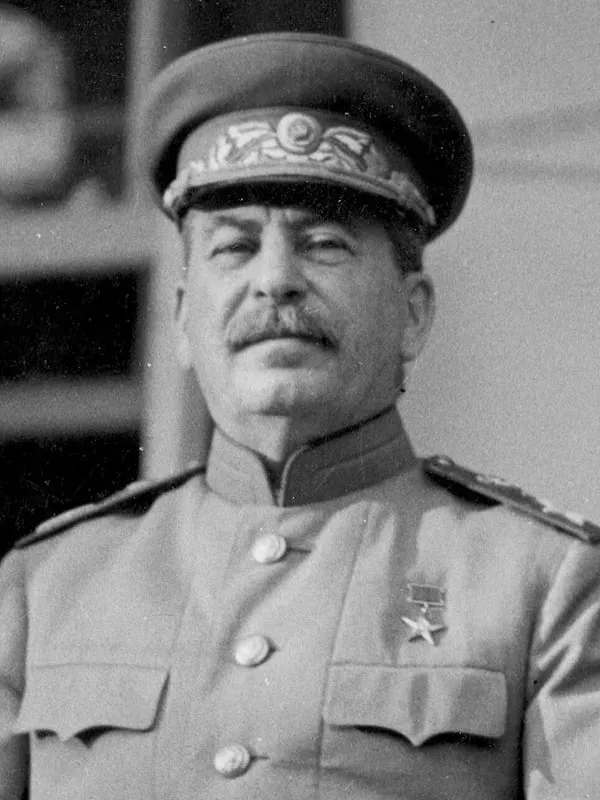
- Born:
- 18 December 1878, Gori, Tiflis Governorate (Russian Empire)
- Died:
- 5 March 1953, Kuntsevo, near Moscow
- Author:
- Łukasz
- Photo:
- Biblioteka Franklina D. Roosevelta, domena publiczna, Wikimedia Commons

Iosif Vissarionovich Dzhugashvili, known by his pseudonym Stalin, was in 1917 one of the handful of closest associates of Vladimir Lenin, and a little over a decade later the sole ruler of the Soviet Union. A Georgian revolutionary who for years stood in the shadow of more dazzling comrades, he built his power within the party apparatus and, after Lenin’s death, defeated his rivals one after another. Forced collectivisation, famine and the Great Terror of the 1930s claimed millions of victims. In August 1939 Stalin concluded the pact with Hitler that opened the way to the Second World War, and on 17 September his army marched into Poland. After the German invasion of 1941 he led the Soviet Union to victory and emerged from the war as master of half of Europe. He is one of the most important figures in the history of the Second World War.
Youth and the underground
He was born on 18 December 1878 (6 December by the Julian calendar) in Gori in Georgia, the son of the cobbler Vissarion Dzhugashvili and his wife Ekaterina. That is the date recorded in the parish register. From the 1920s official biographies gave 21 December 1879, and that date remained in force in the Soviet Union until the dictator’s death. His mother wanted him to become a priest. From 1894 he studied at the theological seminary in Tiflis, which he left in 1899, by then drawn into Marxist circles.
From 1901 he worked in the Social Democratic underground in Tiflis, Batumi and Baku, and from the outset sided with the Bolsheviks. He organised strikes, printing presses and fighting squads that raised money for the party by robbery and extortion among other means. Time and again he was arrested and exiled, and time and again he escaped. In 1912 Lenin co-opted him onto the Central Committee. At the same time Dzhugashvili began signing himself “Stalin”, and at the beginning of 1913 in Vienna, at Lenin’s request, he wrote the treatise “Marxism and the National Question”, which made him the party’s specialist on the nationalities. In February 1913 he was arrested in St Petersburg and exiled to the Turukhansk region on the Yenisei. There, beyond the Arctic Circle, he spent almost the whole of the First World War. In February 1917 a military board declared him unfit for service because of a left arm that had been crippled since childhood.
1917
After the February Revolution he returned to Petrograd in March 1917 together with Lev Kamenev. The two took over the editorship of Pravda and pursued a moderate line towards the Provisional Government. Lenin’s return in April changed everything. Stalin quickly came over to his side and at the end of April was elected to the Central Committee. In the summer, with Lenin in hiding and Leon Trotsky under arrest, he belonged to the party’s inner leadership. On 23 October (10 October Old Style) he voted for an armed uprising. In the coup itself, which overthrew the Provisional Government on 7 November, he played no visible part. The Menshevik Nikolai Sukhanov remembered him as a “grey blur”, and Trotsky repeated for years that in October Stalin had been nowhere to be seen. Some historians, however, such as Stephen Kotkin, believe that even then he was one of the most important Bolsheviks.
Commissar and military commissar
In the first Bolshevik government, the Council of People’s Commissars, Stalin took charge of nationalities. Together with Lenin he signed the declaration that granted the peoples of Russia the right to self-determination up to and including secession from the state, but in practice he developed the formula that this right belonged to the “toiling masses” and not to the “bourgeoisie”. This meant that the Bolsheviks recognised only those states in which their own supporters held power. In the dispute over peace with Germany he backed Lenin from the start.
In the Civil War he sat on the military councils of a succession of fronts. In 1918 at Tsaritsyn on the Volga he exercised power over an army and an apparatus of terror for the first time. Distrustful of the former tsarist officers whom Trotsky was bringing into the Red Army, he had some of them arrested, and his high-handedness led to a bitter quarrel with Trotsky that lasted until the latter’s death. It was then that he grew close to Kliment Voroshilov and Semyon Budyonny, who became the core of his following in the army. In the summer of 1920, in the war against the Poland of Józef Piłsudski, he was commissar of the South-Western Front, which was pressing towards Lwów (Lviv) and delayed sending troops to support the armies of Mikhail Tukhachevsky advancing on Warsaw. After the defeat he was blamed as one of those responsible.
The road to sole power
In April 1922 Stalin became General Secretary of the party. The post was regarded as a technical one, but it gave him control over cadres – that is, over who held which posts throughout the country. In his last notes Lenin warned against him and advised removing him from the office. This never happened. After Lenin’s death in January 1924 Stalin allied himself with Grigory Zinoviev and Kamenev against Trotsky, then with Nikolai Bukharin against Zinoviev and Kamenev, and finally defeated Bukharin. With the slogan of “socialism in one country” he persuaded the party that the Soviet Union could build the new order on its own, without waiting for revolution in Europe. In 1927 Trotsky was expelled from the party, and in 1929 deported from the country. By the end of the 1920s Stalin was the sole ruler.
Collectivisation and the Great Terror
From 1928 Stalin imposed five-year plans and forced industrialisation on the country, paid for by the countryside. The collectivisation of agriculture, carried out from 1929, meant the expropriation and deportation of hundreds of thousands of peasant families branded as “kulaks”. It caused a famine which in 1932–1933 killed, according to various estimates, anywhere from several million to more than seven million people, above all in Ukraine, where it is known as the Holodomor, and in Kazakhstan. At the same time, within a decade, the Soviet Union built up the heavy and armaments industries that allowed it to survive the war.
After the murder of the Leningrad communist leader Sergei Kirov in December 1934 a wave of repression began which in 1937–1938 turned into the Great Purge. In the Moscow show trials former leaders of the party were condemned, among them Zinoviev, Kamenev and Bukharin. According to NKVD documents, about 680,000 people were shot within two years, and hundreds of thousands more were sent to the Gulag camps. The victims included a large part of the Red Army’s officer corps, headed by Marshal Tukhachevsky, which seriously weakened it on the eve of war. A crime in its own right was the so-called Polish Operation of the NKVD, in which more than a hundred thousand people were shot, most of them Poles living in the Soviet Union.
The pact with Hitler
Adolf Hitler’s rise to power in 1933 prompted Stalin to seek closer ties with the West. In 1934 the Soviet Union joined the League of Nations, in 1935 it concluded alliances with France and Czechoslovakia, and the Comintern proclaimed the policy of popular fronts against fascism. The Munich Agreement of 1938, made without Moscow’s participation, convinced Stalin, however, that the Western powers preferred to turn Hitler eastwards. In the summer of 1939 he conducted military talks with France and Britain and negotiations with Germany in parallel. On 23 August 1939 his foreign minister, Vyacheslav Molotov, signed with Joachim von Ribbentrop a non-aggression pact whose secret protocol divided Eastern Europe into spheres of influence. Nine days later Germany attacked Poland.
On 17 September 1939 the Red Army invaded Poland from the east. The occupied lands were incorporated into the Soviet Union, and hundreds of thousands of their inhabitants were deported deep into the USSR. On 5 March 1940 the Politburo, on the proposal of Lavrentiy Beria and with Stalin’s signature, resolved to shoot Polish prisoners of war and prisoners. In the Katyn massacre some 22,000 people were killed, most of them officers and members of the Polish intelligentsia. In November 1939 Stalin attacked Finland, and in the summer of 1940 he seized the Baltic states as well as Romanian Bessarabia and northern Bukovina. Until June 1941 the Soviet Union supplied Germany with raw materials and grain.
War with Germany
Stalin disregarded numerous warnings of a German attack. On 22 June 1941 Germany struck the Soviet Union, and in the first months the Red Army suffered catastrophic defeats, losing millions of soldiers, among them an enormous number taken prisoner. Stalin became head of government, chairman of the State Defence Committee and supreme commander. In the autumn of 1941 he did not leave threatened Moscow, and the Red Army halted the Germans before the capital. In the Battle of Stalingrad, in the city that had borne his name since 1925, the remnants of the German Sixth Army capitulated in February 1943. Victory cost the Soviet Union, by the most commonly cited estimates, some 27 million dead, soldiers and civilians.
Stalin was one of the “Big Three”. At Tehran (1943), Yalta and Potsdam (1945) he shaped the post-war order with Winston Churchill and Franklin Delano Roosevelt, and later with Harry Truman. He forced through recognition of an eastern border of Poland close to the line of 1939 and the shifting of Poland westwards. In 1943 he broke off relations with the Polish government in London after it demanded an investigation into the Katyn massacre, and in 1944 the Red Army gave no help to Warsaw as it fought. In August 1945 the Soviet Union declared war on Japan and occupied Manchuria, southern Sakhalin and the Kuril Islands, regaining with interest what Russia had lost in the Treaty of Portsmouth in 1905.
After the war
After 1945 Stalin imposed the communist system on the states of Central and Eastern Europe, Poland among them, which ushered in the Cold War. At home the terror returned, and his personality cult reached its height. On 1 March 1953 he suffered a stroke at his dacha at Kuntsevo near Moscow and died on 5 March. Three years later his successor, Nikita Khrushchev, condemned some of his crimes at a closed session of the Twentieth Party Congress.
Significance
Stalin’s role in 1917–1918 was falsified for decades: during his rule he was presented as the leader of the revolution second only to Lenin. Modern biographers such as Robert Service, Oleg Khlevniuk and Stephen Kotkin see in him one of Lenin’s handful of closest associates – less brilliant than Trotsky, but hard-working, tough and valued for getting things done – in whom, already during the Civil War, distrust, a propensity for detecting conspiracies and a readiness to resort to terror had come to the surface.
In the history of the Second World War his role is twofold and cannot be reduced to a single formula. The pact with Hitler freed Germany from the threat of a war on two fronts and made Stalin a co-author of the partition of Poland and of crimes against its citizens. At the same time the Soviet Union under his rule bore the main burden of the land war against Germany and played a decisive part in its defeat. For Poland and for the whole of Central and Eastern Europe, however, the victory of 1945 meant not freedom but further decades of dependence on Moscow.
Sources
Mentioned in battles
(51)- The Russo-Japanese War
- The Russian Civil War
- The Polish–Soviet War
- The Spanish Civil War
- The Battle of Lake Khasan
- The Battle of Khalkhin Gol
- Soviet invasion of Poland
- Winter War
- Battle of Kollaa
- Battle of Suomussalmi
- Breaking of the Mannerheim Line
- Invasion of Yugoslavia
- Battle of Białystok–Minsk
- Operation Barbarossa
- Battle of Kiev (1941)
- Battle of Smolensk (1941)
- Anglo-Soviet invasion of Iran
- Siege of Leningrad
- Battle of Moscow
- Siege of Sevastopol (1941–1942)
- Battle of Rostov (1941)
- Fighting on the Kerch Peninsula (1941–1942)
- Rzhev–Vyazma offensive (1942)
- Second Battle of Kharkov
- Case Blue
- Battle of Stalingrad
- Operation Uranus
- Operation Winter Storm
- Battle of Kursk
- Battle of the Dnieper
- Operation Tempest
- Battle of the Korsun–Cherkassy Pocket
- Battle of Narva (1944)
- Crimean offensive (1944)
- Battle of Normandy
- Vyborg–Petrozavodsk offensive
- Operation Bagration
- Lwów–Sandomierz offensive
- Warsaw Uprising
- Operation Dragoon
- Jassy–Kishinev offensive
- Belgrade offensive
- Battle of Debrecen
- Siege of Budapest
- Vistula–Oder offensive
- Operation Frühlingserwachen
- The Rhine crossings
- The Vienna offensive
- The Battle of Berlin
- The Prague offensive
- The Soviet invasion of Manchuria
Often appears with
People who appear in the same events.
On the timeline
(312)The 40 most important of 312 events. All tagged “Joseph Stalin” (42) →