Finland
Carl Gustaf Emil Mannerheim
Regent of Finland (1918–1919), Chairman of the Defence Council (1931–1939), Commander-in-Chief of the Finnish armed forces (1918, 1939–1944), President of Finland (1944–1946)
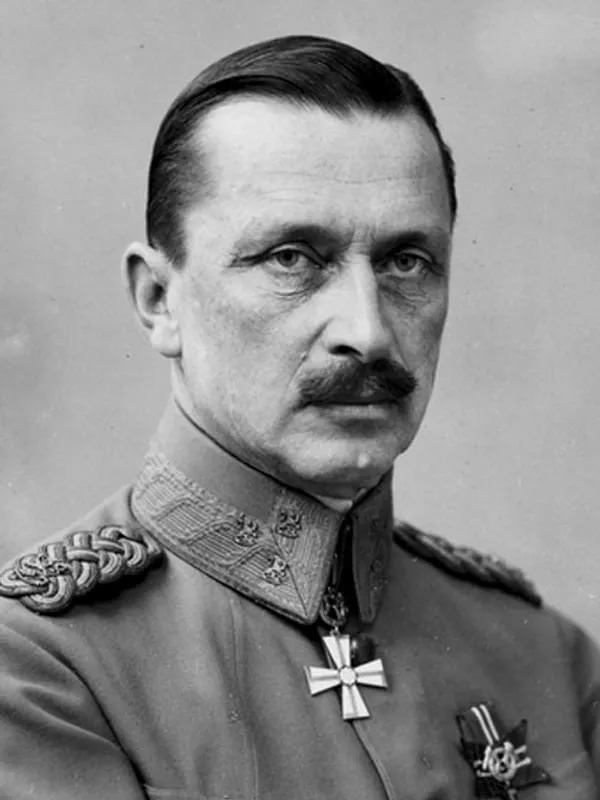
- Born:
- 4 June 1867, Louhisaari, Askainen (Grand Duchy of Finland, Russian Empire)
- Died:
- 27 January 1951, Lausanne (Switzerland)
- Author:
- Łukasz
- Photo:
- Ulrich Romberg ("Rembrandt"), Schaffhausen (CH), b. 1881, d. ≈1945, domena publiczna, Wikimedia Commons

Carl Gustaf Emil Mannerheim lived through several eras and played a major part in each of them. For thirty years he was an officer of the Russian army, rising to the rank of general. When the empire of the tsars fell apart, he led the Whites to victory in the Finnish Civil War and for a few months served as regent of an independent Finland. In the 1930s he prepared the country for war with the Soviet Union, and when the Red Army attacked Finland on 30 November 1939, the 72-year-old marshal took supreme command. He led the Finns in the Winter War and in the Continuation War alongside the Third Reich, and in 1944, as president, he took his country out of the war. Finland lost both its wars with the Soviet Union, yet kept its independence and its democratic system. To the Finns he is the father of the modern state; to some historians he is also a controversial figure – the commander of the White Terror of 1918 and Hitler’s ally in 1941–1944.
Early years
He was born on 4 June 1867 on the family estate of Louhisaari in the parish of Askainen near Turku, in the Grand Duchy of Finland, an autonomous part of the Russian Empire. The Mannerheims, a family of German origin ennobled in Sweden in the 17th century, had settled in Finland at the end of the 18th century. His great-grandfather, Count Carl Erik Mannerheim, headed the first government of the Grand Duchy after Finland was annexed to Russia in 1809. The family’s mother tongue was Swedish; Mannerheim learned Finnish properly only as an adult and never spoke it fluently. As the third son of a count he bore the title of baron. In everyday life he used his second name, Gustaf.
His childhood was not a happy one. His father, Carl Robert, deep in debt, abandoned the family in 1880, and his mother died a year later. The children were divided among relatives. At fourteen Gustaf entered the cadet school at Hamina, the only military school in Finland, but in 1886 he was expelled for leaving the barracks without permission. He passed his school-leaving examinations and in 1887–1889 completed the Nicholas Cavalry School in St Petersburg.
The Tsar’s officer
He began his service as a cornet in the 15th Alexandria Dragoon Regiment at Kalisz, near the German border. In 1891 he transferred to the elite Chevalier Guard Regiment in St Petersburg. In 1892 he married a wealthy Russian, Anastasia Arapova, with whom he had two daughters; the marriage broke down early in the 20th century, although they divorced only in 1919. In 1896 he stood in full dress uniform at the steps of the throne during the coronation of Nicholas II in Moscow. He remained loyal to the last tsar for the rest of his life: Nicholas’s portrait hung in Mannerheim’s Helsinki home until his death.
When the Russo-Japanese War broke out, he volunteered for the front. As a lieutenant colonel he served with the 52nd Nezhin Dragoon Regiment in Manchuria, fought at Mukden and was promoted to colonel for gallantry. In 1906–1908, on the orders of the Russian General Staff, he undertook a great intelligence expedition: posing as an ethnographer, he rode some 14,000 kilometres through Turkestan, Xinjiang and Gansu to Beijing. For part of the way he travelled with the French orientalist Paul Pelliot. He met the exiled 13th Dalai Lama, assembled rich collections for the Finnish national museum and wrote a report for the tsar on the modernisation of China.
He spent the following years in the Polish lands. In 1909 he took command of the 13th Vladimir Uhlan Regiment (PL) at Mińsk Mazowiecki, and in 1911, by then a major general, of His Majesty’s Life Guard Uhlan Regiment (PL) in Warsaw. He moved in the circles of the Polish aristocracy, was a friend of Princess Maria Lubomirska among others, and learned some Polish. In the First World War he commanded the Independent Guards Cavalry Brigade, which fought the Austrians in Galicia and the Lublin region; for the fighting of 1914 he received the Order of St George, 4th Class. From 1915 he commanded the 12th Cavalry Division, with which he moved to the Romanian front in 1916. In April 1917, after the February Revolution, he was promoted to lieutenant general and took over the 6th Cavalry Corps. The new authorities, however, distrusted an officer known for his attachment to the monarchy. In September 1917 he was placed on the reserve list. After the Bolshevik coup he left in December 1917 for Finland, which had declared independence on 6 December.
The White general
In January 1918 the Senate of Pehr Evind Svinhufvud entrusted Mannerheim with command of the government forces, which were built on the volunteer units of the civic guards, the White Guard. On the night of 27–28 January his troops disarmed the Russian garrisons in Ostrobothnia and seized their weapons, while at the same time the Reds took power in Helsinki and the south of the country. The Civil War had begun. From his headquarters at Seinäjoki Mannerheim built an army of volunteers, conscripts, a few dozen Swedish officers and Finnish Jäger trained in Germany. On 6 April, after bloody fighting, his forces took Tampere, the main Red stronghold. Meanwhile the German Baltic Division of General Rüdiger von der Goltz landed in the south and occupied Helsinki on 13 April. On 16 May 1918 Mannerheim took the victory parade in the capital.
The Civil War was short but cruel. Both sides resorted to terror, and after their victory the Whites held tens of thousands of Reds in prison camps, where some 12,000 people died of hunger and disease. According to Finnish research, around 36,000 people died in the war as a whole, most of them on the Red side, and to a large extent after the fighting had ended. As commander-in-chief, Mannerheim bears part of the responsibility for the White Terror; he did issue orders against arbitrary executions, but he failed – and, his critics say, was not very eager – to enforce them. For the Finnish left he long remained “the White general”.
The victorious commander soon fell out with the government, which placed the army under German influence and was looking for a king for Finland from a German dynasty. On 31 May 1918 Mannerheim resigned and left for Sweden, where he kept in touch with Entente diplomats.
Regent
Germany’s defeat in November 1918 put an end to the project of a Kingdom of Finland, and the king-elect, Prince Frederick Charles of Hesse, renounced the throne. On 12 December 1918 parliament elected Mannerheim regent. His greatest success was securing recognition of Finland’s independence by Britain and the United States in 1919. In concert with the White Russians and Winston Churchill, he also considered Finnish participation in the march on Petrograd that General Nikolai Yudenich was leading in the summer and autumn of 1919, on condition that the Whites recognised Finland’s independence. Neither the Whites nor the Finnish government would agree. In July 1919 Mannerheim, monarchist though he was, signed the republican constitution, and on 25 July he lost the presidential election in parliament to the liberal Kaarlo Juho Ståhlberg. He withdrew from politics. According to Polish biographers, during a journey around Europe at that time he also visited Warsaw, where he discussed the war with the Bolsheviks with Józef Piłsudski.
Between the wars
In the 1920s he held no state office. He founded a child welfare league that bore his name, headed the Finnish Red Cross from 1922, sat on the supervisory boards of banks, hunted and travelled to India. In 1920 Finnish communists in Petrograd plotted an assassination attempt against him, which failed. When the far-right Lapua Movement was pushing for power at the turn of the 1930s, some of its supporters saw Mannerheim as a dictator; he, however, refused to take part in a coup.
In 1931 President Svinhufvud appointed him Chairman of the Defence Council and promised in writing that in the event of war he would become commander-in-chief. In 1933 he received the title of field marshal. Throughout the 1930s he tried to persuade successive governments that the only real threat to Finland was the Soviet Union, demanding money for rearmament, stronger fortifications on the Karelian Isthmus and a defensive alliance with Sweden. He offered his resignation several times when parliament and government cut spending. In 1936 he represented Finland at the funeral of George V in London. He also visited Germany, but regarded Hitler and his regime with reserve.
In the spring of 1939, when Berlin offered the Nordic states non-aggression pacts, Mannerheim favoured accepting the offer, but the government rejected it together with Norway and Sweden. In the autumn, when Joseph Stalin presented Finland with territorial demands, Mannerheim, like Juho Kusti Paasikivi, advised conceding more than the government was willing to. He knew the state of the army: it was short of artillery, ammunition, anti-tank weapons and aircraft.
The Winter War
On 30 November 1939, the day of the Soviet attack, President Kyösti Kallio appointed the 72-year-old marshal commander-in-chief. In his first order of the day Mannerheim called the war the continuation and final act of the war of liberation of 1918. He set up his headquarters at Mikkeli. The belt of fortifications on the Karelian Isthmus that he had been urging for years became known to the whole world as the Mannerheim Line, although in reality it was a chain of modest bunkers and trenches rather than a Finnish Maginot Line.
Mannerheim conducted the war sparingly and soberly. In December his army halted the offensive on the Isthmus, while in the forests of central Finland it destroyed Soviet divisions, among other places at Suomussalmi. The marshal knew, however, that a small country could not win a war of attrition. When the Red Army broke through the defences on the Isthmus in February 1940, he backed making peace before the army collapsed, and placed no hope in the promised help from Britain and France, which would have come too late and dragged Finland into the war between the great powers. The Moscow Peace of 12 March 1940 cost Finland the Karelian Isthmus with Viipuri (Vyborg), but saved its independence.
The Continuation War
After the Moscow Peace Mannerheim remained commander-in-chief and belonged to the small circle that brought Finland closer to Germany. In the autumn of 1940 Helsinki agreed to the transit of German troops to Norway, and in 1941 the general staffs of the two countries coordinated their cooperation. When Germany invaded the USSR on 22 June 1941 and Finland, after Soviet air raids on Finnish cities, declared itself at war on 25 June, Mannerheim again took command. In a famous order of the day of 10 July 1941 he recalled his oath of 1918 not to sheathe his sword until East Karelia was free. The order, which implied the conquest of lands that had never belonged to Finland, provoked objections from some politicians.
The Finnish army recovered the territory lost in 1940 and then occupied Soviet East Karelia, including Petrozavodsk, and reached the Svir river. On the Karelian Isthmus Mannerheim halted his troops near the old border and refused the Germans Finnish participation in an assault on Leningrad, even though the Finnish front closed the ring of the siege of the city from the north. In the autumn of 1941 the Finns did cut the Murmansk railway near Petrozavodsk, but in 1942 Mannerheim refused to advance on Belomorsk, an operation meant to cut the bypass the Russians had built around that line, along which Allied aid flowed to the USSR. The dark side of the occupation of East Karelia were the camps for the Russian civilian population and the prisoner-of-war camps, in which more than ten thousand Soviet prisoners and several thousand civilians died of hunger and disease.
On 4 June 1942, his 75th birthday, the government conferred on Mannerheim the title of Marshal of Finland, the only one in the country’s history. That day Adolf Hitler unexpectedly flew to Finland with Wilhelm Keitel; the meeting took place in a railway carriage near Imatra, and a Finnish radio technician secretly recorded part of the conversation – the only known recording of Hitler speaking in his ordinary voice. A few weeks later Mannerheim paid a return visit to Hitler’s headquarters. He kept his dealings with the Germans as formal and cool as possible, however, and towards Britain, which declared war on Finland in December 1941, he felt regret rather than hostility: before the declaration Churchill and Mannerheim had exchanged courteous letters.
President and the way out of the war
In June 1944 the Red Army broke through the Finnish defences on the Karelian Isthmus in the Vyborg–Petrozavodsk offensive and took Viipuri. In return for German military aid, President Risto Ryti gave Joachim von Ribbentrop a personal undertaking that Finland would not conclude a separate peace. The front was halted at the Battle of Tali-Ihantala. Once the situation had stabilised, Ryti stepped down, and on 4 August 1944 parliament, by a special act, entrusted the presidency to Mannerheim. The new president held that Ryti’s undertaking had bound only Ryti personally, and opened talks with Moscow. On 19 September 1944 Finland signed the Moscow Armistice: it lost the territories of 1940 once again and Petsamo as well, had to pay heavy reparations and expel the German troops, which meant the Lapland War against its former ally.
Before breaking with Germany, Mannerheim wrote to Hitler that he could not and would not turn against the Germans the weapons they had given him, but that it was his duty to lead his people out of the war. As president, despite poor health, he carried out the terms of the armistice under the supervision of the Allied Control Commission headed by Andrei Zhdanov. He feared being put on trial in the war-responsibility trials, in which Ryti and Tanner, among others, were convicted, but Moscow spared him; according to some accounts, Stalin later told Finnish politicians that the Finns owed a great deal to their marshal. After the verdicts had been announced, on 4 March 1946, Mannerheim resigned from office, citing his health. He was succeeded by Paasikivi.
Last years and legacy
He spent his last years mainly at the Valmont sanatorium near Montreux in Switzerland, where with the help of assistants he wrote his memoirs, published after his death. He died on 27 January 1951 in a hospital in Lausanne. He was buried on 4 February in Hietaniemi Cemetery in Helsinki; some hundred thousand people followed the coffin.
In Finland Mannerheim is an almost monumental figure: in a 2004 television poll he was voted the greatest Finn in history, his birthday is the Flag Day of the Finnish Defence Forces, and Helsinki’s main street bears his name. Historians see him in a more complex light. He was an aristocrat from the world of Tsarist Russia who struggled to speak the language of his own nation, yet he became its symbol. The commander of the victors in the fratricidal war of 1918 later called for reconciliation, and in 1939 led a united nation into battle. He tied Finland to Hitler, but did not let it be drawn into German crimes, and knew when to turn back. Seen against the road to the Second World War and the war itself, his life shows the fate of a small nation caught between Russia and Germany. Finland was the only state in the Soviet sphere of influence marked out in the Molotov–Ribbentrop Pact that was neither absorbed by the USSR nor turned into its satellite, and Mannerheim had an enormous share in that.
Sources
Commanded in battles
(06)- 30 November 1939 – 13 March 1940Winter WarScandinavia
- 1–17 February 1940Breaking of the Mannerheim LineScandinavia
- 28 February – 13 March 1940Battle of Viipuri (1940)Scandinavia
- 25 June 1941 – 19 September 1944Continuation WarScandinavia
- 8 September 1941 – 27 January 1944Siege of LeningradEastern Front
- 9 June – 9 August 1944Vyborg–Petrozavodsk offensiveScandinavia
Mentioned in battles
(04)Often appears with
People who appear in the same events.
On the timeline
(40)1936
1939
May
October
November
December
- 07
- The Battle of Suomussalmi beginsOn 7 December 1939 the Soviet 163rd Division reached Suomussalmi, burnt by the Finns. The Finnish command sent Colonel Hjalmar Siilasvuo's brigade there.
- The Battle of Kollaa beginsOn 7 December 1939 the Soviet 56th Rifle Division attacked Finnish positions on the Kollaa river in Ladoga Karelia. The Finns held them to the end of the war.