1944: The advance along New Guinea
Battle of the Driniumor River
- Dates:
- 10 July – 25 August 1944
- Front:
- Pacific
- Location:
- The Driniumor River about 30 kilometres east of Aitape and Tadji airfield – from its mouth to the village of Afua at the foot of the Torricelli Mountains – and the jungle on both its banks, on the north coast of the Australian Territory of New Guinea (today Papua New Guinea)On the battle map →
- Sides:
- United States and AustraliaWalter Krueger, Charles P. HallJapanHatazō Adachi
- Result:
- American victory. The Japanese 18th Army, which attacked the American positions on the Driniumor with some 20,000 men, broke through them for a few days but after a month of fighting had to withdraw towards Wewak. It lost – by estimates – between 8,000 and 10,000 dead, many of them from hunger and disease, and ceased to be a force capable of offensive action. The Americans lost about 440 killed and 2,550 wounded.
- Author:
- Natalia
Name and dates
The Battle of the Driniumor River – also known in English-language literature as the Battle of Aitape – is the name given to the fighting in the summer of 1944 on the north coast of New Guinea, some 30 kilometres east of Aitape. There General Hatazō Adachi’s 18th Army, cut off from the rest of the Japanese forces, attacked the American force that had been guarding Tadji airfield since April. The Driniumor – a shallow, stony river running down from the Torricelli Mountains to the sea – was the line on which the Americans decided to stop the enemy, and also the place where the Japanese crossed it.
The battle should not be confused with the capture of Aitape itself in April 1944 (Operation Persecution), covered under the landings at Hollandia and Aitape, nor with the later Australian campaign between Aitape and Wewak, which began at the end of 1944.
The battle is taken to have begun on the night of 10/11 July 1944, when Japanese infantry forced the river. According to the US official history (Robert Ross Smith, The Approach to the Philippines), the Japanese artillery opened fire at about 11.50 p.m., and the infantry moved off a few minutes later; some studies give a time an hour earlier. On the morning of the same day, moreover, American units had crossed to the east bank on a reconnaissance in force, so 10 July was the day of the first clashes. The end is taken to be 25 August 1944, when General Walter Krueger, commander of the Sixth Army, operating as the Alamo Force, declared the Aitape operation over. The fighting on the Driniumor proper had died down earlier – on 9 August the commander of the 32nd Infantry Division reported that resistance on the river line had ceased – and in the last two weeks American patrols were merely pursuing the retreating Japanese.
Background
An army cut off
The Japanese 18th Army had been fighting in New Guinea since the beginning of 1943. It was its convoy that Allied aircraft destroyed in the Battle of the Bismarck Sea, and its divisions that lost Lae, Finschhafen and the Huon Peninsula in the autumn of 1943 and then fell back through mountains and swamps along the coast towards Madang, Hansa Bay and Wewak. Each of these retreats cost thousands of men, who died of exhaustion, hunger and disease.
On 22 April 1944 the Americans landed behind this army – at Hollandia in Dutch New Guinea and at Aitape, some 140 kilometres west of Wewak. In a single bound General Douglas MacArthur left behind him the entire 18th Army, then numbering about 55,000 men, most of them rear-echelon, air force and navy personnel. Cut off from supply by sea and air, the army could rely only on what it had stockpiled at Wewak.
On 2 May Imperial General Headquarters ordered Adachi to bypass Hollandia and Aitape through the interior and break through westward to the 2nd Army, which was defending the western part of the island. Adachi considered the order ruinous. According to the US official history, based on Japanese documents and post-war accounts, the general feared that a march through trackless country and across the Sepik and Ramu rivers would decimate his army more than an attack would; staying at Wewak, on the other hand, would condemn it to inactivity and loss of morale, and food stocks there would run out by September at the latest. He concluded that attack was the only way. At first he considered retaking Hollandia, but soon narrowed the plan to Aitape. In mid-May the order to march west was rescinded, and the 18th Army was given a free hand.
The plan and the shortages
The first plan, drawn up at army headquarters as early as 26 April, envisaged completing preparations by 10 June. The attack was to be made by the 20th and 41st Divisions, reinforced by the 66th Infantry Regiment of the 51st Division. These calculations soon proved unrealistic. By the end of May more than 50,000 troops had been brought across the Ramu and Sepik rivers to the Wewak area, but supplies had to be carried further on men’s backs. Allied aircraft and American PT boats (PL) from Aitape hunted barges and lorries on the coastal road, and torrential rain washed away the tracks. In mid-June the forward units of the 20th Division ran out of food and came to a halt; most of the 41st Division was turned into columns of carriers, which according to Japanese accounts completely broke its morale. For a time some soldiers lived solely on starch from the sago palm (sago). On 19 June Adachi postponed the attack to 10 July.
The state of the army was desperate. According to a tally cited by Smith, the 18th Army had enough weapons – just over 13,000 rifles, more than 700 machine guns and 78 guns of 70 and 75 mm calibre – but only half the ammunition it needed. It was short of signals equipment, clothing, blankets and mosquito nets, which, combined with the shortage of medicines, heralded a wave of malaria. Food, even at half rations for everyone, would last until the end of August at the latest. By the end of June, according to Smith, Adachi realised that supply problems had already sealed his defeat, but he was unwilling to withdraw without a fight. The Japanese plans, worked out in detail since May, still spoke of “annihilating” the American force at Aitape.
The Americans on the Driniumor
The main task of the American force at Aitape – called the Persecution Task Force after the code name of the April operation – was to defend Tadji airfield. At the beginning of May the landing force from the 163rd Infantry Regiment was relieved by General William H. Gill’s 32nd Infantry Division, a veteran of the fighting at Buna. The main line of resistance ran around the airfield and along the Nigia River, with a weaker covering line pushed out to the east. In May and early June the Japanese 20th Division pushed back the American outposts around Yakamul and Babiang until the Americans withdrew to the Driniumor line.
The Americans knew fairly precisely that the Japanese were preparing an attack. Since the beginning of 1944 codebreakers in Brisbane and Washington had been reading Japanese army signals on a large scale, and signals intelligence – known in Allied jargon as Ultra – was supplemented by captured documents, prisoner interrogations and patrol reports. At the end of May Krueger asked for reinforcements. In June MacArthur’s headquarters, drawing on intercepted messages, informed him that the 18th Army intended to attack around 10 July with 20,000 men in the first echelon and 11,000 in reserve. The 112th Cavalry Regiment (fighting dismounted), which arrived on 27 June, the 124th Infantry Regiment of the 31st Division and batteries of heavy howitzers were moved to Aitape, and shipment of the 43rd Infantry Division from New Zealand began.
As reinforcements arrived, Krueger placed a corps headquarters over the force. On the night of 27/28 June command was taken over by General Charles P. Hall with the staff of XI Corps, which had recently arrived in New Guinea from the United States. The Driniumor line was held by Brigadier General Clarence A. Martin’s covering force (Persecution Covering Force) from the 32nd Division: three infantry battalions from the 127th and 128th Regiments and two understrength squadrons of the 112th Cavalry under Brigadier General Julian W. Cunningham. In the north, from the river mouth inland, stood the 2nd Battalion of the 128th, which had to defend a sector more than 5 kilometres long; in the south, around the village of Afua at the foot of the Torricelli Mountains, the cavalry had dug in.
The picture nevertheless remained unclear. Patrols could not locate the main enemy forces – the Japanese screen effectively stopped them a few kilometres beyond the river. Both Hall and MacArthur’s chief of intelligence, General Charles Willoughby, doubted whether a starving army, whose plight was also reported in intercepted messages, was capable of attacking at all. Several alerts were sounded in late June and early July, but the attack, repeatedly delayed by the Japanese, failed to come.
Reconnaissance in force
Krueger, uneasy that the initiative had been handed to the enemy – and perhaps wanting to free some of his troops sooner for further leaps westward, as Smith suggests – ordered Hall on 8 July to carry out a strong reconnaissance in force beyond the Driniumor. Hall would have preferred to land two battalions of the 124th Infantry from the sea behind the 20th Division, and Martin was deeply concerned that the troops for the reconnaissance would have to be taken from an already thinly manned line. The order was nevertheless carried out.
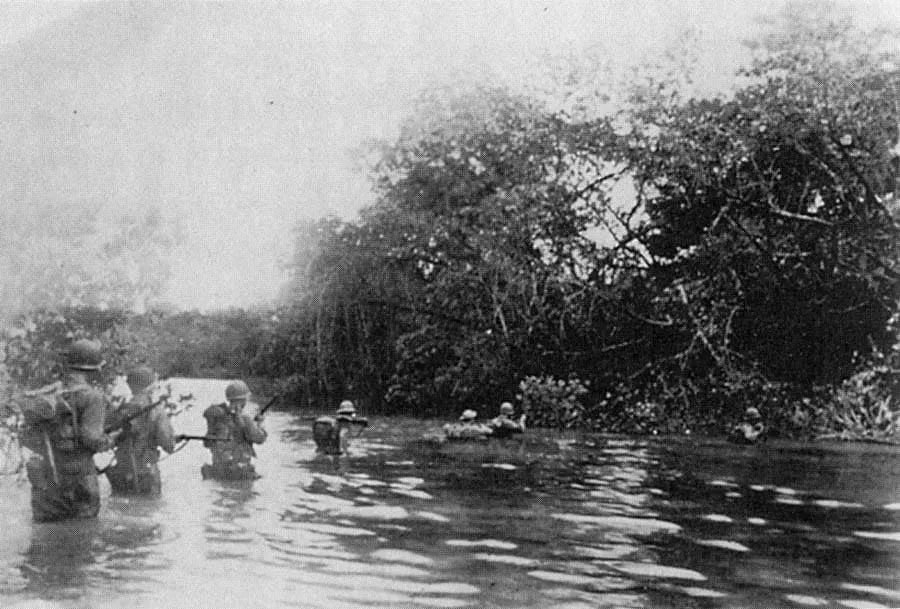
On the morning of 10 July the 1st Battalion of the 128th Infantry waded across the mouth of the Driniumor and set off eastward along the coast, while the 2nd Squadron of the 112th Cavalry moved inland from Afua. Both columns were to reach the Harech River. Before noon, a few kilometres beyond the river, the coastal battalion ran into a dug-in Japanese company and was held up; the cavalry made slow progress through the jungle. In the evening Hall’s staff judged that nothing would happen during the night. At about 11.30 p.m. Hall reported to Krueger that the reconnaissance could continue as planned the next morning.
Course of the battle
The night of 10/11 July: the breakthrough
A quarter of an hour or so after Hall sent his report, at about 11.50 p.m., Japanese 70 mm and 75 mm guns, laboriously dragged through the jungle, began shelling the positions of the 2nd Battalion, 128th Infantry, on the west bank of the Driniumor. A few minutes later the fire stopped and the first waves of infantry surged, shouting, across the shallow river. The Japanese plan provided for three regiments – the 78th and 80th of the 20th Division and the 237th of the 41st Division – to attack simultaneously, shoulder to shoulder, on the sector between the villages of Paup and Afua. In the dark and in the jungle this did not work: some units were late reaching their start lines, and the regiments attacked one after another.
The first attacks of the 78th Regiment on Company G broke down on the wire under machine-gun and mortar fire. The artillery inflicted even heavier losses on the Japanese: two American battalions of 105 mm howitzers, registered in advance on the riverbed and the east bank, opened fire as soon as the attack began. According to Japanese sources cited by Smith, the 1st Battalion of the 78th Regiment shrank in a short time from 400 men to 30, and the artillery fire also destroyed many guns, machine guns and mortars.
Even so, the Japanese got across. Company E, defending a sector more than a kilometre long, was according to the US official history outnumbered more than ten to one in its sector. When it ran out of ammunition its line disintegrated; soldiers fought their way through to neighbouring companies, and a few hid among the Japanese for three days. By about 3 a.m. on 11 July the enemy held a gap some 1,200 metres wide. Towards dawn further units of the 237th Regiment, headquarters staff, gunners and medical orderlies crossed the river.
11–18 July: withdrawal and rebuilding the line
Martin had no reserve with which to close the gap. He obtained Hall’s permission to recall the units sent out on reconnaissance, reasoning that the Japanese had themselves revealed their intentions. The 1st Battalion, 128th Infantry, returned by forced march along the coast and on the morning of 11 July attempted a counter-attack along the track from Anamo to Afua, but was pinned down by fire from the 237th Regiment. Martin therefore ordered a withdrawal to the second delaying line, a few kilometres to the west – along Koronal Creek and the X-ray River. The cavalry abandoned Afua and for several hours struggled through pouring rain, along a track turned to mud, to the X-ray.
Krueger, however, had no intention of giving up ground. He ordered Hall to throw the enemy back across the river, and Hall forbade any further withdrawal unless under clear pressure from superior forces. Command of the reinforced covering force, which with the 124th Infantry had grown almost to the size of a division, was taken over by General Gill. He divided it into a North Force under Brigadier General Alexander N. Stark and Cunningham’s South Force. On the morning of 13 July both moved east. The Japanese units that had crossed the river were unable to exploit their success: they lacked supplies and communications, and their commanders took a long time to sort out their shattered and intermingled units. The cavalry returned to Afua without a fight, and North Force, supported by three battalions of 105 mm howitzers and 155 mm batteries, regained the riverbank in the north.
The hardest task was to close the gap in the centre, at the former crossing point. The Japanese, knowing that the 237th Regiment was in danger of being cut off on the west bank, threw two companies of the 239th Regiment in there. An American battalion of the 124th Infantry and a cavalry troop fought their way through the jungle for several days amid ambushes and attacks from both sides. Only on the morning of 18 July – a week after the Japanese breakthrough – was the Driniumor line once again continuous from Afua to the sea. Over the following days American patrols drove the remnants of the 237th Regiment left on the west bank inland, towards the Torricelli Mountains.
18 July – 1 August: the fighting for Afua
Adachi did not give up. Since the centre of the line had been closed, he shifted the weight of his attack to the south, to the Afua area, where the American line rested on wooded hills at the foot of the Torricelli Mountains and where it was easier to outflank. Units of the 20th Division, including General Miyake’s group, crossed the river above Afua and on the evening of 18 July struck the rear of the cavalry west of the village. From then on, on the southern flank, there was almost continuous, confused fighting by platoons, companies and battalions in dense jungle, often hand to hand.
On the evening of 21 July the Japanese, supported by a mountain gun firing at close range, cut off Troop C of the 112th Cavalry west of Afua and tried to overrun Cunningham’s command post. Relief attempts failed, the Japanese seized the high ground above the village, and on 22 July Cunningham pulled back his right flank and abandoned Afua to the enemy. The encircled troop held out for four days before battalions of the 127th Infantry, coming up on 25 July, opened a way through to it. The cavalry returned to Afua a few days later. Supplies reached this flank mainly by air – they were dropped onto a clearing in a banana grove, which also served as an aid station and command post.
On the Japanese side the situation grew worse by the day. Around 24 July the 66th Infantry Regiment, the last reserve, crossed the river. On 25 July Adachi came in person to the 41st Division’s command post and saw for himself that the division was incapable of attacking the centre of the line; he decided to shift it south so that, together with the 20th Division, it could clear the whole bank from Afua northwards. By the time the units reached their positions they were in tatters. According to Smith, on the morning of 1 August the 41st Division and its attached units numbered fewer than 1,750 men, and Adachi had a total of about 4,000 combat-fit soldiers in the Afua area.
The last major attack came at dawn on 1 August. The Japanese advanced in waves, on a narrow front, against the positions of Troop C, about 1.5 kilometres north of Afua. The American artillery broke up the attack in less than two hours. Patrols afterwards counted 180 Japanese dead in front of the troop’s lines; the Americans lost five killed and six wounded. Between 13 and 31 July, however, South Force had lost nearly a thousand men, 260 of them in the 112th Cavalry – more than 17 per cent of the strength of that understrength regiment.
31 July – 10 August: the counter-offensive and the withdrawal of the 18th Army
Meanwhile Hall was preparing the counter-stroke that Krueger had demanded from the start. On 29 July he decided that the whole 124th Infantry, reinforced by a battalion of the 169th Infantry from the 43rd Division, would cross to the east bank of the Driniumor in the northern part of the line, move east to Niumen Creek and then turn south and west into the rear of the Japanese attacking at Afua. Command of this force, named TED Force, was given to the commander of the 124th Infantry, Colonel Edward M. Starr.
The force crossed the river at 8 a.m. on 31 July and for ten days pushed through unknown, mountainous, jungle-covered terrain in torrential rain, supplied from the air. Along the way it encountered mainly isolated groups and covering detachments, and increasingly sick, wounded and starving soldiers who could not keep up with the retreating army. According to TED Force’s reports, it killed some 1,800 Japanese during this outflanking march, losing about 50 killed and 80 wounded – some of them to its own artillery fire and defective mortar ammunition.
The counter-offensive struck at a moment when the Japanese were withdrawing anyway. On the afternoon of 31 July Adachi warned his units of preparations for a retreat that was to begin on 4 August; according to Smith, the attacks at Afua after 31 July were part of this plan – they were meant to unsettle the Americans, perhaps capture supplies, cover the withdrawal and serve as the army’s last “glorious” effort. Adachi calculated that food in the battle area would run out on 3 August. Communications in his army were so badly disrupted that he learned of the American troops in his rear only on 3 August – and estimated them at a mere 400 men. On that same day he issued detailed orders for all units to withdraw across the Driniumor, and over the following days the 18th Army fell back towards Wewak, covered by the remnants of the 66th Regiment. On the west bank of the Driniumor resistance gradually weakened, and on 9 August General Gill reported to Hall that the Japanese were fleeing east and the covering force could be relieved.
11–25 August: the pursuit
From 11 August units of the 32nd Division and the 112th Cavalry returned to the coast, and their place on the river was taken by General Leonard F. Wing’s 43rd Infantry Division; on 15 August Wing assumed command of the perimeter around Tadji airfield and of the covering line. His division’s patrols went along the coast as far as Marubian and up the Drindaria River without meeting organised resistance; only on the Dandriwad River did they come upon Japanese delaying positions, which they made no attempt to force. On 25 August Krueger, satisfied that the 18th Army no longer threatened either the Aitape perimeter or Tadji airfield, declared the operation over.
Air and naval forces
Because of the dense jungle, most supplies for the troops on the river were dropped from aircraft, and the wounded were evacuated along narrow tracks or by boat along the coast. Air support came from the Australian Beaufighters and Beauforts of No. 71 Wing RAAF, operating from Tadji airfield, and from American reconnaissance aircraft. From the sea, Japanese positions and supply routes were shelled by Task Force 74, with the heavy cruisers HMAS Australia and HMAS Shropshire and two Australian and two American destroyers, while PT boats and destroyers hunted supply barges between Wewak and Aitape by night.
Losses
According to the US official history, the capture and holding of the Aitape area cost the Americans about 440 killed, 2,550 wounded and 10 missing up to 25 August 1944; the great majority of these losses fell in the Battle of the Driniumor River. The 112th Cavalry and the 124th and 169th Infantry Regiments suffered most. Many soldiers were put out of action by malaria, other tropical diseases and combat exhaustion. Four Americans were posthumously awarded the Medal of Honor for the fighting on the river.
Japanese losses were many times higher. According to American counts, 8,821 Japanese were killed and 98 taken prisoner in the Aitape area between 22 April and 25 August; 2,669 of the dead fell in the period of the retreat alone, 2–9 August. The Japanese estimated that of the 20,000 men committed to the battle, the 18th Army lost about 9,000 between 1 June and 5 August. Studies usually give a total of 8,000 to 10,000 killed and dead – to a large extent from hunger, exhaustion and disease rather than bullets. After the battle the regiments of the 20th Division averaged fewer than 100 combat-fit men each, those of the 41st Division about 250, and the 66th Regiment 150. Most of the battalion, company and platoon commanders were killed, and all the artillery and almost all the crew-served weapons were lost.
Significance
The Battle of the Driniumor River was one of the bloodiest battles in New Guinea – second only to the fighting for Buna, Gona and Sanananda at the turn of 1942 and 1943. In Smith’s assessment, two and a third reinforced divisions of the 18th Army were destroyed in a futile attempt to retake Aitape and delay MacArthur’s advance to the Philippines. Neither aim was achieved: the 18th Army suffered a decisive defeat and ceased to be a threat to the Allies anywhere in New Guinea.
For the Americans the battle was essentially a defensive, secondary engagement. It tied down several divisions around Aitape but did not delay the offensive along the north coast of the island. While the fighting on the Driniumor went on, other MacArthur forces completed the capture of Biak, landed on Noemfoor Island on 2 July and at Sansapor on the Vogelkop Peninsula, at the western tip of New Guinea, on 30 July. Morotai followed in September 1944, and the Philippines in October. The Aitape area served as a base and staging point for subsequent operations, and for the 124th Infantry and the 43rd Division it was a school of jungle fighting before the battles in the Philippines.
The battle also highlighted the limits of intelligence. Thanks to signals intelligence the Americans knew the strength and intentions of the 18th Army in advance, yet were nonetheless taken by surprise on the night of 10/11 July – partly because they themselves did not believe that a starving army would decide to attack. The American historian Edward Drea, a specialist in signals intelligence in the war against Japan, devoted a separate study of the defence of the Driniumor to this paradox; the battle is sometimes cited as an example of how even the best information from decrypted messages is no substitute for judging what the enemy is prepared to risk.
For the Japanese, the Driniumor was the last major attempt at offensive action in New Guinea. The remnants of the 18th Army remained around Wewak and in the Torricelli and Prince Alexander Mountains, where they turned to self-sufficiency – cultivating gardens and searching for sago. At the end of 1944 the Americans at Aitape were relieved by the Australian 6th Division, which in the Aitape–Wewak campaign, lasting until August 1945, drove the Japanese step by step back towards Wewak and into the mountains. Adachi surrendered to the Australians in September 1945 at Cape Wom near Wewak. Of the more than 100,000 soldiers who passed through his army at various times (some sources give as many as 140,000), about 13,000, according to frequently cited estimates, survived to the end of the war. Sentenced to life imprisonment by an Australian tribunal at Rabaul for crimes committed by troops under his command, Adachi – who accepted a commander’s responsibility – took his own life on 10 September 1947.