1944–1945: The liberation of Western Europe
Battle of the Scheldt
- Dates:
- 2 October – 8 November 1944
- Front:
- Western Front
- Location:
- Northern Belgium and the south-western Netherlands: the area north of Antwerp (Woensdrecht, Bergen op Zoom), the Breskens pocket between the Leopold Canal and the Western Scheldt, the South Beveland peninsula and the island of Walcheren at the mouth of the Scheldt; on the right flank, North Brabant as far as BredaOn the battle map →
- Sides:
- Canada, United Kingdom and PolandGuy Simonds, Harry Crerar, Bernard Law MontgomeryNazi GermanyGustav-Adolf von Zangen
- Result:
- Allied victory. By 3 November the 3rd Canadian Infantry Division had eliminated the Breskens pocket on the south bank of the Western Scheldt; by 31 October the 2nd Canadian Infantry Division and the British 52nd Infantry Division had taken South Beveland; and on 8 November resistance ceased on Walcheren, assaulted from the sea on 1 November. On the right flank the Polish 1st Armoured Division liberated Breda on 29 October. The estuary still had to be swept of mines; the first convoy reached Antwerp on 28 November 1944. According to the Canadian official history, Allied losses were 12,873 killed, wounded and missing, including about 6,400 Canadians; more than 41,000 Germans were taken prisoner.
- Author:
- Łukasz
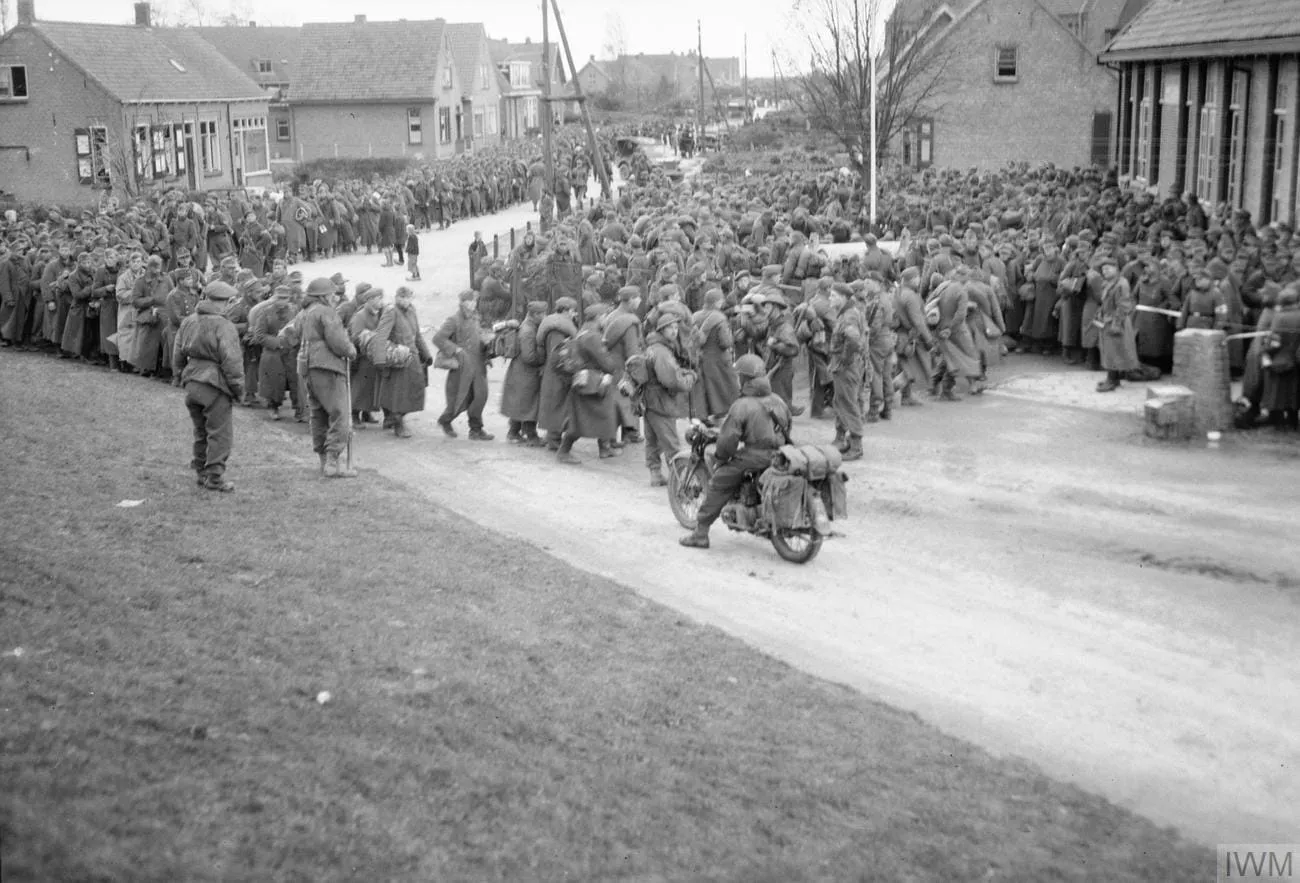
The Battle of the Scheldt was a series of operations conducted in the autumn of 1944 by the First Canadian Army, together with the British and Polish units under its command, to open the estuary of the Scheldt between Antwerp and the North Sea to shipping. The great port, captured by the British almost intact at the beginning of September, could not receive a single Allied ship for two months, because the Germans held both banks of the narrow estuary, several dozen kilometres long. Driving them from the flooded polders, from the Breskens pocket, from the South Beveland peninsula and from the fortified island of Walcheren took more than five weeks and required several amphibious operations, canal crossings and attacks across open, waterlogged ground. The brunt of the fighting fell on three Canadian divisions, commanded – in place of the sick Lieutenant General Harry Crerar – by Lieutenant General Guy Simonds. It was one of the longest and bloodiest battles fought by the Canadian army in the Second World War.
Name and dates
The name “Battle of the Scheldt” is a collective term, established by the Canadian official history and later literature. It covers four main undertakings: the advance north of Antwerp to cut the isthmus leading to South Beveland; Operation Switchback – the elimination of the German bridgehead on the south bank of the Western Scheldt known as the Breskens pocket; Operation Vitality – the capture of the South Beveland peninsula; and Operation Infatuate – the capture of the island of Walcheren.
The most commonly used time frame for the battle runs from 2 October 1944, when the 2nd Canadian Infantry Division set off northwards from the Antwerp area towards Woensdrecht, to 8 November, when organised German resistance on Walcheren ceased. These limits are to some extent arbitrary. The first attempts to force the Leopold Canal and the Polish 1st Armoured Division’s advance to the Scheldt shore near Terneuzen took place as early as the second half of September, while on the army’s right flank the Polish division was still fighting for Breda and Moerdijk until 9 November. The estuary then had to be swept of mines for three weeks – the first convoy did not reach Antwerp until 28 November.
Background
After the destruction of the Germans in the Falaise pocket, the Allied armies swept across northern France and Belgium within a few weeks. On 4 September the British 11th Armoured Division, supported by the Belgian resistance, took Antwerp with its port for the most part intact. It was the largest port in western Europe that the Allies had a chance of using, and it lay only about 120 km from the border of the Reich. Meanwhile supplies were still arriving mainly over the Normandy beaches and through Cherbourg, hundreds of kilometres behind the front line, while the Germans were defending the Channel ports as fortresses or wrecking them before surrendering.
Antwerp, however, lies about 80 km inland, and its route to the sea runs along the Western Scheldt, both banks of which remained in German hands. As early as 5 September Admiral Bertram Ramsay, the Allied naval commander, warned Field Marshal Bernard Law Montgomery, commander of 21st Army Group, that the port would be useless until the estuary had been cleared. Montgomery, however, concentrated his forces on a thrust through the Netherlands towards the Rhine, which ended on 25 September in the failure of Operation Market Garden. The First Canadian Army, given the task of clearing the coast, was occupied throughout September with capturing the Channel ports: Boulogne surrendered on 22 September and Calais on 1 October, while Dunkirk was merely to be surrounded. Crerar warned that he did not have enough strength to clear the Scheldt at the same time; Montgomery did not then give him an additional corps, which was needed at Arnhem. At the end of September Crerar fell ill with dysentery and went to England for treatment, and command of the army passed to the commander of II Canadian Corps, Guy Simonds.
The delay gave the Germans time. Crossing the Western Scheldt northwards by night, on ferries and barges from Breskens to Vlissingen, went the greater part of General of Infantry Gustav-Adolf von Zangen’s Fifteenth Army, which had been threatened with being cut off in Belgium after the fall of Antwerp. Adolf Hitler ordered the Scheldt estuary to be held at all costs and declared Walcheren a fortress. In an order to his troops Zangen wrote that the English needed the port of Antwerp in order to deliver a blow across the North German plain towards Berlin before winter, and that every day by which the opening of the port could be put off was of decisive importance.
The terrain favoured the defenders. The polder country of Zeeland and western Brabant consists of flat, low-lying meadows criss-crossed by ditches, canals and dykes, along which run the only metalled roads. The Germans flooded much of the ground and carefully registered their artillery and mortars on the remaining roads along the dykes. On the south bank, in the Breskens pocket, the 64th Infantry Division of General Knut Eberding (PL), a defensive specialist experienced on the Eastern Front, held out with a huge number of guns left behind by the retreating army, including 20 mm anti-aircraft guns used against infantry. Walcheren and South Beveland were held by General Wilhelm Daser’s 70th Infantry Division together with Kriegsmarine coastal artillery units; the island was one of the most heavily fortified sectors of the Atlantic Wall.
Simonds’s plan was for the 2nd Canadian Infantry Division to strike north from Antwerp and close the isthmus connecting South Beveland with the mainland, for the 3rd Canadian Infantry Division to eliminate the Breskens pocket, and for Walcheren to be taken by amphibious assault after the island had been flooded by bombing its sea walls. On the right flank, covering the advance from the east, were the 4th Canadian Armoured Division and Brigadier General Stanisław Maczek’s Polish 1st Armoured Division, and beyond them the British I Corps.
Course of the battle: Woensdrecht and the Beveland isthmus (2–24 October)
On 2 October Major General Charles Foulkes’s 2nd Canadian Infantry Division set off from the northern suburbs of Antwerp along the east bank of the Scheldt. It covered the first few kilometres relatively quickly, but on 6 October it ran into determined resistance at Woensdrecht. The small town stood on a low rise above the base of the isthmus leading to South Beveland and Walcheren – the only land route by which the Germans could supply and reinforce the defence of the estuary. Field Marshal Walter Model, commander of Army Group B, ordered this corridor to be held at all costs and sent there General Kurt Chill’s battle group with the paratroopers of the 6th Parachute Regiment, followed by the 256th Volksgrenadier Division.
The Canadians attacked across open, partly flooded ground, in the rain, among mines and booby traps. On 13 October, later remembered in Canada as “Black Friday”, the Black Watch battalion from Montreal lost almost an entire assault company in a failed attack. Only in a night attack on 16 October did the Royal Hamilton Light Infantry take most of Woensdrecht, and in the following days the Canadians dug in on the isthmus, cutting Beveland’s land link with the rest of the Netherlands. Their losses were very heavy; the Canadian historians Terry Copp and Robert Vogel wrote that the very name of Woensdrecht made veterans of the 2nd Division shudder.
The Canadians’ difficulties provoked a dispute at the top of the command. Ramsay warned the Supreme Commander, General Dwight Eisenhower, that the First Canadian Army was having to ration ammunition because priority in supplies went to holding the gains around Nijmegen. Around 9 October Eisenhower reminded Montgomery of the “supreme importance of Antwerp”; Montgomery replied sharply that there was no shortage of ammunition, and on 14 October he again demanded command of the land forces for himself. Eisenhower wrote back that the problem was not the command structure but the execution of his orders. On 16 October Montgomery issued a directive declaring the opening of Antwerp the task with absolute priority for the whole of 21st Army Group. The Canadians received reinforcements in the form of the British 52nd (Lowland) Infantry Division, and on 20 October the British Second Army launched Operation Pheasant westwards through North Brabant, covering the whole undertaking from the east.
To secure the isthmus against counter-attack, on 20 October Major General Harry Foster’s 4th Canadian Armoured Division attacked in the Wouwsche Plantage woods north-east of Woensdrecht, and on 22 October it took Esschen. Counter-attacks by the German 85th Infantry Division with self-propelled guns led to several days of very bitter fighting. By 24 October the front had been pushed far enough back from the base of the peninsula for the 2nd Division to move west safely; the 4th Armoured Division pressed on towards Bergen op Zoom, which it liberated at the end of the month.
Course of the battle: the Breskens pocket – Operation Switchback (6 October – 3 November)
The Breskens pocket, stretching from Zeebrugge to the Braakman inlet and from the Western Scheldt south to the Leopold Canal, was almost an island: only a few narrow strips of dry ground led out of it to the mainland. An earlier attempt, in September, by the 4th Canadian Armoured Division to force the double line of the Leopold and Schipdonk canals at Moerkerke had ended in a bloody withdrawal. Simonds decided to strike from two directions: the 7th Brigade of Major General Daniel Spry’s 3rd Canadian Infantry Division was to cross the Leopold Canal from the south, while the 9th Brigade was to land from amphibious vehicles in the rear of the pocket, from the Braakman inlet.
On 6 October, without a preliminary bombardment, behind a barrage of fire from Wasp flamethrower carriers, the Regina Rifles and the Canadian Scottish crossed the canal in boats. They seized two shallow bridgeheads, which over the following days fought off counter-attacks by the 64th Division. The fighting took place on embankments and dykes, in pouring rain, in trenches that flooded every few hours; Copp and Vogel quote veterans who found it worse than the darkest days in Normandy, and estimate that one in two of the soldiers who crossed the Leopold Canal was killed, wounded or went missing. Eberding ordered that soldiers retreating without orders be treated as deserters and shot on the spot, and that their names be made known in their home towns.
The 9th Brigade’s landing was delayed by a day – the Buffalo and Terrapin amphibious vehicles had great difficulty getting through the locks of the Ghent–Terneuzen Canal – but on the night of 8/9 October the Highland Light Infantry of Canada and the North Nova Scotia Highlanders landed near Hoofdplaat, taking the Germans by surprise. Model reported to Hitler that the enemy was seeking a decision in the Breskens area and ordered the bridgehead destroyed; over the following days the brigade fought for the villages of Hoofdplaat, Driewegen and Biervliet. Spry sent the 8th Brigade along the Scheldt shore to link up with the 9th Brigade, while the 10th Brigade of the 4th Armoured Division crossed the Leopold Canal further east. Around 15 October Eberding pulled his depleted units back to a shorter defensive line.
The last phase was a slow, methodical pushing of the Germans towards the sea. The Canadians, suffering from a shortage of infantry replacements, substituted artillery and air power for men. They took Breskens on 22 October and Oostburg on 25 October, in the following days the coastal fortifications including Fort Frederik Hendrik and Cadzand, and on 1 November the North Nova Scotia Highlanders captured Eberding himself. Operation Switchback ended on 3 November with the capture of the Belgian towns of Knokke and Zeebrugge. There were no Germans left south of the Scheldt.
Course of the battle: the Polish 1st Armoured Division on the right flank
The Polish 1st Armoured Division, which in August had helped close the Falaise pocket and at the beginning of September had liberated Ypres, Tielt and Ghent, among other towns, entered Dutch territory as early as the second half of September: after several days of fighting it took Axel and Hulst, and with them Terneuzen, clearing the south bank of the Scheldt east of the Ghent–Terneuzen Canal. It was then moved to the Antwerp area, on the right flank of the 2nd Canadian Division. At the end of September it crossed the Antwerp–Turnhout Canal, took Merksplas in Belgium and on 1 October reached the Dutch border near Baarle-Nassau. There, together with a Canadian armoured regiment, it covered a gap some 30 km wide between the Canadians and the British Second Army. In this area of woods and heathland the Poles fought exhausting positional battles against German paratroopers for nearly four weeks; they entered Baarle-Nassau on 3 October, but the surrounding area remained on the front line until 28 October.
On 20 October, as part of Operation Pheasant, the division, serving under Lieutenant General John Crocker’s British I Corps, attacked northwards through Alphen, Gilze and Molenschot. On 27 October Maczek was ordered to take Breda, the largest town in North Brabant and an important road and rail junction. Instead of the frontal attack from the west that the Germans expected, Colonel Tadeusz Majewski (PL)’s 10th Armoured Cavalry Brigade swung round Breda to the north and attacked from the east, while Colonel Franciszek Skibiński (PL)’s 3rd Rifle Brigade struck from the south-west. Threatened with encirclement, the Germans withdrew, and on 29 October the Poles entered the town, which escaped major damage. According to Polish and Dutch accounts, Maczek dispensed with a heavy artillery preparation in order to spare the inhabitants and the historic buildings. The Breda town council later granted the soldiers of the division honorary citizenship.
After taking Breda the division pressed on northwards towards the Maas (Meuse) and the bridges at Moerdijk, where fighting went on until 8–9 November. The Polish operations were not part of the clearing of the Scheldt estuary itself, but they tied down German forces and pushed them back across the Maas, securing the eastern flank of the First Canadian Army.
Course of the battle: South Beveland – Operation Vitality (24–31 October)
On 24 October the 2nd Canadian Infantry Division, thinned out by the fighting for Woensdrecht – in many battalions it was no longer possible to muster four full rifle companies – moved west along the South Beveland peninsula. Once again the advance bogged down in mud, on mines and in front of paratroopers’ positions, but on 25 October it broke through the narrowest point of the peninsula. To outflank the German defence line on the canal that cuts across Beveland, on the night of 25/26 October the British 156th Brigade of the 52nd (Lowland) Division crossed the Western Scheldt in amphibious vehicles from Terneuzen and landed on the south shore of the peninsula, in the German rear. The Canadian 6th Brigade forced the canal frontally in assault boats, and engineers bridged it on the main road. General Daser, judging the situation hopeless, withdrew the remnants of his units to Walcheren. By 31 October the peninsula had been cleared, and the Canadians stood before the Sloedam causeway, the only land link with the island.
Course of the battle: Walcheren – the flooding of the island and Operation Infatuate (3 October – 8 November)
Walcheren, formerly an island and joined to Beveland only by a narrow causeway, was the most strongly defended point in the estuary: coastal artillery batteries in concrete shelters lined its western and southern shores, and a ring of fortifications had been built around the port of Vlissingen – called Flushing by the British. Most of the island lies below sea level, so the Allies decided to flood it. After warning leaflets had been dropped, aircraft of RAF Bomber Command bombed the sea wall near Westkapelle, at the western tip of the island, on 3 October. The sea poured through the breach into the interior of Walcheren. The inhabitants had nowhere to flee; in Westkapelle alone between about 150 and 180 people were killed, according to various sources, many of them in a windmill where they had taken shelter. On 7 and 11 October the dykes were breached east and west of Vlissingen and near Veere. The flooding forced the Germans to concentrate on the dunes and in the towns, and allowed the Allies to use amphibious vehicles. The consequences for the population and for farming were severe: salt water lay on the island for the whole of the following year, and the last breach in the dykes was not closed until October 1945.
Walcheren was attacked from three sides. On the night of 31 October/1 November the 2nd Canadian Infantry Division attacked along the Sloedam causeway, more than a kilometre long and completely exposed. Successive battalions – the Black Watch, the Calgary Highlanders and the Régiment de Maisonneuve – managed to seize only a shallow bridgehead at the far end, and on 2 November they were relieved by Scots of the 52nd Division. That division’s commander, Major General Edmund Hakewill-Smith, instead of renewing the frontal attack, sent a battalion across the shallows a little south of the causeway, outflanking the German positions. The costly fighting for the causeway, still judged critically today, is one of the most controversial episodes of the Canadian campaign.
On the morning of 1 November two seaborne landings went in. In Operation Infatuate I, No. 4 Commando – which included two troops of French commandos – and battalions of the British 155th Brigade crossed from Breskens and landed in the port of Vlissingen; after several days of street fighting the town was in Allied hands. In Operation Infatuate II the British 4th Special Service (Commando) Brigade – Nos. 41, 47 and 48 Commando of the Royal Marines and the inter-Allied No. 10 Commando, represented here mainly by Belgians and Norwegians – landed on both sides of the breach in the dyke at Westkapelle, supported by the guns of the battleship HMS Warspite, two monitors and a squadron of support craft, and specialised vehicles of the British 79th Armoured Division were also brought ashore. Because of the weather, air support was limited. German batteries sank or badly damaged most of the support craft, and shells from Allied ships also fell on Domburg, killing many civilians. Over the following days the commandos took Westkapelle, Domburg and the batteries in the dunes, advancing along the narrow strip of dry land around the island’s flooded interior.
On 6 November a company of the Royal Scots reached Middelburg, the capital of Zeeland, in Buffalo amphibious vehicles across the flooded fields, and General Daser surrendered. The last pockets of resistance in the north of the island were eliminated on 8 November. As early as 4 November, anticipating the fall of Walcheren, Ramsay had sent minesweepers into the Scheldt estuary.
Losses
The Canadian official history (C. P. Stacey) states that between 1 October and 8 November the First Canadian Army lost 12,873 men killed, wounded and missing; roughly half, about 6,400, were Canadians, and the rest mainly British, along with Poles and commandos of other nationalities. According to the same source, 41,043 Germans were taken prisoner; the number of German killed and wounded is not known precisely. More than 160 soldiers of the 1st Armoured Division who fell in the fighting in the Netherlands lie in the Polish war cemetery in Breda.
The civilian population of Zeeland and Brabant suffered heavy losses – in the bombing of the dykes, in artillery fire and in the floods. The victims numbered in the hundreds: in addition to those killed in Westkapelle and Domburg, historians mention among others several dozen inhabitants of Arnemuiden, shelled by artillery during the fighting for the causeway, and the victims of air raids on Vlissingen and the surrounding villages. Thousands of people lost their homes and farms on the flooded polders.
The battle also exposed a problem that would soon shake Canadian politics. Canada sent only volunteers overseas, and infantry losses on the Scheldt far exceeded the number of replacements arriving. Canadian battalions were short of men, soldiers went for months without rest, and many broke down psychologically from combat exhaustion.
Significance
The Battle of the Scheldt opened the port of Antwerp to the Allies. After the sweeping of the shipping channel, which went on until the end of November, the first convoy entered the port on 28 November 1944, led by the Canadian-built freighter Fort Cataraqui. By the end of the war millions of tons of supplies had passed through Antwerp, resolving the logistical crisis that had held back the advance of all the Western Allied armies on Germany in the autumn. The Germans understood the port’s importance well: Antwerp was bombarded with V-2 rockets and V-1 flying bombs more heavily than any other city, and its recapture was the main objective of the Ardennes offensive launched on 16 December 1944.
At the same time the battle became an example of the cost of the mistaken decisions of early September. Historians – from the American Charles B. MacDonald to the Briton Antony Beevor – point out that the Scheldt estuary could have been cleared at far lower cost if it had been given priority immediately after the capture of Antwerp, instead of allowing the Fifteenth Army to cross the estuary and dig in on the polders; Montgomery himself admitted in his post-war memoirs that he had underestimated the task. The Germans managed to delay the opening of the port by nearly three months. Copp and Vogel, for their part, stress that in October the First Canadian Army carried out one of the most difficult tasks faced by any Allied army, on extremely unfavourable ground and with a growing shortage of men.
In Canada the losses on the Scheldt hastened the conscription crisis: the defence minister, Colonel James Ralston, who was demanding that conscripts be sent overseas, was forced out of the government at the beginning of November by Prime Minister William Lyon Mackenzie King, who nevertheless agreed himself at the end of November to send some of the conscripts to Europe. In the Netherlands the battle completed the liberation of Zeeland and most of North Brabant – the Polish 1st Armoured Division went over to the defensive on the Maas near Moerdijk – while north of the great rivers the rest of the country had still to endure the “Hunger Winter” and wait for freedom until May 1945. In Breda and in Zeeland the memory of the Canadians, British and Poles of that autumn remains alive to this day.