United Kingdom
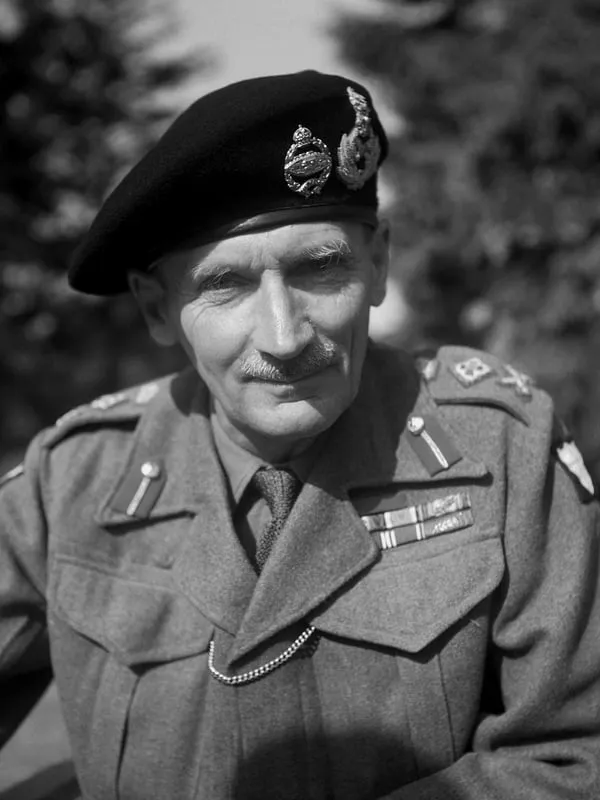
Bernard Montgomery
Commander of the Eighth Army (1942–1943), commander of the 21st Army Group (1944–1945), Chief of the Imperial General Staff (1946–1948), field marshal
- Born:
- 17 November 1887, Kennington, London (England)
- Died:
- 24 March 1976, Isington near Alton (England)
- Author:
- Natalia
- Photo:
- Possibly Edward George William Malindine, domena publiczna, Wikimedia Commons

Bernard Law Montgomery, known in the army and the press simply as “Monty”, was the most famous British general of the Second World War. In August 1942 he took command of the Eighth Army at El Alamein, beat off Erwin Rommel’s last offensive in Egypt and in the autumn won the Second Battle of El Alamein – the first great victory of the British Army over the Germans. He then led the Eighth Army through Libya and Tunisia to Sicily and into Italy, and in 1944 he commanded all Allied ground forces in Normandy and then the 21st Army Group until the German surrender in north-west Europe. He was a methodical commander who prepared every battle with great care and a master at building his soldiers’ morale, but he was also a difficult man – vain and inclined to claim credit due to others – and this set him at odds with many of his allies.
Childhood and youth
He was born on 17 November 1887 in Kennington, London, the fourth of the nine children of an Anglican clergyman, Henry Montgomery, and Maud, née Farrar, the daughter of the well-known preacher and author Frederic Farrar. The family descended from the Protestant gentry of County Donegal in Ireland. In 1889 his father became Bishop of Tasmania, and Bernard spent his childhood there. His mother, stern and cold, beat her children; Montgomery remembered his childhood as unhappy and remained on bad terms with her for the rest of his life.
After the family returned to London in 1901 he attended St Paul’s School and then the military college at Sandhurst, from which he was nearly expelled for brawling and violence towards other cadets. In September 1908 he was commissioned as a second lieutenant into the 1st Battalion of the Royal Warwickshire Regiment and went with it to India before the year was out.
The First World War
In August 1914 his battalion landed in France with the British Expeditionary Force. Montgomery fought at Le Cateau and in the retreat from Mons, and on 13 October 1914, at Méteren near the Franco-Belgian border, in the fighting that preceded the First Battle of Ypres, he led a bayonet charge and was badly wounded: a sniper’s bullet pierced his right lung and another hit him in the knee. A soldier who tried to help him was killed and fell on top of him, shielding him from further shots. At the dressing station the doctors had already ordered his grave to be dug. He survived and was awarded the Distinguished Service Order.
He returned to the front in 1916 as a staff officer and went through the Battle of the Somme, the Battle of Arras and Passchendaele. He ended the war as a lieutenant colonel and chief of staff of the 47th Division. The lesson he drew from it shaped him for good: the generals did not know their soldiers, the staffs lived in comfort far from the front, and the losses were appalling. He concluded that a commander must be visible to his men and that a battle must be prepared so as not to waste human life.
Between the wars
After the war he served with the British Army of the Rhine, passed through the Staff College at Camberley and in 1921, as brigade major of the 17th Infantry Brigade, was sent to County Cork in the last phase of the Irish War of Independence. He drew a cool conclusion from it: the rising could have been crushed only by ruthless methods that public opinion would not allow, so the only way out was self-government for Ireland. In 1926–1929 he taught at Camberley and then wrote an infantry training manual.
In 1927 he married Elizabeth (Betty) Carver, a widow with two sons and the sister of the armoured warfare pioneer Percy Hobart; their son David was born in 1928. The marriage was very happy, and Betty, as those close to them wrote, softened his most difficult traits. In 1937 she died of septicaemia after an insect bite. Montgomery never remarried and threw himself into his work.
From 1931 he commanded his own 1st Battalion in Palestine, Egypt and India; in 1934–1937 he taught at the Staff College in Quetta, and in 1937 he took over the 9th Infantry Brigade at Portsmouth. In October 1938, by then a major general, he took command of the 8th Division in Palestine, where he put down the Arab revolt against the Mandate authorities and Jewish immigration. In the summer of 1939, after a serious illness, he returned to England and, just before the outbreak of war, was given the 3rd Infantry Division, earmarked for the British Expeditionary Force.
France and Belgium (1939–1940)
In the autumn of 1939 the 3rd Division took up its place in France in II Corps under General Alan Brooke, who became his patron. When Montgomery issued a circular on preventing venereal disease in language that outraged the chaplains, Brooke saved him from being removed. During the Phoney War most divisions dug fortifications, while Montgomery ran exercises lasting several days in night marches and withdrawals from one river line to the next. When the Germans struck on 10 May 1940, the 3rd Division occupied its assigned positions on the Dyle at Louvain, as part of the Belgian campaign, and beat off attacks by German infantry there. In the retreat to the sea its training paid off: on the night of 27–28 May the division moved just behind the front from the right flank of the Expeditionary Force to its left and closed the gap left by the surrendering Belgian army. On 30 May Montgomery succeeded Brooke, who had been recalled to England, at the head of II Corps, and commanded it in the last days of the defence of Dunkirk.
In England (1940–1942)
After his return from France Montgomery sharply criticised the command of the Expeditionary Force, which alienated the War Office. His 3rd Division, the only fully equipped division in the country, prepared a series of plans that were never carried out – for seizing the Portuguese Azores and the Cape Verde Islands. In July 1940 he took over V Corps in Hampshire and Dorset, where he fell into a long-running conflict with the head of Southern Command, General Claude Auchinleck. In 1941 he commanded XII Corps in Kent, and in December he took over South-Eastern Command, which he renamed South-Eastern Army. Everywhere he imposed the same regime: constant exercises, a high level of physical fitness, staff officers included, and the ruthless removal of commanders he judged unfit for battle.
As commander of South-Eastern Army he was responsible in the spring of 1942 for the military side of planning the landing at Dieppe, to be carried out by the 2nd Canadian Division. When the operation was cancelled in July, he advised against reviving it. It was revived without him, when he was already in Egypt, and the Dieppe Raid of 19 August 1942 ended in a bloody disaster. In his memoirs Montgomery disclaimed responsibility for its final form.
El Alamein
At the beginning of August 1942 he was appointed to command the British First Army in the planned landing in French North Africa. After the death of General William Gott, whom Winston Churchill had chosen to command the Eighth Army, the Chief of the Imperial General Staff, Brooke, pushed through Montgomery’s appointment instead. On 13 August, two days before the appointed date, Montgomery took command of the army at El Alamein and at once announced that there would be no further retreat. He moved his headquarters next to that of the air force, replaced some of the commanders, placed a fresh division on the Alam Halfa ridge and ordered the tanks to fight from prepared positions. He drove from unit to unit, spoke to the soldiers and began wearing a black tank crewman’s beret, which became his trademark.
When Rommel struck on the southern sector of the front on the night of 30–31 August, Montgomery knew his intentions from decrypted German signals. At the Battle of Alam Halfa the German panzer divisions became stuck in the minefields under artillery fire and air attack, and after a few days, out of fuel, they withdrew. Montgomery did not pursue them: he did not want to risk an army he did not yet consider ready. The dispute continues to this day over how much of the credit for the battle was his and how much belonged to the defence plan drawn up in the summer by Auchinleck and his deputy chief of staff, Eric Dorman-Smith; Montgomery claimed it all for himself.
Over the following weeks, despite pressure from Churchill, he built up his forces and trained the army. When he opened the Second Battle of El Alamein on 23 October 1942, he had a clear superiority in men, tanks – including new American Shermans – and aircraft. The battle did not go as he had planned: breaking through the minefields took longer and losses were heavy. Montgomery shifted the direction of the attack several times until, at the beginning of November, Rommel began to withdraw in defiance of Hitler’s order. Some 30,000 Axis soldiers, most of them Italians, were taken prisoner. Montgomery was knighted and promoted to full general. He was later criticised for a slow pursuit that allowed the remnants of Rommel’s army to escape westwards.
From Tripoli to Italy
The Eighth Army took Tripoli in January 1943, in March it beat off Rommel’s attack at Medenine and outflanked the Mareth Line, and in May, together with the forces that had landed in Algeria and Morocco, it ended the Tunisian campaign with the surrender of the Axis forces. In the summer of 1943 Montgomery forced through a change in the plan for the landing in Sicily so that both armies would land close together in the south-east of the island; his rivalry with the American generals George Patton and Omar Bradley then began to sour relations within the coalition. On 3 September 1943 the Eighth Army crossed the Strait of Messina to Calabria, but its advance northwards, over wrecked roads and through successive German defence lines, was slow. Montgomery called the Italian campaign a muddle without a plan. In the last days of 1943 he handed the Eighth Army over to General Oliver Leese; under Leese’s command it later included, among others, the Polish II Corps of General Władysław Anders.
Normandy
At the beginning of 1944 Montgomery took over the 21st Army Group and command of all Allied ground forces for the planned invasion of France, under the Supreme Commander, General Dwight Eisenhower. He persuaded the Allies to widen the first wave of the landing to five divisions. On 6 June 1944 the Allies landed in Normandy. Caen, which Montgomery had intended to take on the first day, fell only after a month of heavy fighting; he later claimed that from the start his aim had been to pin the German panzer divisions in front of the British so that the Americans could break through in the west – which was partly true and partly an explanation after the event. At the end of July the Americans broke out, and in August the Germans suffered a crushing defeat in the Falaise Pocket, which was closed by, among others, the Polish 1st Armoured Division of General Stanisław Maczek, fighting in the 21st Army Group. On 1 September Eisenhower took direct command of the ground forces, and on the same day Montgomery was made a field marshal.
From Arnhem to Lüneburg
Montgomery demanded a single powerful thrust in the north, towards the Ruhr, instead of an advance on a broad front. In September 1944 Eisenhower agreed to Operation Market Garden – an attempt to seize the bridges in the Netherlands as far as the Rhine at Arnhem – which ended in failure. After the battle Montgomery, in a letter to Brooke, judged that the Polish 1st Independent Parachute Brigade had fought badly; in December 1944 its commander, General Stanisław Sosabowski, was removed from command under British pressure. Historians now regard these charges as unjust. Montgomery himself later admitted that it had been a mistake to put off clearing the approaches to Antwerp, which the Canadians then had to pay for with heavy losses in the Battle of the Scheldt.
When the Germans attacked in the Ardennes in December, Eisenhower gave him command of two American armies on the northern flank of the breach. The press conference of 7 January 1945, at which Montgomery spoke of his role in mastering the crisis, infuriated the Americans and was one of the low points in relations between the Allies. In March 1945 the 21st Army Group crossed the Rhine at Wesel, and on 4 May 1945, on Lüneburg Heath, Admiral Hans-Georg von Friedeburg signed before Montgomery the surrender of the German forces in north-west Germany, the Netherlands and Denmark.
After the war
Until 1946 Montgomery commanded the British occupation forces in Germany and sat on the Allied Control Council. In January 1946 he was created Viscount Montgomery of Alamein, and in 1946–1948 he was Chief of the Imperial General Staff, although he coped poorly with work in Whitehall and with disputes with the other chiefs of staff. In 1948–1951 he chaired the commanders’ committee of the Western Union, and in 1951–1958 he was Deputy Supreme Allied Commander of NATO forces in Europe. In 1958 he published his memoirs, in which he criticised Auchinleck, Eisenhower and other commanders so harshly that they provoked many protests, and he had to tone down some of his charges. As a member of the House of Lords he spoke often on public affairs, not infrequently in controversial terms. He died on 24 March 1976 at his home, Isington Mill, near Alton in Hampshire, and was buried in the churchyard at nearby Binsted.
Significance
Montgomery was the first British commander in this war to defeat the Germans in a major land battle, and he did so at a moment when Britain – after Dunkirk, Singapore and Tobruk – desperately needed a victory. El Alamein became a symbol of the turning point, and he himself a national hero. His style of command grew out of his experience of the First World War: he did not attack until he had superiority and a detailed plan, he paid close attention to supply and co-operation with the air force, he was sparing of his soldiers’ lives and he knew how to give them the sense that their commander knew what he was doing. This caution could also be his weakness – he was criticised for slow pursuits and missed opportunities.
As an ally he was difficult. Convinced of his own infallibility, he looked down on the Americans and their generals, publicly claimed the credit of others and chafed at being subordinate to Eisenhower, which repeatedly threatened the unity of the coalition. The arguments over his place in history – how much he owed to Auchinleck at El Alamein, whether Normandy went according to his plan and who was to blame for Arnhem – go on to this day. In Poland he is also remembered as the commander under whom General Maczek’s soldiers fought, and as the author of the unjust verdict on Sosabowski’s paratroopers.
Sources
Commanded in battles
(11)- 30 August – 5 September 1942Battle of Alam el HalfaMediterranean
- 23 October – 11 November 1942Second Battle of El AlameinMediterranean
- 17 November 1942 – 13 May 1943Tunisian campaignMediterranean
- 20–28 March 1943Battle of the Mareth LineMediterranean
- 10 July – 17 August 1943Allied invasion of SicilyMediterranean
- 9–16 September 1943Battle of SalernoMediterranean
- 6 June – 30 August 1944Battle of NormandyWestern Front
- 17–25 September 1944Operation Market GardenWestern Front
- 2 October – 8 November 1944Battle of the ScheldtWestern Front
- 16 December 1944 – 25 January 1945Battle of the BulgeWestern Front
- 7–31 March 1945The Rhine crossingsWestern Front
Mentioned in battles
(11)Often appears with
People who appear in the same events.
On the timeline
(116)The 40 most important of 116 events. All tagged “Bernard Montgomery” (36) →