United Kingdom
Bertram Ramsay
Flag Officer commanding Dover (1939–1942), commander of the Dunkirk evacuation (1940), Allied Naval Commander-in-Chief, Expeditionary Force (1943–1945), admiral
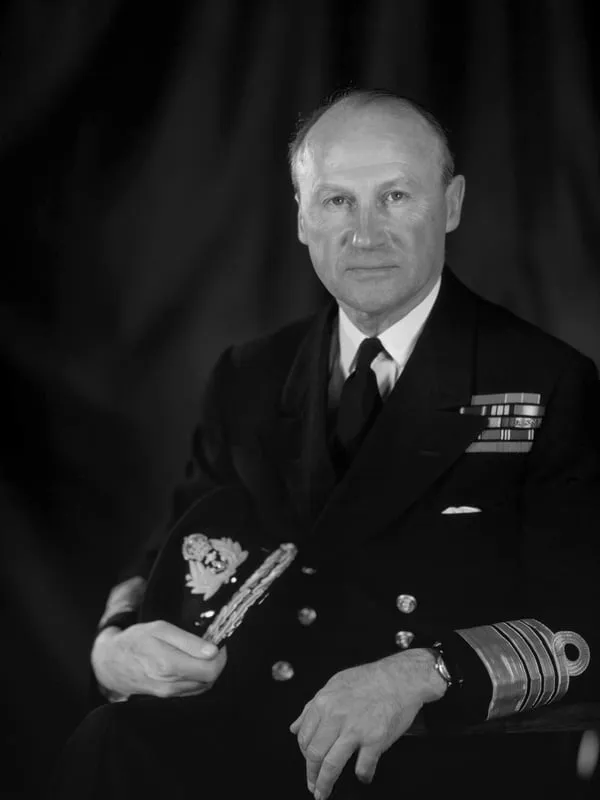
- Born:
- 20 January 1883, Hampton Court (England)
- Died:
- 2 January 1945, Toussus-le-Noble (France)
- Author:
- Łukasz
- Photo:
- British official photographer, domena publiczna, Wikimedia Commons

Sir Bertram Home Ramsay was a British naval officer whose name links the two moments of the war in the West that mattered most to Britain: the evacuation of the army from France in 1940 and its return there in 1944. As vice admiral at Dover he organised and led Operation Dynamo, which rescued more than 338,000 soldiers from Dunkirk. Four years later, as Allied Naval Commander-in-Chief, Expeditionary Force, he planned and carried out the naval part of the Normandy landings, the largest amphibious operation in history. Before the war a dispute with a superior had all but ended his career, and in 1938 he was placed on the retired list. The war brought him back into service, and his gift for organisation proved one of the assets that enabled Britain to survive 1940 and return to the Continent.
Youth and early service
He was born on 20 January 1883 at Hampton Court Palace near London. He was the son of a British Army officer, from an old Scottish family. His brothers followed their father into the army; he chose the navy. He went to school in Colchester, and in 1898 began his training as a cadet in the training ship Britannia at Dartmouth. In 1899 he joined the cruiser HMS Crescent, flagship of the North America and West Indies Station.
He first saw active service in 1903–1904 during the British expedition against the insurgents in British Somaliland. In December 1904 he became a lieutenant, and he then served in the revolutionary battleship HMS Dreadnought during her first commission. In 1909–1911 he trained at the naval signal school in Portsmouth and became a signals specialist. It was an unusual choice for an ambitious officer, but it suited his interest in how to direct the movements of whole fleets rather than individual ships. In 1913 he completed the course at the Royal Naval War College.
The First World War
He began the war in Dreadnought with the Home Fleet. In 1915 he turned down the offer of a post as flag officer in the armoured cruiser HMS Defence. A year later that ship blew up at the Battle of Jutland, and not one of her crew survived. In August 1915 Ramsay received his first independent command, the small monitor M25 in the Dover Patrol, which shelled German positions on the Belgian coast. In June 1916 he was promoted to commander, and in October 1917 he took command of the destroyer HMS Broke, also in the Dover forces. In February 1918 he was appointed a Member of the Royal Victorian Order, which, according to his biographers, he owed to ferrying King George V across the Channel. On the night of 9–10 May 1918 Broke took part in the second Ostend Raid, for which Ramsay was mentioned in despatches. Two years in the Strait of Dover gave him a knowledge of the waters on which, in 1940, he was to conduct his most important operation.
The interwar years
After the war he accompanied Admiral John Jellicoe on his tour of the Dominions, the purpose of which was to prepare plans for the naval defence of the Empire. In 1923 he was promoted to captain. In 1927–1929 he was an instructor at the Royal Naval War College, then commanded the heavy cruiser HMS Kent, flagship of the China Station, and served as chief of staff to its commander-in-chief. From 1931 he lectured at the Imperial Defence College in London, and from November 1933 he commanded the battleship HMS Royal Sovereign. In 1929, at the age of 46, he married Helen Margaret Menzies. They had two sons.
In 1935 Ramsay became a rear admiral, and in August that year chief of staff to the new Commander-in-Chief, Home Fleet, Admiral Roger Backhouse. The two were friends but had entirely different ideas of command. Backhouse wanted to do everything himself and was reluctant to delegate; Ramsay believed that a modern fleet should be directed through a staff and through subordinates one trusted. After three months, in December 1935, Ramsay asked to be relieved of his post. He waited nearly three years for another appointment. He declined the offer of command of the Yangtze flotilla, and in October 1938, having reached the top of the rear admirals’ list, he was placed on the retired list. According to some sources he retired with the rank of vice admiral. He settled with his family in Scotland. Paradoxically, it was just then that the Admiralty asked him to prepare plans for re-establishing the Dover command, which he knew from his time in the Patrol, in the event of war.
Dover and Dunkirk
On 24 August 1939, in the last days of peace, the Dover command was revived and entrusted to Ramsay. In October he persuaded the Admiralty to make it an independent command answerable directly to it, and he himself took the title of Vice Admiral, Dover. His task was to guard the strait against enemy submarines and destroyers and to cover the transports carrying troops and supplies to France. He set up his headquarters in the tunnels cut into the chalk cliffs beneath Dover Castle.
When in May 1940 the Germans broke through the front and reached the English Channel, the task of preparing the evacuation of the British Expeditionary Force under General Lord Gort fell to Ramsay. He held the first conference on the matter on 20 May at Dover, in a room that had housed a dynamo during the previous war. The operation took its codename, “Dynamo”, from it. He began gathering ships and had safe routes through the minefields and shoals laid out and marked, charts prepared and stocks of water laid in. On the afternoon of 26 May, without waiting for a formal order, he sent the first ships towards Dunkirk, and at 6.57 p.m. the Admiralty officially ordered the operation to begin. It was expected that about 45,000 men could be lifted in two days.
For nine days Ramsay and his small staff hardly slept. He directed the movements of hundreds of warships, ferries, trawlers and small civilian craft that plied between Dunkirk and the English ports under Luftwaffe attack. True to his convictions, he gave wide latitude to his subordinates on the spot: Captain William Tennant, who at Dunkirk hit on the idea of embarking troops from the mole, and Rear Admiral Frederic Wake-Walker, who coordinated the traffic off the beaches. When, on 29 May, after heavy losses, the Admiralty withdrew its most modern destroyers, Ramsay persuaded the First Sea Lord, Admiral Dudley Pound, to return them the following day. After the losses of 1 June he moved the evacuation to the hours of darkness. When the operation ended on 4 June, 338,226 British and Allied soldiers were in England. Ramsay reported on the operation in person to King George VI, and on 7 June 1940 he was knighted as a Knight Commander of the Order of the Bath.
Defending the strait
After Dunkirk Ramsay commanded at Dover during the period of greatest danger of invasion. The Strait of Dover was the shortest route across the Channel and the most likely place for a German landing, and in the summer and autumn of 1940 the Battle of Britain was fought above it. His ships escorted coastal convoys and attacked the barges the Germans were assembling in French and Belgian ports, while working with the army and the air force gave him experience of combined operations.
The worst setback of his command at Dover came in February 1942. On 12 February the German battleships Scharnhorst and Gneisenau and the cruiser Prinz Eugen broke out from Brest and dashed through the Channel in daylight to German ports (Operation Cerberus). The British had a plan ready to counter such a move but were taken by surprise, and the attacks by ships and aircraft – including the heroic but suicidal attack by Swordfish torpedo bombers – achieved nothing. The public saw the episode as a humiliation for the Royal Navy.
North Africa and Sicily
In the spring of 1942 Ramsay left Dover and was designated naval commander for the planned invasion of the Continent. When the Allies postponed it, he prepared the naval part of Operation Torch, the landings in North Africa in November 1942, as deputy to Admiral Andrew Cunningham, who commanded the naval forces under General Dwight Eisenhower. In July 1943, during the invasion of Sicily, he commanded the Eastern Task Force, which put the British Eighth Army ashore on the island. General Bernard Montgomery judged him the only sailor who understood that a landing was only the beginning of a combined operation. In December 1943 Ramsay was made a Knight Commander of the Order of the British Empire for Sicily.
Normandy
In October 1943 Ramsay was appointed Allied Naval Commander-in-Chief, Expeditionary Force, with the acting rank of admiral. In April 1944 he was restored to the active list, from which he had been struck off in 1938, and formally promoted to admiral. He directed the planning of Operation Neptune, the naval part of Operation Overlord. His orders for the invasion fleets ran to hundreds of pages and covered everything from sweeping the channels and bombarding the coast to unloading supplies and building the artificial harbours. On 6 June 1944 a fleet numbering, according to various tallies, anywhere from several thousand to nearly seven thousand vessels of every kind landed more than 130,000 soldiers on the Normandy beaches, and by the end of June more than 850,000 had gone ashore. The historian Correlli Barnett called it an “unsurpassed masterpiece of planning”.
Before the invasion Ramsay also settled a dispute between the king and the prime minister. Winston Churchill wanted to watch the landings from the deck of the cruiser HMS Belfast, and when George VI declared that in that case he would go too, Ramsay refused to take responsibility for the safety of either of them. Both stayed ashore.
In the autumn of 1944 Ramsay warned that the port of Antwerp, captured on 4 September, would be useless as long as the Germans controlled the Scheldt estuary. The Allied command dealt with the matter belatedly. It was only the Battle of the Scheldt, which ended in November with the landing on Walcheren – an operation Ramsay helped to prepare – that opened the port, and the first convoy entered Antwerp at the end of November.
Death
On 2 January 1945 Ramsay was flying to Brussels for a conference with Montgomery. His aircraft crashed on take-off from the airfield at Toussus-le-Noble near Paris. He was killed together with everyone else on board. He was 61. He was buried in the cemetery at Saint-Germain-en-Laye, and Eisenhower was among those who attended the funeral. He did not live to see the victory to which he had contributed so much.
Significance
Ramsay was not a commander of sea battles and had no sunken battleships to his name. His speciality was organisation: the ability to foresee thousands of details, prepare a plan and entrust its execution to men he trusted. In 1940 this ability made it possible to save the core of the British Army, without which Britain could hardly have carried on the war. In 1944 it made it possible to carry that army and its allies back to France. For a long time he remained in the shadow of Eisenhower and Montgomery, and he is sometimes called the forgotten architect of the Normandy landings. His decorations included the French Legion of Honour, the American Legion of Merit and the Soviet Order of Ushakov. In 2000 a statue of him was unveiled outside Dover Castle, above the tunnels in which he had planned Operation Dynamo.
Sources
Commanded in battles
(01)Mentioned in battles
(03)Often appears with
People who appear in the same events.