United States
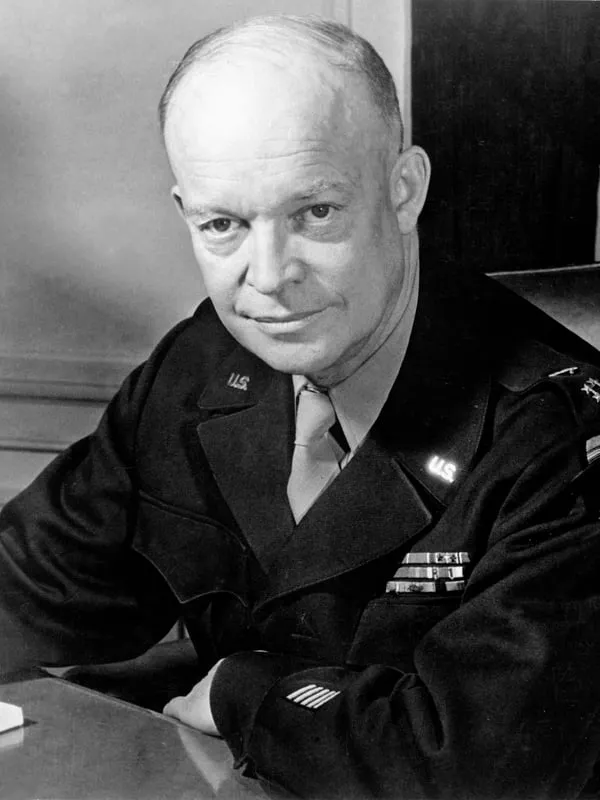
Dwight D. Eisenhower
Chief of the Operations Division (1942), commander of ETOUSA (1942), Supreme Commander, Allied Expeditionary Force (1944–1945), General of the Army (1944), President of the United States (1953–1961)
- Born:
- 14 October 1890, Denison (Texas, United States)
- Died:
- 28 March 1969, Washington, D.C.
- Author:
- Łukasz
- Photo:
- US Army Signal Corps, domena publiczna, Wikimedia Commons

Dwight David Eisenhower, known to everyone as “Ike”, was a soldier who had not commanded so much as a regiment in battle by the age of fifty, yet within three years of the Second World War he stood at the head of the largest coalition army in history. In June 1942 he arrived in London as a little-known major general, a staff officer from the War Department. In November that year he commanded the landing in North Africa, in 1943 the invasions of Sicily and Italy, and on 6 June 1944 the landing in Normandy. As Supreme Commander of the Allied Expeditionary Force he accepted Germany’s surrender at Reims on 7 May 1945. He was neither a great tactician nor a battlefield commander of the stamp of Rommel or Patton. His strength lay in his ability to reconcile people, nations and interests: he held together in a single command structure Americans, Britons, Canadians, Frenchmen and Poles, as well as generals many of whom could not stand him. After the war he was Army Chief of Staff, the first Supreme Allied Commander of NATO forces in Europe and, from 1953 to 1961, the 34th President of the United States.
Abilene and West Point
He was born on 14 October 1890 in Denison, Texas, the third of the seven sons of David Jacob Eisenhower and Ida Stover. He was christened David Dwight, but his mother reversed the order of his names to avoid confusion with his father. The family descended from German immigrants from the Palatinate who had settled in Pennsylvania in the 18th century, and belonged to a pacifist religious community, the River Brethren. In 1892 the Eisenhowers moved to Abilene, Kansas, which Dwight always regarded as his home town. His father worked at a creamery, the household was modest, and the sons earned their own keep from an early age.
After high school Eisenhower worked at the creamery and thought about going to college. He was too old for the Naval Academy at Annapolis, but in 1911 he passed the entrance examination for the Military Academy at West Point, where tuition was free. His mother accepted his choice with sorrow. At West Point he was an average student and a keen football player until a knee injury ended his sporting career. He graduated in 1915, 61st out of 164. His year later became known as “the class the stars fell on”: 59 of its graduates became generals, among them Omar Bradley.
The war he never saw
As a second lieutenant of infantry he was posted to Fort Sam Houston in Texas. There he met Mamie Doud, from a well-to-do Denver family, and married her on 1 July 1916. They had two sons: Doud Dwight, who died of scarlet fever in 1921 at the age of three – a loss Eisenhower called the greatest misfortune of his life – and John, born in 1922, later an officer and historian.
When the United States entered the First World War in April 1917, Eisenhower wanted to fight in France, but his superiors valued him as an instructor. In 1918 he commanded Camp Colt, a training camp for tank crews at Gettysburg, where several thousand men passed through training under his command. His orders to go to France were for November 1918. The armistice was signed a week before he was due to leave. For years Eisenhower felt like a soldier who had missed his war.
In 1919 he took part in a military motor convoy across the whole of the United States, which took almost two months and showed how dreadful American roads were. At Camp Meade he became friends with George Patton. Both wrote articles on the future of armoured forces, for which Eisenhower was told by his superiors that his views ran counter to infantry doctrine.
Years of learning
The greatest influence on his development was Brigadier General Fox Conner, under whom Eisenhower served as a staff officer in the Panama Canal Zone in 1922–1924. Conner, formerly chief of operations on John Pershing’s staff in France, gave him the military classics and works of history to read and argued that the next war would come, that it would be a coalition war and that one had to prepare for it. Thanks to his patronage Eisenhower got into the Command and General Staff School at Fort Leavenworth, from which he graduated first out of 245 students in 1926. He then completed the Army War College, and in 1927–1929 worked for the American Battle Monuments Commission under Pershing, for which he prepared a guide to the American battlefields of the First World War. This work took him to France for more than a year.
From 1929 he worked in Washington in the office of the Assistant Secretary of War on plans for industrial mobilisation, and from 1933 as an aide to the Army Chief of Staff, General Douglas MacArthur. He was at his side in July 1932 when troops drove out of the capital the veterans camped there to demand payment of their war bonuses; he regarded the operation as a mistake. In 1935 he went with MacArthur to the Philippines as his deputy in the advisory mission that was to build the army of the Philippine Commonwealth. He spent four years there, learned to fly and found his chief’s vanity ever harder to bear. A later quip is attributed to him that he had studied acting under MacArthur for seven years.
Rapid promotion
At the end of 1939, after the outbreak of war in Europe, Eisenhower returned to the United States and at last received a posting with troops: he served as an officer in the 15th Infantry Regiment, then as chief of staff of a division and of a corps. In June 1941 General Walter Krueger took him on as chief of staff of the Third Army. In September 1941 Krueger’s army won the great Louisiana Maneuvers, the largest exercise in the history of the US Army, and the press gave part of the credit to his chief of staff. At the beginning of October Eisenhower received the star of a brigadier general.
On 12 December 1941, five days after the attack on Pearl Harbor, the Army Chief of Staff, General George Marshall, summoned him to Washington and asked him what should be done in the Pacific. After a few hours Eisenhower replied that the Philippines could not be held, but that everything possible had to be done to prolong their defence, and that a base should be built up in Australia. Marshall liked the answer. In February 1942 he put Eisenhower in charge of the War Plans Division, renamed the Operations Division in March after the reorganisation of the army, and promoted him to major general. Eisenhower consistently argued for the “Germany first” strategy agreed with the British at the Arcadia Conference and for concentrating forces in Britain for an invasion of France. His memorandum of March 1942 formed the basis of the Bolero and Roundup plan that Marshall presented in London in April.
London and North Africa
In May 1942 Marshall sent him to England on an inspection tour, and in June appointed him commander of American forces in Europe. On 24 June Eisenhower flew into London and took command of the European Theater of Operations, US Army. On 7 July he was promoted to lieutenant general. When in July the Allies gave up a landing in France in 1942 in favour of one in North Africa, Eisenhower thought it a mistake, but in August he became Commander-in-Chief of Operation Torch. On 8 November 1942 American and British troops landed in Morocco and Algeria. Eisenhower directed them from his headquarters in the tunnels of Gibraltar.
North Africa was his school of war and politics. To stop the resistance of the Vichy forces, his deputy, General Mark Clark, with his approval, made an agreement with Admiral François Darlan, until then a collaborator of the Germans, who became High Commissioner for North Africa. The “Darlan deal” caused outrage in Britain and the United States; it ended with the admiral’s assassination in December 1942, and power passed to General Henri Giraud. In February 1943 the American II Corps suffered a heavy defeat in Tunisia at the Kasserine Pass. Eisenhower learned from it, removed incompetent commanders and gave the corps to Patton. In May 1943 the Axis forces in Tunisia surrendered, and, by various estimates, between 230,000 and 250,000 German and Italian soldiers were taken prisoner.
In July 1943 Eisenhower commanded the invasion of Sicily, and in September the landing in Italy, preceded by the announcement of an armistice with the government of Marshal Pietro Badoglio. He learned to run a combined headquarters in which British commanders of the land, naval and air forces worked under an American commander: General Harold Alexander, Admiral Andrew Cunningham and Air Chief Marshal Arthur Tedder.
Overlord
In December 1943 Franklin Delano Roosevelt, who did not want to part with Marshall in Washington, chose Eisenhower as Supreme Commander for the invasion of France. In January 1944 Eisenhower arrived in London and took charge of Supreme Headquarters Allied Expeditionary Force (SHAEF). His deputy was Tedder; the ground forces in the first phase were commanded by General Bernard Montgomery, the naval forces by Admiral Bertram Ramsay and the tactical air forces by Trafford Leigh-Mallory. Against the resistance of the strategic bomber commanders, among them Arthur Harris, Eisenhower won his case that before the invasion the bombers should strike at the French railway network.
He took the hardest decision of all on the evening of 4 June and the morning of 5 June 1944: on the strength of the meteorologists’ forecast of a brief break in the stormy weather, he gave the order to launch Operation Overlord. He also prepared a note in case of failure, in which he took all the blame on himself. On 6 June the Allies landed in Normandy. After the breakout and the battle of the Falaise Pocket, Allied forces liberated Paris in August, and on 1 September Eisenhower took personal command of the ground forces.
In the autumn of 1944 he fought the fiercest disputes of his career. Montgomery demanded that all forces be concentrated in a single thrust in the north; Eisenhower chose an advance on a broad front. He agreed to Operation Market Garden, in which the Polish 1st Independent Parachute Brigade fought and which ended in defeat at Arnhem. In December the German Ardennes offensive took his intelligence by surprise, but Eisenhower quickly sent reserves to the threatened area and ordered Patton to strike from the south. On 20 December 1944 he received the newly created five-star rank of General of the Army.
The end of the war in Europe
In the spring of 1945 Allied forces crossed the Rhine and encircled the Ruhr. At the end of March Eisenhower, without consulting the British, wrote to Joseph Stalin that his main objective was not Berlin but a junction with the Red Army in central Germany. Winston Churchill was outraged, but Eisenhower believed that Berlin lay in the future Soviet occupation zone and that taking it would cost tens of thousands of casualties. On 12 April 1945, with Bradley and Patton, he visited the liberated camp at Ohrdruf, a subcamp of Buchenwald. He ordered that soldiers, journalists and politicians should see the camps, because he wanted to make sure that no one in the future could claim that the accounts of the crimes were propaganda.
On 7 May 1945, at his headquarters in Reims, General Alfred Jodl signed the unconditional surrender of Germany. Eisenhower did not meet Jodl at the signing and received him only afterwards. In his signal to Washington he wrote simply that “the mission of this Allied force was fulfilled”. After the war he commanded the American occupation zone in Germany and sat on the Allied Control Council together with Marshal Georgy Zhukov, with whom he was on good terms.
General and president
In November 1945 he succeeded Marshall as Army Chief of Staff and oversaw the army’s demobilisation. In 1948 he left active service and became president of Columbia University, and his war memoirs, Crusade in Europe, became a bestseller. At the turn of 1950 and 1951 President Harry Truman appointed him the first Supreme Allied Commander of NATO forces in Europe.
Both parties courted him as a presidential candidate. In 1952 he accepted the Republican nomination and defeated the Democrat Adlai Stevenson, with Richard Nixon as his vice-president. He served two terms, from 1953 to 1961. He ended the Korean War with an armistice in July 1953, did not send troops to Indochina in 1954, in 1956 forced Britain, France and Israel to withdraw from Egypt during the Suez Crisis, and made no attempt to stop the Soviet crushing of the Hungarian uprising by force. He based his security policy on nuclear deterrence and covert CIA operations. At home he built the network of interstate highways, modelled in part on the German autobahns he had seen in 1945, and in 1957 he sent troops to Little Rock to secure Black pupils’ admission to school. In his farewell address in January 1961 he warned Americans against the growing influence of the military–industrial complex.
After his presidency he lived on his farm near Gettysburg. He died on 28 March 1969 at Walter Reed Army Hospital in Washington after a series of heart attacks. He was buried in Abilene.
Significance
Eisenhower was the most important coalition commander of the Second World War. He won no battle through a brilliant manoeuvre, and not all his decisions have stood the test of time: critics point to the Darlan deal, his caution in Italy, the broad-front advance and the decision not to go for Berlin. British generals, especially Montgomery and the Chief of the Imperial General Staff, Alan Brooke, regarded him as a poor strategist. Yet his greatest achievement was something that in the First World War had not been built until its last months: an integrated Allied command in which Americans and Britons fought as a single army. Churchill argued with him many times but trusted him to the end. The road from a modest staff officer from Kansas who arrived in London in June 1942 as a general nobody had heard of to the victor over the Third Reich and President of the United States was one of the most remarkable careers of the war.
Sources
Commanded in battles
(08)- 8–16 November 1942Operation TorchMediterranean
- 17 November 1942 – 13 May 1943Tunisian campaignMediterranean
- 14–24 February 1943Battle of the Kasserine PassMediterranean
- 10 July – 17 August 1943Allied invasion of SicilyMediterranean
- 9–16 September 1943Battle of SalernoMediterranean
- 6 June – 30 August 1944Battle of NormandyWestern Front
- 16 December 1944 – 25 January 1945Battle of the BulgeWestern Front
- 7–31 March 1945The Rhine crossingsWestern Front
Mentioned in battles
(14)Often appears with
People who appear in the same events.
On the timeline
(166)The 40 most important of 166 events. All tagged “Dwight D. Eisenhower” (35) →
1932
1939
1940
1941
1942
1943
1944
1945
March
April
May
- 08
- Key eventVictory in Europe DayOn 8 May 1945 the West celebrated Germany's surrender in London, Paris and New York. The guns fell silent at 11.01 p.m.; in Poland, joy was clouded by doubt.
- Key eventThe surrender at KarlshorstOn 8 May 1945 in Berlin-Karlshorst, Keitel, Friedeburg and Stumpff signed Germany's final act of unconditional surrender before Zhukov and Tedder.