The Borneo campaign
- Dates:
- 1 May – 15 August 1945
- Front:
- Pacific
- Location:
- Borneo and its offshore islands – Tarakan off the north-east coast of Dutch Borneo, Labuan island and the shores of Brunei Bay in North Borneo, Brunei and Sarawak (Miri, Lutong, Beaufort), Balikpapan on the Makassar Strait in eastern Borneo; inland, the route of the death marches from Sandakan to RanauOn the battle map →
- Sides:
- Australia, the United States and the NetherlandsDouglas MacArthur, Thomas Blamey, Leslie MorsheadJapanMasao Baba
- Result:
- Allied victory. The Australian I Corps captured Tarakan, Labuan, the shores of Brunei Bay and Balikpapan, and fighting inland went on until Japan's surrender. According to Australian tabulations the Allies lost about 2,100 killed and wounded in all (including some 570 Australians killed) and the Japanese about 4,700 killed; by the same estimates more than 1,800 more died fighting the guerrillas. The Tarakan airfield was not restored in time, and historians still dispute the purpose of the whole campaign.
- Author:
- Łukasz
Name and dates
The Borneo campaign is the name given to a series of Allied amphibious and land operations on Borneo and the surrounding islands, conducted from 1 May to 15 August 1945. They were carried out chiefly by the Australian I Corps under Lieutenant General Leslie Morshead, supported by American and Australian naval and air forces. The whole undertaking bore the code name Oboe: the plan provided for six successive phases, of which three were carried out – Oboe One (Tarakan), Oboe Six (Labuan and Brunei Bay) and Oboe Two (Balikpapan). The numbering therefore does not match the order of events: “Six” came before “Two”.
The starting date is set by the landing on Tarakan island on the morning of 1 May 1945 (preceded on 30 April by the landing of commandos and an artillery battery on the neighbouring islet of Sadau). The end is taken to be 15 August 1945, when Emperor Hirohito announced the acceptance of the surrender terms and the Australian units halted offensive operations. The large landings were over by July, but skirmishes with scattered Japanese units on Tarakan, in North Borneo and in the interior beyond Balikpapan continued until the very last days of the war. The formal surrender of the Japanese forces on Borneo did not take place until September.
The campaign is also called the “second Battle of Borneo” (the first being the Japanese invasion of 1941–1942). It was the Australian Army’s last major land operation of the Second World War and also one of the last great amphibious operations of the Pacific War. The landing at Balikpapan on 1 July 1945 is sometimes described as the last major Allied amphibious operation of the war.
The campaign remains in the shadow of the simultaneous battles for Okinawa and Luzon, and in Australia itself it is remembered in two ways: as a skilfully executed combined operation and as an example of fighting that – in the view of many historians – did little to change the course of the war.
Background
Before the war Borneo was divided between two colonial empires. The north belonged to the British and was made up of North Borneo, administered by a chartered company, Sarawak, ruled by the Brooke dynasty of “White Rajahs”, the sultanate of Brunei and the island of Labuan. The south and east formed part of the Dutch East Indies. The island was sparsely populated – about three million inhabitants – covered in jungle and almost without roads; most traffic moved by river. Its importance lay in oil: the fields at Miri and Seria in the north, on Tarakan island and around Balikpapan, with its large refinery, yielded crude so pure that it could, if need be, be poured into warships’ tanks with almost no refining.
It was this oil that the Japanese reached for at the start of the Pacific War. On 16 December 1941 they landed at Miri and Seria, and in January 1942 on Tarakan and at Balikpapan, as part of the Dutch East Indies campaign. The Dutch garrisons managed to destroy some of the oil installations, for which the Japanese took revenge on prisoners and civilians; at Balikpapan between 80 and 100 Europeans were murdered. Japanese engineers quickly restored production, however, and until 1944 Borneo was one of the main sources of fuel for the Imperial Navy. For the inhabitants this meant forced labour, requisitions and hunger. In October 1943 a revolt by the Chinese and local population in Jesselton (today Kota Kinabalu) was bloodily suppressed.
From 1942 Australian and British prisoners of war captured in Singapore were also held in North Borneo, in a camp at Sandakan. They built a military airfield, working on starvation rations and beaten by the guards. In the summer of 1943 most of the officers were moved to Batu Lintang camp near Kuching, and conditions for those left behind grew even worse.
By 1945 the strategic situation had been completely reversed. The Americans were retaking the Philippines, submarines and aircraft were sinking tankers, and the Japanese garrisons in the Dutch East Indies had been cut off from the home islands. On 27 January 1945 the Japanese General Staff instructed these forces to defend the territory they held without counting on reinforcements. Borneo had ceased to be a source of oil for Japan, because the oil could no longer be shipped home.
The Australian Army, for its part, had a political problem. Its best formations – veterans of North Africa and New Guinea from the 7th and 9th Divisions – had not been in action for more than a year. General Douglas MacArthur, who since March 1942 had commanded the South West Pacific Area from Australia, had kept them out of the fighting in the Philippines, although the government of Prime Minister John Curtin had pressed for their inclusion. The remaining Australian divisions were meanwhile engaged in gruelling fighting on Bougainville, on New Britain and in the Aitape–Wewak area.
Plans and forces
The plan to recapture Borneo was drawn up at MacArthur’s headquarters around the turn of 1944 and 1945 as part of the wider Operation Montclair, which was to cover the southern Philippines and the whole of the Dutch East Indies. The six phases of Oboe envisaged, in turn: Tarakan (1), Balikpapan (2), Banjarmasin (3), Surabaya or Batavia on Java (4), the eastern part of the Dutch East Indies (5) and North Borneo (6). Tarakan was to provide an airfield for fighters covering the subsequent landings, Brunei Bay a base for the British Pacific Fleet, and the oilfields fuel for the Allies. MacArthur also argued that the operation would raise Allied prestige in the region and allow the Dutch administration to be restored. Some historians, among them David Horner, believe that his main aim was to show the Dutch government that he had tried to recover its territory.
The Australian high command did not share this enthusiasm. The Commander-in-Chief of the Australian Military Forces, General Thomas Blamey, advised in particular against the landing at Balikpapan, which in his view had no strategic significance whatsoever. After long hesitation, however, the government in Canberra gave way to MacArthur’s insistence. Blamey did manage to persuade Prime Minister Curtin not to release the 6th Division for the planned landing on Java – and so the further phases of Oboe collapsed.
Morshead’s Australian I Corps was assigned to the campaign with two experienced infantry divisions: the 7th (Major General Edward Milford) and the 9th (Major General George Wootten). The corps was directly subordinate to MacArthur as an independent force, not to the US Eighth Army fighting in the Philippines. More than 74,000 Allied servicemen took part in the first landings. Naval support was provided by Admiral Thomas Kinkaid’s US Seventh Fleet – including the amphibious forces of Rear Admirals Forrest Royal and Albert Noble – together with ships of the Royal Australian Navy and the Dutch navy, and air support by the Australian First Tactical Air Force of the RAAF and the US Thirteenth Air Force, operating from Morotai and the Philippines. The Americans also supplied most of the shipping and supplies without which the Australians could not have moved. Small detachments of the Dutch colonial army (KNIL) took part in the landings, among them a company of Ambonese soldiers under Dutch officers, as did Dutch civil administration units (NICA).
On the Japanese side, northern and western Borneo were defended by Lieutenant General Masao Baba, from late 1944 commander of the 37th Army, with his headquarters at Jesselton. The Japanese had begun preparing their defences in mid-1944. Expecting a landing in the Brunei area and an advance along the west coast towards Singapore, they moved most of their troops from north-eastern Borneo westwards on foot – in exhausting marches through mountains and jungle. The east and south, formerly Dutch Borneo, came under the navy: Balikpapan was defended by Rear Admiral Michiaki Kamada’s 22nd Special Base Force together with part of the 71st Independent Mixed Brigade. Allied intelligence estimated the total Japanese strength on Borneo at around 32,000 men, of whom 15,000 were combat troops. Many were garrison soldiers, poorly armed and undernourished for months, but they were dug in in tunnels, bunkers and on hills, with large numbers of mines and booby traps.
Tarakan (1 May – June)
The first objective was Tarakan – a small, swampy island off the north-east coast of Borneo with the Djoeata oilfield and an airfield. The landing was entrusted to the Australian 26th Brigade of the 9th Division, commanded by Brigadier David Whitehead and reinforced by two pioneer battalions, commandos, engineers, an American amphibian tractor battalion and a Dutch infantry company – nearly 12,000 men in all, including almost a thousand Americans and Dutch. The island was held by some 2,200 Japanese: Major Tadao Tokoi’s 455th Independent Infantry Battalion and naval units.
From 12 April RAAF and American aircraft bombed the island from Morotai and the Philippines, destroying the airfield, the batteries and the town; the civilian population suffered as well – according to Australian findings, the pre-landing bombing alone caused at least a hundred civilian casualties. For several days minesweepers cleared the approaches. On 30 April commandos and an artillery battery landed on the islet of Sadau, from where the next day they supported the engineers clearing obstacles from the Lingkas beaches.
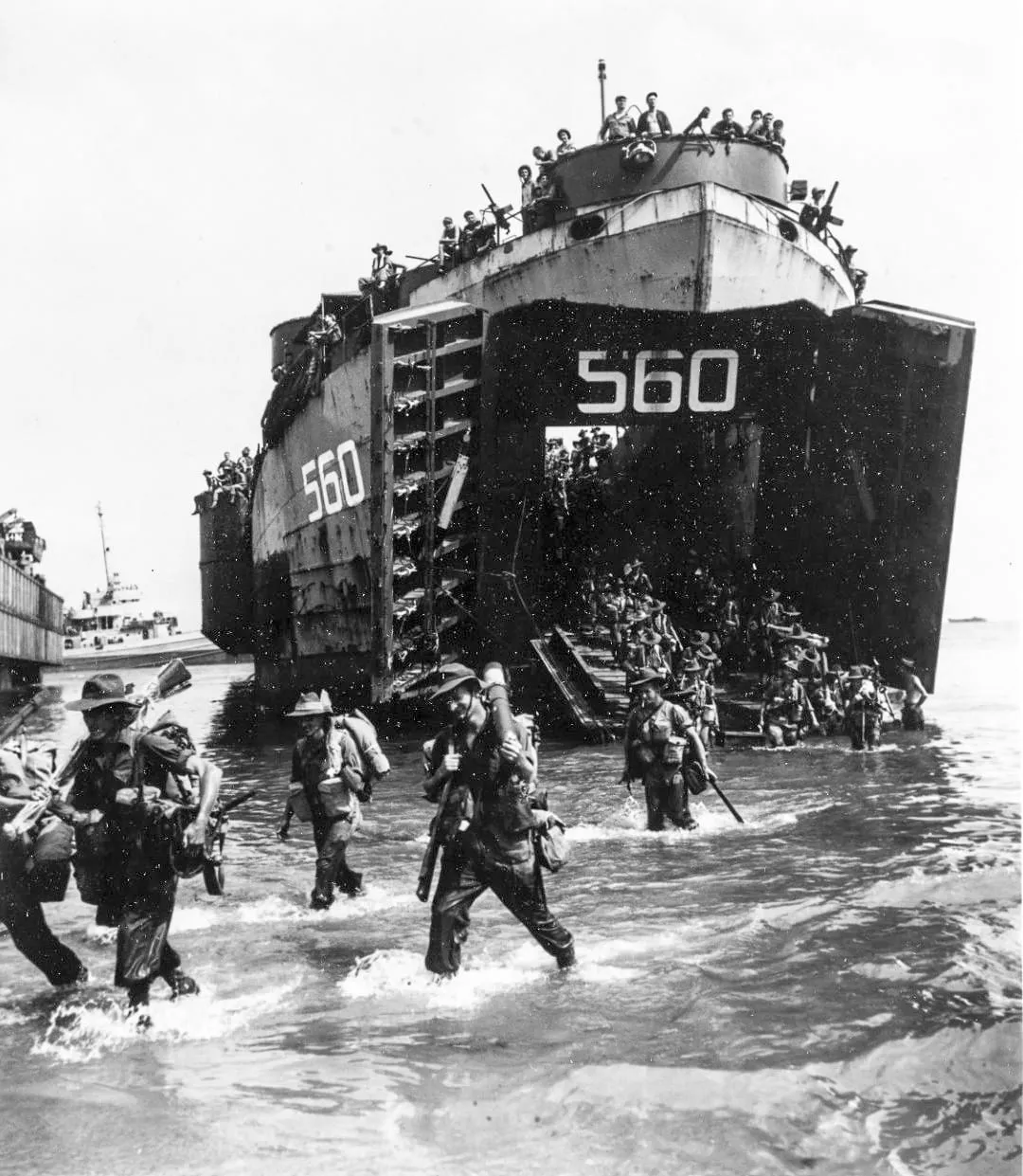
On the morning of 1 May 1945, covered by the fire of three cruisers and seven destroyers, the 2/23rd and 2/48th Battalions went ashore. At first they met no resistance and by evening had established a firm beachhead. Then resistance stiffened: the Japanese withdrew to the wooded hills in the interior of the island, densely mined and honeycombed with tunnels. The Australians took the airfield on 5 May, but the fighting for successive hills – given code names before the landing – dragged on for weeks. On 12 May Corporal John Mackey was killed while single-handedly capturing three Japanese machine-gun posts; he was posthumously awarded the Victoria Cross. The last important strongpoint, Hill 90, fell on 20 June, and on 21 June the island was declared secure, although smaller clashes continued until the end of the war and some 300 Japanese hid in the jungle until the surrender.
The main aim of the operation was not achieved. The airfield was so badly damaged by bombing and so waterlogged that repairing it took eight weeks; it was opened only on 28 June and was fully ready when the war was practically over. It could not therefore support the landings in North Borneo or at Balikpapan. According to the Australian official history, 225 Australians were killed on Tarakan (some tabulations give more than 250) and 669 wounded; the Japanese lost 1,540 killed and 252 taken prisoner. The official historian Gavin Long, and most scholars after him, concluded that the capture of the island was not worth these losses.
Labuan and Brunei Bay (10 June – August)
The second phase, Oboe Six, was carried out by the rest of General Wootten’s 9th Division: the 20th and 24th Brigades, some 29,000 men in all together with air force and rear-echelon units, of whom just over a thousand were Americans and British. They were covered by a force of Australian and American warships under Rear Admiral Royal. On the morning of 10 June 1945 the 24th Brigade landed on Labuan island at the entrance to Brunei Bay, and the 20th Brigade on the coast of Brunei. MacArthur watched the landing from the deck of a cruiser and went ashore that same day. The Japanese kept away from the beaches, so the landings were made almost without loss.
On Labuan the 24th Brigade quickly took the airfield and the town, but the rest of the garrison – several hundred men – dug in in a fortified position on wooded ridges inland. The first attack by the 2/28th Battalion on 16 June brought heavy losses; the position was then shelled for several days by ships, guns and aircraft, and on 21 June the battalion, with Matilda tanks, destroyed the defenders. The fighting on Labuan cost the Australians 34 killed and 93 wounded; 389 Japanese dead were counted and 11 were taken prisoner. In North Borneo, in the fighting at Beaufort on 28 June, Private Tom Starcevich of the 2/43rd Battalion single-handedly captured several machine-gun posts, for which he received the Victoria Cross.
The 20th Brigade took the town of Brunei on 13 June and advanced south-west along the coast towards the oilfields of Seria and Miri; on 20 June the 2/13th Battalion landed at Lutong. The Japanese withdrew, setting oil wells on fire as they went – dozens of wells burned at Seria for many weeks and were later extinguished by Australian engineers. The 24th Brigade crossed the bay and from Weston pushed inland along the only railway line towards Beaufort. The heaviest fighting on the mainland took place at Beaufort on the night of 27–28 June, when more than a hundred Japanese were killed. After that the Australians, under orders to avoid unnecessary casualties, advanced cautiously, covering the infantry with artillery and aircraft, and halted on the Beaufort–Tenom railway line. Skirmishes nevertheless continued into August: as late as 3 August the Japanese counter-attacked positions of the 2/28th Battalion.
The operations in North Borneo were also the Australian Army’s largest civil undertaking of the war. The 9th Division fed thousands of starving inhabitants, set up hospitals and rebuilt ruined towns.
Guerrillas in the interior
The landings were prepared and supported by covert parties of Special Operations Australia: Agas in North Borneo and Semut in Sarawak. More than a hundred men of Semut, mostly Australians parachuted in from March 1945, organised their own guerrilla bands, several hundred warriors strong, among the Dayaks – peoples who hated the occupiers for their requisitions and violence. They were supplied by Australian naval craft and RAAF aircraft. The guerrillas attacked Japanese posts along the rivers and ambushed columns withdrawing from the coast into the interior. According to Australian estimates they killed more than 1,800 Japanese in North Borneo and Sarawak (some studies give lower figures). The Agas parties in North Borneo achieved less: they gathered intelligence of varying value and played a limited part in the fighting.
One of the Agas parties also reconnoitred the Ranau area at the request of I Corps headquarters, because reports of the Sandakan prisoners had been reaching the Australians. Earlier, at the beginning of 1945, Operation Kingfisher had been considered – a parachute landing intended to free the prisoners. The plan stalled in the spring of 1945 because of mistaken or incomplete intelligence, and a later, erroneous report that there were no longer any prisoners in the camp finally killed it. After the war Blamey and other Australian officers blamed MacArthur for the lack of transport aircraft; most historians, however, believe that the operation was never close to being carried out.
Balikpapan (1 July – August)
The third and last phase was Oboe Two – the landing at Balikpapan, the main centre of the oil industry in eastern Borneo. The area of the town was defended by Rear Admiral Kamada’s garrison: according to various estimates between 8,400 and 10,000 men, of whom only 3,100–3,900 were combat troops, with strong coastal batteries and a network of tunnels in the hills. The landing fell to General Milford’s 7th Division – for the first time in the war it fought complete, with all three of its brigades (the 18th, 21st and 25th). Together with supporting units, 33,000 men were assigned to the operation, 21,000 of them from the division.
Preparations lasted almost three weeks: aircraft bombed the area for 20 days, and for 15 days minesweepers cleared the waters of mines under fire from Japanese batteries; three of them were sunk. Because the airfield on Tarakan was still not operational, air cover was provided by aircraft from the southern Philippines. Rear Admiral Noble’s invasion force sailed from Morotai on 26 June, and from 29 June Australian, American and Dutch warships fired more than 45,000 shells at the coast. Feint preparations at Manggar were intended to mislead the Japanese about the landing site.
On the morning of 1 July 1945 three battalions – the 2/10th, 2/12th and 2/27th – landed on the beaches between Klandasan and Stalkoedo, south of the town. Smoke from the bombardment hampered navigation and some units came ashore in the wrong places, but the landing met no opposition and the beachhead expanded quickly. MacArthur again watched the landing from a ship and went ashore. This landing is sometimes regarded as the last major Allied amphibious operation of the Second World War.
The 18th Brigade, attacking to the left, took the hills around Klandasan and, on 3 July, the town and port; mopping up took another day. The 21st Brigade advanced east along the coast towards the airfields at Sepinggang and Manggar and ran into strong resistance: the coastal batteries and mortars defending Manggar held it up for several days until some of the guns had been captured and the defenders crushed by air strikes and naval gunfire. The 25th Brigade, landed on 2 July, pushed inland along a road the Australians called the “Milford Highway” towards Batuchampar, where Kamada had placed his headquarters and one of his battalions. By 4 July both airfields had been taken, and by 9 July the forward Japanese battalions had been destroyed.
The Japanese fought a delaying defence: with mines, booby traps, snipers, night raids and fighting in tunnels. Australian engineers neutralised more than 8,000 mines and booby traps and destroyed more than a hundred tunnels. At Batuchampar the Japanese rearguard fell back to a second position on 9 July and, on the night of 21–22 July, further inland before the Australians could encircle it. By the end of July organised resistance had died out, but patrols pursued the retreating units in the hills until the end of the war. According to Australian figures, the capture of Balikpapan cost 229 killed and 634 wounded; the Japanese lost 2,032 killed and 63 taken prisoner.
The Sandakan death marches (January – August)
The most tragic chapter of these months was played out far from the landing beaches. In January 1945 some 1,900 Australian and British prisoners were still alive in the Sandakan prisoner-of-war camp. When Allied aircraft destroyed the airfield they had been building and a landing seemed imminent, the camp commandant, Captain Susumu Hoshijima, decided to move them west to Ranau at the foot of Mount Kinabalu, some 260 kilometres away through swamp, jungle and mountains. He later claimed that he had been carrying out an order from General Baba, commander of the 37th Army.
The first groups – some 470 prisoners judged the fittest, who were to carry the baggage of Japanese battalions – set off between 28 January and March, with four days’ rations for a journey lasting nine. Anyone who collapsed from exhaustion was killed or left to die. The second march, of about 536 prisoners in groups of fifty, set off on 29 May on the orders of the new commandant, Captain Takuo Takakuwa; it lasted 26 days and 183 men reached Ranau. There they found only six prisoners from the first marches still alive. In June the 75 weakest prisoners were also driven out onto the track; none of them got more than 50 kilometres – those who fell were finished off. Those left behind at Sandakan died of starvation and disease or were murdered.
At the end of July 38 prisoners, too weak to work, were still alive at Ranau. An order was received to kill them; the guards carried it out in August, probably even after Japan’s surrender had been announced. According to Australian findings, accepted by the Australian War Memorial among others, some 2,400 prisoners died on the Sandakan death marches and in the Sandakan and Ranau camps – roughly 1,800 Australians and 640 Britons (the figure most often given is 2,434 victims). Six Australians survived, all of them by escaping: Owen Campbell and Richard Braithwaite got away during the second march, and Nelson Short, William Sticpewich, Keith Botterill and William Moxham from Ranau in July. Local people hid and fed them at the risk of their own lives. In Australia this crime is regarded as the worst ever suffered by Australian servicemen in the Second World War; it is compared with the Bataan Death March, but at Sandakan only six of some 2,500 prisoners survived.
After the war the camp commandants were tried before Australian military courts at Labuan and Rabaul: Hoshijima and Takakuwa were executed in 1946. General Baba was convicted at Rabaul for his responsibility for the marches and executed in 1947. The memory of Sandakan still shapes the Australian view of the Borneo campaign: some critics have asked whether a quicker landing in North Borneo or a rescue operation might have saved at least some of the prisoners.
Losses
The casualty figures come mainly from the Australian official history and for the Japanese side are approximate, being based on body counts after the fighting. According to these tabulations, some 570 Australians were killed in the three main operations: 225 on Tarakan, about 115 in North Borneo (including 34 on Labuan) and 229 at Balikpapan. Total Allied losses – killed and wounded, including American sailors, airmen and engineers and Dutch soldiers – are estimated at about 2,100. The Japanese lost about 4,700 killed in these operations (1,540 on Tarakan, about 1,200 in North Borneo and 2,032 at Balikpapan); only a few hundred were taken prisoner before the surrender. To these must be added the losses inflicted by the guerrillas in the interior, by Australian estimates more than 1,800 killed, and the thousands of Japanese soldiers who died of starvation and disease on the marches through the jungle.
No one has accurately counted the civilian victims. The bombing that preceded the landings ruined Tarakan, Balikpapan, Labuan and the towns around Brunei Bay. It is estimated that around 16 per cent of the population of North Borneo died during the three years of occupation – from reprisals, forced labour, hunger and disease.
The dispute over the campaign’s purpose
Even in 1945 the campaign raised doubts in Australia, and after the war it became one of the examples of the so-called “unnecessary campaigns” – alongside the fighting on Bougainville, on New Britain and in the Aitape–Wewak area. Critics pointed out that the Japanese garrisons on Borneo were cut off from Japan, could threaten no one and could not ship oil home, and so did not need to be attacked. The British historian Max Hastings wrote that any rational strategic assessment would have left them to themselves, watched by small forces, until Japan’s defeat. The official historian Gavin Long judged the capture of Tarakan not worth the losses incurred, and Peter Dennis assessed the whole of Oboe as operations of “doubtful strategic value” but “skilfully executed”. Most of the objectives were not achieved: the Tarakan airfield was not ready in time to support anything, the fleet made no use of Brunei Bay, and the wrecked oilfields produced no fuel before the end of the war.
Defenders of the campaign drew attention to its other consequences. The landings further isolated the Japanese forces in the Dutch East Indies and deprived Japan of oil and rubber, and in North Borneo they brought liberation to a starving population and help that no one else could have given. The surviving prisoners and interned civilians in Batu Lintang camp near Kuching were also freed (though only after the surrender). Militarily, as the Australian historian Eustace Keogh wrote, the operations were the most successful element of the whole undertaking: the largest landings the Australians carried out in the war demanded complex cooperation between the land, naval and air forces of several nations, and they went smoothly. The cautious style of command – with orders to spare the troops and heavy fire support – was moreover a response to the awareness that the war was drawing to a close.
Surrender
When the Emperor announced the end of hostilities on 15 August 1945, Australian patrols were still combing the jungle for stragglers. More than 21,000 Japanese soldiers and civilians still remained in North Borneo. At the beginning of September Rear Admiral Kamada surrendered at Balikpapan to the headquarters of General Milford’s 7th Division, and on 10 September General Masao Baba surrendered the 37th Army to General Wootten on Labuan, at a spot now marked by a plaque. The Pacific War was formally ended by the Japanese Instrument of Surrender, signed on 2 September 1945 in Tokyo Bay, at which Australia was represented by General Blamey. Australian brigades served as occupation troops on Borneo until early 1946, and the 21st Brigade accepted the surrender of the Japanese forces at Makassar on Celebes.
Significance
The Borneo campaign was Australia’s last great military effort of the Second World War and one of the last series of major Allied landings of the war. It showed how far the break-up of the Japanese empire had already gone by 1945: garrisons cut off from the home islands, without a navy or air force, could only inflict casualties, hold out in tunnels and wait for the end. The dispute over its purpose – whether it was worth paying with soldiers’ lives for objectives that had lost their significance in the face of Japan’s imminent surrender – continues in Australian historiography to this day and is bound up with the wider question of the role MacArthur assigned to the Australians in the last year of the war.
The campaign also had consequences that reached beyond the war. The reconstruction of North Borneo and Sarawak under Australian military administration preceded the transformation of both territories into British Crown colonies in 1946 and, in the longer run, their inclusion in Malaysia. The Seria oilfields, restored after the fires of 1945, became the foundation of Brunei’s wealth. In former Dutch Borneo, the return of the Dutch administration, brought back by Australian troops, became entangled in the struggle for Indonesian independence, proclaimed on 17 August 1945. Finally, the memory of Sandakan and Ranau – a crime that the Allied landings came too late to prevent – has remained one of the most painful chapters of Australian military history, commemorated among other places at Kundasang at the foot of Mount Kinabalu.