1941–1942: The Japanese offensive in the Pacific
Dutch East Indies campaign
- Dates:
- 11 January – 9 March 1942
- Front:
- Pacific
- Location:
- The Dutch East Indies (present-day Indonesia): Dutch Borneo (Tarakan, Balikpapan), Celebes, Ambon, Sumatra, Bali, Timor and Java, together with the Java Sea and the Sunda StraitOn the battle map →
- Sides:
- JapanHitoshi Imamura, Ibō TakahashiNetherlandsHein ter Poorten, Karel DoormanABDA Command: United Kingdom, United States and AustraliaArchibald Wavell
- Result:
- Japanese victory. On 8 March 1942 at Kalidjati the Japanese demanded unconditional surrender, and on 9 March the KNIL accepted it and laid down its arms. More than 80,000 Allied soldiers were taken prisoner, and Japan seized the oil for which it had gone to war.
- Author:
- Łukasz
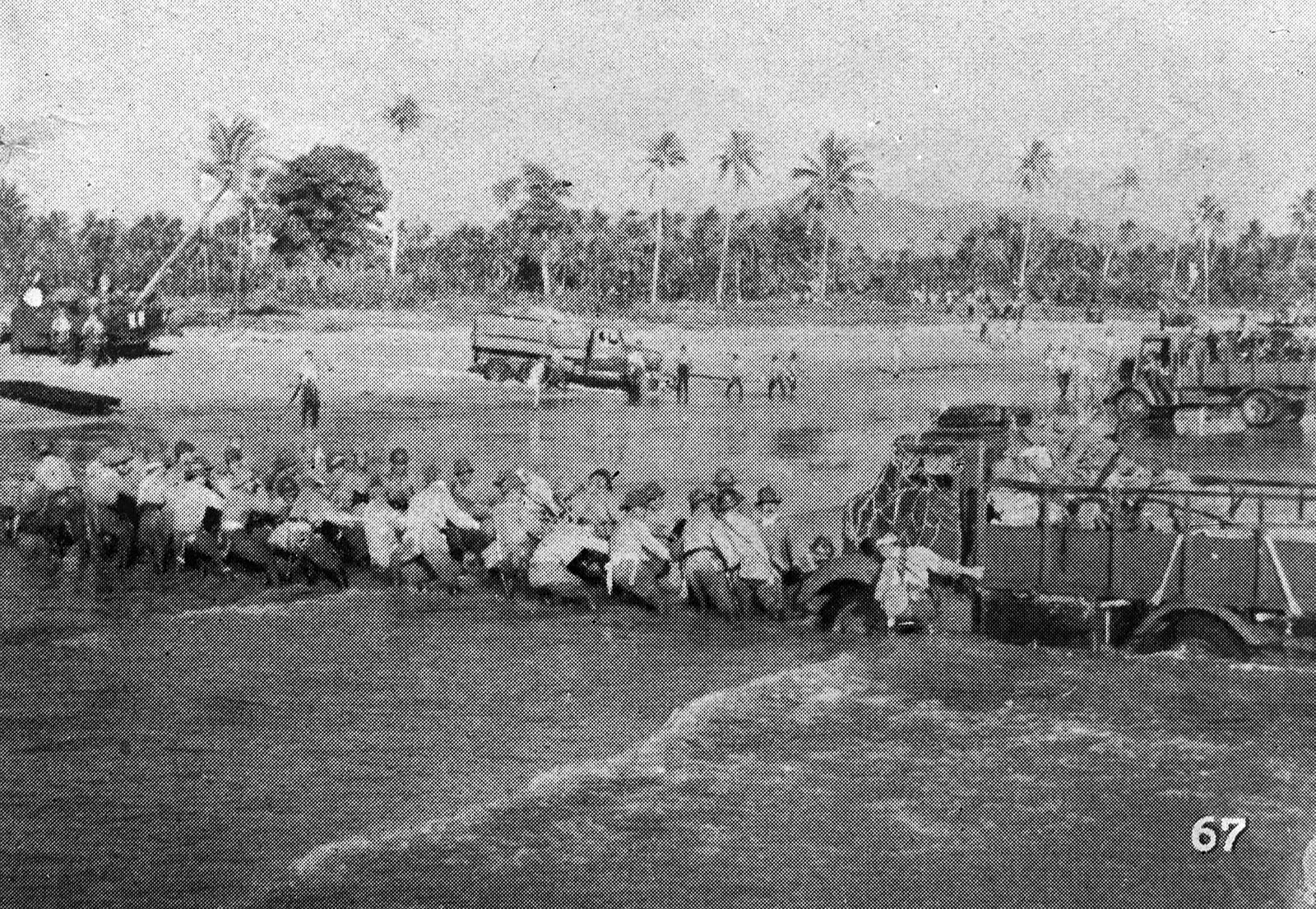
In the early hours of 11 January 1942 Japanese soldiers landed on Tarakan, a small, swampy island off the east coast of Borneo with several hundred oil wells, and a few hours later at the northern tip of Celebes (Sulawesi), near Manado, where for the first time in Japan’s history paratroopers jumped into battle. That same day Tokyo, which had never handed the Dutch a formal declaration of war, announced that a state of war existed between the two countries. So began the campaign for which the Empire had taken up arms in the first place: the conquest of the Dutch East Indies, one of the largest oil producers in the world. It lasted less than two months. The Japanese advanced in three columns, from airfield to airfield, leaping from island to island. The Allies, united for the first time in this war under a joint command, were unable to stop them either on land or at sea. On 27 February Rear Admiral Karel Doorman’s squadron lost the Battle of the Java Sea, on 1 March the Japanese landed on Java, and on 8 and 9 March the Dutch colonial army laid down its arms. Three hundred years of Dutch rule over the archipelago came to an end within a few weeks.
Name and dates
The fighting is generally known as the Dutch East Indies campaign; in Dutch literature it is often called simply the “Battle of Java” or, more broadly, the war against Japan (de strijd tegen Japan). The campaign has no single, generally accepted starting date. Some historians include the Japanese landing in British Borneo on 16 December 1941, because the operation against Sarawak and Brunei was the first step towards the Dutch oilfields, and the Dutch fought there alongside the British from the outset. Others take 11 January 1942 as the start: the day of the first landings on Dutch territory, at Tarakan and near Manado, and also the day on which Japan declared that it was at war with the Netherlands (12 January Tokyo time, according to Japanese sources). There was no formal declaration of war: the Imperial Rescript of 8 December had left out the Netherlands. The Netherlands had proclaimed a state of war with Japan as early as 8 December 1941, and its ambassador delivered a note to that effect in Tokyo on 10 December, but Tokyo deliberately delayed its response for more than a month, hoping that the Dutch would not destroy their oil installations in advance.
The campaign is taken to have ended on 9 March 1942. On 8 March the Governor-General, Alidius Tjarda van Starkenborgh Stachouwer, and the army commander, Lieutenant General Hein ter Poorten, presented themselves at Kalidjati airfield, now in Japanese hands, where the commander of the Japanese 16th Army demanded unconditional surrender. Ter Poorten accepted it on 9 March; Dutch radio announced a ceasefire and the troops laid down their arms. The British, Australians and Americans on Java formally signed the surrender in Bandung on 12 March. The fighting did not stop everywhere, however: in northern Sumatra Dutch units held out until 28 March, and on Timor Australian commandos waged a guerrilla war until early 1943.
Background
In 1941 the Dutch East Indies were the largest colony in South-East Asia: an archipelago of thousands of islands stretching more than five thousand kilometres from Sumatra to New Guinea, with a population of some 70 million. They produced rubber, tin, quinine, coffee and sugar, but for Japan what mattered most was oil. Before the war the oilfields of Sumatra, Borneo and Java, worked mainly by companies of the Shell group, produced some 8 million tons a year – more than the entire Japanese Empire needed. Japan itself covered only a small fraction of its requirements from its own production and bought the rest, above all from the United States.
In the summer of 1941 this dependence became a noose for Tokyo. After Japanese troops entered southern Indochina, the Americans froze Japanese assets and cut off oil supplies. They were joined by the Dutch government-in-exile in London, which had governed the colony since May 1940, when Queen Wilhelmina left her occupied country. Since the autumn of 1940 the Dutch had been resisting Japanese demands for increased deliveries, and now they turned off the tap completely. The Japanese navy reckoned that its stocks would last a year and a half, two years at most. At the Imperial Conference of 5 November 1941 the decision was taken to go to war if negotiations with Washington did not bring about the lifting of the embargo. The conquest of the “Southern Resources Area” was the aim of that war, and the attack on Pearl Harbor, the Malayan campaign and the Philippines campaign were to make it possible: by removing the American fleet from the path, taking Singapore and cutting off Manila, from which the Americans could have threatened the sea lanes from the East Indies to Japan.
The Japanese plan provided for the conquest of the archipelago in two stages. First, in December, airfields and ports on the periphery were taken: British Borneo, Davao on Mindanao and the island of Jolo. From there three groups were to set out. The eastern group, made up of naval infantry units, was to take Celebes, Ambon and Timor. The central group, with Major General Shizuo Sakaguchi’s detachment, was to seize the oilfields of Tarakan and Balikpapan and then the airfields of southern Borneo. The western group, with the 38th Division brought down from Hong Kong, was to strike at Palembang on Sumatra. Once the air forces had moved forward from base to base and surrounded Java on three sides, a landing was to follow on that most populous and most important island, the seat of the colonial government in Batavia. The plan allotted five months to the whole undertaking. It was carried out in three.
The colony was not defenceless, but it was unsuited to a war of this kind. The Royal Netherlands East Indies Army (KNIL) numbered, according to various compilations, about 85,000 soldiers, most of them Indonesian and Indo-European (of mixed descent), trained to put down uprisings rather than to fight a modern army. It was scattered in garrisons across dozens of islands, and half of it consisted of poorly armed reserve formations and town guards. The army and navy air arms had obsolete Martin bombers, Brewster Buffalo fighters and flying boats. The fleet, the Koninklijke Marine, had three light cruisers, a few destroyers and a dozen or so submarines in Asia. The Dutch knew they could not hold everything. At every oilfield, therefore, teams of engineers stood ready with orders to destroy the wells, refineries and storage tanks the moment the enemy appeared.
The opposing forces and ABDA Command
On the Japanese side the campaign was directed by General Hisaichi Terauchi’s Southern Army. The conquest of the East Indies was assigned to Lieutenant General Hitoshi Imamura’s 16th Army: the 2nd Division, the 38th Division, the 48th Division, which had fought in the Philippines in December and January, and the detachments of Sakaguchi and Colonel Toshinari Shōji. At sea the invasion forces were covered by Vice Admiral Ibō Takahashi’s 3rd Fleet, subordinate to Vice Admiral Nobutake Kondō’s Southern Force. It was Takahashi who led the convoys of the eastern and central groups, while his subordinates, Rear Admirals Takeo Takagi, Shōji Nishimura and Raizō Tanaka, escorted the landings. In the west, off the coast of Sumatra, Vice Admiral Jisaburō Ozawa’s force was operating. The decisive factor, however, was air power: the naval air groups of bombers and Mitsubishi A6M “Zero” fighters, flying from every captured airfield, and in February also the carriers of Vice Admiral Chūichi Nagumo – the same ones that had attacked Pearl Harbor two months earlier.
The Allies tried to counter this with a joint command. At the Arcadia Conference in Washington, Roosevelt and Churchill agreed that the whole area from Burma to northern Australia would come under a single command, made up of American, British, Dutch and Australian forces. It was named ABDA from the initials of those countries. The Supreme Commander was General Archibald Wavell, until then Commander-in-Chief in India, who flew to Java on 10 January and formally assumed command on 15 January at his headquarters at Lembang near Bandung. His deputy was the American air force general George Brett; the naval forces were commanded by Admiral Thomas C. Hart, commander of the US Asiatic Fleet, the land forces by ter Poorten, and the air forces by the British Air Marshal Richard Peirse.
On paper this looked impressive; in reality ABDA was from the outset a coalition of conflicting interests. The British thought first and foremost of Singapore and the route to India, the Americans of the Philippines and of Australia as a base for a future counter-offensive, the Australians of the defence of their own continent, and the Dutch of Java and Sumatra, where many of them had lived for generations. From the very first days Wavell believed that the archipelago could not be held, and he did not hide this from London. On top of this came entirely practical difficulties: different languages, codes, procedures and weapons, the lack of common communications and, above all, the lack of aircraft. ABDA’s naval forces were a scratch collection of ships: the American cruisers Houston, Marblehead and Boise, the Dutch De Ruyter, Java and Tromp, the British heavy cruiser Exeter, the Australian Perth and Hobart, along with twenty-odd destroyers and several dozen submarines, which had never exercised together.
Course of the campaign: January 1942 – Tarakan, Manado and Balikpapan
On the night of 10–11 January Sakaguchi’s detachment, several thousand strong, and a naval infantry unit from Kure landed on the east coast of Tarakan. The Dutch garrison, some 1,300–1,400 men under Lieutenant Colonel Simon de Waal, had received word of the approaching convoy on the evening of 10 January and immediately set fire to the wells and tanks. All night the Japanese could see the glow of the burning oil. After a day of fighting, on the morning of 12 January, de Waal sent an envoy offering to surrender. The message did not, however, reach the coastal battery in the south of the island, which that same day sank two Japanese minesweepers as they entered the harbour in the belief that the fighting was over. More than 150 Japanese sailors were killed. A few days later – on 18 January, according to post-war findings – the Japanese took about 215 Dutch prisoners out to sea to the spot where the minesweepers had gone down and drowned them. Post-war proceedings were unable to establish whether all of them were murdered at sea or whether some were shot on land.
Near Manado, on the Minahasa peninsula, the seaborne landing was preceded by the drop of 334 paratroopers of the Yokosuka 1st Special Naval Landing Force under Commander Toyoaki Horiuchi. They came down on 11 January over Langoan airfield. This was the first combat parachute drop in Japan’s history, carried out not by the army but by the navy. The few defenders from the KNIL and the local guard inflicted painful losses on the paratroopers but could not hold the airfield. A second wave was dropped the next day, and after the fighting, according to eyewitness accounts and post-war investigations, the Japanese shot some of the prisoners who had defended the airfield.
The next objective was Balikpapan, with the largest refinery on Borneo. From Tarakan the Japanese sent two captured Dutch officers there with an ultimatum: if the installations were destroyed, the defenders would be punished. The garrison commander, Lieutenant Colonel Cornelis van den Hoogenband, responded by ordering them to be blown up. On 20 January clouds of smoke hung over the town. The convoy of sixteen transports that left Tarakan on 21 January was attacked by Dutch bombers and the submarine K XVIII, and on the night of 23–24 January by four old American destroyers – John D. Ford, Pope, Parrott and Paul Jones – under Commander Paul Talbot. Against the glow of the burning wells the destroyers sank three transports and a patrol vessel, and the Dutch submarine one more. It was the American navy’s first surface action since the Spanish–American War of 1898 and the only clear Allied success at sea in the entire campaign. It did not stop the landing. The Japanese entered Balikpapan on 24 January, and the garrison withdrew inland. According to post-war findings, in reprisal for the destruction of the refinery they murdered several dozen European prisoners and civilians over the following weeks.
At the same time the eastern group took Kendari in south-eastern Celebes on 24 January, with the best airfield in the whole of the East Indies. The defenders withdrew without a fight. From Kendari Japanese bombers could already reach Java, Timor and northern Australia, and in February Nagumo’s carriers anchored in a nearby bay.
Course of the campaign: February 1942 – Ambon, Sumatra, Bali and Timor
On 30 January the Japanese landed on Ambon, an island with an important naval base and Laha airfield. It was defended by Lieutenant Colonel Joseph Kapitz’s KNIL troops and the Australian Gull Force, some 1,100 men of the 2/21st Battalion, sent from Darwin in December. On 3 February the defenders capitulated. In the days that followed, the Japanese murdered about three hundred Australian and Dutch prisoners in four massacres near Laha airfield. The rest endured captivity on Ambon, and some of them on the Chinese island of Hainan, with a death rate that, according to Australian historians, was exceeded only by the fate of the prisoners at Sandakan. Of more than a thousand men of Gull Force, about three hundred survived the war.
Allied ships tried to stop the successive convoys, but without air cover they became easy targets. On 4 February Japanese bombers spotted Doorman’s force in the Flores Sea and badly damaged the cruisers Houston, which lost her after gun turret, and Marblehead, which had to sail to the United States for repairs. On the night of 8–9 February the Japanese landed near Makassar in southern Celebes, and on 10 February Sakaguchi’s detachment, which had marched through the jungle from Balikpapan, took Banjarmasin in southern Borneo. In mid-February Hart – officially on health grounds, but in reality also under Dutch pressure – handed over ABDA’s naval command to the Dutch Vice Admiral Conrad Helfrich.
The most spectacular blow fell on Sumatra. On 14 February several hundred army paratroopers of Colonel Seiichi Kume’s 2nd Parachute Regiment jumped over the Pangkalan Benteng airfield and the refineries at Pladjoe near Palembang. They failed to take the airfield but briefly seized the Pladjoe refinery, before a Dutch counter-attack allowed engineers to destroy part of the installations. The defenders managed to blow up the neighbouring refinery at Soengei Gerong. The next day barges carrying the 38th Division came up the River Musi, and the British and Australian air forces, which had been moved to Sumatra in January from threatened Singapore, had to flee to Java. By 15 February, the day Singapore capitulated, southern Sumatra was lost and Java lay exposed from the west.
The Japanese closed the eastern flank within a few days. On the night of 18–19 February they landed on Bali, separated from Java only by a narrow strait. Doorman attacked the convoy on the night of 19–20 February in the Battle of Badung Strait, but his ships, thrown into the fight in separate groups and without coordination, failed to destroy a single transport, and two of the four Japanese destroyers sank the Dutch destroyer Piet Hein. On 19 February Nagumo’s carriers and bombers from Kendari attacked Darwin in Australia, sinking several warships and merchant ships in the harbour and, according to official figures, killing about 240 people; some estimates give a higher number. It was the heaviest attack on Australia in its history, and at the same time it cut the route by which reinforcements were to have sailed to Java. The following night the Japanese landed on Timor: near Kupang in the Dutch part of the island, where they were supported by a drop of naval paratroopers, and near Dili in neutral Portuguese Timor. The main body of the Australian Sparrow Force capitulated on 23 February, but several hundred commandos of the 2/2nd Independent Company withdrew into the mountains and waged a guerrilla war until early 1943, tying down thousands of Japanese soldiers.
Course of the campaign: the Battle of the Java Sea
By the end of February Java was surrounded. Wavell, convinced that the island could not be defended, flew off to India on 25 February, and ABDA Command effectively ceased to exist. The Dutch, determined to fight to the end, took over the defence. Air reconnaissance spotted two large convoys: an eastern one, sailing from Borneo with the 48th Division towards the north coast of eastern Java, and a western one, carrying the 2nd Division and Shōji’s detachment from Indochina. Helfrich threw everything he had against the eastern convoy. The combined striking force was commanded by Doorman: two heavy cruisers, HMS Exeter and USS Houston; three light cruisers, the flagship HNLMS De Ruyter, Java and the Australian HMAS Perth; and nine Dutch, British and American destroyers. The crews were exhausted by several days of cruising at sea, the ships had no common signalling system, and orders were translated from Dutch into English as they went.
On the afternoon of 27 February Doorman ran into Rear Admiral Takagi’s convoy escort: the heavy cruisers Nachi and Haguro, two light cruisers and fourteen destroyers. On paper the forces were evenly matched, but the Japanese had reconnaissance seaplanes, better night-fighting training and long-range Type 93 torpedoes, about which the Allies knew almost nothing. The Battle of the Java Sea began with a long and largely ineffective exchange of fire. The turning point came when a shell from Haguro hit Exeter‘s boiler room, and shortly afterwards a Japanese torpedo tore apart the Dutch destroyer HNLMS Kortenaer. The Allied ships scattered, and the British destroyer Electra, covering the damaged Exeter, was lost fighting Japanese destroyers. Doorman turned back in a last attempt to reach the transports. In the evening Jupiter struck a Dutch mine, and the American destroyers, which had already fired all their torpedoes, were sent to Surabaya to refuel. Shortly before midnight Nachi and Haguro fired a spread of torpedoes at the cruisers. Java was hit and sank within minutes, the burning De Ruyter a few hours later. Doorman went down with his ship. According to survivors’ accounts, his last order told Houston and Perth not to pick up survivors but to make for Batavia. More than a thousand Allied sailors were killed in the battle itself, and, counting the ships lost in the following days, about 2,300 according to various calculations. The convoy was delayed by a day and did not lose a single ship.
The defeat had a sequel. On the night of 28 February – 1 March Houston and Perth, trying to break through the Sunda Strait into the Indian Ocean, ran into the western convoy and its escort in Bantam Bay. In the Battle of Sunda Strait both cruisers were sunk, and with them their captains, Albert Rooks and Hector Waller. Some of the torpedoes fired by the Japanese ships hit their own transports, most probably by mistake. Among the ships sunk was the one from which General Imamura himself had to swim ashore. On 1 March Exeter and the destroyers accompanying her, Encounter and Pope, were sunk in the Java Sea. Already on 27 February Japanese aircraft had sunk, south of Java, the old USS Langley, the first American aircraft carrier, converted into a seaplane tender, which was carrying P-40 fighters to the island. Of the ships still in the waters around Java at the beginning of March, almost the only survivors were four American destroyers that escaped to Australia through the Bali Strait.
Course of the campaign: the fall of Java
On the night of 28 February – 1 March the 16th Army landed on Java at three points. In the west the 2nd Division came ashore in Bantam Bay and near Merak, from where it advanced on Batavia and Buitenzorg. Shōji’s detachment landed near Eretan Wetan, halfway along the north coast, and on 1 March itself took Kalidjati airfield, from which Japanese aircraft could reach Bandung, the seat of the KNIL command, within a quarter of an hour or so. In the east the 48th Division landed near Kragan and advanced on Surabaya and the port of Tjilatjap on the south coast. According to Dutch studies, some 23,500 Japanese soldiers landed in western Java alone.
The defenders were more numerous, but only on paper. Ter Poorten had several tens of thousands of KNIL soldiers, many of them reservists and militia, and alongside them stood some 5,500 British troops under General Hervey Sitwell, mostly from air force and anti-aircraft units, about three thousand Australians under Brigadier Arthur Blackburn (the so-called Blackforce) and an American field artillery battalion from Texas that had been on its way to the Philippines. They had no air force, which had all but ceased to exist in the last days of February, and no reserves, and from the very first hour the enemy had command of the air. Dutch counter-attacks on Kalidjati on 2 and 3 March collapsed under air attack. Batavia was declared an open city, and the Japanese entered it on 5 March. Buitenzorg fell in the same days, and on 7 March Japanese troops broke through to the Bandung plateau. In the east the Dutch withdrew from Surabaya, and at Tjilatjap ships were scuttled in the harbour to keep them out of enemy hands.
Ter Poorten still considered carrying the fight into the mountains, but his commanders concluded that further resistance would only mean the destruction of Bandung, where tens of thousands of civilians had taken refuge. On 8 March the Governor-General and ter Poorten drove to Kalidjati. Imamura demanded the unconditional surrender of all forces on Java and threatened to bomb Bandung. The Dutch general tried to surrender only the city. That evening the Dutch broadcaster NIROM ended its transmissions with the words: “Listeners, we are closing now. Farewell until better times. Long live the fatherland, long live the Queen!” On 9 March ter Poorten accepted the Japanese terms and announced the surrender over the radio. According to some accounts, ter Poorten did not consult the British and Australian commanders, who wanted to fight on but had no choice but to comply. On 12 March they too signed the surrender in Bandung. Vice Admiral Helfrich and some of the staff had already left for Australia and Ceylon, and the Lieutenant Governor-General, Hubertus van Mook, now directed from Australia what was left of the colonial administration. Queen Wilhelmina’s government in London had lost its most valuable possession.
Losses
There is no precise reckoning for the campaign, and the figures given by different sources vary considerably. The most tangible losses are the men taken prisoner. According to a compilation cited in the literature, after the surrender on Java and the other islands the Japanese took more than 82,000 Allied soldiers prisoner: about 66,000 from the KNIL, more than 10,000 British, nearly 5,000 Australians and several hundred Americans. The Japanese soon released some of the Indonesian KNIL soldiers to their homes, but kept the Europeans and many Ambonese in camps until the end of the war. Thousands of them later died building the Burma Railway, on Sumatra, in Japan and aboard sunken prisoner transports.
The heaviest combat losses were borne by the navies. In the battles of the Java Sea and the Sunda Strait and in the last days of the retreat, two heavy cruisers, three light cruisers and more than a dozen destroyers were sunk, and several thousand Allied sailors were killed. Over the whole campaign the Japanese lost a few smaller warships and a dozen or so transports, and their losses on land were many times smaller than those of the defenders; the numbers of dead given in various studies range from several hundred to several thousand.
To this must be added the crimes committed against prisoners during the campaign: on Tarakan, near Manado, at Balikpapan, on Ambon, and in February and March also on Sumatra, Java and Timor. Soon after the surrender the Japanese also interned some hundred thousand European and Indo-European civilians from across the archipelago, including women and children. According to Dutch estimates, more than ten thousand of them did not survive the camps.
Significance
The capture of the Dutch East Indies fulfilled the aim for which Japan had gone to war. Within three months of the attack on Pearl Harbor the Empire held the oil, rubber and tin of South-East Asia, and together with Malaya, the Philippines and Burma it had closed a defensive perimeter behind which, it was believed in Tokyo, it would be able to withstand an American counter-offensive. The destruction carried out by Dutch engineers delayed production but did not stop it: Japanese specialists quickly brought some of the wells and refineries back into operation, especially at Palembang, and for almost two years oil from Sumatra and Borneo fuelled the Japanese fleet. Only American submarines, which from 1943 sank tankers ever more effectively, cut Japan off from this source.
For the Allies the campaign was a string of defeats that seriously undermined their position in Asia. The coalition’s first joint command lasted six weeks and fell apart before it could become an effective instrument, although its experience was later drawn on in creating subsequent Allied commands. Australia, after the fall of Singapore and Java and the raid on Darwin, felt directly threatened with invasion for the first time in its history and turned for help above all to the United States. Rear Admiral Doorman, who died trying to carry out a task that had no chance of success, became a symbol of this struggle in the Netherlands.
The campaign’s longest-lasting consequences, however, were for the archipelago itself. The swift defeat of the Dutch shattered the myth of the invincibility of the white colonisers, which had sustained their rule for three centuries. The Japanese freed the leaders of the national movement from exile, among them Sukarno, and made use of them, while at the same time mobilising millions of people for forced labour as romusha. The occupation cost the Indonesians enormous suffering, including the great famine on Java in 1944–1945; estimates of the victims run into the millions but are highly uncertain. When Japan surrendered, Sukarno proclaimed Indonesia’s independence on 17 August 1945. The Dutch, who returned to the islands after the war, spent four years trying to regain the colony in a war against the Indonesian republicans, and under international pressure recognised Indonesia’s independence in December 1949. Thus March 1942, when ter Poorten laid down his arms at Kalidjati, became the beginning of the end of the Dutch empire in Asia.