Australia
Leslie Morshead
Commander of the 9th Australian Division (1941–1943) and of the Tobruk fortress (1941), commander of Australian forces in the Middle East (1942–1943), of II and I Corps (1943–1945)
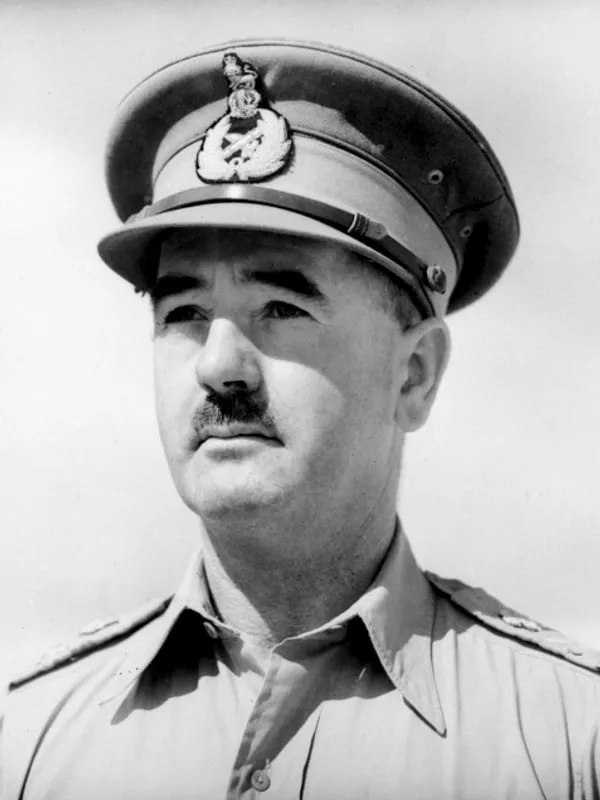
- Born:
- 18 September 1889, Ballarat (Victoria, Australia)
- Died:
- 26 September 1959, Sydney (Australia)
- Author:
- Natalia
- Photo:
- (NEGATIVE BY G. SILK), domena publiczna, Wikimedia Commons

Leslie James Morshead was the most famous Australian commander of the Second World War, even though he was never a regular officer. A teacher by training and a shipping company manager between the wars, he regarded soldiering as volunteer service in the militia. In the First World War he rose from a lieutenant on the beach at Gallipoli to one of the finest battalion commanders in the Australian army. In April 1941 his 9th Australian Division, under-trained and under-equipped, fell back before the Afrika Korps into Tobruk and for half a year defended the fortress against Erwin Rommel. It was one of the first battles in which German armour failed to achieve its objective. A year and a half later Morshead’s division played one of the leading parts in the Second Battle of El Alamein. His soldiers called him “Ming the Merciless”, after the cruel tyrant of the Flash Gordon comic strip, and later simply “Ming”.
The schoolteacher from Ballarat
He was born on 18 September 1889 at Ballarat, a former gold-rush town in the state of Victoria, the sixth of seven children of William Morshead, a miner who had come to Australia from Cornwall, and Mary Eliza, née Rennison. His father died when Leslie was six. He went to the state school at Mount Pleasant, where in 1906 he became a pupil-teacher, and after completing teachers’ college in Melbourne he taught in country schools in Victoria. In 1912 he moved to The Armidale School, a private school in New South Wales, and in 1914 to the prestigious Melbourne Church of England Grammar School. At both schools he commanded the cadet corps, and from 1913 he was also a lieutenant in the militia.
Gallipoli and the Western Front
On the outbreak of the First World War he left teaching, and in September 1914 he was commissioned as a lieutenant in the 2nd Battalion of the Australian Imperial Force (AIF). By then a captain, he landed with it at Anzac Cove on the Gallipoli peninsula on 25 April 1915. That day the battalion advanced further than any other Australian unit, but in the afternoon Turkish counter-attacks threw it back. In June Morshead was promoted to major, and in August he fought in the bloody Battle of Lone Pine; according to Australian historians, he was the only one of the battalion’s 22 officers to come out of it unscathed. In September he fell ill with dysentery and paratyphoid and was evacuated to England.
After returning to Australia, in April 1916, at the age of 26, he became a lieutenant colonel and commanding officer of the 33rd Battalion, which he himself raised and trained in Australia and in England. The battalion belonged to the 3rd Division of General John Monash, the outstanding Australian commander of that war, under whose eye Morshead developed. The Australian official historian Charles Bean called him an “elegant little schoolmaster”, the nearest of the young colonels to a strict disciplinarian, and judged his battalion one of the best in the army. Morshead led it at Messines and Passchendaele in 1917, and in the spring of 1918 at Villers-Bretonneux, where the Australians helped to halt the German Spring Offensive. In April 1918 he was gassed with mustard gas and out of action for several weeks. In August 1918 he commanded the battalion at the Battle of Amiens, the first day of the great Allied offensive, and took some 500 Germans prisoner. For his service in that war he received the Distinguished Service Order, the Order of St Michael and St George and the French Legion of Honour, and he was mentioned in dispatches five times.
Between the wars
He returned to Australia at the end of 1919. He tried farming on land granted under the soldier settlement scheme near Quilpie in Queensland, but soon gave it up. On 17 November 1921 he married Myrtle Catherine Hay Woodside, the sister of one of his former pupils; they had one daughter. In 1924 he found work with the British shipping company Orient Line, in which he rose over the following years, working in Sydney, Melbourne and Brisbane. In 1936 he became manager of its Sydney branch.
Throughout this time he served in the militia, Australia’s volunteer army: he commanded in turn the 19th and 36th Battalions and, from 1933, as a colonel, the 14th, 15th and 5th Infantry Brigades. In 1938 he became a temporary brigadier. His views were distinctly right-wing. According to the Australian Dictionary of Biography, in the mid-1920s he was briefly involved with a secret organisation preparing to counter communist subversion; some writers also link him with the paramilitary New Guard of the early 1930s.
From England to Cyrenaica
On 13 October 1939 Morshead was appointed to the newly forming Second Australian Imperial Force and took command of the 18th Infantry Brigade in General Thomas Blamey’s 6th Division. The brigade sailed from Sydney in May 1940, but after the fall of France it was diverted to Britain. It trained on Salisbury Plain and formed part of the defence of southern England during the Battle of Britain, when a German invasion was expected. In November it sailed for the Middle East and reached Alexandria on 31 December.
At the end of January 1941, when the commander of the new 9th Australian Division, Major General Henry Wynter, fell seriously ill, Blamey gave the division to Morshead, who was promoted to major general in February. The outlook was grim. The division was short of weapons and equipment, its men were poorly trained, and its own artillery was not ready. On top of that, two of its brigades had been exchanged for less well-prepared brigades of the 7th Division, so that the best-equipped units could go to Greece. In March the division relieved General Iven Mackay’s 6th Australian Division in Cyrenaica. Morshead did not hesitate to argue with his superiors. When the Commander-in-Chief Middle East, General Archibald Wavell, came to visit, Morshead told him frankly that his leading brigade was in too dangerous a position and proposed pulling it back to a more defensible line east of Benghazi. Wavell agreed.
Tobruk
When at the end of March Rommel went over to the offensive, the British command in Cyrenaica fell apart, and General Neame and General Richard O’Connor were taken prisoner. Morshead was the only general of Cyrenaica Command to escape capture, and his division, despite contradictory orders and a lack of transport, reached Tobruk exhausted but still an organised force. He took over the fortress, whose defences he had inspected closely in January, first under the overall command of Major General John Lavarack, and on 14 April as its commander, reporting directly to Wavell. “There’ll be no Dunkirk here,” he told his officers. “There is to be no surrender and no retreat.”
His tactics came as a surprise to the Germans. The infantry were to let through the tanks that broke into the perimeter and cut off the German infantry following them, while the tanks were to be stopped in depth by the artillery, anti-tank guns and the armoured reserve. On the night of 13–14 April, during the Easter Battle, a German panzer regiment lost almost half its vehicles in this way, and at Ras el Medauar at the turn of April and May Rommel gained only a small dent in the perimeter. Morshead conducted an aggressive defence: he insisted that no man’s land should become “our land”, sent out patrols and raids every night, and tried to win back every piece of ground the enemy took. This policy could be costly and did not please every battalion commander, but it kept the enemy off balance. When his attention was drawn to a British propaganda article headed “Tobruk Can Take It”, he is said to have replied that his men were not there to take it, but to give it.
Wavell had asked for Tobruk to be held for about two months; the fortress held out for more than six and survived two failed British relief attempts, Operation Brevity in May and Operation Battleaxe in June. German propaganda called the defenders “rats”, and the Australians adopted the nickname “the Rats of Tobruk” as a badge of honour. In the summer Morshead concluded that the health and strength of his men were rapidly running down, and he backed General Thomas Blamey’s efforts to have the division withdrawn. Successive Australian governments – those of Robert Menzies, Arthur Fadden and John Curtin – got their way despite the reluctance of Winston Churchill and of the new Commander-in-Chief Middle East, General Claude Auchinleck. From August to October the Australians were replaced by sea with the Polish Independent Carpathian Rifle Brigade and the British 70th Infantry Division. Morshead left Tobruk on 22 October 1941. For the defence of Tobruk he received the Polish Virtuti Militari, according to some sources presented to him in November 1941 by General Władysław Sikorski, and in 1942 a knighthood as a Knight Commander of the Order of the British Empire.
El Alamein
After its withdrawal from Tobruk the 9th Division rested and trained in Syria and Palestine. When, after the outbreak of war in the Pacific, the 6th and 7th Divisions returned to Australia, in March 1942 Morshead took command of all Australian forces in the Middle East and was promoted to lieutenant general, while keeping command of the division. In July 1942, when Rommel stood at the gates of Egypt, the 9th Division was sent to El Alamein. It was then that Morshead had his celebrated quarrel with Auchinleck, who wanted to parcel out the Australian brigades among British battle groups. He refused firmly and agreed to detach a single brigade only once the whole division had come under his command at El Alamein. In the July fighting the division had its successes, but on 27 July it lost almost the whole of the 2/28th Battalion. Morshead hoped for a corps command, but Auchinleck regarded him as “a difficult subordinate”, and the new commander of the Eighth Army, General Bernard Montgomery, did not want to entrust a corps to a reserve officer. The post went to a Briton younger than Morshead, Oliver Leese.
In the Second Battle of El Alamein, from 23 October 1942, the 9th Division fought at the northern end of the front. After the initial assault Morshead launched a series of attacks northwards towards the sea, which threatened to cut off the German units along the coast road and drew almost the entire Afrika Korps onto the Australians. This made Montgomery’s final breakthrough at the beginning of November easier. The price was high: according to Australian figures, the division lost some 1,200 killed and more than 3,600 wounded in the El Alamein fighting. Morshead was awarded the Order of the Bath for the battle.
New Guinea and Borneo
In February 1943 the 9th Division returned to Australia, and in March Morshead took command of II Corps. In the autumn of 1943 his corps took over command in the Lae and Finschhafen area of New Guinea just as the Japanese counter-attacked, and Morshead urgently brought up reinforcements for the 9th Division fighting there. From November 1943, after Mackay’s departure, he commanded New Guinea Force and the Second Army. In July 1944 he took over I Corps, the main striking force of the Australian army. In 1945, under the overall command of General Douglas MacArthur, he conducted the landings on Borneo: at Tarakan in May, in North Borneo in June and at Balikpapan in July, one of the last large amphibious operations of the war.
After the war
In September 1945 he returned to Sydney and reluctantly agreed to preside over a military court of inquiry into General Gordon Bennett’s escape from Singapore in 1942. On 1 January 1946 he transferred to the reserve, and the next day he went back to the Orient Line, of which he became general manager in Australia in 1948. He turned down offers of military and diplomatic posts, as well as the governorship of Queensland. He was president of the Bank of New South Wales and chairman of the board of the David Jones department store. From 1950 to 1952 he headed a secret organisation preparing to counter communist subversion. He died of cancer in Sydney on 26 September 1959. His funeral procession passed through streets lined by former soldiers of the 9th Division.
Significance
Morshead was one of the few Allied commanders who in 1941 managed to stop the German army while on other fronts – in Greece, on Crete and in Cyrenaica – the British suffered defeat after defeat. The defence of Tobruk not only denied Rommel a port without which he could not supply his forces on the Egyptian frontier, but also tied down a substantial part of his army around the fortress for half a year. It showed that German armoured tactics could be stopped by a defence in which the infantry did not give way to the tanks, while the artillery and reserves destroyed those that broke through. At El Alamein his division bore the heaviest burden of the fighting. Australian historians see him as Monash’s successor: an amateur commander who, through discipline, hard work and organising ability, matched the best professionals.
Sources
Commanded in battles
(04)Mentioned in battles
(01)Often appears with
People who appear in the same events.