The Battle of Okinawa
- Dates:
- 1 April – 22 June 1945
- Front:
- Pacific
- Location:
- Okinawa, in the Ryukyu archipelago, some 550 km south of Kyushu – the Hagushi beaches on the west coast with the Yomitan and Kadena airfields, the Motobu Peninsula in the north, the defensive line around Shuri Castle and the town of Naha in the south, the Oroku Peninsula and the last stronghold at the southern tip of the island near Itoman; also the Kerama Islands and Ie Shima, and the waters around Okinawa where the fleet fought the kamikazeOn the battle map →
- Sides:
- United StatesRaymond Spruance, Simon Bolivar Buckner Jr., Joseph Stilwell, Richmond Turner, Marc MitscherJapanMitsuru Ushijima, Isamu Chō, Hiromichi Yahara
- Result:
- United States victory. Organised resistance by the 32nd Army ended on 21–22 June 1945, and on 22 June the Americans declared the island secured; General Ushijima and his chief of staff committed suicide. According to official American figures, more than 12,000 Americans were killed or missing, including about 4,900 sailors. Japanese losses are estimated at about 77,000–110,000 soldiers killed, including conscripted Okinawans; for the first time in the Pacific, more than 7,000 Japanese soldiers were taken prisoner. Between about 40,000 and about 94,000 of the island’s civilians also died, depending on the estimate.
- Author:
- Łukasz
Name and dates
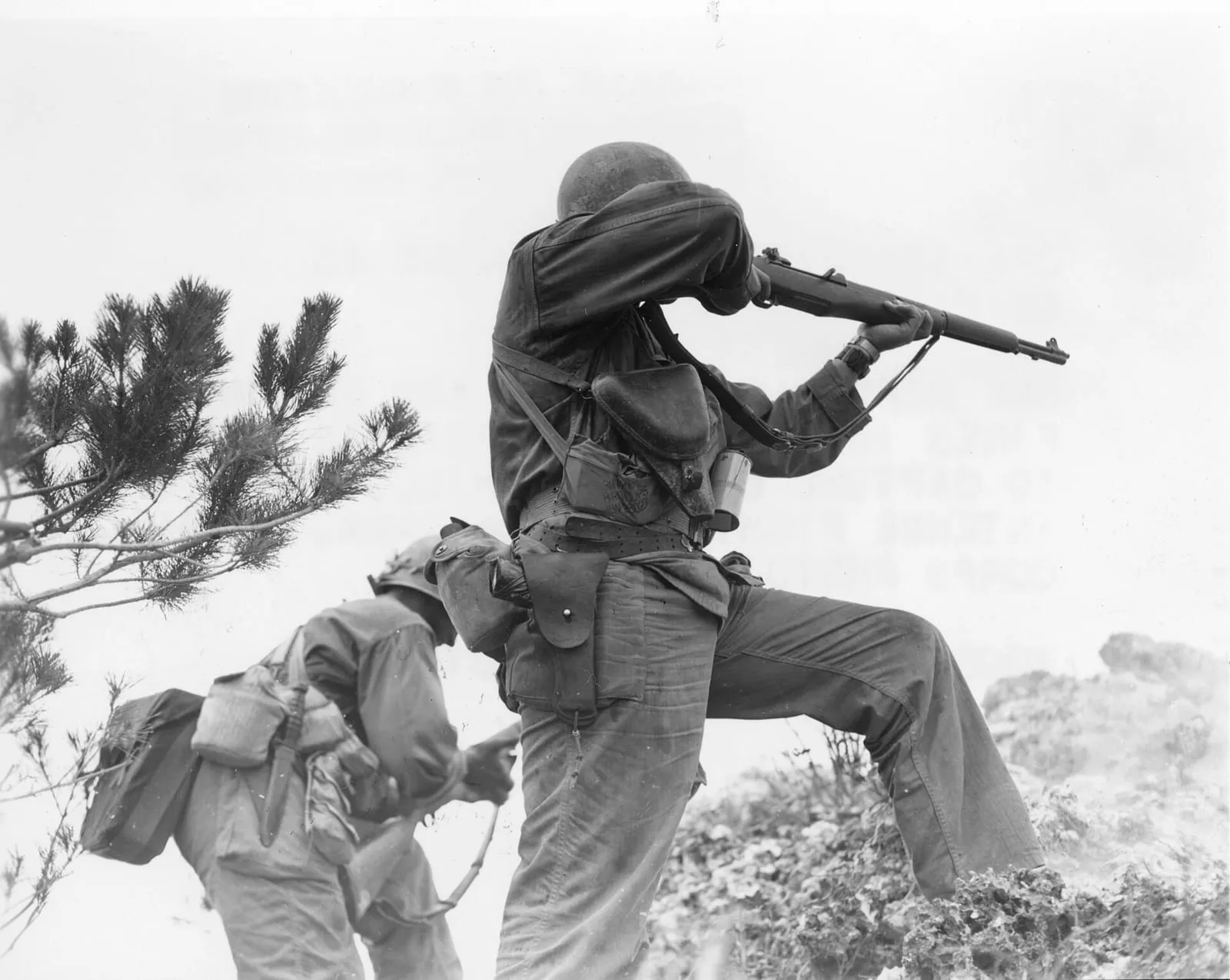
The Battle of Okinawa is the name given to the fighting for Okinawa, the largest island of the Ryukyu archipelago, between 1 April and 22 June 1945. The Americans gave the whole operation the code name Iceberg. The Japanese call it Okinawa-sen, while the islanders themselves speak of the “typhoon of steel” (tetsu no bōfū), after the storm of fire that rained down on the island from the sea, from the air and from the land for almost three months.
The starting date is set by the main landing: on the morning of 1 April 1945 – Easter Sunday, which that year happened to fall on April Fools’ Day – two corps of the American Tenth Army came ashore on the Hagushi beaches on the island’s west coast. The Americans called the day “L-Day” (Love Day). The first troops, however, had landed as early as 26 March, on the small Kerama Islands west of Okinawa, and carriers had been bombing the island since 23 March, so some historians date the campaign from these earlier points.
The battle is taken to have ended on 22 June. Organised resistance by the Japanese 32nd Army collapsed on 21 June; during the night of 21–22 June (23 June according to some Japanese sources) its commander, General Mitsuru Ushijima, committed suicide, and on 22 June the Tenth Army raised the flag to mark the end of organised fighting. Mopping up the scattered remnants went on until 30 June, and the last Japanese garrisons in the Ryukyus did not sign their surrender until 7 September 1945. In Japan, 23 June is observed as Okinawa Memorial Day.
Okinawa covers about 1,200 square kilometres and is more than 100 kilometres long, ranging from a few to about 30 kilometres in width. The north of the island is mountainous and wooded; the south is densely populated and cut by limestone ridges, ravines and caves, and contains Shuri, the old capital of the Ryukyu Kingdom, and the port town of Naha. Okinawa lies about 550 kilometres from Kyushu, the southernmost of Japan’s main islands. Unlike Iwo Jima, it was inhabited: at the time of the invasion, according to American planning estimates, some 300,000 civilians lived there, and close to half a million people in the whole of Okinawa Prefecture.
It was the largest amphibious operation of the Pacific War and the longest carrier campaign of the entire war, as well as the bloodiest battle of the Pacific War – for both armies and for the civilian population.
Background
In the summer of 1944 American commanders argued over which route to take towards Japan. Admiral Ernest King and some of the navy’s planners wanted to seize Formosa, General Douglas MacArthur wanted to return to the Philippines, and Admiral William Halsey proposed bypassing Formosa and striking at Okinawa. The dispute over the road to Japan was settled in the autumn: MacArthur’s forces were to land on Leyte and Luzon, while those of Admiral Chester Nimitz were to take Iwo Jima and then Okinawa. Formosa was ultimately bypassed. Okinawa, lying halfway between Formosa and Kyushu, was to give the fleet an anchorage and the air forces bases from which fighters and bombers could reach Japan, as well as a staging area for the planned invasion of the Japanese home islands.
The island had already been a target of American air attacks: on 10 October 1944 Halsey’s carriers struck Okinawa and destroyed much of Naha, opening a series of strikes that culminated in the raids on Formosa. From the autumn of 1944 the Japanese employed suicide air attacks on a mass scale – off Leyte kamikaze attacked the carriers, and in January 1945 they harried the fleet sailing to Luzon. The Japanese high command hoped that off Okinawa, within range of the airfields on Kyushu and Formosa, suicide aircraft would inflict such heavy losses on the American fleet that the United States would agree to a peace on terms Japan could accept.
The date of the invasion was postponed several times, since it depended on progress on Luzon and Iwo Jima. The Battle of Iwo Jima dragged on until 26 March 1945 and cost more than expected; some of the fire-support ships went straight from Iwo Jima to Okinawa. In mid-March the carriers of Vice Admiral Marc Mitscher struck the airfields of Kyushu and the port of Kure in order to destroy as many Japanese aircraft as possible in advance; during this action the carrier Franklin was badly damaged. From 23 March carrier aircraft were attacking Okinawa itself, and from 25 March battleships and cruisers were shelling its southern coast.
Forces and plans
The operation as a whole was directed by Admiral Raymond Spruance, commander of the Fifth Fleet. The amphibious forces were commanded by Vice Admiral Richmond Turner, and the fast carriers of Task Force 58 by Vice Admiral Mitscher. On land the fighting was done by the newly formed Tenth Army under Lieutenant General Simon Bolivar Buckner Jr. – a mixed army of Army and Marine Corps troops. It consisted of XXIV Corps under General John R. Hodge (the 7th, 27th, 77th and 96th Infantry Divisions) and the Marines’ III Amphibious Corps under General Roy Geiger (the 1st, 2nd and 6th Marine Divisions). At the start of the battle the Tenth Army numbered about 183,000 men, and far more passed through its ranks in the course of the fighting. It was supported by a vast fleet: several dozen carriers of various sizes, more than a dozen battleships, dozens of cruisers and destroyers, and hundreds of transports and landing vessels – some 1,300 ships in all.
For the first time the British Pacific Fleet, whose creation had been announced at the Second Quebec Conference, took part in a major operation in the Pacific. As Task Force 57, under Vice Admiral Bernard Rawlings, with the carriers of Vice Admiral Philip Vian, its task was to neutralise the airfields on the Sakishima Islands, through which Japanese aircraft could stage from Formosa towards Okinawa. The force also included Australian, New Zealand and Canadian ships.
Okinawa was defended by the Japanese 32nd Army under Lieutenant General Mitsuru Ushijima, with the fiery, attack-minded Lieutenant General Isamu Chō as chief of staff and the cool, methodical Colonel Hiromichi Yahara as chief of operations. The army comprised the 24th and 62nd Infantry Divisions, the 44th Independent Mixed Brigade, strong artillery, and some 9,000–10,000 sailors under Rear Admiral Minoru Ōta at the naval base on the Oroku Peninsula. Depending on the source, it numbered from about 67,000 to 77,000 regular soldiers, and about 100,000 men including the sailors and the mobilised islanders. Tens of thousands of Okinawans were drafted into auxiliary home-defence units (Boeitai) and as labourers, and more than 1,700 boys aged 14–17 into the “Blood and Iron” units (Tekketsu Kinnōtai). Secondary-school girls were sent as nurses to the field hospitals.
At the end of 1944 Imperial General Headquarters took the 32nd Army’s best formation, the 9th Division, away from Okinawa and moved it to Formosa. Ushijima and Yahara then abandoned the idea of defending the beaches. They concluded that, given the overwhelming firepower of the American fleet and air forces, their only chance lay in a protracted defence in depth – in a system of caves, tunnels and fortifications in the limestone hills of the south, around the old Shuri Castle, beneath which the army headquarters had been dug. The central and northern parts of the island, with the Yomitan and Kadena airfields, were left practically undefended. The ground forces were to pin down the Americans and bleed them white, while the outcome of the battle was to be decided by suicide aircraft attacking the fleet off the island. Like Tadamichi Kuribayashi on Iwo Jima, Ushijima forbade pointless banzai charges – although under pressure from Chō he twice departed from this principle.
The Kerama Islands and L-Day (26 March – 1 April)
The first to go ashore were the soldiers of the 77th Infantry Division. From 26 March they occupied the Kerama Islands, about 25 kilometres west of Okinawa. The group was needed as a sheltered anchorage and supply base for the fleet, and in the process the Americans destroyed several hundred motorboats intended for suicide attacks on the transports. The fighting lasted a few days and cost the 77th Division 27 dead. Here the first civilian tragedy was already played out: on Tokashiki and the neighbouring islets hundreds of inhabitants, convinced that torture and rape awaited them at the hands of the Americans, died in mass suicides – often using grenades handed out beforehand by Japanese soldiers. On 31 March a battery of 155 mm guns capable of shelling southern Okinawa was emplaced on Keise reef, some ten to fifteen kilometres from Naha.
On 1 April, after the heaviest preparatory bombardment of the Pacific War to date – according to the official US Army history, the ships fired 44,825 shells, 33,000 rockets and 22,500 mortar rounds before the landing – XXIV Corps and III Amphibious Corps landed on the Hagushi beaches at 8.30 a.m. At the same time the 2nd Marine Division staged a feint landing off the Minatoga beaches on the south-east coast to hold the Japanese reserves there. The Americans had expected a massacre on the shore; instead they came ashore almost without loss. By evening more than 60,000 troops had been landed, and the Kadena and Yomitan airfields were taken before noon, at about 10 and 11.30 a.m. A rapid advance across the island reached the east coast as early as 2 April, cutting Okinawa in two.
The north of the island and Ie Shima (April)
In view of the weak resistance, Buckner brought forward the occupation of the northern part of the island, originally planned for later. The 6th Marine Division pushed north across the Ishikawa isthmus and on 7 April sealed off the Motobu Peninsula, and on 13 April its patrols reached Cape Hedo at the northern tip of the island. On the Motobu Peninsula a force under Colonel Takehiko Udo held out in the mountainous Yaedake massif; the Marines cleared it in heavy fighting by 18–20 April.
On 16 April the 77th Infantry Division landed on Ie Shima, a small, flat island off the western tip of the Motobu Peninsula, with an airfield prized by both sides. The Japanese garrison, supported by armed islanders, fought from fortifications around Iegusugu hill and the small town of Ie; the fighting lasted until 21 April. On 18 April Ernie Pyle, the best-known American war correspondent, was killed there by a burst of machine-gun fire; after years on the fronts in North Africa, Italy and France, he had come to the Pacific. The airfield on Ie Shima later became one of the American bases for raids on Japan.
Kikusui and the Yamato
The calm of the first days ended on 6 April. That day the Japanese launched the first of ten mass air attacks known as Kikusui (“floating chrysanthemums”, after the crest of the 14th-century hero Masashige Kusunoki). The first strike alone, on 6–7 April, involved several hundred aircraft from Kyushu, including several hundred kamikaze. Further Kikusui attacks followed every few days or weeks until 22 June; between them came smaller attacks by individual aircraft from Kyushu and Formosa. According to American figures, the Japanese sent some 1,900 suicide aircraft in all against the fleet off Okinawa, and piloted Ōka rocket-powered bombs, released from bombers, were also used – on 12 April one of them sank the destroyer Mannert L. Abele.
The heaviest burden fell on the destroyers and smaller vessels stationed around the island as radar picket ships. They were the first to detect incoming formations and the first to be attacked; some were hit several times within a few minutes. Kamikaze also damaged many large ships: on 11 April the carrier Enterprise was hit, and the battleship Missouri suffered minor damage. On 11 May two suicide aircraft struck Mitscher’s flagship, the carrier Bunker Hill, killing between about 350 and nearly 400 men according to various tallies; three days later Enterprise, to which Mitscher had transferred his flag, was hit again and had to withdraw for the rest of the war. Spruance’s flagships were also hit twice. The British carriers, with their armoured flight decks, were back in action within hours of kamikaze hits.
The Japanese navy’s final act was Operation Ten-ichi-gō, part of the wider Operation Ten-gō. On 6 April the world’s largest battleship, Yamato, the light cruiser Yahagi and eight destroyers sailed from Tokuyama under Vice Admiral Seiichi Itō. They were to break through to Okinawa, beach themselves and fight as shore batteries until destroyed; according to an oft-repeated but disputed account, they were given fuel for a one-way voyage only. Itō and his captains considered the plan senseless and accepted it only when it was presented to them as the Emperor’s wish and a matter of the navy’s honour. On 7 April, south-west of Kyushu, the force was attacked by several hundred aircraft from Mitscher’s carriers. After about two hours, struck by at least a dozen torpedoes and many bombs, Yamato capsized and blew up. About 3,000 men died aboard Yamato alone, Itō among them, and in the force as a whole between about 3,700 and over 4,000, according to different sources; Yahagi and four destroyers were also sunk. The Americans lost 10 aircraft and 12 airmen.
The Shuri Line (April – May)
In the south, XXIV Corps ran into forward Japanese positions as early as 4–5 April, and a few days later into the main defensive belt. The Shuri Line ran across the island from near Naha in the west to Yonabaru in the east, with Ushijima’s headquarters in tunnels beneath Shuri Castle. It consisted of several successive belts of fortifications that made use of every hill and ravine. The Japanese placed their positions on the reverse slopes of the hills: there they sat out the bombardment by artillery, ships and aircraft, and when the Americans climbed onto the crest, they showered them with mortar fire and grenades.
The first great obstacle proved to be Kakazu Ridge, for which the 96th Infantry Division fought from 9 April. Attack after attack broke down. On 12–14 April Ushijima, yielding to Chō’s urging, launched a night counter-attack along the whole width of the front; it was beaten off with heavy losses, and the 32nd Army returned to the defensive. On 19 April Hodge, now with the 27th Division in the line as well, opened a new offensive with a barrage from 324 guns – the largest of the Pacific War – supported by ships and several hundred aircraft. Even so, he failed to break the defences; a tank thrust behind Kakazu Ridge ended with the loss of 22 vehicles. The Japanese abandoned the ridge only during the night of 23–24 April, falling back to the next line. At the Maeda Escarpment near Urasoe heavy fighting went on from the end of April into early May; there the 77th Division medic Desmond Doss, who refused to carry a weapon, evacuated about 75 wounded men under fire, according to his citation, and was awarded the Medal of Honor.
At the end of April fresh divisions came into the line: the 1st Marine Division relieved the 27th Division, and the 77th relieved the 96th. At the beginning of May the whole Tenth Army was committed, with III Amphibious Corps on the right, western flank. On 4–5 May the 32nd Army, again at Chō’s insistence and against Yahara’s advice, went over to a general counter-offensive, supported by landings from the sea behind the American lines and by artillery firing in the open. The attack collapsed within a day; the Japanese lost between 5,000 and 7,000 men, according to various estimates, and much of their artillery, which, having come out of hiding, fell victim to American counter-battery fire. Ushijima later admitted to Yahara that he had been right.
On 11 May Buckner launched a general attack on the entire Shuri Line. In the east, the 96th Division took Conical Hill, which dominated the Yonabaru plain, on 13 May. In the west, from 12 to 18 May the 6th Marine Division fought one of the bloodiest actions of the war for the small Sugar Loaf Hill and the neighbouring heights of Half Moon and Horseshoe, which covered one another with fire. The summit changed hands several times. According to the Marine Corps history, the division lost more than 2,600 killed and wounded in this fighting, and almost 1,300 men to severe combat fatigue. Critics, among them some naval commanders, accused Buckner of making costly frontal attacks instead of landing a force behind the Japanese lines; Buckner believed that a landing on the south coast would be hard to supply and just as costly.
The rains and the withdrawal from Shuri (late May)
At the end of May the rainy season arrived. Downpours turned roads and slopes into a sea of mud in which tanks and lorries bogged down; the wounded had to be carried on stretchers for many kilometres, and supplies brought up only with great difficulty. Bodies lay unburied on the battlefield for weeks. Soldiers likened the landscape to the Western Front of the First World War. Okinawa also produced more cases of psychiatric breakdown among American troops than any other battle of the Pacific War.
With both flanks of the Shuri Line broken, the 32nd Army faced encirclement. On 22 May Ushijima decided – following Yahara’s proposal and against the wishes of some officers who wanted to die at Shuri – to withdraw to a last line of defence on the Kiyan Peninsula at the southern tip of the island. The withdrawal, begun on 26 May, was carried out by night, in torrential rain and under fire; the command managed to bring about 30,000 soldiers back to the new positions. The seriously wounded in the cave hospitals were often left behind – according to many accounts, after being given poison or grenades. On 24–27 May the Marines took the ruins of Naha, and on 29 May a company of the 1st Marine Division entered the abandoned Shuri Castle, wrecked by shellfire. The Americans realised that the Japanese were pulling out too late to cut off their retreat.
The final phase (June)
On 4 June the 6th Marine Division landed on the Oroku Peninsula, held by Rear Admiral Ōta’s sailors. After ten days of fighting, on 13 June, Ōta and his officers committed suicide in their underground command post. In his last report to Tokyo, Ōta described the suffering of the islanders and asked that the Okinawans be given special consideration in future in return – a telegram still often invoked on Okinawa today.
In the south the Americans took one ridge after another – Yaeju-dake and Yuza-dake – and drove the remnants of the 32nd Army towards the sea. For the first time in the Pacific War thousands of Japanese soldiers, especially conscripted Okinawans, gave themselves up; American leaflets and loudspeaker appeals, often in Japanese and in the Okinawan language, also persuaded many civilians to come out of the caves. On 18 June General Buckner, watching a Marine attack from a forward observation post near Mezado, was killed by fragments of a Japanese artillery shell – the highest-ranking American officer killed by enemy fire in the entire war. The next day the commander of the 96th Division, Brigadier General Claudius Easley, was killed by machine-gun fire. Geiger temporarily took command of the Tenth Army – the only Marine officer ever to command a field army in combat – and on 23 June he was replaced by General Joseph Stilwell, the former commander of American forces in China, Burma and India.
Ushijima and Chō, surrounded in the headquarters cave on Hill 89 near Mabuni, committed ritual suicide (seppuku) in the early hours of 22 June (23 June according to some sources). Ushijima forbade Yahara to die and ordered him to survive so that he could tell the truth about the battle; the colonel, hiding among civilians, was captured in July and was the most senior officer of the 32nd Army to survive. On 22 June the Tenth Army announced the end of organised resistance and raised the flag over the island; mopping up scattered units continued until 30 June.
The civilian population
The Okinawans were caught between two armies. Before the battle the authorities evacuated only some of the inhabitants to Japan and Formosa; most stayed on the island, and in the final weeks tens of thousands of refugees crowded into its southern tip – the very area to which the 32nd Army had withdrawn. They died from artillery and naval shelling, air raids, hunger and disease. American soldiers, unable to tell civilians from soldiers, fired on houses and caves from which shots were sometimes fired. Japanese soldiers drove the inhabitants out of their hiding places, took their food and used them as shields, and, according to witnesses and historians’ findings, also killed hundreds of people, especially those suspected of espionage – including for speaking the Okinawan language. According to testimony gathered after the war, there were also rapes, committed by both Japanese and American soldiers.
The most tragic chapter was the “mass suicides” (shūdan jiketsu) that took place in the Kerama Islands and on Okinawa itself: families killed themselves with grenades, knives and farm tools, or threw themselves off the cliffs on the south coast. For years propaganda had portrayed the Americans as barbarians, and many survivors testified that Japanese soldiers had handed them grenades with orders not to be taken alive. The army’s role in these deaths is still disputed in Japan – in 2007 an attempt to soften its description in school textbooks provoked mass protests on Okinawa.
The schoolgirls of the Himeyuri unit became the symbol of the young people’s suffering: 222 girls and 18 teachers from two girls’ schools in Naha, sent as nurses to the cave hospital at Haebaru. After the unit was disbanded on 18 June, they were left to fend for themselves on the battlefield; according to the Himeyuri Peace Museum, 136 of them died, most in the final days of the battle. About half of the boys in the Tekketsu Kinnōtai units also died. Estimates of civilian deaths vary: from about 40,000 according to American figures to about 94,000 according to Okinawa Prefecture; together with the islanders conscripted into the armed forces, more than 120,000 Okinawans died, according to the prefecture. The Cornerstone of Peace memorial at Itoman bears more than 149,000 names of Okinawans, including those conscripted and those who died during the war as a whole.
Losses
According to official American figures, more than 12,000 Americans were killed or missing: about 4,900 sailors, about 4,700 Army soldiers and about 2,900 Marines; some 36,000 were wounded, and there were tens of thousands of cases of sickness and combat fatigue on top of that. In the navy the number of dead exceeded the number of wounded. At sea 36 ships and auxiliary vessels were sunk and more than 360 damaged, the overwhelming majority by kamikaze; the Americans also lost about 760 aircraft.
Japanese losses are harder to establish. American estimates speak of about 110,000 dead, including conscripted Okinawans; the Cornerstone of Peace bears some 77,000–78,000 names of soldiers from Japan. More than 7,000 regular soldiers and about 3,400 Okinawan conscripts were taken prisoner during the battle – the first time in the Pacific War that so many had surrendered. Japan lost the Yamato and more than a dozen other ships and – according to analyses of Japanese records – about 1,400–1,500 aircraft, most of them suicide aircraft.
Significance
Okinawa was the last great battle of the Pacific War and also its bloodiest. The Americans gained the base they needed: airfields and anchorages were expanded on the island, and in the plans for the invasion of Japan – Operation Downfall – Okinawa was to be the main staging area for the landing on Kyushu, scheduled for November 1945.
Far more important, however, was the lesson Washington drew from Okinawa. President Harry Truman and his advisers saw that the enemy would fight to the last man and that the kamikaze could inflict losses on the fleet greater than any earlier battle had. When Truman approved the plan for the invasion of Kyushu on 18 June, the day Buckner died, casualty forecasts were based largely on the experience of Iwo Jima and Okinawa. Some historians believe that it was Okinawa above all that settled the readiness to use the atomic bomb as a way of ending the war without a bloody invasion; others point out that the decision was shaped by many factors – the casualty calculus, the wish to end the war quickly before the Soviet Union entered it, and policy towards Moscow. The atomic bombings of Hiroshima and Nagasaki in August 1945 and the Soviet entry into the war meant that the invasion never took place.
For the Okinawans the battle became the defining experience of their modern history. The island remained under American occupation until 1972, and American bases, Kadena foremost among them, operate there to this day. The memory of the “typhoon of steel”, of the civilian victims and of the Japanese army’s role in the mass suicides still shapes the Okinawans’ attitude both to Tokyo and to Washington.