Japan
Hirohito
Regent (1921–1926), Emperor of Japan (1926–1989), supreme commander of the army and navy (until 1945)
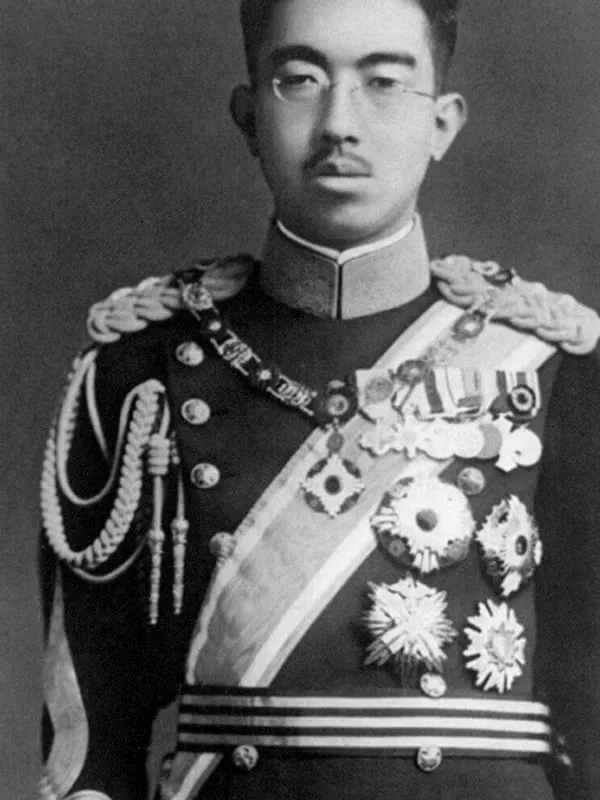
- Born:
- 29 April 1901, Tokyo (Aoyama Palace, Japan)
- Died:
- 7 January 1989, Tokyo (Fukiage Palace)
- Author:
- Natalia
- Photo:
- autor nieznany, domena publiczna, Wikimedia Commons

Hirohito was Emperor of Japan for 62 years, longer than any of his predecessors, but for the history of the war it is above all the first twenty years of his reign that matter. In his name the Kwantung Army seized Manchuria in 1931, Japan began the war with China in 1937, and in December 1941 it attacked the United States, Britain and the Netherlands. Under the constitution he was the source of all authority and supreme commander; in official ideology he was a descendant of the sun goddess; in practice he was a ruler who seldom imposed his will, but who approved, questioned, admonished and rewarded. In August 1945 it was his decision that settled the question of surrender. The Americans concluded that they would need him during the occupation and did not put him on trial. The debate over how much power he really held, and what responsibility he bears for the war and for the crimes committed by his army, continues to this day.
Childhood of Meiji’s grandson
He was born on 29 April 1901 in the Aoyama Palace in Tokyo, the first son of Crown Prince Yoshihito, later Emperor Taishō, and Princess Sadako. His grandfather was the reigning Emperor Mutsuhito. In keeping with court custom, at only a few weeks old he was handed over to be raised in the household of Admiral Count Sumiyoshi Kawamura, returning to court after the admiral’s death in 1904. In 1908 he began his education at the Gakushūin, the school for the aristocracy, whose head, appointed by Emperor Meiji, was General Maresuke Nogi, the conqueror of Port Arthur. The stern, ascetic Nogi had a great influence on the boy. When Emperor Meiji died in July 1912 and his son ascended the throne, the eleven-year-old Hirohito became heir to the throne and received his first officer’s ranks in the army and navy. In September of that year Nogi committed suicide on the day of the emperor’s funeral.
From 1914 to 1921 Hirohito was educated at a special school created solely for him and a few boys of his age, headed by Admiral Heihachirō Tōgō. The curriculum included history, ethics, military science and natural science. The historian Kurakichi Shiratori taught him the history of the imperial house, and he was taught ethics by Shigetake Sugiura, who lectured in the spirit of the Imperial Rescript on Education of 1890. Nature, and marine biology in particular, became his true and lifelong passion. He was formally invested with the title of Crown Prince on 2 November 1916.
Journey to Europe and the regency
From 3 March to 3 September 1921 Hirohito travelled to Europe, the first journey abroad ever made by a Japanese crown prince. Court conservatives opposed it, but it was supported by the senior statesmen, among them Field Marshal Aritomo Yamagata and Prince Kinmochi Saionji. Aboard the battleship Katori he reached Britain, Japan’s ally, in May and was the guest of King George V. The relaxed atmosphere of the British court made a great impression on him, and he later said that it was there that he had felt like a free man for the first time. He also visited France, Belgium, the Netherlands and Italy, as well as the battlefields of the First World War, including Verdun.
His father, Emperor Yoshihito, had been ill for years and was unable to carry out his duties. On 25 November 1921 Hirohito became regent (sesshō). That same month Prime Minister Takashi Hara was assassinated in Tokyo, and on 1 February 1922 Yamagata died. In 1923 the regent visited Taiwan, a Japanese colony since 1895. After the Great Kantō earthquake of 1 September 1923, which destroyed Tokyo and Yokohama, mobs and vigilante groups, with the participation of the police and the army, murdered thousands of Koreans in the chaos, accused by rumour of arson and of poisoning wells. On 27 December 1923 a young radical, Daisuke Nanba, fired at the regent at Toranomon in Tokyo but missed. On 26 January 1924 Hirohito married Princess Nagako of the Kuni family, even though Yamagata had tried to block the marriage. In 1933 their son and heir to the throne, Akihito, was born.
The beginning of the Shōwa era
On 25 December 1926 Yoshihito died and Hirohito became the 124th Emperor of Japan. His reign was given the name Shōwa, meaning “enlightened peace”. The formal enthronement took place in Kyoto on 10 November 1928.
Under the Meiji Constitution the emperor was “sacred and inviolable”, combined in himself all the rights of sovereignty, sanctioned the laws and exercised supreme command over the army and navy. In practice, since Meiji’s time, decisions had been taken by ministers and commanders and approved by the emperor. The chiefs of staff, however, had the right to approach him directly, bypassing the government, and only serving officers could be ministers of the army and navy. This arrangement, built largely by Yamagata, meant that the only place where civil and military authority met was the throne. That is why the way the emperor used this authority matters so much.
The first test was the assassination of 4 June 1928, when Kwantung Army officers blew up the train of the Manchurian warlord Zhang Zuolin. Prime Minister Giichi Tanaka promised the emperor that the culprits would be punished, but under army pressure the affair was hushed up. When in June 1929 Tanaka brought a report of lenient disciplinary penalties, Hirohito rebuked him sharply, and on 2 July the Tanaka government resigned. After the war the emperor recalled that he had been young and rash at the time, and that from then on he had resolved to approve the government decisions submitted to him even when he disagreed with them. Historians who regard him as sharing responsibility for the war reply that in the years that followed he repeatedly managed to influence decisions when he wished to.
Manchuria and the rule of violence
On 18 September 1931 Kwantung Army officers blew up a section of railway track near Mukden and blamed the Chinese. The Mukden Incident gave them a pretext to seize the whole of Manchuria, and the army acted against the wishes of the government in Tokyo. The Kwantung Army had grown out of the railway zone that Japan had taken over from Russia under the Treaty of Portsmouth. When the commander of the army in Korea sent troops across the border into Manchuria without orders, the emperor was displeased, but in the end he approved the expenditure for the operation and the government fell into line. In January 1932 he issued a rescript praising the Kwantung Army for its courage. In March 1932 the puppet state of Manchukuo was created, and in 1933 Japan left the League of Nations, which had refused to recognise it. On 8 January 1932 the Korean independence activist Lee Bong-chang threw a grenade at the imperial procession in Tokyo, but the emperor escaped unharmed.
Politics was increasingly governed by violence. In May 1932 young naval officers shot Prime Minister Tsuyoshi Inukai, and that was the end of party government. On 26 February 1936 some 1,400 soldiers led by young officers of the “Imperial Way” faction occupied the centre of Tokyo and murdered several ministers and dignitaries, including the former prime minister Makoto Saitō and the finance minister Korekiyo Takahashi. The rebels claimed to be acting in the emperor’s name. From the very first hours Hirohito called them rebels, demanded that the uprising be suppressed and threatened that, if the commanders delayed, he would lead the Imperial Guard himself. The 26 February Incident ended on 29 February with the rebels’ surrender. It was one of the few occasions on which the emperor openly imposed his will. The consequences, however, proved paradoxical: the army, purged of its radicals, gained even greater influence over the government, and in May 1936 the rule that only officers on the active list could serve as ministers of the army and navy was restored.
The war with China
On 7 July 1937 an exchange of fire at the Marco Polo Bridge near Beijing grew into a full-scale war with China. The military assured the emperor that the war would be over in a few months, and although he was chiefly worried about the threat from the USSR, he approved the dispatch of further divisions. The government called the war an “incident” rather than a war, which made it possible to disregard international conventions. In August the Vice-Minister of the Army ordered that the term “prisoners of war” not be used for captured Chinese. In November 1937 Imperial General Headquarters was established, where the emperor personally received reports from the chiefs of the army and navy.
In December 1937 the Japanese captured the Chinese capital, Nanjing. Over the following weeks soldiers murdered prisoners and civilians there and raped women. The death toll of the Nanjing Massacre is disputed: the Tokyo tribunal accepted a figure of over 200,000, Chinese historiography gives 300,000, and some Japanese historians a few tens of thousands. The troops at Nanjing were commanded by General Iwane Matsui and the emperor’s uncle, Prince Yasuhiko Asaka. In Tokyo the capture of Nanjing was celebrated as a great victory. There is no evidence that the emperor knew the scale of the crimes at the time, but reports of them reached Tokyo, and neither Prince Asaka nor any of the other commanders was held to account.
The Japanese army used chemical weapons in China. According to research by the Japanese historians Yoshiaki Yoshimi and Seiya Matsuno, authorisation for their use was issued in the form of General Staff orders under the emperor’s authority. In 1936 an imperial decree also expanded a unit and incorporated it into the Kwantung Army; it grew into Unit 731 near Harbin. The unit carried out experiments on human beings and developed biological weapons that were later used against the Chinese population. No documents exist that would establish how much the emperor knew about the experiments on prisoners. In the 1940s the army waged campaigns against the guerrillas in northern China that the Chinese called the “Three Alls” policy (burn all, kill all, loot all). The historian Mitsuyoshi Himeta estimates that more than 2.7 million civilians died in them, directly or indirectly. The American historian Herbert Bix argues that the emperor knew of and sanctioned these operations; other scholars believe his knowledge was limited.
The road to Pearl Harbor
In 1939 Hirohito opposed a military alliance with Germany, but after Adolf Hitler’s victories in Europe he agreed to it. On 27 September 1940 Japan signed the Tripartite Pact with Germany and Italy in Berlin. In April 1941 it concluded a neutrality pact with the USSR, whose People’s Commissar for Foreign Affairs was Vyacheslav Molotov. After Japan occupied southern Indochina, the United States froze Japanese assets in July and August 1941 and halted oil deliveries.
On 6 September 1941 a conference held in the emperor’s presence decided that if negotiations with the Americans produced no result by early October, Japan would prepare for war. The day before, Hirohito had sharply questioned the Army Chief of Staff, Hajime Sugiyama, reminding him that the war with China had been supposed to last a few months. At the conference itself, breaking with the custom of silence, he read out a poem by his grandfather about the seas of the four quarters of the world being brothers, which those present understood as an expression of a wish for peace. He did not stop the preparations. In October Prime Minister Fumimaro Konoe resigned, and the emperor, on the advice of the Lord Keeper of the Privy Seal, Kōichi Kido, entrusted the office to the War Minister, General Hideki Tōjō. He rejected the candidacy of his uncle, Prince Higashikuni, because he did not want a member of the imperial family to bear responsibility for the war. On 5 November another conference adopted the war plan, and in the following weeks the emperor listened to detailed reports on the planned operations, including the attack on Pearl Harbor. On 1 December 1941, at an Imperial Conference, he approved the decision for war with the United States, Britain and the Netherlands. On 8 December, Tokyo time (7 December in Hawaii), Japanese aircraft attacked Pearl Harbor and troops landed in Malaya.
The emperor at war
For the first six months Japan won nothing but victories, taking the Philippines, Malaya, Singapore, the Dutch East Indies and Burma. The emperor followed the fighting closely. According to staff documents and courtiers’ diaries, he repeatedly pressed his commanders – over the capture of the Bataan Peninsula in the Philippines in 1942 and the transfer of army aviation to Guadalcanal, among other things – and in later years, as the situation worsened, he demanded new offensives and battles. After the defeats at Midway in June 1942 and in the Solomon Islands, the initiative passed to the Americans. In July 1944, after the loss of Saipan, Tōjō’s government fell. Even then the emperor was hoping for one great victorious battle that would allow better peace terms to be negotiated. In February 1945 he rejected the advice of Konoe, who warned of revolution and urged a swift end to the war, replying that one more victory had to be won first.
Surrender
In the spring of 1945 American bombers were burning Japanese cities; in April the Americans landed on Okinawa, and Germany surrendered in May. In June the emperor called on the government to look for ways of ending the war, but the attempt to secure Soviet mediation led nowhere. On 26 July the Allies called on Japan, in the Potsdam Declaration, to surrender unconditionally. The government of Prime Minister Kantarō Suzuki decided to ignore it. On 6 August an atomic bomb destroyed Hiroshima. On 8 August Molotov handed the Japanese ambassador in Moscow a declaration of war; the next day the Red Army entered Manchuria, and on that same day a second bomb fell on Nagasaki.
On the night of 9–10 August, at a meeting in the shelter beneath the palace, the Supreme Council was evenly divided: half wanted to accept the declaration with a single condition, the preservation of the emperor’s position, while the other half insisted on further conditions. Suzuki asked the emperor to decide, and Hirohito came down in favour of accepting the Allied terms. On 14 August, after an ambiguous Allied reply on the future of the monarchy, he again settled the dispute in favour of surrender. That night a group of officers tried to take over the palace and seize the recording of his address, but the coup failed. At noon on 15 August the radio broadcast the emperor’s recorded speech. It was the first time the Japanese had heard his voice. He spoke in archaic court language and did not use the word “surrender”; he stated that the war situation had developed “not necessarily to Japan’s advantage”, referred to “a new and most cruel bomb” and called on his subjects to “endure the unendurable”. On 2 September 1945 the instrument of Japan’s surrender was signed aboard the battleship Missouri in Tokyo Bay.
Occupation and a new role
On 27 September 1945 Hirohito called for the first time on General Douglas MacArthur, the Supreme Commander of the occupation forces. The photograph of the tall American in an open-necked uniform beside the slight emperor in a morning coat shocked the Japanese. According to MacArthur’s memoirs, the emperor declared that he bore full responsibility for the political and military decisions taken during the war. The Japanese record of the conversation, made public only years later, contains no such words.
Australia, China, the USSR and a large part of American public opinion demanded that the emperor be put on trial. MacArthur concluded that a cooperative emperor would make for a peaceful occupation and smoother reforms, and Washington agreed. The emperor did not appear before the Tokyo tribunal, which tried the major war criminals in 1946–1948, and his name was carefully avoided. American prosecutors and Japanese officials made sure that the defendants, Tōjō among them, did not incriminate him in their testimony. Tōjō and Matsui were sentenced to death and hanged. No one answered before that tribunal for the crimes of Unit 731, because the Americans had granted its head, Shirō Ishii, and his associates immunity in exchange for their research results.
On 1 January 1946 the emperor issued a rescript later known as the “Humanity Declaration”, in which he rejected the “false conception” that he was a living god and that the Japanese were a people superior to others. The new Constitution of Japan, written largely by the Americans and in force from 3 May 1947, made him “the symbol of the State and of the unity of the people”, without political power. According to accounts from those years, members of his family, including his brothers, Prince Chichibu and Prince Mikasa, urged him to abdicate in favour of his son. Hirohito did not give up the throne. Between 1946 and 1954 he toured the country, visiting factories, schools and ruined cities, including Hiroshima in 1947.
The long post-war reign
For decades thereafter Hirohito was a discreet symbol of reconstruction and of the Japanese economic miracle. He carried out research on hydrozoans in a laboratory in the palace and published several scientific works describing previously unknown species. In 1971 he became the first reigning Emperor of Japan to visit Europe. In Britain and the Netherlands he was met by protests from former prisoners of war and inmates of Japanese camps. In 1975 he visited the United States. At a press conference after his return, asked about his responsibility for the war, he replied that he did not understand such “figures of speech”, and of the atomic bomb he said that it was regrettable but could not have been avoided in wartime. After 1975 he never again visited the Yasukuni shrine, where in 1978 fourteen convicted and accused Class A war criminals were enshrined among the venerated spirits. Notes made by one of his aides, published in 2006, confirmed that this was the reason.
Hirohito died of duodenal cancer on 7 January 1989 at the Fukiage Palace in Tokyo, at the age of 87. He was given the posthumous name Emperor Shōwa. Representatives of more than 160 countries attended his funeral on 24 February 1989.
The debate over responsibility
For decades the dominant image was the one shaped during the occupation: that of a pacifist emperor and constitutional monarch who could not stand up to the military and only in 1945 brought the war to an end. It was supported by the so-called Emperor’s Monologue, published in 1990, which he had dictated to his advisers in 1946, most probably in preparation for a possible trial. Courtiers’ diaries and military documents, released from the 1960s onwards, changed that picture. Herbert Bix, in a biography published in 2000 and awarded the Pulitzer Prize, presented Hirohito as an active participant in wartime decisions, guided above all by the defence of the dynasty. Other historians stress that his power was limited by custom and by fear of a coup, and that his influence over an army that did not obey even its own government was slight. Most scholars today agree that he was well informed, that he took part in the decisions on going to war and in its conduct, and that he acquiesced in a policy that led to conquest. The dispute concerns the extent to which he could have acted otherwise. For the victims of Japan’s war in China, Korea and South-East Asia, his impunity has remained a symbol of a past never reckoned with.
Significance
Hirohito was the grandson of the emperor under whose rule Japan won the war with Russia and annexed Korea, and the heir to an empire built by Mutsuhito, Yamagata and their generation. During his reign that empire expanded into Manchuria, China and South-East Asia, and then collapsed. In a system in which every decision was taken in his name and his authority was absolute, he approved conquests that claimed millions of lives, and it was he, too, who ended the war. He escaped a reckoning because the victors judged him more useful on the throne than in the dock.
Sources
Mentioned in battles
(19)- The Japanese invasion of Manchuria
- The defence of the Great Wall
- The Battle of Nanjing
- The Battle of Xuzhou
- The Battle of Lake Khasan
- The Battle of Khalkhin Gol
- Japanese invasion of French Indochina
- Attack on Pearl Harbor
- Philippines campaign (1941–1942)
- Burma campaign (1942)
- Battle of Midway
- Guadalcanal campaign
- Naval Battle of Guadalcanal
- Bougainville campaign
- New Britain campaign
- Operation Ichi-Go
- Battle of Saipan
- The Borneo campaign
- The Soviet invasion of Manchuria
Often appears with
People who appear in the same events.
On the timeline
(73)The 40 most important of 73 events. All tagged “Hirohito” (11) →