1937–1945: The Sino-Japanese War
Hundred Regiments Offensive
- Dates:
- 20 August – 5 December 1940
- Front:
- Far East
- Location:
- North China – the provinces of Shanxi, Hebei and southern Chahar, above all the Shijiazhuang–Taiyuan (Zhengtai) railway and the Datong–Puzhou, Beijing–Hankou and Tianjin–Pukou railwaysOn the battle map →
- Sides:
- China (the Communist Eighth Route Army, formally the 18th Group Army of the National Revolutionary Army)Peng Dehuai, Zhu De, Nie Rongzhen, Liu Bocheng, He LongJapan (the North China Area Army and the Mongolia Garrison Army) and collaborationist forcesHayao Tada, Yoshio Shinozuka
- Result:
- The Communists paralysed the Zhengtai railway for several weeks and destroyed hundreds of outposts, but the Japanese quickly rebuilt the lines and in the autumn laid waste the Communist bases in Shanxi and Hebei.
- Author:
- Natalia
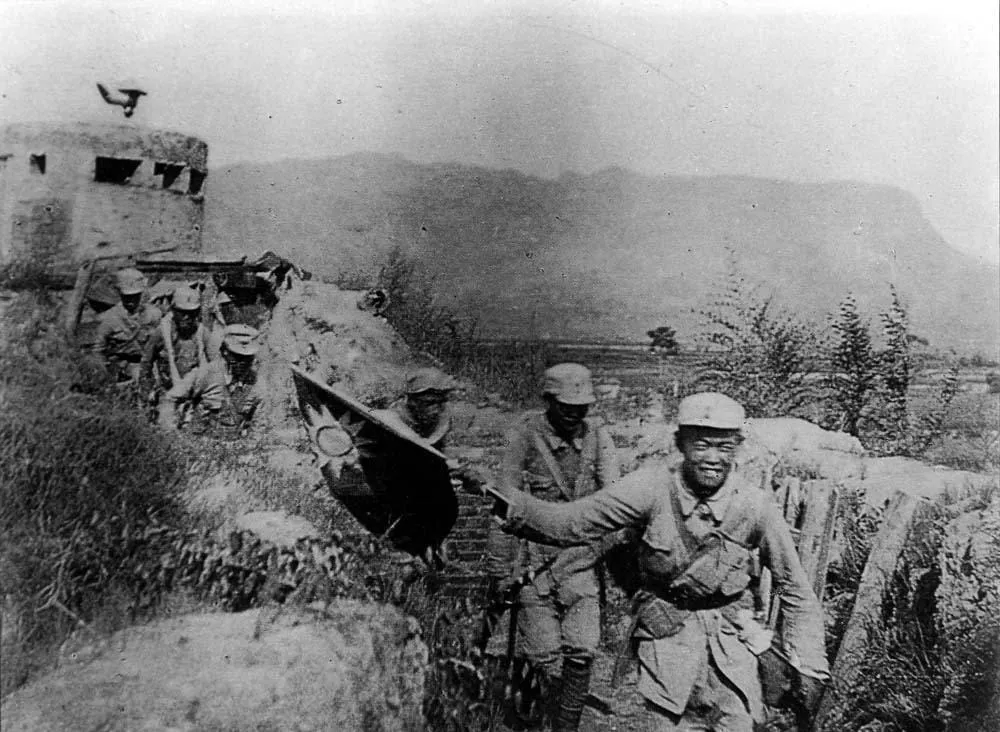
The Hundred Regiments Offensive was the largest operation the Chinese Communists mounted against the Japanese in the whole of the Second Sino-Japanese War. On the evening of 20 August 1940 units of the Eighth Route Army, supported by local militias and thousands of peasants armed with picks and crowbars, struck simultaneously at railway lines, stations, bridges and fortified outposts in the provinces of Shanxi and Hebei. The main target was the railway from Shijiazhuang to Taiyuan, which crossed the Taihang Mountains. The offensive was directed by the deputy commander-in-chief of the Eighth Route Army, General Peng Dehuai. The plan envisaged at least 22 regiments, but more and more units joined the fighting, and within a few days there was talk of more than a hundred. The Communists paralysed the most important railway in Shanxi for several weeks and took by surprise the Japanese, who had not expected so large an action from them. They paid a high price, however: from the autumn of 1940 the Japanese army waged campaigns against their bases that devastated the villages of North China, and the offensive itself became a matter of dispute within the Chinese Communist Party, which years later was turned against its commander.
Name and dates
The Chinese name of the operation, bǎituán dàzhàn (百团大战), means literally “the great battle of a hundred regiments”. The Chinese word tuan (团) means a regiment, and the number referred to the 105 regiments which, according to the Eighth Route Army headquarters, took part in the fighting: 39 from the Shanxi–Chahar–Hebei Military District, 46 from the 129th Division and 20 from the 120th Division, in both cases including the units subordinate to them. The operation was originally called the “Zhengtai Railway campaign”. When the number of regiments involved passed a hundred, Peng Dehuai and the chief of staff Zuo Quan renamed it the battle of the hundred regiments. Accounts differ as to the day: 22 or 26 August is most often given. The Japanese adopted the Chinese name (hyakudan taisen), and called their own reprisal operations the first and second Central Shanxi operations.
The regiments of the Eighth Route Army did not correspond to the regiments of regular armies. Many of them had been formed only after 1937 from volunteers and local detachments; they were poorly armed and varied greatly in strength. Chinese sources usually put the number of troops at over 200,000, not counting the militia and the civilians who helped tear up the track. Some historians in Taiwan regarded the “hundred regiments” as a propaganda figure. According to a report sent to Chongqing in the autumn of 1940 by the government’s Military Commission office in Xi’an, only eleven Communist regiments fought on the Zhengtai railway itself.
The offensive began on 20 August 1940, with the attack going in at about 8 p.m. that day. Its end is taken to be 5 December 1940, the date given by the Communist leadership and accepted by Chinese historiography. Some studies extend the third phase, the fighting against the Japanese sweeps, into January 1941. The official history of the People’s Republic of China divides the offensive into three phases: the destruction of the railways from 20 August to 10 September, the capture of Japanese outposts from 22 September to early October, and the defence of the bases against Japanese reprisals from 6 October to 5 December. Critics in Taiwan pointed out that the third phase was in fact a Japanese counter-offensive which Communist propaganda had counted as part of its own victory.
Background
The Communists behind Japanese lines. After the outbreak of war in July 1937 the Chinese Red Army was formally incorporated into the government army as the Eighth Route Army (later renamed the 18th Group Army). At that time it had three divisions and about 45,000 men, and its commander-in-chief was Zhu De. In line with the policy of Mao Zedong, it avoided big battles and infiltrated behind enemy lines, into the mountains of Shanxi and the plains of Hebei, where the retreat of the government troops had left a power vacuum. There it set up bases and organised an administration, militias and conscription. The Japanese controlled the towns, the railways and the roads; the Communists controlled the countryside. In December 1939 the Japanese North China Area Army estimated the Communist regular forces at about 88,000 men. By the summer of 1940 there were considerably more.
This growth came largely at the expense of their allies. The Communists absorbed government units left behind Japanese lines. At the turn of 1939 and 1940 in Shanxi, during the Chinese Winter Offensive, there were clashes with the troops of Yan Xishan, and in the spring of 1940 the Eighth Route Army routed the government forces of Zhu Huaibing and Shi Yousan in southern Hebei and Shanxi. The Kuomintang accused the Communists of “moving about rather than fighting” and of growing at the government’s expense rather than the Japanese.
The “cage policy”. The Japanese army responded to the guerrillas by building a network that the Chinese called the “cage policy”: the railways were to be the bars, the roads the chains and the fortified outposts the padlocks. Towers and bunkers went up along the railway lines, ditches and new roads cut the countryside into pieces, and from time to time Japanese units combed the mountains in “mopping-up” operations. The Japanese forces, however, were very thinly spread. On the Zhengtai railway a single platoon, sometimes only a section, guarded a station or a bridge, and the next outpost was several kilometres away.
The crisis of summer 1940. The Communists decided to strike at a moment when China’s situation seemed hopeless. In March 1940 Wang Jingwei’s government was set up in Nanjing, offering the Chinese peace with Japan. In June the Japanese took Yichang on the Yangtze and intensified their air raids on Chongqing. The fall of France cut China off from supplies through Indochina, and in July Britain agreed to close the Burma Road for three months. In Tokyo the second Konoe government proclaimed a “new order” in East Asia. Rumours reached Yan’an of secret talks between the Japanese and Chiang Kai-shek’s people. Such talks were indeed taking place, and the Japanese called them Operation Kiri. The Communist leadership feared an “Oriental Munich” – a settlement between Chongqing and Tokyo at the Communists’ expense. It also feared a Japanese advance westwards towards Xi’an. A great action behind enemy lines was meant to raise morale in China, make it harder for the government to capitulate and show that the Communists were fighting.
Preparations
Peng Dehuai had been planning a large-scale action against the railways since the spring of 1940. On 1 April he issued an order under which all divisions were to strike at the lines of communication on 10 April. Mao Zedong, however, held it back, as he considered the Kuomintang troops surrounding the Shaanxi base to be the greater threat. On 22 July the Eighth Route Army headquarters in the village of Zhuanbi in Wuxiang County, in south-eastern Shanxi, issued a “preliminary order” signed by Zhu De, Peng Dehuai and the deputy chief of staff Zuo Quan. Zhu De had been in Yan’an since the spring, so in the field the operation was directed by Peng and Zuo. The order provided that no fewer than 22 regiments would “destroy the Zhengtai railway in a great blow”. Smaller forces were to attack other railways and roads in North China at the same time. The order was also sent to the party leadership in Yan’an; the dispute over whether the leadership had approved it resurfaced years later. On 8 August headquarters issued the executive order and set the start of the attack for 20 August.
The Zhengtai railway, about 250 kilometres long, linked Shijiazhuang on the Beijing–Hankou line with Taiyuan. It crossed the Taihang Mountains and separated the two main Communist bases: the Shanxi–Chahar–Hebei district in the north and the Taihang Mountains base in the south. It ran past the coal mines at Jingxing and Yangquan, which supplied Japanese industry. The Shanxi–Chahar–Hebei Military District of General Nie Rongzhen was given the eastern section, from Shijiazhuang to the Niangziguan Pass. The 129th Division of Liu Bocheng, whose political commissar was Deng Xiaoping, was given the western section from Yangquan to Yuci. The 120th Division of He Long was to cut the Datong–Puzhou railway north of Taiyuan and hold up Japanese reinforcements. Preparations were made in secret: only the brigade commanders knew the objective, scouts in disguise reconnoitred the outposts, and blacksmiths forged crowbars and picks. Through the millet, which stood high at that time of year, the units reached the track unseen.
On the other side, North China was held by the North China Area Army of Lieutenant General Hayao Tada, with its headquarters in Beijing. In Shanxi stood its First Army under Lieutenant General Yoshio Shinozuka, headquartered in Taiyuan, with three divisions (the 36th, 37th and 41st) and several independent mixed brigades intended to garrison the occupied territory. The Zhengtai railway was guarded mainly by the 4th Independent Mixed Brigade, with battalions at Yangquan, Shouyang and Yuci, and by the 8th Mixed Brigade in the Jingxing and Shijiazhuang area. In the north, in southern Chahar, stood the 2nd Mixed Brigade, subordinate to the Mongolia Garrison Army. Japanese estimates put the army in North China at that time at about 200,000 men, with the same number of collaborationist troops – or, according to other sources, about 150,000. There was less than half a Japanese soldier to every square kilometre.
Phase one: the Zhengtai railway (20 August – 10 September)
At about 8 p.m. on 20 August the attack went in along the whole length of the Zhengtai railway and simultaneously on other lines. The right-hand column of the Shanxi–Chahar–Hebei district attacked the Niangziguan Pass, one of the most famous fortresses of the Great Wall, on the border between Shanxi and Hebei, and blew up the railway bridge below it. According to Chinese accounts it took the pass. According to Japanese accounts the small garrison, scattered among several posts, held part of its positions, and only thanks to soldiers from a train that happened to be passing. The centre column broke into the Jingxing coal mine, whose three shafts were each guarded by a few Japanese sections. Together with the miners, the Communists wrecked the equipment of one of them, and according to Japanese documents that part of the mine stood idle for six months. During the fighting at Jingxing Nie Rongzhen’s soldiers found two little Japanese girls whose father had been killed. Nie took care of them and sent them back with a letter to the Japanese garrison. Chinese propaganda made use of this story for decades.
In the western sector the 129th Division took several stations between Yangquan and Yuci, blew up bridges and tore up the track. On Shinao hill near Yangquan one of its regiments beat off counter-attacks for six days, covering the destruction of the railway. Rails were unbolted, laid on burning sleepers and bent so that they could not be used again, and embankments were dug away. The 120th Division cut the Datong–Puzhou railway and the roads north of Taiyuan, while smaller detachments attacked the Beijing–Hankou, Tianjin–Pukou and Beijing–Mukden railways. On the other side surprise reigned. Japanese outposts cut off from one another defended themselves alone, and the destroyed track and severed telephone lines made it impossible to send reinforcements quickly. In some places the Japanese even armed civilians who had settled there. The command in Taiyuan had to bring up troops from as far away as the 37th Division in the south of the province.
On the Beijing–Hankou railway the Japanese had driven off the attackers by 25 August with forces of the 110th Division and the 1st Mixed Brigade. The Zhengtai railway, however, was impassable for several weeks. On 30 August the First Army went over to the counter-attack. In the first Central Shanxi operation, which lasted until 18 September, the 4th and 9th Mixed Brigades attacked the 129th Division from two sides, but the division, following the principles of guerrilla warfare, dispersed and escaped encirclement. According to internal Japanese figures the First Army lost 199 killed, 283 wounded and 9 missing in the first phase. The Japanese claimed to have counted 4,880 enemy dead left on the field.
Phase two: storming the outposts (22 September – early October)
The first successes emboldened the command. Mao Zedong wrote to Peng that the battle of the hundred regiments was “truly inspiring” and asked whether one or two more such actions could be organised. On 22 September headquarters issued the orders for the second phase. Its aim was now not only to destroy track but also to capture Japanese outposts deep within the Communist bases and along the roads that cut through them. The 129th Division struck at the Yushe–Liaoxian road in the Taihang Mountains. According to Japanese figures many of the weak, scattered outposts of the 4th Mixed Brigade fell or were almost completely destroyed, and the brigade lost 162 killed in September, its heaviest losses of the whole offensive. The Shanxi–Chahar–Hebei district struck in the Laiyuan and Lingqiu area on the border of Hebei and Chahar. At Dongtuanbao, after several days of assaults, the Communists wiped out a Japanese NCO training battalion. According to Japanese sources two outposts of the 4th Independent Infantry Battalion of the 2nd Mixed Brigade fell after a siege of several days. The 120th Division again attacked the Datong–Puzhou railway, where on 22 September the outposts of the 3rd Mixed Brigade in Ningwu County suffered heavy losses.
The second phase exposed the weakness of the Eighth Route Army in conventional fighting. The Communists had no artillery, and to take a bunker they had to dig approach trenches to within a few dozen metres of the loopholes and then rush them with explosive charges and grenades. Many soldiers were killed. The Japanese, now prepared, defended themselves in their fortifications and, according to Chinese sources, used poison gas. In early October the attacks petered out. The Communists abandoned most of the outposts they had captured, and the Japanese quickly rebuilt them.
Phase three: the Japanese reprisal (6 October – 5 December)
On 6 October General Tada ordered the First Army to surround and destroy the 129th Division in south-eastern Shanxi. From 11 October to 3 December the second Central Shanxi operation took place, involving the 36th, 37th and 41st Divisions and the 4th Mixed Brigade. At the same time, from mid-October into November, the Mongolia Garrison Army and other units combed the Shanxi–Chahar–Hebei base, while smaller columns swept the Taiyue Mountains and north-western Shanxi. This time the Japanese did not confine themselves to chasing troops they could not catch. Their orders spoke of “annihilation operations” (jinmetsu sakusen): the destruction of everything that might be of use to the Communists. The troops burned villages, grain stores and tools, and killed livestock and people suspected of collaborating with the guerrillas. According to Chinese figures about 5,000 inhabitants of Qinyuan County were killed in two weeks at the end of October. The Chinese later called this practice the “Three Alls” policy: “kill all, burn all, loot all”.
The Eighth Route Army responded with ambushes and harassment, but it tried a conventional battle once more. At the end of October a Japanese detachment under Lieutenant Colonel Kenju Okazaki, drawn from battalions of the 37th Division, approached the Eighth Route Army headquarters. On 29 October it occupied Guanjiaonao hill in Wuxiang County. Peng Dehuai threw several brigades against it and personally directed the fighting from close range. According to the recollections of participants, Liu Bocheng advised breaking off the assault, but Peng would not give way. For two days, 30 and 31 October, the Communists attacked some 500 Japanese dug in on the summit. The detachment lost its commander but held on, and on 1 November Japanese reinforcements arrived and the Communists had to withdraw. According to Chinese figures the two attacking regiments lost about 500 killed and more than 1,500 wounded. Japanese documents give about 50 killed and 99 wounded on their side. Guanjiaonao is regarded as the costliest failed offensive battle of the Eighth Route Army.
On 5 December the Communist leadership declared the offensive over. Mao, however, instructed Peng not to announce this publicly. Relations with the Kuomintang were deteriorating rapidly, and Yan’an wanted to exploit the fame of the battle of the hundred regiments in its dispute with Chongqing.
Losses
The casualty figures diverge more widely than for most battles of the war. The Eighth Route Army headquarters drew up two returns based on data up to 5 December. According to the first, 12,645 Japanese and 5,153 collaborationist troops were killed or wounded, 281 Japanese and 1,407 collaborators taken prisoner, and 293 outposts captured. According to the second, dated 10 December 1940 and adopted by the official historiography of the People’s Republic of China, 20,645 Japanese and 5,155 collaborators were killed or wounded, 281 Japanese and 18,407 collaborators taken prisoner, and 1,845 collaborationist troops went over to the Communists. In addition 2,993 outposts were destroyed, along with some 474 kilometres of track, more than 1,500 kilometres of road and 213 bridges. The Communists put their own losses at about 17,000 killed and wounded. Other Chinese figures speak of more than 22,000, to which must be added thousands of victims of poison gas.
The Japanese figures are much lower, but also incomplete, as no comprehensive casualty return has survived. The hardest-hit 4th Independent Mixed Brigade lost 276 killed in the whole offensive, the 2nd Mixed Brigade 133 killed and 31 missing. According to Japanese documents 73 bridges and 3 tunnels on the railways were blown up, 20 stations burned, the track destroyed at 117 points over a total length of more than 44 kilometres, and over 2,400 telegraph poles cut down or toppled. The government report from Xi’an estimated Japanese losses at about 3,000, collaborationist losses at over 2,000 and Communist losses also at about 3,000. Some researchers, drawing on Japanese medical data, put the losses of the entire North China Area Army from August to December 1940 – including those in fighting against government troops – at about 2,350 killed and 4,000 wounded. Historians in Taiwan and Japan regard the Yan’an figures as greatly inflated. Chinese historians defend them, arguing that the Japanese returns left out the collaborationist forces and part of the losses.
The heaviest losses were suffered by the civilian population of the Communist bases in the third phase and in the years that followed. Their number cannot be established.
Significance
For the Communists the battle of the hundred regiments was a tactical success but a questionable strategic one. It paralysed the Zhengtai railway and the mines for several weeks, destroyed many outposts and proved that the Eighth Route Army could co-ordinate an attack over a vast area. At a time when China was losing hope, it gave Communist propaganda – and for a while government propaganda too – a reason to celebrate. Even the government in Chongqing sent its congratulations. The damage, however, was quickly repaired: according to figures cited by historians in Taiwan, the Beijing–Hankou railway was running again on 25 August and the Datong–Puzhou railway on 8 September. The Zhengtai railway was reopened to traffic at the end of September.
The most lasting consequence was a change in Japanese policy. The North China Area Army, which until then had regarded the government forces as its main enemy, now saw the Communists as the greatest threat. Its intelligence concentrated on them, and in February 1941 began breaking their codes. In July 1941 General Yasuji Okamura succeeded Tada in command. From 1941 the army conducted “public order strengthening campaigns”: it surrounded the Communist bases with ditches and towers, cut them off from the outside world and combed them piece by piece, burning villages and driving out the population. In 1941–1942 the bases in North China shrank, and according to Communist figures their population fell from about 44 million to 25 million. In May 1942 Zuo Quan, co-author of the plan for the offensive, was killed during one of the sweeps. The Eighth Route Army never again undertook an operation on such a scale for the rest of the war.
The offensive also hastened the break-up of the united front. The government in Chongqing received it with mixed feelings, since it revealed how much the Communist army had grown – and on territory the government regarded as its own. In the autumn of 1940 it demanded that the Eighth Route Army and the New Fourth Army move north of the Yellow River. In January 1941 government troops destroyed a column of the New Fourth Army in southern Anhui, and at the end of 1940 the government had stopped paying the Eighth Route Army and supplying it with ammunition.
Within the Communist Party itself the offensive became a subject of controversy. As early as September 1940 Mao cautioned that it should not be presented as a great counter-offensive. When in 1941–1942 the bases found themselves in their most desperate situation, Peng began to be accused of having revealed the party’s strength prematurely, bringing the Japanese blow down upon it and bleeding the army white in assaults on bunkers instead of waging guerrilla warfare. In 1943 Peng was recalled to Yan’an. In 1945, at a conference on work in North China, he had to make a self-criticism. In 1959, when he criticised the policy of the Great Leap Forward at the Lushan Conference, Mao brought up the battle of the hundred regiments again. During the Cultural Revolution the Red Guards accused Peng of having launched the offensive on his own initiative, without Mao’s consent, and of having thereby saved Chiang Kai-shek. Peng died in prison in 1974. After his rehabilitation in 1978 the authorities of the People’s Republic of China declared the offensive one of the most glorious pages in the Communists’ war against Japan, and its image in China once again became uncritical.