China
Zhu De
Commander of the Fourth Red Army (1928), Commander-in-Chief of the Red Army (1930–1937), commander of the Eighth Route Army (1937–1945), Commander-in-Chief of the People's Liberation Army (1946–1954), Marshal of the People's Republic of China (1955)
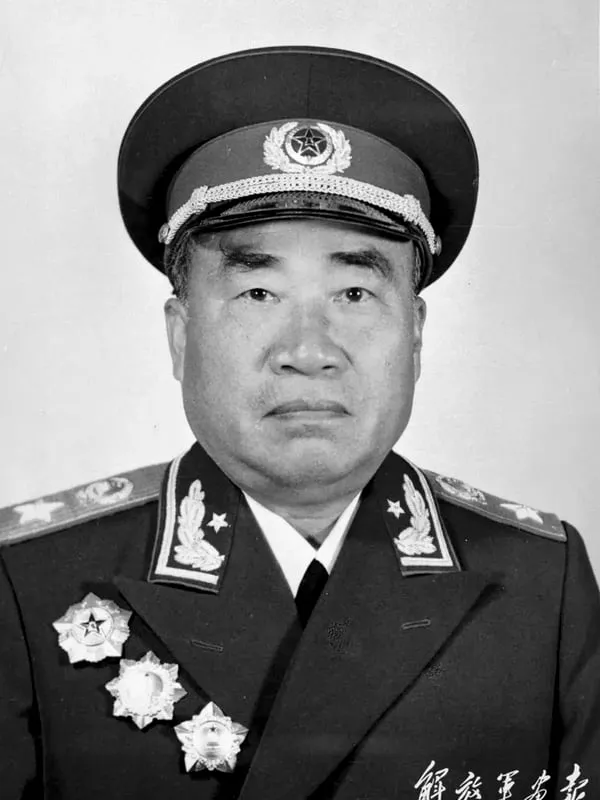
- Born:
- 1 December 1886, Yilong County (Sichuan, Qing China)
- Died:
- 6 July 1976, Beijing
- Author:
- Łukasz
- Photo:
- 《新华社》记者 齐观山, domena publiczna, Wikimedia Commons

Zhu De was the father of the Chinese Red Army, just as Mao Zedong was its political leader. For two decades their names were spoken in the same breath: the peasants of the Jinggang Mountains talked of “Zhu-Mao” as if they were a single person. A former provincial army officer and warlord who gave up opium, the army and his family to join the Communist Party in Berlin, he commanded the Red Army in the wars against the Kuomintang and on the Long March, and in the war against Japan the Eighth Route Army, whose offensive of August 1940 is known as the Hundred Regiments Offensive. After 1949 he was the first of the ten marshals of the People’s Republic of China and one of its formal dignitaries, but he held less and less real power.
From a poor home to military academy
He was born on 1 December 1886 in Yilong County in northern Sichuan, into a poor family of tenant farmers descended from settlers from Guangdong. Of more than a dozen children, only some survived. As a child he was adopted by his uncle, and the family pooled its money to pay for his education. He attended a traditional school, then a modern secondary school and a physical education college in Chengdu, and briefly worked as a gymnastics teacher in his home county. In 1909 he walked to Kunming in Yunnan province and was admitted to the military academy there. There he joined Sun Yat-sen’s secret revolutionary organisation, the Tongmenghui.
Revolutionary and warlord
After the outbreak of the Xinhai Revolution he took part in the rising in Kunming on 30 October 1911 that overthrew imperial rule in Yunnan. He served under General Cai E, and in 1915–1916, when Cai led Yunnan’s war against Yuan Shikai, who had proclaimed himself emperor, Zhu made his name as a unit commander in the fighting in Sichuan. He became a general and a brigade commander. The death of Cai E in 1916 and the death of his wife plunged him into opium addiction. For several years he was one of the many provincial militarists of the warlord era, and in 1921 he was chief of police of Yunnan. In 1922, when his patron lost the struggle for power in the province, he had to flee.
In Shanghai he cured himself of his addiction and, according to some accounts, met Sun Yat-sen, who offered him command of troops. Zhu, however, decided to start afresh. He approached the Communist leader Chen Duxiu, but Chen rejected the former warlord. At the end of 1922 Zhu left for Europe. In Berlin he met Zhou Enlai, on whose recommendation he was admitted to the Chinese Communist Party, while officially continuing to appear as a member of the Kuomintang. He studied at Göttingen, was active among Chinese students, was twice arrested and in 1925 was expelled from Germany. He returned to China in 1926 by way of Moscow, where he studied Marxism and military affairs.
Zhu-Mao
After Chiang Kai-shek crushed the Communists in the Shanghai massacre, Zhu, then chief of police in Nanchang and head of an officers’ school, was one of the leaders of the Nanchang Uprising on 1 August 1927. After its defeat he led the remnants of the troops to the border region of Guangdong, Jiangxi and Hunan and for several months hid them under a false name in the army of a former comrade from Yunnan. In January 1928, together with Chen Yi, he sparked a rising in southern Hunan, and in April he brought several thousand men into the Jinggang Mountains, where he joined forces with Mao Zedong’s unit. This was how the Chinese Red Army came into being: Zhu became commander of the Fourth Army and Mao its Party representative. It was then that Zhu formulated the principle of guerrilla warfare that Mao developed: the enemy advances, we retreat; the enemy halts, we harass; the enemy tires, we attack; the enemy retreats, we pursue.
The two leaders did not always agree. In 1929 Zhu and his supporters briefly removed Mao from the leadership of the army, but setbacks persuaded them to restore him to his post. From 1930 Zhu was Commander-in-Chief of the Red Army and, in the Chinese Soviet Republic in Jiangxi, chairman of its military council. He directed the repulse of four of Chiang Kai-shek’s encirclement campaigns. The fifth campaign, in 1933–1934, forced the Communists to abandon their base. On the Long March, which began in October 1934, Zhu was commander-in-chief, and at the Zunyi Conference he backed Mao. When the armies of Mao and Zhang Guotao separated in the summer of 1935, Zhu found himself in Zhang’s camp and had to march south with him. According to the Party version he was in effect a hostage there and opposed the split. He rejoined Mao’s army only in October 1936 in Gansu. Mao later praised his conduct, saying that he had “a heart as broad as the sea and a will as hard as steel”.
The war against Japan
After the Xi’an Incident and the formation of the Second United Front, in August 1937 the Red Army in the north formally became part of the government army as the Eighth Route Army (soon renamed the 18th Army Group). Zhu De became its commander, with Peng Dehuai as his deputy, and received the rank of general from the government. In the autumn of 1937 his troops fought in Shanxi alongside the army of Yan Xishan, and then dispersed behind Japanese lines, setting up bases in Shanxi, Hebei and Shandong. Zhu was also deputy commander of the 2nd War Area, commanded by Yan. He wrote on guerrilla warfare in the Party press, and his headquarters in Shanxi received foreign journalists, among them the American writer Agnes Smedley, who became his biographer.
In the spring of 1940, as tension grew between the Communists and the Kuomintang, Zhu held talks in Luoyang with the commander of the 1st War Area, General Wei Lihuang, on demarcating the zones of the two armies, and in May he returned to Yan’an. The orders for the Hundred Regiments Offensive, launched on 20 August 1940, bore his signature alongside those of Peng and Zuo Quan, but it was Peng who directed it in the field. Zhu did not suffer for it as much as Peng did, although during the Cultural Revolution the Red Guards accused both men of organising it without Mao’s approval. When Japanese reprisal campaigns and the blockade imposed by the government in Chongqing brought the Communist bases to the brink of famine, Zhu became the moving spirit behind the army’s self-sufficiency. His troops cleared wasteland at Nanniwan near Yan’an, and the slogan of army production became part of the Yan’an legend.
At the Seventh Party Congress in April 1945 he delivered the report “On the Battlefront of the Liberated Areas”, and in June he joined the Politburo and the Secretariat as second in the Party hierarchy after Mao. On 10 and 11 August 1945, when Japan announced its readiness to surrender, he issued orders instructing Communist forces to accept the surrender of the Japanese and to occupy towns. Chiang Kai-shek forbade this, and the dispute over who was to disarm the Japanese army was one of the causes of the renewed civil war.
The civil war and the People’s Republic of China
In the civil war of 1946–1949 Zhu was Commander-in-Chief of the People’s Liberation Army, although strategy was now set mainly by Mao and the battles were fought by the commanders of the field armies. On 21 April 1949, together with Mao, he signed the order for the general advance across the Yangtze. On 1 October 1949 he took the parade on the day the People’s Republic of China was proclaimed.
In the new state he held high but increasingly ceremonial posts. He was Vice-Chairman of the Central People’s Government, Vice-Chairman of the People’s Republic in 1954–1959, Vice-Chairman of the Party in 1956–1966, and from 1959 until his death Chairman of the Standing Committee of the National People’s Congress. In September 1955 he was made a marshal, first on the list of ten. He was never Minister of Defence: that post went to Peng Dehuai in 1954. At the Lushan Conference in 1959 Zhu criticised Peng only mildly, for which Mao reproached him for having “missed the point”, and Lin Biao called him an “old careerist”. In the years that followed Zhu cautiously supported a retreat from the excesses of the Great Leap Forward, including the abolition of the rural public canteens.
The Cultural Revolution and death
During the Cultural Revolution the followers of Lin Biao and Jiang Qing called him a “black commander” and a “big warlord”, and in 1969 he lost his place in the Party’s inner leadership. Mao, however, protected him, and Zhu, unlike Peng, escaped arrest. In October 1969, at a time of tension with the USSR, he was sent from Beijing to Guangdong together with other marshals. After Lin Biao’s death in 1971 his position improved, and in 1973 he returned to the Standing Committee of the Politburo. Mao then told him jokingly that there could be no “Mao” without “Zhu”. He died in Beijing on 6 July 1976, six months after Zhou Enlai and two months before Mao Zedong. He was married several times. One of his wives, Wu Ruolan, fell into the hands of government troops in 1929 and was executed; his last wife, Kang Keqing, a veteran of the Long March whom he married in 1929, outlived him by many years.
Significance
Zhu De was neither a great theorist nor a politician of the stature of Mao or Zhou Enlai, but without him the Chinese Communists would have had no army. It was he who brought the first regular units to Jinggang, who commanded the Red Army through the wars of the 1930s and throughout the war against Japan, and whose popularity among the soldiers gave the Party authority within the army. In the history of the Second World War in Asia he is the commander of the army that, behind Japanese lines in northern China, built up bases with tens of millions of inhabitants. The Hundred Regiments Offensive of August 1940, prepared under his name, showed how great a force this army had become, and at the same time brought brutal reprisals down on its bases. In the end this strength served above all to win the civil war in 1949.
Sources
Commanded in battles
(02)Often appears with
People who appear in the same events.