China
Peng Dehuai
Deputy commander of the Eighth Route Army (1937–1945), commander of the Chinese People's Volunteers in Korea (1950–1953), PRC Minister of Defence (1954–1959), Marshal of the PRC (1955)
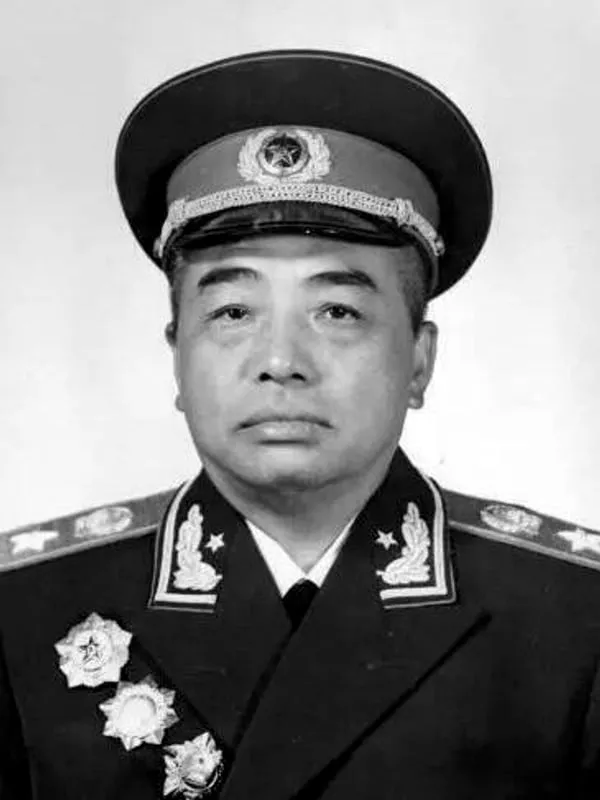
- Born:
- 24 October 1898, Shixiang, Xiangtan County (Hunan, Chinese Empire)
- Died:
- 29 November 1974, Beijing
- Author:
- Natalia
- Photo:
- 《新华社》记者 郑景康, domena publiczna, Wikimedia Commons

Peng Dehuai was one of the ablest commanders of the Chinese Communists and one of the few who dared to oppose Mao Zedong openly. The son of poor peasants from Hunan, he rose from private in a provincial warlord’s army to colonel in the Kuomintang, and in 1928 went over to the Communists with his regiment. In the war against Japan he was Zhu De’s deputy in the Eighth Route Army, and in August 1940 he led the Communists’ largest offensive of that war, the Hundred Regiments Offensive. After 1949 he commanded the Chinese forces in Korea and was Minister of Defence of the People’s Republic of China until, in 1959, he criticised the policy of the “Great Leap”. For this he lost all his posts, and during the Cultural Revolution he was abused in prison, where he died.
A childhood of poverty
He was born on 24 October 1898 in the village of Shixiang (Wushi) in Xiangtan County, Hunan province – the same county that Mao Zedong came from. He was given the name Dehua. The family owned a small plot of land and his father ran a little shop, but the drought of 1905–1906 reduced them to destitution. His mother died in 1905, a younger brother starved to death and his father had to mortgage the land. The boy, who had managed to complete a few years of traditional schooling, was begging around the villages with his brothers at the age of ten, and later herded water buffalo. An elderly great-uncle, a former participant in the Taiping Rebellion, told him of a world in which the land was shared out equally and everyone had enough to eat. All his life Peng emphasised his peasant origins.
In 1911 he worked in a coal mine in Xiangtan, pushing carts thirteen hours a day, until the owners went bankrupt and fled without paying the workers. In 1913, during another famine, he took part in seizing a grain merchant’s granary and had to flee from the police. For two years he worked building dykes on Lake Dongting.
Soldier of the warlords and the Kuomintang
In March 1916 he enlisted as a private in the Hunan provincial army. This was the Warlord Era, when provincial generals fought one another for power. Peng was promoted slowly but steadily. One of his officers, a veteran of the Xinhai Revolution, instilled in him a sympathy for the slogans of the Kuomintang: national unification and social reform. In 1921, as a young officer, he had a landlord who exploited the peasants arrested and shot, for which he was reprimanded. In 1922–1923 he completed officer school in Hunan, and it was then that he first used the name Dehuai. In 1926 his unit joined the National Revolutionary Army, and Peng, as a major and then a lieutenant colonel, fought in the Northern Expedition against the warlord Wu Peifu.
The split in the Kuomintang in 1927 and the massacre of Communists in Shanghai disillusioned him with the party of Chiang Kai-shek. The Communists, among them former comrades of his, persuaded him that they alone truly wanted to give the land to the peasants. By April 1928 at the latest Peng, now a colonel, had secretly joined the Chinese Communist Party. Sent to the mountainous county of Pingjiang to stamp out the Communist guerrillas, on 22 July 1928 he led his regiment in mutiny, seized the town, had officials and landlords executed and proclaimed Soviet power. A counter-attack by government troops forced him to retreat, and at the end of the year he reached the Jinggang Mountains with a small detachment – the place where, that spring, Mao and Zhu De’s Red Army had been born.
Red Army commander
Peng quickly became one of the Communists’ best commanders. In April 1930 he took over the Third Red Army, and in July, carrying out the order of the then party leader Li Lisan to capture a provincial capital, he took Changsha, the capital of Hunan. He held it for only a few days, and a second attempt in September ended in heavy losses. In the defence of the Jiangxi base against Chiang Kai-shek’s encirclement campaigns he was second only to Lin Biao. From the outset he preferred regular mobile warfare to the guerrilla tactics advocated by Mao. In 1931 he joined the Central Military Commission, and in 1933 he became its vice-chairman.
The Fifth Encirclement Campaign of 1933–1934 forced the Communists to abandon Jiangxi. In October 1934 Peng led the Third Corps on the Long March. Of his roughly 18,000 men, a few thousand reached Shaanxi in the autumn of 1935. At the Zunyi Conference in January 1935 he backed Mao, although soon afterwards Mao accused him and Lin Biao of wanting to take the command away from him. In September 1935 Peng commanded the Shaanxi–Gansu Detachment, which fought its way through to northern Shaanxi, and Mao wrote a poem in his honour asking who it was that so boldly scattered the enemy on horseback, and answering: “only our great General Peng”. In 1936 the American journalist Edgar Snow spent several days at his headquarters and in his book Red Star over China devoted more space to him than to anyone except Mao.
The war against Japan
After the Second United Front and the outbreak of war with Japan in 1937, the Red Army formally became part of the government army as the Eighth Route Army. Zhu De became its commander and Peng its deputy commander. At the Luochuan conference in August 1937 Peng, like many other commanders, argued for genuinely fighting the Japanese alongside the Kuomintang, whereas Mao wanted to husband his forces for the future showdown with Chiang Kai-shek. In the autumn of 1937 Peng coordinated Communist operations in Shanxi with the troops of Yan Xishan in the Battle of Taiyuan. From the end of 1938, from his headquarters in the Taihang Mountains on the border of Shanxi and Hebei, he was in practice in command of most of the Eighth Route Army, building up bases and guerrilla warfare behind Japanese lines.
In the summer of 1940, when China was going through the worst period of the war, Peng prepared a great blow against the Japanese railways in North China. The orders were signed by Zhu De, Peng and the deputy chief of staff Zuo Quan, but because Zhu was in Yan’an, it was Peng who directed the operation. On 20 August 1940 the Hundred Regiments Offensive began: Communist units destroyed hundreds of kilometres of track, as well as bridges and stations on the Zhengtai railway and other lines, and the mine at Jingxing. In later phases they attacked fortified Japanese outposts, which cost them heavy losses, and the Japanese responded with brutal reprisal operations. At Guanjianao at the end of October Peng personally directed an attack on an encircled Japanese detachment and suffered a defeat that he later counted among the worst of his career.
Mao at first greeted the offensive with enthusiasm but later judged it a mistake: it had revealed the strength of the Communists, brought down on their bases Japanese reprisals – which the Chinese called the “Three Alls” policy – and alarmed Chiang Kai-shek. In May 1942, during a Japanese sweep against the headquarters of the Eighth Route Army in the Taihang Mountains, Zuo Quan was killed and Peng barely escaped. At the end of 1943 Peng went to Yan’an, where the Rectification Campaign was under way, and never returned to the front. At the North China conference in 1945 he was criticised for forty days over the Hundred Regiments Offensive and forced to make a self-criticism. Until the end of the war he dealt mainly with political and staff matters, and in 1944 he received the American officers of the Dixie Mission in Yan’an. In June 1945 he joined the party’s Politburo.
Civil war and Korea
After Japan’s surrender and the resumption of the civil war, Peng commanded the most poorly armed of the Communist field armies, in north-western China. When General Hu Zongnan’s government troops attacked Yan’an in March 1947, Peng covered the evacuation of the party leadership and then, in a series of mobile battles, routed the enemy forces and by 1949 had taken control of Shaanxi, Gansu, Ningxia and Qinghai. His troops also occupied Xinjiang. After the proclamation of the People’s Republic of China he administered the whole of the country’s north-west.
When, in the autumn of 1950, the American-led UN forces crossed the 38th parallel in Korea, Mao decided to intervene. Lin Biao declined the command; Peng accepted it. On 5 October he became commander and political commissar of the Chinese People’s Volunteers, who began crossing the Yalu on the night of 19–20 October. He took the enemy by surprise and by the end of 1950 had driven them out of North Korea, and in early 1951 he briefly captured Seoul. Further offensives, undertaken under pressure from Mao, collapsed with huge losses under the fire of American artillery and aircraft. In November 1950 Mao’s son, Mao Anying, was killed in an American air raid on Peng’s headquarters. In 1952 Peng returned to China, and on 27 July 1953 he signed the armistice agreement at Panmunjom.
Minister of Defence and Lushan
His experience in Korea convinced him that China needed a modern, professional army. As Minister of Defence from 1954 he introduced into the People’s Liberation Army, on the Soviet model, military ranks, regular conscription, training and discipline, while curbing the role of the political commissars. In September 1955 he became one of the ten marshals of the PRC. He was a modest and hot-tempered man. He disliked the cult of Mao and opposed the hanging of his portraits in government offices.
When the Great Leap Forward began heading for disaster in 1958, Peng, on a visit to his home region in Hunan, saw the effects of the policy with his own eyes. At the party leadership conference at Lushan in July 1959 he wrote Mao a letter criticising the inflated harvest figures, the forced production of steel in backyard furnaces and “petty-bourgeois fanaticism”. Mao took this as an attack on himself and threatened to split the party if the delegates backed Peng. On 16 August 1959 Peng was condemned as the leader of an “anti-party clique of right opportunists”. One of the charges also concerned the Hundred Regiments Offensive. In September Lin Biao took over the Ministry of Defence. Zhu De, who had criticised Peng only mildly, himself came under fire from Mao. The famine caused by the Great Leap claimed tens of millions of lives in the years that followed.
Persecution and death
Peng went to live in seclusion near Beijing, under surveillance. In 1962 he sent the party leadership a long letter in his own defence, in which he wrote that he wished to be like Hai Rui, the Ming dynasty official who had dared to rebuke the emperor. In 1965 Mao allowed him to work on building up the arms industry in south-western China. After the outbreak of the Cultural Revolution, Red Guards incited by Mao’s wife, Jiang Qing, seized him in Chengdu in December 1966 and took him to Beijing. He was repeatedly paraded at “struggle sessions”, beaten and interrogated for a dozen or more hours a day; his ribs were broken and his lungs damaged. In 1970 a special tribunal sentenced him to life imprisonment. Gravely ill, he died in prison in Beijing on 29 November 1974. According to accounts, his last wish was to see Zhu De. His body was cremated and his ashes sent to Chengdu under a false name.
Significance
Peng’s death was concealed until 1978, when, after Mao’s death, the party leadership under Deng Xiaoping rehabilitated him and declared the Lushan decision “completely wrong”. Today China honours him as one of the most outstanding commanders of its army, and the Hundred Regiments Offensive, used against him for decades, is regarded as one of the great victories of the war against Japan.
For the history of the Second World War in Asia, Peng Dehuai matters above all as the architect of that offensive. In 1940 it showed that the Communists had become a real military force in North China, but it also brought Japanese reprisals down on their bases and on the civilian population. The dispute over it – over whether the Communists should really fight the Japanese or save their strength for the war against the Kuomintang – was at bottom a dispute over Mao’s strategy itself, and it dogged Peng until his death.
Sources
Commanded in battles
(01)Mentioned in battles
(01)Often appears with
People who appear in the same events.