China
Mao Zedong
Co-founder of the CCP (1921), Chairman of the Chinese Soviet Republic (1931–1934), leader of the CCP (from 1935, Chairman from 1943), leader of the PRC (1949–1976)
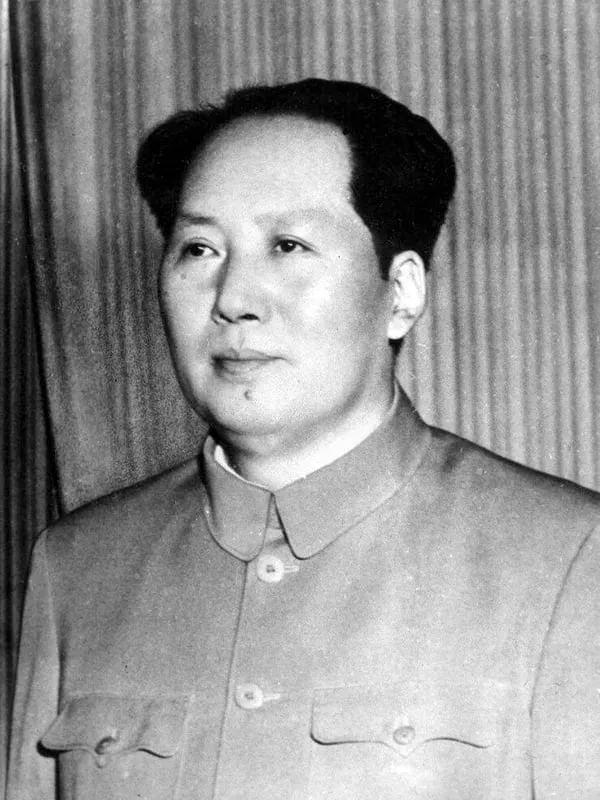
- Born:
- 26 December 1893, Shaoshan, Hunan province (Qing Empire)
- Died:
- 9 September 1976, Beijing
- Author:
- Łukasz
- Photo:
- Chen Zhengqing (1917–1966), domena publiczna, Wikimedia Commons

Mao Zedong was the son of a prosperous peasant from Hunan who became one of the founders of the Chinese Communist Party and later its undisputed leader. Against the orthodoxy that saw the strength of the revolution in the urban workers, he staked everything on the peasants and on guerrilla war. After the Communists were crushed in the cities in 1927 he built his own army and his own state in the mountains, led their remnants through the Long March and, during the war with Japan, expanded the party from a few tens of thousands to more than a million members. In 1949 he defeated Chiang Kai-shek and proclaimed the People’s Republic of China. He was one of China’s two leaders in the war against Japan and the man who gained most from it. As dictator after 1949 he bears responsibility for the deaths of tens of millions of people.
Youth in Hunan
He was born on 26 December 1893 in the village of Shaoshan in Hunan province. His father, a former soldier, had grown rich from land, the grain trade and moneylending, and was a harsh man. His mother, a devout Buddhist, softened his rule. Mao attended the village school, where he learned the Confucian classics by rote, but he preferred to read novels about rebels and warriors. At fourteen he was married off at his father’s wish, but he refused to recognise the marriage. During the Xinhai Revolution he served for several months as a soldier in the revolutionary army in Changsha. From 1913 to 1918 he studied at the teachers’ training college in Changsha, where his mentor was the philosopher Yang Changji, his future father-in-law.
In 1918 he went to Beijing, where Yang found him a job as an assistant in the library of Peking University. Its head was Li Dazhao, the first propagator of Bolshevism in China. The year 1919, with the protests of the May Fourth Movement against the transfer of the former German rights in Shandong to Japan by the Paris Peace Conference and the Treaty of Versailles, found him in Hunan as a radical journalist. In Shanghai he met Chen Duxiu, who with Li was the second father of Chinese communism. By 1920 he had moved from anarchism and liberal nationalism to Marxism.
A Communist in the ranks of the Kuomintang
In July 1921 Mao was one of a dozen or so delegates who, at a congress in Shanghai attended by envoys of the Comintern, founded the Chinese Communist Party. He returned to Hunan as its secretary and organised trade unions and strikes by miners and railwaymen. In 1920 he had married Yang Kaihui, his teacher’s daughter.
When Moscow and Sun Yat-sen concluded an alliance, the Communists joined the Kuomintang while keeping their own party. Mao did so with zeal. In January 1924 he became an alternate member of the Kuomintang’s Central Executive Committee; in 1925–1926 he was de facto head of its propaganda department, and in 1926 he ran an institute in Canton that trained activists for the peasant movement. In the countryside he found his subject. In his report on the peasant movement in Hunan of early 1927 he wrote that hundreds of millions of peasants would rise “like a hurricane” and sweep away everything in their path, and he defended violence against landlords. A revolution, he wrote, is not a dinner party.
The Red Army in the mountains
In April 1927 Chiang Kai-shek turned on the Communists in the Shanghai massacre, and in the summer the left wing of the Kuomintang also broke with them. The Communists responded with uprisings. On 1 August 1927 units mutinied in Nanchang, and in China that day is regarded as the birthday of the Communist army. Mao took no part in that uprising. At a party meeting on 7 August he coined the phrase that became his motto: political power grows out of the barrel of a gun. In September he led the Autumn Harvest Uprising in Hunan. After its defeat he took refuge with the remnants of his units in the Jinggang Mountains on the border of Hunan and Jiangxi. The party leadership in Shanghai punished him for this by removing him from its governing bodies.
In the spring of 1928 he was joined in the Jinggang Mountains by the units of Zhu De that had survived Nanchang. In May the combined forces took the name 4th Red Army, with Zhu as commander and Mao as political commissar. The birth of the Chinese Red Army as a force capable of survival is dated from this merger, known as the Zhu–Mao army. Over the following years Zhu and Mao worked out the principles of guerrilla war: the enemy advances, we retreat; the enemy camps, we harass; the enemy tires, we attack; the enemy retreats, we pursue. In 1928 Mao formed a relationship with a young woman partisan, He Zizhen.
The Chinese Soviet Republic
At the beginning of 1929 the Red Army moved to southern Jiangxi. There the largest Communist base grew up, and on 7 November 1931 the Chinese Soviet Republic was proclaimed at Ruijin, with Mao as its chairman. The base lived on confiscated land and on terror against “class enemies”. In December 1930, during a purge of supposed Kuomintang agents, an envoy of Mao’s arrested and tortured local activists at Futian, which provoked a mutiny by some units. In the purges in Jiangxi in 1930–1931 several thousand party members and soldiers were killed, and by some estimates many more. In November 1930 the Kuomintang executed his wife, Yang Kaihui, in Changsha.
The Red Army beat off Chiang Kai-shek’s first encirclement campaigns, but from 1932 Mao was losing influence to party officials sent from Moscow and to the Comintern adviser Otto Braun, who waged positional warfare. Chiang’s fifth campaign, conducted methodically and with the help of German advisers, forced the Communists to abandon Jiangxi.
The Long March
In October 1934 some 86,000 people set out on the Long March. In January 1935, at the Zunyi Conference, the existing command was condemned and Mao entered the inner military leadership. From then on his influence grew, although he gained full power only several years later. After a year on the march, across rivers and mountains, fighting and pursued, covering by official figures some 12,000 kilometres, a few thousand men of the main column reached northern Shaanxi in October 1935. The Long March became the party’s legend, and Mao its hero. From 1937 the Communists’ capital was Yan’an.
In 1936 he received the American journalist Edgar Snow, whose book Red Star Over China presented Mao to the world as a modest patriot and reformer. The Communists were then proclaiming the slogan of a joint struggle against Japan. When in December 1936 Zhang Xueliang arrested Chiang Kai-shek at Xi’an, Moscow ordered the Communists to work for his release and for an agreement.
The war with Japan
After the outbreak of the Sino-Japanese War in July 1937 the Communists and the Kuomintang formed the Second United Front. The Red Army was formally incorporated into the government forces as the Eighth Route Army, and in the south the New Fourth Army was created. In September 1937 the troops of Lin Biao destroyed a Japanese column at Pingxingguan, a success that propaganda exploited for a long time. Mao, however, did not want his troops bled white in regular battles. He sent them behind enemy lines, where they set up bases and organised guerrilla forces and administration in the countryside. In his 1938 lectures On Protracted War he predicted that China would not lose if it held out, while Japan would exhaust itself in a war across vast spaces.
The Communists’ only great offensive, the Hundred Regiments Offensive, was carried out in the second half of 1940 by General Peng Dehuai. It damaged Japanese railways and mines but brought down cruel retribution: the Japanese answered with pacification campaigns, which the Chinese called the “Three Alls” policy (kill all, burn all, loot all), and these shrank the Communist bases. In January 1941 Kuomintang troops destroyed a column of the New Fourth Army, which in practice ended cooperation between the two sides. For the rest of the war both parties fought Japan while also preparing for a reckoning with each other. Historians disagree over how far the Communists fought the Japanese and how far they were building up their forces for the future. In any case, the burden of the great battles against the Japanese army was borne by the government forces.
In Yan’an Mao consolidated his power. In 1942–1944 he conducted the Rectification Movement, in which, under the direction of the security chief Kang Sheng, thousands of party members were interrogated, forced into self-criticism and accused of espionage; some of them died. In March 1943 he became Chairman of the Politburo. The party’s Seventh Congress in the spring of 1945 wrote “Mao Zedong Thought” into its constitution. In 1938 he had married Jiang Qing, an actress from Shanghai. As the war drew to an end the party had more than a million members and its armies and militias hundreds of thousands of soldiers. In August 1945 the USSR occupied Manchuria, and the Communists quickly established themselves there, taking over some of the Japanese army’s weapons.
Victory and power
At the end of August 1945 Mao flew to Chongqing for talks with Chiang Kai-shek. The agreement they reached did not last. In 1946 the civil war broke out again. The Communists, who in Manchuria could rely on captured weapons and the nearby USSR, destroyed the Kuomintang’s main armies in 1948–1949. The siege of Changchun in 1948, in which the Communists starved the city, cost the lives of at least 160,000 civilians. On 1 October 1949 in Beijing Mao proclaimed the People’s Republic of China. Chiang fled to Taiwan.
In February 1950 Mao concluded an alliance with Stalin in Moscow, and in the autumn of that year he sent Chinese “volunteers” into the Korean War, in which his eldest son was killed. In the land reform and the campaigns against “counter-revolutionaries” of the early 1950s between one million and several million people were executed or murdered. The brief Hundred Flowers Campaign of 1957 was followed by repression of hundreds of thousands of “rightists”. The Great Leap Forward of 1958–1962 caused a famine in which, according to various estimates, from fifteen or so to more than forty million people died; the figure most often given is about thirty million. In 1966 Mao unleashed the Cultural Revolution, which cost the lives of hundreds of thousands of people, and according to some researchers more than a million. After the break with the USSR he received President Nixon in Beijing in 1972. He died on 9 September 1976. His embalmed body lies in a mausoleum on Tiananmen Square.
Significance
The Communist Party still holds to the verdict of its 1981 resolution, according to which Mao’s merits outweigh his mistakes; colloquially this is put as seventy per cent merits and thirty per cent mistakes. Historians outside China see him as one of the greatest tyrants of the twentieth century, and at the same time as the man who unified the country and restored it to great-power status. For the history of the road to the Second World War, and of the war itself, something else matters. The split in the Chinese national camp in 1927 meant that China faced Japanese aggression divided and weakened by civil war. The war with Japan, in turn, destroyed Chiang Kai-shek’s army and state, and gave Mao the time and space to build the force that took power in 1949. Without the Japanese invasion Mao’s story would probably have turned out quite differently. He himself, receiving Japanese visitors in the 1960s, would say mischievously that he owed his victory to Japan.
Sources
Commanded in battles
(01)Mentioned in battles
(03)Often appears with
People who appear in the same events.