China
Chiang Kai-shek
Commandant of the Whampoa Academy (1924–1926), commander-in-chief of the National Revolutionary Army (from 1926), leader of the Republic of China (1928–1949), president on Taiwan (1950–1975)
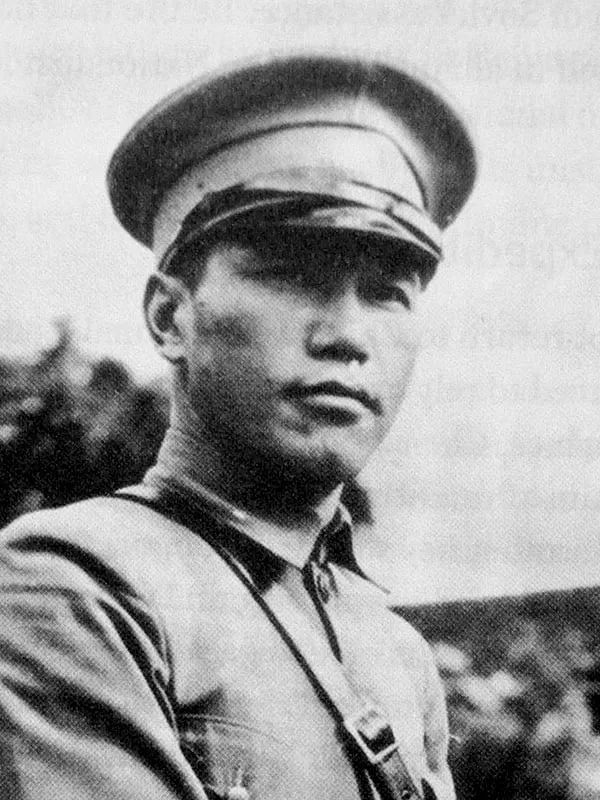
- Born:
- 31 October 1887, Xikou, Fenghua County, Zhejiang Province (Qing Empire)
- Died:
- 5 April 1975, Taipei (Taiwan)
- Author:
- Natalia
- Photo:
- autor nieznany, domena publiczna, Wikimedia Commons

Chiang Kai-shek ruled China for more than twenty years and then Taiwan for a quarter of a century. A professional officer trained in Japan, raised up by Sun Yat-sen to head an officer school financed by Moscow, in 1926–1928 he unified most of the country under the rule of the Kuomintang. In 1927 he broke bloodily with the communists, opening a civil war that went on, with interruptions, until 1949. From Japan’s seizure of Manchuria in 1931 until 1937 he avoided open war with the Japanese, believing that the communists had to be crushed first. From 1937 he waged war against Japan for eight years, and from December 1941 he was one of the leaders of the anti-Hitler coalition, alongside Franklin Delano Roosevelt, Churchill and Stalin. That war exhausted his state, and in 1949 he lost to Mao Zedong’s communists and fled to Taiwan. To some he was the defender of China and a patriot; to others, a dictator who failed his people.
Youth and Japanese schooling
He was born on 31 October 1887 in Xikou in Zhejiang Province, not far from the port of Ningbo, into the family of a salt merchant. His father died in 1895, and the boy was brought up by his mother, a devout Buddhist. At fourteen, at his family’s wish, he married Mao Fumei, who was older than he was, and with her had a son, Jingguo. He broke with the old order in 1906: he cut off his queue, the symbol of submission to the Manchu dynasty, and went to Japan. He then studied at the military school in Baoding, and in 1908 returned to Tokyo to a school preparing Chinese cadets. There his friend and fellow provincial Chen Qimei introduced him to the Tongmenghui (Revolutionary Alliance) led by Sun. From 1910 he served in a field artillery regiment of the Japanese army in Niigata Prefecture. The discipline of the Japanese army and its cult of loyalty left a mark on him for the rest of his life.
A revolutionary in Shanghai
When the Xinhai Revolution broke out in October 1911, Chiang returned home and commanded a unit that helped take Hangzhou. In the following years he was Chen Qimei’s right-hand man in Shanghai. In January 1912 he personally shot Tao Chengzhang, Chen’s rival within the revolutionary movement, in a hospital. He took part in the failed “Second Revolution” against Yuan Shikai in 1913 and in the conspiracies of the following years. After Chen’s assassination in May 1916 he lived in Shanghai on the borderline between politics, the stock exchange and the underworld. It was then that he made the acquaintance of Green Gang bosses such as Du Yuesheng, connections that proved useful to him in 1927.
From 1918 he served Sun Yat-sen in the south, in the Cantonese army. In June 1922, when General Chen Jiongming rebelled against Sun, Chiang joined him on the gunboat where Sun had taken refuge and spent several weeks there with him. From then on Sun trusted him completely.
Whampoa and the road to power
After Sun’s agreement with Moscow, Chiang went to Soviet Russia in August 1923 at the head of a military delegation. For three months he inspected units of the Red Army and talked with its leaders, among them Leon Trotsky. He liked the system of political commissars, but came back convinced that the Bolsheviks wanted to subjugate China just as the other imperialists did. In May 1924 he became commandant of the new Whampoa Academy near Canton, financed by Moscow and run with the help of Soviet advisers, among them General Vasily Blyukher. Its graduates, devoted to the “Commandant”, became the core of his power for the next quarter of a century. In 1925 Chiang’s eldest son, Jingguo, went to study in Moscow. The young man spent twelve years in the USSR, in practice as Stalin’s hostage.
After Sun’s death in March 1925 Chiang quickly overtook the party’s more senior leaders. On 20 March 1926, on the pretext of suspicious movements by the gunboat Zhongshan, he imposed martial law in Canton, arrested communist officers and forced the communists to curtail their influence in the Kuomintang. Moscow, unwilling to lose an ally, gave way. In July 1926, as commander-in-chief of the National Revolutionary Army, he led the Northern Expedition against the warlords. Within a few months the army had reached the Yangtze.
The break with the communists
By the spring of 1927 the Kuomintang camp was already divided: the left and the communists formed a government in Wuhan, while Chiang relied on the army and on the wealthy circles of Shanghai. On 12 April 1927 his soldiers and Green Gang squads disarmed the communist workers’ militias in Shanghai and began rounding up communists and trade unionists. In the Shanghai massacre and in the repression that then spread to other cities, many thousands of people were killed. The figures are disputed: they range from several hundred executed and thousands missing in Shanghai alone to tens of thousands of victims of the “White Terror” across the country over the following year. On 18 April Chiang set up his own government in Nanjing. In the summer the Wuhan left also broke with the communists, and the Soviet advisers left. The First United Front was over, and the civil war had begun.
On 1 December 1927 Chiang married Soong Mei-ling, the American-educated sister of Sun’s widow. The marriage linked him to the richest family in the country and to Sun, and in 1930 Chiang was baptised into the Methodist Church. In 1928 he resumed the march north. In May his troops clashed at Jinan with the Japanese, who were determined to prevent China’s unification under Nationalist rule. Chiang bypassed the city, avoiding open war, which the Chinese long remembered (the Jinan incident). In June he took Beijing, and officers of the Japanese Kwantung Army assassinated the warlord Zhang Zuolin as he withdrew to Manchuria. In December 1928 his son, Zhang Xueliang, placed Manchuria under the government in Nanjing. On 10 October 1928 Chiang became Chairman of the National Government. For the first time since 1916 China was formally united.
The Nanjing decade
The years 1928–1937 brought China road and railway building, financial reform, the expansion of education and the state’s recovery of control over customs duties. Chiang’s power, however, was limited. The former warlords kept their own armies, and in 1930, in the Central Plains War, Chiang had to defeat a coalition of Feng Yuxiang, Yan Xishan and Wang Jingwei which, by frequently cited estimates, cost the two sides around a quarter of a million killed and wounded. The Kuomintang ruled as the sole party, and critics were imprisoned and sometimes murdered. In 1934 Chiang launched the Confucian New Life Movement, and his supporters founded the secret Blue Shirts Society, modelled on Italian and German paramilitary squads. Some historians call this system “Confucian fascism”; others see it rather as an authoritarian modernising nationalism.
From 1928 Chiang made use of German military advisers: first Colonel Max Bauer, then General Georg Wetzell, in 1933–1935 Hans von Seeckt, and from 1935 General Alexander von Falkenhausen. Germany supplied arms and built factories in exchange for Chinese tungsten. The cooperation continued after Hitler came to power, and Chiang’s younger, adopted son, Wei-kuo, trained in the German army.
On 18 September 1931 the Japanese Kwantung Army staged the Mukden incident and within a few months had overrun Manchuria, where the puppet state of Manchukuo was created in 1932. Chiang did not go to war. He placed his hopes in the League of Nations and proclaimed the slogan “first internal pacification, then external resistance”. His troops carried out five encirclement campaigns against the communist bases in Jiangxi. The fifth, conducted methodically with the help of German advisers, forced the Red Army in October 1934 to set off on the Long March. Meanwhile the Japanese were extracting further concessions in northern China, and Chiang’s conciliatory stance provoked student protests.
On 12 December 1936 Zhang Xueliang, whom Chiang had ordered to fight the communists rather than the Japanese, arrested him in Xi’an. After two weeks of talks, in which the communist Zhou Enlai also took part and during which Moscow pressed for Chiang’s release, he was freed on 25 December. The civil war came to a halt, and in September 1937 the Kuomintang and the communists proclaimed the Second United Front against Japan.
The war with Japan
On 7 July 1937 an exchange of fire at the Marco Polo Bridge near Beijing escalated into the Sino-Japanese War. Chiang chose to resist. In August he threw his best, German-trained divisions into the Battle of Shanghai. The fighting lasted three months and cost China hundreds of thousands killed and wounded, including a large part of the Whampoa officer corps. In December the Japanese took the capital and in Nanjing massacred tens of thousands – according to Chinese figures, hundreds of thousands – of prisoners and civilians. The government moved to Wuhan and then to Chongqing in Sichuan.
In the spring of 1938 the Chinese won a victory at Tai’erzhuang. In June, to stop the Japanese advancing on Zhengzhou, Chiang’s troops breached the dykes of the Yellow River at Huayuankou. The flood inundated parts of Henan, Anhui and Jiangsu provinces. By various estimates it killed from several hundred thousand to nearly a million people, and millions lost their homes. In November 1938, as part of a scorched-earth policy, Changsha was set on fire, and many of its inhabitants died. In the autumn the Japanese took Wuhan and Canton. The war bogged down: Japan controlled the cities and railways of eastern China, while Chiang’s government held out in the interior.
In 1937–1941 the USSR was China’s chief supplier of arms and aircraft. In 1938 Germany opted for alliance with Japan, recognised Manchukuo and withdrew its advisers. In December 1938 Sun’s former comrade Wang Jingwei defected to the Japanese, and in March 1940 he became head of a collaborationist government in Nanjing. When Germany and Italy recognised that government in July 1941, Chiang broke off relations with them. The United Front with the communists was weakening. In January 1941 Kuomintang forces destroyed a column of the communist New Fourth Army in southern Anhui, killing and capturing thousands of soldiers.
One of the Big Four
After the attack on Pearl Harbor China formally declared war on Japan, Germany and Italy on 9 December 1941. Chiang became Supreme Commander of Allied forces in the China theatre, with the American general Joseph Stilwell as his chief of staff. The two loathed each other. Stilwell, who called Chiang “Peanut”, accused him of corruption, of husbanding his troops for the fight against the communists and of passivity towards the Japanese. Chiang, for his part, felt that the Americans were taking his troops away to Burma and supplying too few arms. In 1943 Britain and the United States renounced extraterritoriality in China, and after the death of Lin Sen in August of that year Chiang became acting Chairman of the National Government; on 13 September he was elected to the office, and on 10 October he formally assumed it. In November 1943 he sat down with Roosevelt and Churchill at the Cairo Conference. The Cairo Declaration announced that Manchuria, Taiwan and the Pescadores would be returned to China.
The year 1944, however, brought defeat. The Japanese Ichi-gō offensive shattered Chiang’s armies in central and southern China. Roosevelt demanded that command be handed over to Stilwell. Chiang refused, and in October Washington recalled the general. China was exhausted: inflation ate up wages, the peasants were starving, and conscription resembled a manhunt. At the Yalta Conference in February 1945 Roosevelt and Churchill, without China’s participation, promised Stalin rights in Manchuria in return for entering the war against Japan. Chiang accepted this in a treaty with the USSR in August 1945. On 9 September 1945 in Nanjing General Yasuji Okamura signed the surrender of the Japanese forces in China. China emerged from the war as a permanent member of the UN Security Council, but ruined and divided.
Defeat and Taiwan
Talks with Mao in Chongqing in the autumn of 1945 and the American mediation of General George Marshall did not prevent the resumption of the civil war in 1946. On Taiwan, taken over from Japan, the unrest of February 1947 (the February 28 incident) was put down by troops sent from the mainland, who killed thousands of people. In 1948 Chiang was elected President of the Republic of China. In 1948–1949 the communists destroyed his armies in Manchuria and central China. In January 1949 Chiang stepped down from office but continued to direct the party and the army, and in December he flew to Taiwan. On 1 March 1950 he resumed the presidency there.
On Taiwan he ruled until his death under martial law, which remained in force until 1987. The years of the White Terror saw tens of thousands arrested and thousands executed. At the same time he carried out land reform and laid the foundations for the island’s rapid economic growth. Until 1971 his government represented China at the UN. He died in Taipei on 5 April 1975. Effective power had already passed to his son Chiang Ching-kuo, then prime minister. Chiang Ching-kuo became president in 1978 and towards the end of his life lifted martial law.
Assessment
Chiang Kai-shek unified China in 1928 and led the resistance that for eight years tied down the greater part of the Japanese army on the mainland. Without that resistance Japan could have turned more forces against the USSR, India or the United States. His critics point to the slaughter of the communists in 1927, his yielding to Japan after 1931, the breaching of the Yellow River dykes, the corruption of his entourage and the repression on Taiwan. Historians have long debated whether he lost to Mao through his own mistakes or chiefly because the war with Japan destroyed his army and his state while giving the communists time to grow. One thing is certain: the history of China and of all East Asia in 1927–1949 can hardly be told without him.
Sources
Commanded in battles
(04)Mentioned in battles
(12)- The Japanese invasion of Manchuria
- The defence of the Great Wall
- The Battle of Nanjing
- The Battle of Xuzhou
- The First Battle of Changsha
- Hundred Regiments Offensive
- Japanese invasion of French Indochina
- Battle of Hong Kong
- Burma campaign (1942)
- Salween offensive
- Siege of Myitkyina
- The Soviet invasion of Manchuria
Often appears with
People who appear in the same events.
On the timeline
(119)The 40 most important of 119 events. All tagged “Chiang Kai-shek” (16) →