China
Yan Xishan
Military governor and de facto ruler of Shanxi province (1911–1949), commander of the 2nd War Area (1937–1945), Premier of the Republic of China (1949–1950)
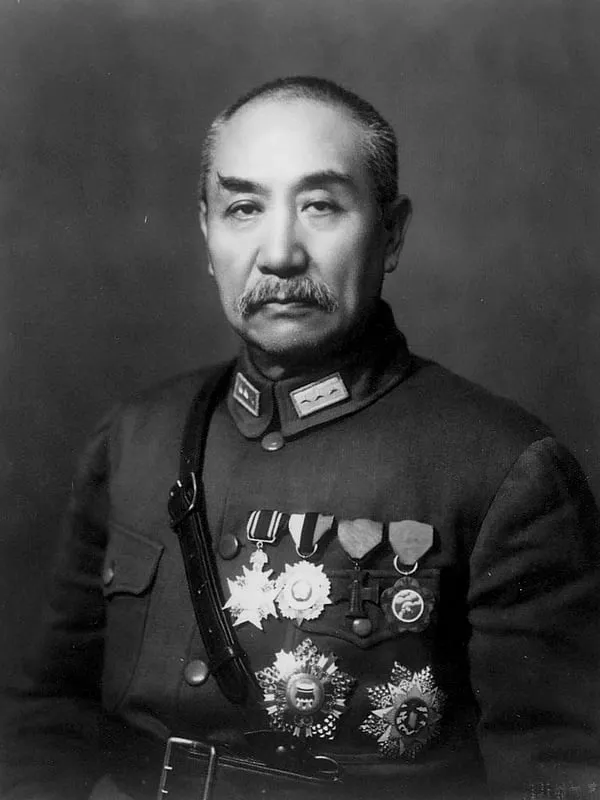
- Born:
- 8 October 1883, Hebian, Wutai County (Shanxi, Qing China)
- Died:
- 23 May 1960, Taipei
- Author:
- Natalia
- Photo:
- autor nieznany, domena publiczna, Wikimedia Commons

Yan Xishan ruled the mountainous province of Shanxi in northern China longer than any other general of the warlord era: from the revolution of 1911 until the Communists took his capital in 1949. Trained at a Japanese military school, in the 1920s he was regarded as the “model governor”, who built schools, roads and factories instead of making war on his neighbours. In 1930 he tried to wrest control of China from Chiang Kai-shek and lost. In the war against Japan he commanded the 2nd War Area, and in the autumn of 1937 he fought some of the heaviest battles of its first year in Shanxi; later, pushed back into the mountains, he played a three-sided game with the government in Chongqing, with the Communists and with the Japanese. He himself said that he was dancing on three eggs. Towards the end of his life he was the last Premier of the Republic of China on the mainland.
Youth and Japan
He was born on 8 October 1883 in the village of Hebian in Wutai County, in central Shanxi, into a family of small merchants and moneylenders. He lost his mother early and was brought up by his grandmother. After a Confucian school he helped his father in business, and when the family went bankrupt he entered a free military school in Taiyuan in 1901. In 1904 he was sent to study in Japan, first at the Shinbu Gakkō preparatory school in Tokyo and then at the Imperial Japanese Army Academy, from which he graduated in 1909.
His five years in Japan shaped him for life. He witnessed Japan’s victory over Russia in 1905 and concluded that its strength came from its ability to mobilise the whole of society. In 1905 he joined the Tongmenghui, the revolutionary league of Sun Yat-sen that sought to overthrow the Qing dynasty. On his return home he became an instructor and then a regimental commander in the New Army in Shanxi, among whose young officers conspiracy was rife.
Revolution and the warlord era
When the Xinhai Revolution broke out in October 1911, the officers of the New Army in Taiyuan rose on 29 October, killed the provincial governor and declared the province independent of the Qing. Yan, commander of one of the regiments, became military governor of Shanxi. Before long the troops of Yuan Shikai occupied much of the province, and Yan, rather than fight a stronger opponent, came to terms with him: he did not support the “Second Revolution” against Yuan in 1913 and in 1915 even backed his plan to proclaim himself emperor. This allowed him to survive. After Yuan’s death in 1916 China broke up into the domains of the generals, and in 1917 Yan also became civil governor, from then on ruling Shanxi unchallenged.
For the next decade, during the warlord era, he kept the province out of the great civil wars, making and breaking alliances so as always to be on the stronger side. During this time he built his own model of the state in Shanxi. He proclaimed a programme of “Six Policies”: irrigation, afforestation, sericulture, the suppression of opium, the cutting of queues and the campaign against the binding of women’s feet. He introduced compulsory schooling, and by the early 1920s most children of school age attended school, something exceptional in the China of the day. He built one of the country’s largest arsenals in Taiyuan, and in the 1930s, under a ten-year plan, a state industrial combine, mines, ironworks and a railway running the length of the province. Foreigners called him the “model governor” and Shanxi the “model province”, although many of his reforms remained on paper.
With Chiang Kai-shek and against him
In 1927, as the armies of the Kuomintang advanced north in the Northern Expedition, Yan recognised the Nationalist government, raised its flag and moved against Zhang Zuolin, the ruler of Manchuria and Beijing. In June 1928 his troops were the first to enter Beijing, which brought the expedition to an end. Chiang rewarded him with the posts of Minister of the Interior and deputy commander-in-chief, and with control of Hebei, Beijing and Tianjin.
The alliance did not survive the drive for centralisation. When Chiang began to cut back the provincial armies, Yan, together with Feng Yuxiang, Li Zongren and the Kuomintang left under Wang Jingwei, rose against Nanjing in 1930. The result was the Central Plains War, the largest civil war of those years. Yan’s troops occupied much of Shandong, including Jinan, and he himself headed a rival government in Beijing. The outcome, however, was decided by Zhang Xueliang, who in September 1930 declared for Chiang and occupied Beijing. Yan stepped down and fled to Dalian, in territory leased by Japan.
In August 1931 he returned secretly to Shanxi, and after the Mukden Incident Nanjing, needing unity in the face of Japan, made its peace with him. In 1932 Yan was appointed head of the Pacification Office in Taiyuan and once again ruled the province, formally as a subordinate of the central government but in practice on his own.
Between Japan and the Communists
After seizing Manchuria, Japan began to put pressure on the provinces of northern China, hoping that Yan, a graduate of a Japanese academy and an admirer of Japanese modernisation, would cooperate. In 1935 he held talks with the Japanese, but rejected their proposal for an “autonomous” northern China and warned publicly that Japan wanted to conquer the whole country. At the same time he feared the Communists. In February 1936 the Red Army crossed the Yellow River into Shanxi and routed his troops; it was driven out only with the help of divisions sent by Chiang, which then stayed in the province. In the autumn of 1936 Yan’s soldiers under Fu Zuoyi, in the Suiyuan campaign, beat off the Japanese-backed Mongol forces of Prince Demchugdongrub and on 24 November took Bailingmiao, news that was greeted with enthusiasm across China.
Concluding that Japan and Nanjing were more dangerous to him than the Communists, in 1936 Yan reached a secret understanding with the latter. He allowed Communist activists such as Bo Yibo to run the Sacrifice League for National Salvation, set up under his patronage to mobilise the population for resistance. During the Xi’an Incident in December 1936 he called for Chiang’s release and for the agreement that paved the way for the Second United Front.
The war for Shanxi
After the Marco Polo Bridge Incident in July 1937 Yan became commander of the 2nd War Area, covering Shanxi, Suiyuan, Chahar and northern Shaanxi. His deputy was the Communist Zhu De, commander of the Eighth Route Army, which entered Shanxi. In the autumn of 1937 some of the heaviest battles of the war’s first year were fought in Shanxi. At the Pingxingguan pass and at Xinkou, Yan’s troops, government divisions and the Communists held up the Japanese 5th Division of General Seishirō Itagaki and other units for several weeks. Yan tried to halt his troops’ retreat with an iron hand and had General Li Fuying shot for abandoning his positions without orders. When the Japanese broke through the Niangziguan pass to the east, the defence collapsed and Taiyuan fell on 8 November. The Battle of Taiyuan cost the Japanese many thousands of dead and destroyed much of Yan’s army.
Yan moved his headquarters to Linfen, and when in February 1938 the Japanese took that town too and reached the Yellow River, he withdrew into the mountains of western Shanxi and, in the winter of 1938–1939, across the river to Qiulin in Shaanxi. Later he set up his headquarters at Kenanpo in Ji County, in the mountains of western Shanxi. The Japanese held the towns and railways, while the countryside was divided among his soldiers, the government divisions and the Communists. The volunteer New Army that Yan had allowed to be raised in 1937 grew to several tens of thousands of men and obeyed the Communist Party rather than him.
In the spring of 1939 Yan decided to regain control of it: he abolished its political commissars and assigned officers from his old army to its units. In late November and early December 1939, in the first days of the Chinese winter offensive, fighting broke out in western Shanxi between his troops and units of the New Army, most of which went over to the Communists. The Communists accused Yan of treachery and collusion with the Japanese; he and the government in Chongqing spoke of a mutiny. The 2nd War Area’s offensive, which around the turn of the year included the fighting near Changzhi, failed to achieve its aims. From then on Yan controlled only part of south-western Shanxi.
The three-sided game
In 1940 Ryūkichi Tanaka, an old acquaintance of Yan’s, became chief of staff of the Japanese 1st Army in Shanxi, and the Japanese launched the so-called Operation Yan, intended to draw him into cooperation against the Communists and perhaps even to persuade him to break with Chongqing. The talks dragged on for years. In September 1941 envoys agreed a preliminary ceasefire, but in return Yan demanded the withdrawal of Japanese troops from much of Shanxi, together with weapons, food and money, and he refused to announce a break with Chiang Kai-shek. A meeting with the Japanese in May 1942 produced nothing, and the Japanese again tried to force his hand with a blockade and attacks. Later both sides observed an informal truce and traded with each other, and in 1944 Yan’s troops fought mainly against the Communists. Also involved in the talks was Daisaku Kōmoto, the organiser of the 1928 assassination of Zhang Zuolin, by then head of a Japanese industrial combine in Taiyuan. The American diplomat John S. Service wrote that Yan had “two faces for the government, two for the Japanese, two for the Communists and two for the people”.
Civil war and Taiwan
After Japan’s surrender in August 1945 Yan returned to Taiyuan in an armoured train guarded by Japanese soldiers. Instead of handing them over for repatriation, he enlisted several thousand to over ten thousand Japanese soldiers and officers into his army, and the Japanese general Raishirō Sumita became his adviser. His first attempt to recover south-eastern Shanxi ended in disaster. In the autumn of 1945, in the Shangdang campaign near Changzhi, the Communist forces of Liu Bocheng and Deng Xiaoping destroyed two of his groupings, taking more than 30,000 prisoners. In 1946–1948 Yan lost one part of the province after another until he was left only with encircled Taiyuan, turned into a fortress with thousands of bunkers.
On 29 March 1949, however, he flew to Nanjing to seek help and never returned. The troops of Xu Xiangqian took Taiyuan on 24 April 1949 after a six-month siege. Some of Yan’s commanders and officials took their own lives, and Nationalist propaganda turned them into the legend of the “Five Hundred Perfect Men of Taiyuan”, although the real number of suicides is disputed. So ended his 38 years of rule over Shanxi.
In June 1949, as the Nationalist government fled south, the Legislative Yuan in Canton (Guangzhou) confirmed Yan as Premier and Minister of Defence. He tried without success to reconcile the acting president, Li Zongren, with Chiang Kai-shek, who had formally stepped down but kept control of the army and the treasury. When the government lost the whole of the mainland at the end of 1949, Yan moved to Taiwan in December. In March 1950, after Chiang had resumed the presidency, he resigned as Premier. He spent his last ten years as a presidential adviser without real power, at his home in the Yangmingshan mountains near Taipei, writing books on philosophy and politics. He died on 23 May 1960 and was buried there.
Significance
Yan Xishan was one of the last great warlords to survive from the era of China’s fragmentation until the Communist victory. In the autumn of 1937 his troops fought some of the hardest battles of the early phase of the war, and later, when the front stagnated, Yan became the archetype of the leader prepared to talk to anyone in order to survive. His conflict with the New Army at the turn of 1939 and 1940 was one of the first open clashes between Nationalists and Communists during the war against Japan, and a harbinger of the civil war that broke out after 1945. In the People’s Republic of China he was portrayed for decades as a reactionary and a collaborator; only since the 1980s has he been written about more favourably, with recognition of his reforms and his resistance in 1937.
Sources
Commanded in battles
(01)Mentioned in battles
(01)Often appears with
People who appear in the same events.