1943–1944: Operation Cartwheel
New Georgia campaign
- Dates:
- 21 June – 25 August 1943
- Front:
- Pacific
- Location:
- The New Georgia group in the central Solomon Islands: New Georgia itself (Segi Point, Viru, Zanana, Munda, Enogai and Bairoko), Rendova, Vangunu, Arundel and Kolombangara, and the waters of Kula Gulf and New Georgia Sound (“the Slot”)On the battle map →
- Sides:
- United StatesWilliam Halsey, Richmond Turner, Oscar Griswold, John HesterJapanNoboru Sasaki, Minoru Ōta
- Result:
- American victory. Munda airfield was taken on 5 August 1943, and organised resistance on New Georgia ended on 25 August. A campaign planned for one division consumed the strength of four, and most of the Japanese garrison managed to withdraw to Kolombangara.
- Author:
- Łukasz
Name and dates
The New Georgia campaign is the name given to the fighting between American ground, Marine, naval and air forces and the Japanese for the New Georgia group of islands in the central Solomon Islands. It was the first part of Operation Cartwheel – the Allied plan to encircle and isolate the great Japanese base at Rabaul – and one stage of the wider Solomon Islands campaign. The landings themselves were codenamed Toenails. The main objective was the Japanese airfield on Munda Point, on the western coast of New Georgia.
The limits of the campaign are drawn in different ways. The plan called for the landings to begin on 30 June 1943, and some accounts date the campaign from that day. The first American troops, however, came ashore on New Georgia as early as 21 June, when two companies of the 4th Marine Raider Battalion were rushed to Segi Point to protect a threatened coastwatcher station. For this reason John Miller, in the US official history (“Cartwheel: The Reduction of Rabaul”, 1959), writes of a campaign that lasted “more than four months from the Marines’ landing at Segi Point”, and that day can be regarded as its beginning. The closing date is taken to be 25 August 1943, when, according to Miller, the Americans occupied the shores of Bairoko Harbour without a fight and organised Japanese resistance on New Georgia itself came to an end. Fighting continued afterwards on neighbouring Arundel Island (until 20–21 September), and the Japanese evacuated Kolombangara by the beginning of October; the landing on Vella Lavella on 15 August and the fighting on that island, which dragged on until 6–7 October 1943, are usually counted as part of the campaign in its broader sense.
Background
The Japanese occupied New Georgia in 1942, and in mid-November, at the height of the fighting for Guadalcanal, they secretly began building an airfield on Munda Point – the crowns of the coconut palms above the works were reportedly suspended on cables to hide them from airmen for as long as possible, and the Americans grasped the enemy’s intentions only at the beginning of December. The airfield came into operation in December 1942 and from then on shortened the route of Japanese aircraft flying from Rabaul to Guadalcanal. When, after the end of the fighting on Guadalcanal on 9 February 1943, the Americans began to think about advancing further up the archipelago, Munda became the obvious target: air raids and naval bombardments were not enough, because the Japanese repaired the runway within a few hours of each attack. The airfield had to be taken on land.
As early as 21 February 1943 the forces of Admiral William Halsey occupied, unopposed, the Russell Islands, which lie between Guadalcanal and New Georgia and became the forward base for the coming operation. On the night of 5–6 March American cruisers bombarding Munda and the Vila airfield on Kolombangara sank two Japanese destroyers returning from a supply run in the Battle of Blackett Strait. At the same time, in March 1943, the US Joint Chiefs of Staff approved a plan under which the forces of General Douglas MacArthur were to advance along New Guinea and those of Halsey up the Solomon Islands, so as eventually to close a pincer around Rabaul. New Georgia lay west of the 159th meridian, and therefore within MacArthur’s area; Halsey thus conducted the operation under MacArthur’s general directives but with his own forces, while answering to Admiral Chester Nimitz in matters of supply.
By then Japan was already on the defensive. At the beginning of March its convoy to Lae had been destroyed in the Battle of the Bismarck Sea, and on 18 April Admiral Isoroku Yamamoto’s aircraft was shot down over Bougainville. The army and navy could not agree on a common strategy: the army preferred to make its stand only in the northern Solomons, while the navy wanted to keep the Allies as far from Rabaul as possible. As a result the defence of the central Solomons was entrusted to the navy, and from 2 July command on the spot was exercised by Major General Noboru Sasaki, commander of the Southeastern Detachment, to whom Rear Admiral Minoru Ōta’s 8th Combined Special Naval Landing Force was also subordinated. According to Miller, Sasaki had about 10,500 soldiers and sailors on New Georgia and Kolombangara, divided roughly equally between them; other studies give higher figures that include the reinforcements sent in July.
The American plan, drawn up by Halsey’s staff and by the commander of the amphibious force, Rear Admiral Richmond Turner, provided for simultaneous landings on 30 June 1943 at four points: at Wickham Anchorage off Vangunu Island, at Segi Point and Viru Harbour on the southern coast of New Georgia, and on Rendova, which lies across Blanche Channel opposite Munda. From Rendova the artillery was to shell the airfield, and from there the infantry was to cross to New Georgia. The core of the ground forces was Major General John Hester’s 43rd Infantry Division, a National Guard division from New England with no combat experience; Hester also commanded the New Georgia Occupation Force as a whole. The planners assumed that one division would be enough to take Munda.
Course: Segi Point and Rendova (21 June – 1 July)
The plan was changed by events at Segi Point, on the south-eastern tip of New Georgia. This was the home of Donald Kennedy, a New Zealand official of the British colonial administration and, since 1942, a coastwatcher, who with the help of the local people reported Japanese movements, rescued downed airmen and maintained a band of guerrillas. In mid-June part of a Japanese battalion set out from Viru Harbour to finish him off. On 20 June Kennedy radioed that he was withdrawing into the interior and asked for help. Losing Segi would have deprived the Americans of the ground for a planned airfield, so Turner at once sent from Guadalcanal, on two fast destroyer-transports, the forces he had to hand – Lieutenant Colonel Michael Currin’s 4th Marine Raider Battalion, less two companies. At dawn on 21 June 1943 the Marines came ashore by the light of fires lit by Kennedy. There were no Japanese. The next day two companies of the 103rd Infantry Regiment and an airfield survey party arrived; a naval construction battalion (Seabees) began clearing the jungle on 30 June, and by 11 July the strip at Segi was already taking fighters.
From Segi, Currin’s raiders set off on 27 June in rubber boats and then through the jungle towards Viru Harbour. The march through swamps and streams took longer than expected: the Marines reached the harbour on the evening of 30 June and took it the following day with the support of dive bombers. Meanwhile, on 30 June, troops of the 103rd Regiment and the remaining raider companies landed on Vangunu and moved on Wickham Anchorage.
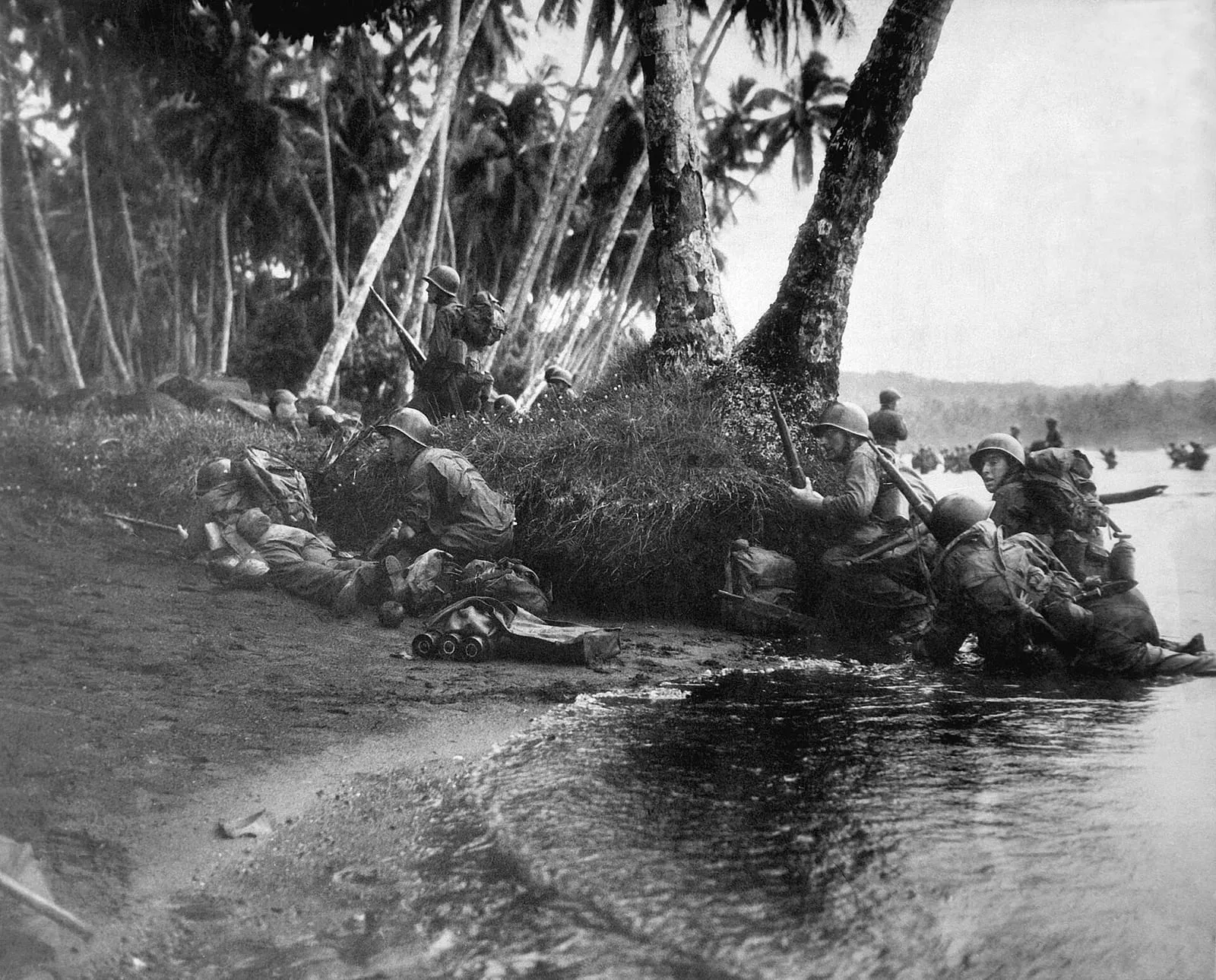
The main blow fell on Rendova on 30 June. Before dawn companies of the 169th Infantry Regiment and a detachment of islanders trained by New Zealanders seized the islets closing Blanche Channel, and from 6.40 a.m. elements of the 172nd Infantry Regiment, the 9th Marine Defense Battalion and the Seabees streamed onto Rendova’s beaches – some 6,000 men in the first wave. The small Japanese garrison of the island withdrew after a brief fight. Unloading was the bigger problem: torrential rain turned the beaches into mud in which vehicles and equipment became bogged down. Japanese aircraft from Rabaul reacted only towards midday; in the course of the day several dozen Japanese aircraft were shot down over Blanche Channel, but in the afternoon a torpedo from one of the bombers struck Turner’s flagship, the transport McCawley. In the evening American PT boats, taking the crippled ship for an enemy vessel, fired more torpedoes into her and McCawley sank. Even so, by evening 105 mm howitzers were already in position on Rendova, and over the following days they were joined by Army and Marine 155 mm guns and howitzers, which shelled Munda airfield across the channel.
Course: Zanana, Kula Gulf and Kolombangara (2–14 July)
The infantry crossed to New Georgia on 2 July. Laiana beach, only about 3 km from the airfield, was strongly defended, so Zanana, a few kilometres further east, was chosen instead. The landing went off without loss, but from then on two regiments of the 43rd Division – the 169th and 172nd – had to fight their way towards Munda through virgin jungle, hills and swamps, along narrow tracks on which it was hard to bring up ammunition and food, and harder still to carry out the wounded. Samuel Eliot Morison later judged the choice of Zanana to be one of the campaign’s main mistakes.
On the night of 4–5 July Turner put ashore at Rice Anchorage on Kula Gulf, on the island’s northern coast, Colonel Harry Liversedge’s Northern Landing Group: the 1st Marine Raider Battalion and two infantry battalions of the 37th Division. Its task was to cut the trail from Bairoko along which the Japanese were moving reinforcements from Kolombangara to Munda. That same night Japanese destroyers carrying troops to Kolombangara torpedoed, from long range, the destroyer Strong, which was covering the landing. On the afternoon of 5 July reconnaissance reported another run by Japanese destroyers, and Halsey turned back Rear Admiral Walden Ainsworth’s cruisers. In the night Battle of Kula Gulf of 5–6 July Japanese torpedoes sank the light cruiser Helena; the Japanese lost the destroyer Niizuki, on which the force commander, Rear Admiral Teruo Akiyama, was killed, and Nagatsuki, which ran aground and was destroyed by aircraft the following day. According to Miller, however, they managed to land some 850 troops at Vila.
On land, the advance from Zanana got properly under way on 9 July and almost at once bogged down at the Barike River. The Japanese of Colonel Genjirō Hirata’s 229th Infantry Regiment defended themselves from dugouts of palm logs and coral, almost invisible in the undergrowth, and at night infiltrated the American bivouacs, shouting, firing into them and throwing grenades. The inexperienced soldiers of the 43rd Division fired blindly and did not sleep; in the 169th Regiment it came to the point where men wounded and killed one another in the dark. In the north Liversedge advanced slowly through the jungle, but on 10–11 July his Marines took the Japanese position at Enogai Inlet, together with the guns that had been firing on the entrance to Kula Gulf.
The Japanese kept strengthening their defences. On the night of 12–13 July Ainsworth, this time with three cruisers – including the New Zealand Leander – and ten destroyers, intercepted another convoy north of Kolombangara. In the Battle of Kolombangara concentrated American fire sank the light cruiser Jintsū with almost her entire crew and the force commander, Rear Admiral Shunji Izaki, but Japanese torpedoes damaged all three Allied cruisers and sank the destroyer Gwin, and some 1,200 Japanese troops reached Kolombangara. Meanwhile Hester, wanting to shorten his supply lines, sent the 172nd Regiment south through the jungle towards Laiana beach; the regiment reached it on 13 July, and the next day a battalion of the 103rd Regiment, with a platoon of Marine tanks, landed at Laiana under Japanese artillery fire. From then on supplies could be shipped to the front directly from Rendova.
Course: crisis and change of command (15–31 July)
By mid-July the drive on Munda had come to a complete standstill. Major General Oscar Griswold, commander of XIV Corps and Hester’s immediate superior, had arrived on Rendova on 11 July as an observer, and by 13 July he was reporting that things were “going badly” and that the 43rd Division would never take Munda because it was “about to fold up”. He demanded that the rest of the 37th Division and part of the 25th Division be sent at once. Halsey then gave the commander of Army forces in the South Pacific, Lieutenant General Millard Harmon, full responsibility for ground operations on New Georgia. At midnight on 15–16 July Griswold took command of the whole Occupation Force, leaving Hester to concentrate on his own division alone. At the same time, on 15 July, Turner – transferred to the Central Pacific to prepare landings in the Gilbert Islands – was replaced at the head of the amphibious force by Rear Admiral Theodore Wilkinson.
The Japanese tried to exploit the confusion. Sasaki brought over from Kolombangara Colonel Satoshi Tomonari’s 13th Infantry Regiment and threw it against the right flank and rear of the 43rd Division. On the night of 17–18 July the Japanese simultaneously attacked the division’s command post near Zanana and the bivouacs of the engineers and medical units, and in an ambush at the Barike River finished off several wounded men of the 169th Regiment; the attackers broke into the command post’s signal centre and wrecked the lines before they were driven off, while the artillery laid down a barrage around it all night. Tomonari withdrew without achieving his aim, and Sasaki was – as Miller writes – disappointed. In the north, on 20 July, Liversedge, reinforced by the 4th Raider Battalion, attacked Bairoko. The Marines and the men of the 148th Regiment ran into superbly prepared Japanese bunkers with machine guns and mortars, without artillery or air support, and the next day had to fall back to Enogai. The two raider battalions lost 46 killed and 161 wounded.
The most alarming phenomenon was the soldiers’ mental state. According to figures cited by Miller, between 30 June and 30 September some 2,500 men of the Occupation Force were diagnosed with so-called war neurosis; the 43rd Division accounted for 62 per cent of these cases in July alone, and about 1,500 of the casualties came from its three infantry regiments – 700 from the 169th, 450 from the 172nd and 350 from the 103rd. The XIV Corps surgeon, Colonel Franklin Hallam, concluded that in most cases this was extreme combat fatigue rather than true neurosis: the result of night attacks, lack of sleep, rain, poor food, disease and inexperience, as well as the poor training of officers. The new command set up rest camps on the islets in Blanche Channel with hot meals, baths and clean clothing, and improved the evacuation of the wounded and the building of roads; bulldozers shielded with steel plates cut from the wrecks of Japanese barges carved tracks through the jungle. On 29 July Harmon, judging that Hester was exhausted, replaced him at the head of the 43rd Division with Major General John Hodge of the Americal Division, a veteran of Guadalcanal.
Course: the XIV Corps offensive and the capture of Munda (25 July – 5 August)
Griswold had no intention of renewing piecemeal attacks. For ten days he reorganised supply, brought up reinforcements – the rest of Major General Robert Beightler’s 37th Division and the 161st Infantry Regiment of the 25th Division – and prepared an attack by the whole corps. The offensive opened on 25 July after a half-hour bombardment by destroyers and a heavy air raid: the 43rd Division was to advance along the coast towards the airfield, and the 37th Division, on its right flank, westwards through the hills towards Bibilo Hill, so as to outflank the defences from the north.
The first days brought little progress. The Japanese line consisted of hundreds of dugouts of palm logs and coral, sunk into the ground so that barely a few dozen centimetres showed above the surface, screened by undergrowth and mutually supporting. Every ridge – Horseshoe Hill, Bartley Ridge, Shimizu Hill – had to be taken separately. The Americans at last learned to coordinate infantry with Marine tanks and flamethrowers: the tanks fired into the embrasures at close range, while flamethrower operators crawled forward under their cover and burned out the defenders. The Japanese infantry responded by attacking the tanks with mines and grenades, and Colonel Hirata urged his men to kill ten Americans for every Japanese killed and to fight to the death. At the end of July Tomonari’s 13th Regiment struck the right flank of the 37th Division and cut the supply route of the 148th Regiment, which had pushed far ahead and had to fight its way back; in one of these clashes, on 31 July, Private Rodger Young was killed while throwing a grenade at a Japanese machine gun that had pinned down his platoon, and was posthumously awarded the Medal of Honor.
The Japanese, however, were at the end of their strength. Their units, harried by artillery fire and air raids, sick and hungry, were melting away, and communications with Rabaul kept breaking down. On 29 July a staff officer of the 8th Fleet passed Sasaki the order to withdraw to a line running inland from Munda Point and to abandon the airfield. The Americans noticed the retreat on 1 August and pressed forward faster. The 43rd Division, under Hodge’s command since 29 July, reached the edge of the airfield, and the 37th Division reached Bibilo Hill. On 5 August 1943, after the last bunkers on Kokengolo Hill had been taken, the infantry crossed the runway, strewn with craters and the wrecks of Japanese aircraft. “Munda is yours as of 2.10 p.m.,” Brigadier General Leonard Wing reported to Hodge by telephone. Griswold informed Halsey that his troops had “wrested Munda from the Japs” and presented it to the admiral “as the sole owner”, and Halsey replied with a “receipt”. The Seabees at once began repairing and lengthening the runway; on 13 August the first Allied aircraft landed on it, and on 14 August two squadrons of Marine Corsair fighters began operating from it.
On the night of 6–7 August the Japanese made a last attempt to reinforce the garrison. In the Battle of Vella Gulf six American destroyers under Commander Frederick Moosbrugger surprised four Japanese destroyers bound for Kolombangara and sank three of them with torpedoes – with troops on board – without losing a single ship.
Course: Bairoko and the Japanese withdrawal (6–25 August)
After the fall of the airfield Sasaki no longer intended to hold New Georgia. His task from then on was to delay the Americans for as long as possible, to give Japan time to fortify the northern Solomons, and above all to save his men. On the night of 8–9 August he moved his headquarters to Kolombangara, leaving a covering force on New Georgia. The regiments of Major General J. Lawton Collins’s 25th Division set off through the jungle to the north and west, towards the village of Zieta (taken on 15 August), Piru Plantation and Bairoko Harbour, where they were to link up with Liversedge’s group; the 37th Division cleared the coast north-west of Munda. On 20–21 August men of the 169th and 172nd Regiments seized the islet of Baanga, from which Japanese guns had been shelling the airfield. All this time, under cover of darkness, Japanese barges were taking troops from Bairoko to Kolombangara. When the Americans entered Bairoko Harbour on 25 August, they took it without a fight – Sasaki’s main force had slipped away, moving lightly equipped through the jungle faster than the American columns weighed down with equipment. On that day organised resistance on New Georgia itself came to an end.
In parallel, Halsey decided on a move that was to become a model for the rest of the Pacific war. Instead of taking strongly held Kolombangara, where Sasaki had concentrated some 10,000–12,000 men, he resolved to bypass it and strike at the more weakly defended island of Vella Lavella, further north-west and closer to Bougainville. On 15 August 1943, after the ground had been reconnoitred by patrols landed there back in July, some 6,500 soldiers and sailors under Brigadier General Robert McClure, mainly of the 35th Infantry Regiment, landed under the cover of Wilkinson’s destroyers at Barakoma, on the south-eastern tip of the island. Japanese aircraft attacked the beachhead but could not disrupt the landing, and a fighter airfield was quickly built on Vella Lavella. Kolombangara, cut off from supplies, lost its importance.
Further fighting after 25 August
The New Georgia campaign in its broader sense went on for more than a month. On 27 August the 172nd Regiment landed on Arundel Island, which lies between New Georgia and Kolombangara. Sasaki let the Americans come ashore and then counter-attacked at many points, tying down much larger forces; only the arrival of reinforcements and Marine tanks broke the resistance, and on the night of 20–21 September the Japanese abandoned the island. On Vella Lavella, from September, Major General Harold Barrowclough’s 3rd New Zealand Division fought on, pushing the Japanese back into the north-western tip of the island. Between 28 September and 4 October the Japanese navy evacuated the garrison of Kolombangara by night in destroyers and barges, and on the night of 6–7 October it took off the last 600 or so troops from Vella Lavella; the destroyers covering the evacuation then clashed with American ones, and each side lost one ship. According to Miller, the Japanese managed in this way to save some 9,400 men in all from the New Georgia group, who would go on to fight on Bougainville and at Rabaul. Miller pays tribute in this context to “the stubborn General Sasaki”, who with much weaker forces had held off almost four Allied divisions.
Casualties
Casualty figures vary depending on the source and on how the campaign is defined. Miller’s US official history, drawing on the report of the New Georgia Occupation Force, gives 1,094 killed and died of wounds and 3,873 wounded for the ground forces on New Georgia; the 43rd Division suffered most, with 538 killed and 1,942 wounded. Miller stresses that these figures cover only casualties from enemy fire, not the sick – from malaria, dysentery and other tropical diseases – nor the victims of combat fatigue, who numbered several thousand. Other tallies, which also include the navy and air forces, speak of about 1,200 Americans killed and nearly 100 aircraft lost. At sea the Americans lost the light cruiser Helena, the destroyers Strong and Gwin and the transport McCawley during the campaign.
Japanese losses cannot be established precisely. The XIV Corps staff counted 2,483 bodies of Japanese soldiers, not including Vella Lavella; some studies give a lower figure of about 1,700 killed, others higher estimates that include deaths from disease and starvation. In the battles of Kula Gulf, Kolombangara and Vella Gulf the Japanese navy lost the cruiser Jintsū and five destroyers, and the air forces at Rabaul – according to American figures – several hundred aircraft and many experienced pilots whom Japan could no longer replace.
Significance
The New Georgia campaign ended in American victory, but little in it went according to plan. An operation allotted one division and a few weeks consumed the strength of four divisions and lasted more than two months, and most of the Japanese garrison escaped to the north. Samuel Eliot Morison, the historian of the US Navy, called it “the least intelligently conducted land campaign of the Pacific war (with the possible exception of Okinawa)”, and regarded the choice of the beach at Zanana and the failed outflanking manoeuvre of the 43rd Division in July as its greatest mistakes. The campaign showed how hard it was for untried troops to fight a well dug-in enemy in the jungle, and it became a lesson for the US Army: from then on more attention was paid to jungle-warfare training, to coordination between infantry, tanks and flamethrowers, to the rotation of units and to the treatment of combat fatigue.
More important, however, was the strategic lesson. Bypassing Kolombangara and landing on Vella Lavella was the first clear-cut example in the South Pacific of leapfrogging strongly defended positions, which Halsey and MacArthur would later repeat on an ever larger scale. The capture of Munda and Vella Lavella gave the Allies airfields from which fighters could cover the next step: in November 1943 the Americans landed on Bougainville, and in 1944 Rabaul, instead of being stormed, was surrounded and neutralised. For Japan, New Georgia was another stage in the attrition of its forces, especially its aircraft and destroyers, in fighting on the periphery of the empire; in the autumn of 1943 the Japanese high command moved the line it intended to hold at all costs far to the north and west, leaving the bases in the Solomon Islands and at Rabaul to their fate.