Equipment
Avro Lancaster
The four-engined bomber that from 1942 carried the RAF's night offensive over Germany, from Cologne and the Ruhr dams to Dresden and food drops.
- Role:
- heavy bomber
- State:
- United Kingdom
- Maker:
- Avro (A.V. Roe and Company)
- First flight:
- 9 January 1941
- Built:
- 7,377
- Author:
- Łukasz
- Updated:
- 1 November 2026
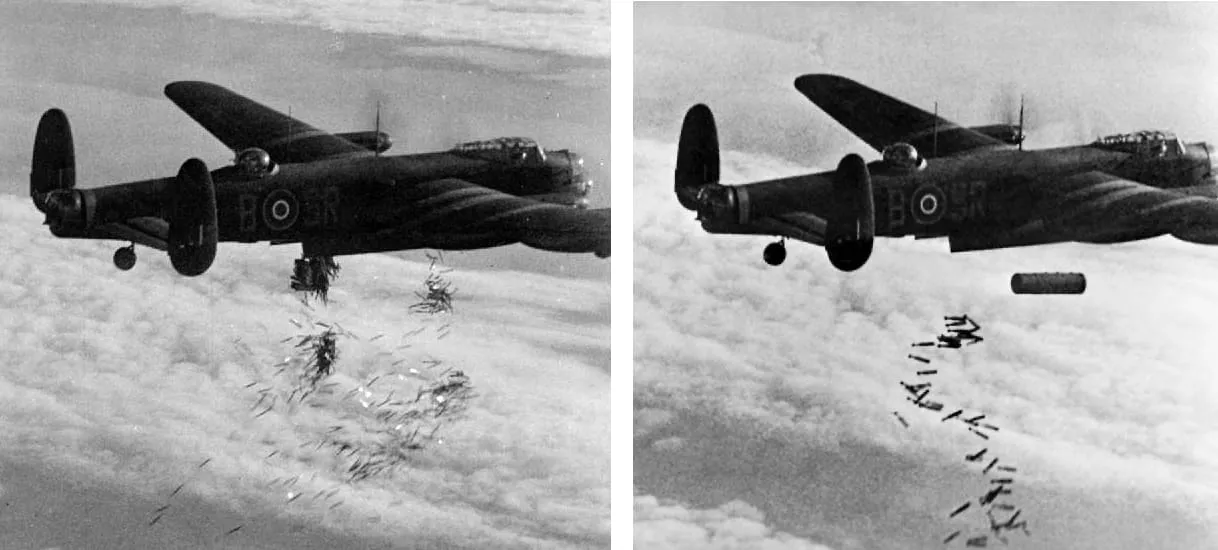
The Avro Lancaster was the most important British bomber of the Second World War and the instrument with which RAF Bomber Command waged its night offensive against Germany from 1942. It was neither the fastest nor the best armed, but it carried more bombs further than any other British aircraft, and its simple, robust structure adapted easily to new tasks: from ordinary raids on cities to precision attacks on dams, ships and viaducts. Crews from across the British Commonwealth flew Lancasters, and so did Poles. The same versatility, however, cost the lives of tens of thousands of airmen and German civilians.
Out of the Manchester’s failure
The Lancaster was born of a failed aircraft. Avro of Manchester built, to Air Ministry requirements of 1936, the twin-engined Avro Manchester bomber, which entered service in November 1940. Its new Rolls-Royce Vulture engines overheated, broke down and never gave the promised power. As early as 1940 Avro’s chief designer Roy Chadwick proposed a way out: a longer wing and four proven Rolls-Royce Merlin engines in place of two unreliable ones. The prototype BT308, converted from a Manchester airframe, was first flown at Ringway near Manchester on 9 January 1941 by the test pilot H.A. “Sam” Brown.
The new machine was at once far better than its predecessor, so Manchesters still standing on the assembly lines were completed as Lancasters. Production was spread over several factories: Avro’s main works at Chadderton, which survived the German raids on Manchester, and also Metropolitan-Vickers, Armstrong Whitworth, Vickers-Armstrongs, Austin and Canada’s Victory Aircraft. Because Merlins were short, a small series with Bristol Hercules radial engines was also built, and the B.III version was powered by Merlins made under licence by the American firm Packard. The heart of the aircraft was its long, unbroken bomb bay, which could take bombs weighing several tons.
Into battle (1942)
No. 44 Squadron at Waddington received the first aircraft on Christmas Eve 1941. In March 1942 its crews laid the first mines in the Heligoland Bight, and a few days later bombed Essen. The new head of Bomber Command, Arthur Harris, at once judged the Lancaster the best aircraft he had, and until the end of the war he pressed for factories to build it instead of other types. On 17 April 1942 twelve Lancasters of Nos. 44 and 97 Squadrons flew in daylight at low level to Augsburg to bomb the works making engines for U-boats. The factory was hit, but according to different counts between five and seven aircraft failed to return, and the raid showed that a heavy bomber would not survive a daylight sortie deep into the Reich.
For a long time Lancasters were few. In the thousand-bomber raid on Cologne in May 1942 most of the force still consisted of twin-engined Wellingtons. Only over the following year did they become the core of the heavy bomber force alongside the Halifaxes, while the weaker Stirlings and Wellingtons disappeared from raids over Germany.
The height of the offensive (1943–1944)
In 1943 the Lancaster became Harris’s main instrument. It flew in the Battle of the Ruhr, and on the night of 16–17 May nineteen specially modified aircraft of No. 617 Squadron attacked the Möhne and Eder dams in Operation Chastise, dropping the spinning bombs of Barnes Wallis. Eight of them did not return. From November 1943 Lancasters carried most of the weight of the Battle of Berlin: the first raid, on 18 November, involved 440 Lancasters and only four other aircraft. That winter Harris’s force lost several per cent of its aircraft on every major raid, and on the night of 30–31 March 1944 over Nuremberg 95 bombers failed to return, most of them Lancasters.
The aircraft had weaknesses that crews learnt at first hand. It usually had no gun position under the fuselage, so German night fighters with upward-firing Schräge Musik cannon could close in from below unseen. The escape hatch was narrow: according to post-war analyses by British operational researchers, about 15 per cent of the airmen in shot-down Lancasters saved themselves by parachute, against about 25 per cent from Halifaxes and Stirlings.
In spring 1944 Lancasters bombed French railway junctions ahead of the invasion of Normandy, and in summer they supported the ground forces, among other places over Caen. In March 1944 the Polish No. 300 Squadron at Faldingworth received its first Lancasters; it flew its first operation on the night of 18–19 April and its last on 25 April 1945, over Berchtesgaden.
Special bombs and last tasks (1944–1945)
The last year of the war showed what the Lancaster’s bomb bay could do. Nos. 617 and 9 Squadrons dropped Tallboy bombs of about 5.4 tons from it on U-boat pens, railway tunnels and V-weapon sites. On 12 November 1944 such bombs sank the battleship Tirpitz in Norway. From March 1945 a few dozen modified aircraft carried the ten-ton Grand Slam, the heaviest bomb used in this war; the first destroyed a railway viaduct near Bielefeld.
At the same time the raids on cities went on. In February 1945 two night waves of Lancasters attacked Dresden before American B-17s arrived over the city. At the end of April Lancasters were dropping sacks of food instead of bombs for the starving Dutch in Operation Manna, and in May they flew freed prisoners of war home to England. They were also being prepared for the war against Japan as part of Tiger Force, but Japan surrendered first.
The balance
According to British figures, Lancasters flew about 156,000 sorties in 1942–1945 and dropped over 600,000 tons of bombs. 3,249 aircraft were lost in action, and more crashed in accidents. Only a few dozen Lancasters passed a hundred operations. 7,377 were built, and by the end of the war in Europe about fifty squadrons flew them. After the war the RAF replaced them with the enlarged Avro Lincoln (PL), while Canada used them for maritime patrol and aerial photography for more than a decade. A dozen or more survive today, two of them airworthy. For the British the Lancaster remained a symbol of the courage of Bomber Command’s crews; for the people of German cities, a symbol of the nights when their homes burned.
Sources
In the chronicle
(34)1942
- 13 March 1942Gee raids on the Ruhr
- 5 April 1942RAF raids on Cologne and Hamburg
- 30 May 1942The thousand-bomber raid on Cologne
- 2 June 1942The thousand-bomber raid on Essen
- 25 June 1942The thousand-bomber raid on Bremen
- 27 July 1942The RAF raid on Hamburg of 26/27 July
- 10 September 1942The raid on Düsseldorf
- 22 October 1942The raid on Genoa
1943
- 16 January 1943RAF raids on Berlin in January 1943
- 5 March 1943The Battle of the Ruhr begins
- 15 April 1943The raids on Stuttgart and Pilsen
- 16 May 1943Operation Chastise
- 29 May 1943The raid on Wuppertal
- 20 June 1943Operation Bellicose
- 24 June 1943The raid on Elberfeld and the evacuation of the Ruhr
- 3 September 1943The evacuation of Berlin
- 22 October 1943The raid on Kassel
- 18 November 1943The air Battle of Berlin begins
- 27 November 1943Raids on Berlin in November 1943
- 3 December 1943Murrow's "orchestrated hell"