- Category:
- Military operations
- Front:
- Scandinavia
- Date:
- 12 November 1944
- Author:
- Łukasz
- Tags:
- Kriegsmarine, RAF, Norway, United Kingdom
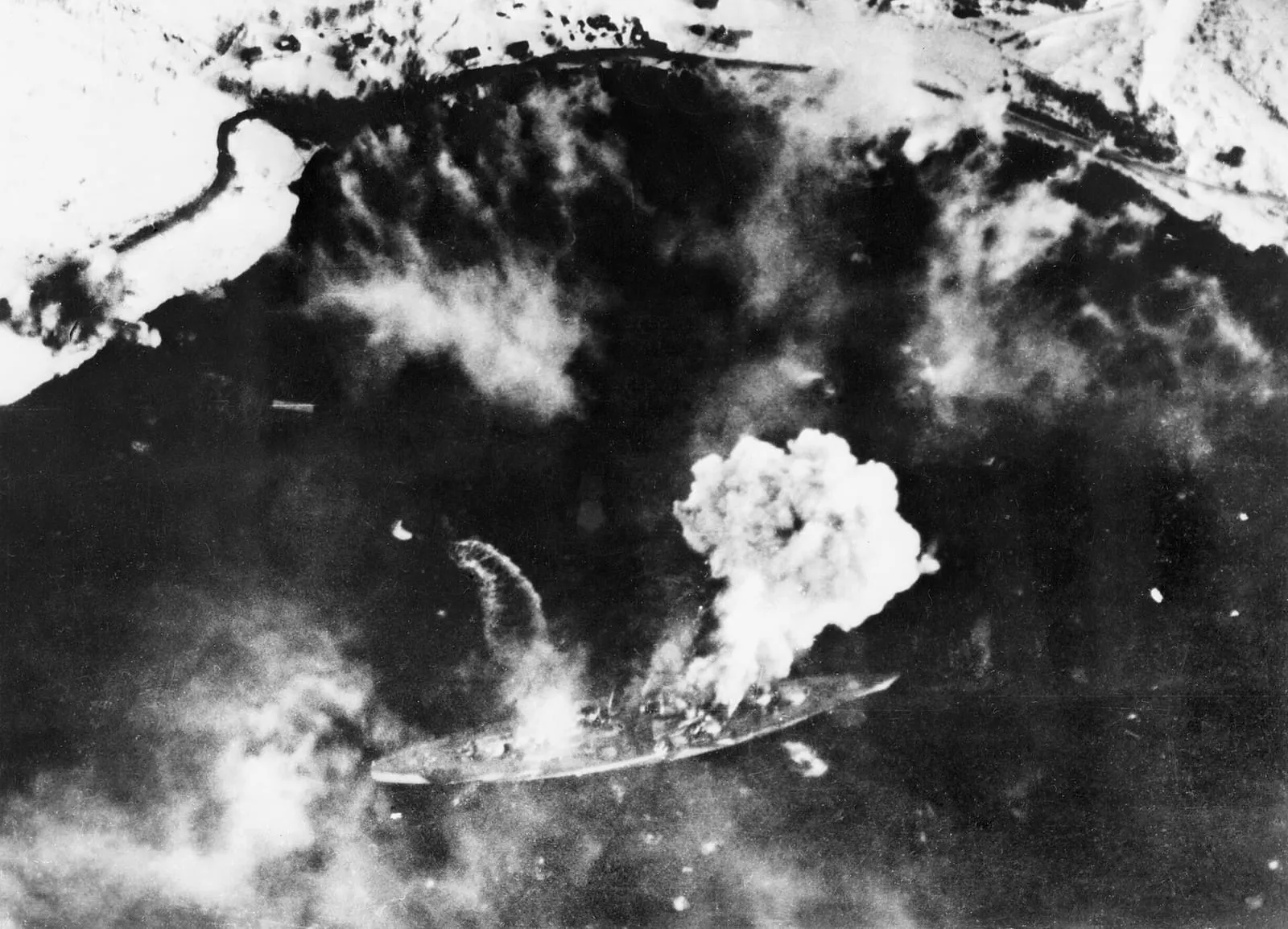
Shortly before noon on 12 November 1944 British Avro Lancaster heavy bombers of Nos. 9 and 617 Squadrons RAF appeared over the islet of Håkøya, a few kilometres west of the Norwegian town of Tromsø. Each carried a single Tallboy bomb weighing about 5.4 tonnes. Within a few minutes at least two of them struck the German battleship Tirpitz, and others exploded in the water close to her port side. The ship heeled over, the magazine of her after turret blew up, and less than a quarter of an hour after the first hit the largest battleship ever built by a European navy lay bottom up in the shallows of the fjord. Between about 950 and more than 1,200 members of her crew were killed – historians’ figures differ, and the most common estimate is about a thousand dead. The British did not lose a single airman. Operation Catechism ended a hunt lasting almost three years for a ship that had spent most of that time in Norwegian fjords, tying down a large part of the British fleet, without ever once fighting a battle against enemy warships.
The statement that Tirpitz sank “after numerous bombings at her anchorage off Tromsø” needs qualifying: almost all the earlier attacks – by midget submarines, by carrier aircraft and the first Lancaster raid – fell on the ship while she lay in Kåfjord in the far north of Norway. Tirpitz came to Tromsø only in mid-October 1944, and before 12 November she had been attacked there only once.
The Bismarck’s sister
Tirpitz was the second ship of the Bismarck class. Launched at Wilhelmshaven on 1 April 1939, she was commissioned in February 1941. Armed with eight 380 mm guns in four turrets (designated Anton, Bruno, Caesar and Dora), after successive modifications she was some 2,000 tonnes heavier than her sister. When in May 1941 the Royal Navy sank the Bismarck, Tirpitz was still completing her training in the Baltic, and the Kriegsmarine command judged that sending her alone into the Atlantic would be too risky.
In November 1941 Grand Admiral Erich Raeder proposed moving the ship to Norway. There she was to threaten the convoys sailing from Britain and Iceland to Murmansk and Archangel and – by her mere presence – deter the Allies from a landing in Norway, which Adolf Hitler feared. In January 1942 the battleship moved to the fjords near Trondheim. The classic naval idea of the “fleet in being” – a ship that need not fight in order to tie down the enemy’s forces – worked to perfection here. The British Home Fleet had to keep modern battleships and aircraft carriers permanently at Scapa Flow, and heavy ships covered the Arctic convoys for part of their route. Prime Minister Winston Churchill called Tirpitz “the Beast” and repeatedly pressed the Admiralty to be rid of her. It was chiefly with her in mind that in March 1942 the British destroyed the great dry dock at Saint-Nazaire – the only one on France’s Atlantic coast able to take so large a ship.
Tirpitz’s combat record was modest. In March 1942 she sortied briefly against convoys PQ 12 and QP 8, failed to find them and herself escaped an attack by torpedo aircraft from the carrier Victorious. In July 1942 the mere fear of her was enough: on 4 July the Admiralty, convinced that the battleship had left her anchorage and would at any moment fall upon convoy PQ 17, ordered the convoy to scatter, and the unescorted merchant ships fell prey to U-boats and aircraft. Tirpitz put to sea in Operation Rösselsprung only the next day and turned back the same day. In September 1943 Tirpitz, together with Scharnhorst, bombarded Allied stations on Spitsbergen – the only time her main guns fired at targets ashore in offensive action.
Three years of attacks
The British tried to reach the battleship almost from the moment she arrived in Norway. Between January and April 1942 RAF bombers attacked her four times in Fættenfjord near Trondheim, suffering losses and scoring no hits. In the autumn of 1942 a Norwegian fishing boat tried to smuggle two Chariot manned torpedoes under the ship, but they broke loose from their tow in a gale just short of the target. From the spring of 1943 Tirpitz lay in Kåfjord, a side arm of the Altafjord in Finnmark, out of range of bombers flying from Britain. There, on 22 September 1943, British midget submarines reached her; the charges they laid in Operation Source put the battleship out of action for more than six months. Three months later, at the Battle of the North Cape, the Royal Navy sank the Scharnhorst, and from then on Tirpitz was the last German heavy ship in the north. In February 1944 Soviet long-range bombers also attacked her, without success.
As the repairs carried out in the fjord neared completion, naval aviation took over. On 3 April 1944, in Operation Tungsten, aircraft from the carriers Victorious and Furious and four escort carriers – above all Fairey Barracuda dive bombers – caught the ship just as she was preparing for sea trials. They scored more than a dozen hits and, according to different authors, killed between 122 and 132 sailors and wounded several hundred, but the light bombs did not penetrate the main armour. Further carrier raids – called off because of the weather in April and May, then on 17 July (Operation Mascot) and in a series of attacks from 22 to 29 August (Operation Goodwood) – achieved almost nothing. The Germans shrouded the anchorage with smokescreens lit within a few minutes of the first alarm, and the Fleet Air Arm’s carrier aircraft and their bombs were too weak for so heavily armoured a target. On 24 August one 1,600-pound bomb did pierce both armoured decks, but it failed to explode.
The Admiralty concluded that further carrier attacks were pointless and handed the task to the bombers. The head of RAF Bomber Command, Air Chief Marshal Arthur Harris, was reluctant to divert forces from the raids on Germany, but he had at his disposal two specialised squadrons of No. 5 Group: No. 617 – famous since the raid on the Ruhr dams in May 1943 – and No. 9. Both flew Lancasters adapted to carry the Tallboy, a bomb designed by Barnes Wallis. Dropped from a great height, the streamlined six-ton bomb approached the speed of sound and could pierce a thick concrete roof or an armoured deck before exploding.
Paravane and Obviate
Kåfjord lay beyond the range of Lancasters flying from Scotland, so the first attack was mounted from the USSR. In September 1944 the bombers flew to Yagodnik airfield near Archangel, and from there on 15 September they set out on Operation Paravane. Despite the smokescreen one Tallboy hit the bow, passed right through the ship and exploded beneath the hull. Some 800–1,000 tonnes of water poured into the bow section. Tirpitz did not sink, but – as was established after the war – she ceased to be a ship capable of fighting at sea: she could make at most 8–10 knots, and full repair would have taken many months and a dock that the Germans did not have in Norway. The British did not know this; aerial photographs did not allow the extent of the damage to be assessed.
In the autumn of 1944 the Red Army was approaching Finnmark, and the Wehrmacht was withdrawing from northern Finland after the Finns’ break with Germany. Grand Admiral Karl Dönitz decided to move the crippled ship south and use her as a floating coastal battery defending the Tromsø area against an expected Allied landing. Dönitz also reckoned that the British would continue to see the battleship as a threat. On 15–16 October Tirpitz made her way to Tromsø under her own power – the last voyage of her career – and anchored off the islet of Håkøya. The spot was chosen because the water there seemed shallow enough for the ship, even if sunk, to settle on the bottom with her guns above the surface. It turned out to be deeper than thought, however, and because of the anti-torpedo nets she could not be moved closer inshore. The Germans therefore began dumping gravel and sand under the hull; by 12 November the work was about half done.
Moving the ship proved a mistake. Tromsø lay within range of Lancasters flying from northern Scotland – provided their mid-upper and front gun turrets and some of their armour were removed and extra fuel tanks and more powerful engines fitted. On 29 October 1944 Nos. 9 and 617 Squadrons attacked the ship in Operation Obviate. The bombers flew over the Norwegian Sea, crossed the coast through gaps in the German radar and assembled over Lake Torneträsk in Swedish Lapland – in violation of Swedish neutrality – so as to come in from the east, where the Germans did not expect an attack. At the last moment cloud covered the target; one bomb exploded close to the stern and damaged the port propeller shaft and the rudder, but there were no hits.
12 November
After Obviate the Germans strengthened their defences: they placed additional anti-aircraft guns and nets around the ship, and two flak ships kept watch over the anchorage. The smoke generators that had repeatedly saved the battleship in Kåfjord were still being installed at Tromsø; in their place were a few fishing boats with smoke-making equipment, too weak to screen the whole ship. Several dozen fighters of Jagdgeschwader 5, recently withdrawn from Kirkenes, were moved to Bardufoss airfield, a few dozen kilometres from Tromsø. The unit, however, was in disarray, and many of its pilots were poorly trained. On 4 November Tirpitz’s commander, Captain Wolf Junge, handed the ship over to his executive officer, Captain Robert Weber. There were about 1,700 men on board; the crew had been reduced, since the ship was no longer going to sea anyway. Weber was counting on the polar night arriving within a few weeks and putting an end to the raids.
The British knew that date too: from the end of November the sun no longer rises over Tromsø, and without daylight aiming the Tallboys would have been impossible. Twice – on 5 and 7 November – the Lancasters flew up to bases in Scotland and then returned because the weather over Norway was bad. On 11 November the aircraft of both squadrons gathered again at Lossiemouth, Kinloss and Milltown. The forecast was uncertain, but the commander of No. 5 Group, Air Vice-Marshal Ralph Cochrane, decided to take the chance. Early on the morning of 12 November 18 aircraft of No. 617 Squadron and 13 of No. 9 Squadron took off; several other No. 9 Squadron bombers could not be cleared of snow and ice in time. They were accompanied by a Lancaster of No. 463 Squadron RAAF, whose task was to film the attack.
The bombers flew singly along the Obviate route: through the gap in the German radar between Mosjøen and Namsos, over the mountains and on to Lake Torneträsk. Two No. 9 Squadron Lancasters arrived late at the rendezvous and turned back. Over the lake the commander of No. 617 Squadron, Wing Commander James Brian “Willie” Tait, fired a signal flare and the force turned north-west. German observation posts had been reporting aircraft for more than an hour, but the reports came through late and the first aircraft were thought to be heading for the USSR. On Tirpitz the air-raid alarm was sounded only at about 8.50 a.m. British time, and the fighters at Bardufoss were scrambled so late that they had no chance of arriving in time. Major Heinrich Ehrler, who was temporarily in command of them, flew to the Tromsø area alone and did not find the bombers.
This time the weather was perfect. Tait spotted the battleship from more than 30 km away – she lay, as he recalled, squat and black among her nets, like a spider in its web. At about 9.38 a.m. Tirpitz opened fire with her main guns using special anti-aircraft shells, but failed to break up the formation. The bombs began to fall a few minutes later; the first Tallboy dropped, from Tait’s aircraft, hit the ship. In under ten minutes 29 bombs were dropped. One pierced the deck beside the forward turret Bruno and did not explode. Another struck the port side amidships, near the aircraft catapult, and exploded above a boiler room, tearing a huge hole in the side and bottom. A third probably hit as well. Several bombs exploded in the water close to the port side: they damaged the hull, blew craters in the seabed and washed away much of the embankment built up beneath the ship.
The list to port grew rapidly – first to 15–20 degrees, then within a few minutes to 30–40. Weber, still convinced that the shallow water would not let the ship capsize, first ordered counter-flooding to save her, and when that proved impossible, ordered the lower decks abandoned. Then the magazine of the after turret Caesar exploded; its roof and part of its structure were hurled into the air. A few minutes before 10 a.m. Tirpitz rolled over, bottom up, driving her superstructure into the bed of the fjord. The Australian aircraft passed over the wreck at a height of a dozen or so metres, filming the ship’s last moments.
One of No. 9 Squadron’s Lancasters, damaged by anti-aircraft fire, made an emergency landing in Sweden; its crew were interned and later returned to Britain. The rest, despite headwinds and low fuel, landed in the afternoon at various airfields in Scotland.
The dead
Many of the sailors manning the anti-aircraft guns were killed by the bombs even before the ship capsized. Within two hours fewer than 600 men had been pulled from the water or had swum ashore. Hundreds of others were trapped in the hull. Sailors who climbed onto the exposed bottom marked the places from which knocking could be heard, but there were not enough acetylene torches to cut through the thick steel. Within a day 82–87 men (the figures in the sources differ) were brought out through holes cut in the hull. The work went on for two more days, until it was judged that the air inside had run out. Weber and almost all the senior officers were killed. The death toll, given in the literature as anything from about 940–950 to 1,204, has never been finally established. Some of the survivors were later transferred to the cruiser Lützow.
Norwegian informants
The whole hunt for Tirpitz rested on information from Norwegians. The resistance reported the ship’s move to Norway to London in January 1942, and wireless operators of the British Secret Intelligence Service and of the Milorg organisation watched her anchorages throughout. The best known of them, Torstein Raaby – after the war a member of the Kon-Tiki expedition – hid in Alta for ten months and transmitted detailed reports on the ships and German radars to England, connecting his transmitter to a German officer’s aerial. On 12 November a Milorg agent near the Swedish border transmitted radio homing signals for the bombers, and immediately after the attack Egil Lindberg confirmed by radio from Tromsø that the ship had gone down. Many inhabitants of Tromsø received the news with relief, if only because it ended the obligation to billet sailors; a few people who showed their joy in public were arrested by the Gestapo. Others watched with dismay the deaths of hundreds of young men trapped in the wreck.
After the sinking
On 13 November the British Air Ministry announced the destruction of the battleship, and the next day the news made the front pages. The airmen were congratulated by King George VI and Churchill, as well as by Franklin D. Roosevelt and Joseph Stalin. Tait described the attack on the BBC, and the leader of No. 9 Squadron on the raid, Bill Williams, spoke to the American correspondent Edward R. Murrow. Cochrane recommended Tait for the Victoria Cross, and Harris supported the recommendation; in the end Tait received a third bar to his Distinguished Service Order (DSO). Tait himself had private doubts – in his notes he judged that the attack had contributed little to victory, since the ship was already crippled.
For the Germans it was a blow to prestige and a human disaster. Dönitz ordered an inquiry into why the ship had capsized; it found that the depth at the prepared berth had not met the requirements. Ehrler and several other officers were court-martialled; Ehrler was sentenced to three years’ imprisonment, released after a month and reduced in rank. He was killed in air combat on 4 April 1945, and many historians and former pilots believe he was made a scapegoat. Researchers including John Sweetman and Daniel Knowles attribute the failure of the defence above all to poor communication between the Kriegsmarine and the Luftwaffe and to the belated order for the fighters to take off.
The wreck was sold in 1948 to a Norwegian salvage firm and cut up on the spot by 1957. The remains of many of the sailors were buried in Norwegian cemeteries. Relics of the ship can be seen today in Norwegian museums, including at Kåfjord near Alta.
Place in the war
The sinking of Tirpitz closed the history of the German battle fleet. The Kriegsmarine no longer had a single battleship that could threaten the Arctic convoys, and the Royal Navy was able to send a large part of the Home Fleet – including battleships and aircraft carriers – to the Far East and the Pacific, where in 1945 they fought Japan as part of the British fleet commanded by Admiral Bruce Fraser. The military significance of the attack itself was smaller than was believed in 1944, because the ship had been unfit to fight at sea since September. Yet Tirpitz remains the best example of how a single ship that almost never fought could for three years tie down the enemy’s battleships, carriers, aircraft and men – and of how much effort it took to destroy her: in all, more than a dozen attacks by the RAF, naval aviation and Soviet aircraft, and by midget submarines.
Sources
Meanwhile
(04)Elsewhere, within a week.
- 9 November 1944 · Western FrontPatton's offensive on the MoselleOn 9 November 1944 XX Corps of the Third Army crossed the flooded Moselle north of Metz. Patton's November offensive in Lorraine had begun the day before.
- 7 November 1944 · PoliticsRoosevelt's fourth termOn 7 November 1944 Roosevelt defeated Thomas Dewey, the only US president ever to win a fourth term. He died less than three months after his inauguration.
- 5 November 1944 · PacificKamikaze attack the carriersOn 5 November 1944 a kamikaze hit Lexington off Luzon. On 25 November suicide aircraft struck Intrepid, Essex, Cabot and Hancock.
- 5 November 1944 · PacificThe raid on SingaporeOn 5 November 1944 B-29s from India bombed the Singapore naval base, disabling its great dry dock for three months – the first of a series of raids.
Related events
(04)The same battle, people or subject.
- 26 December 1943 · AtlanticThe sinking of the ScharnhorstOn 26 December 1943 ships of Admiral Fraser's Home Fleet sank the Scharnhorst in the Barents Sea. Of a crew of almost two thousand, only 36 survived.
- 9 April 1945 · Western FrontThe raid on KielOn the night of 9/10 April 1945, 591 RAF Lancasters bombed the port of Kiel. The Admiral Scheer capsized; the Admiral Hipper and Emden were badly damaged.
- 22 September 1943 · AtlanticOperation SourceOn 22 September 1943 British midget submarines laid charges under the Tirpitz in Kåfjord. The battleship was put out of action for half a year.
- 20 January 1945 · Eastern FrontThe flight from East PrussiaAround 20 January 1945 a mass flight of civilians began from East Prussia. Koch had long banned evacuation, so the wagon columns left too late, in bitter frost.