United Kingdom
Charles Portal
Commander-in-Chief, RAF Bomber Command (1940), Chief of the Air Staff (1940–1945), Marshal of the Royal Air Force (1944), Viscount Portal of Hungerford (1946)
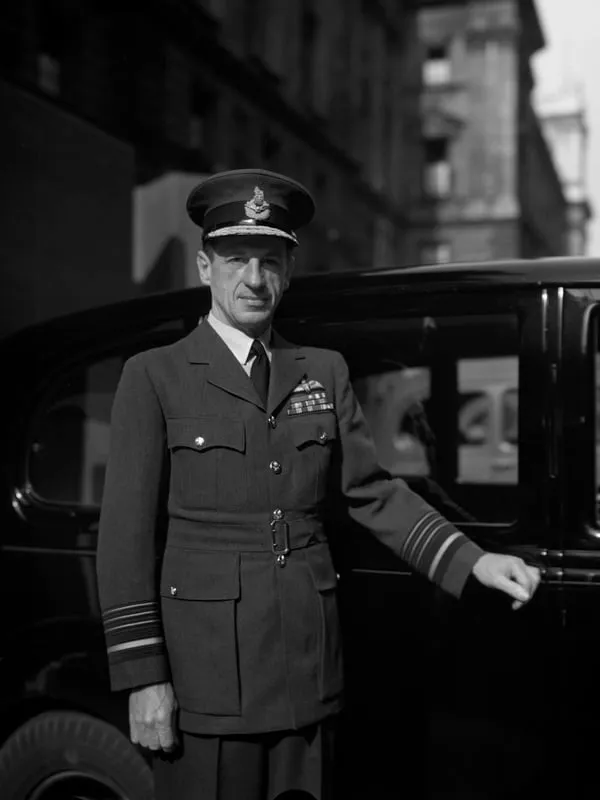
- Born:
- 21 May 1893, Hungerford (England)
- Died:
- 22 April 1971, West Ashling near Chichester (England)
- Author:
- Łukasz
- Photo:
- Official photographer, domena publiczna, Wikimedia Commons

For almost the whole of the Second World War Charles Portal was the most senior commander of British air power. He became Chief of the Air Staff of the Royal Air Force on 25 October 1940, at the age of 47, and held the post until the end of the war. He sat on the British Chiefs of Staff Committee alongside the heads of the navy and the army, accompanied Winston Churchill to the great Allied conferences, and from 1943, on behalf of the Anglo-American Combined Chiefs of Staff, coordinated the two countries’ joint bombing offensive against Germany. It was he who argued in the autumn of 1940, while still head of Bomber Command, that destruction in German cities should cease to be a by-product of the raids and become their aim. His British and American colleagues valued him for his calm, his discretion and his clarity of thought. Historians judge him one of the ablest commanders of the war, but also as sharing responsibility for the strategy of bombing cities, which cost the lives of hundreds of thousands of German civilians.
Youth and the First World War
Charles Frederick Algernon Portal was born on 21 May 1893 at Eddington House in Hungerford, Berkshire, into a prosperous landed family. The Portals were descended from Huguenots who had settled in England in the seventeenth century. His younger brother Reginald became an admiral in the Royal Navy. To his family and friends he was known as Peter. He was educated at Winchester College and at Christ Church, Oxford, and from his youth was a keen falconer. He intended to become a barrister but never completed his studies.
When war broke out in August 1914 he enlisted as a private in the motorcycle section of the Royal Engineers and went to the Western Front as a motorcycle dispatch rider. He was quickly promoted to corporal and, after a few weeks, commissioned as a second lieutenant; in September he was mentioned in the dispatches of the Commander-in-Chief, Sir John French. In July 1915 he transferred to the Royal Flying Corps, first as an observer and from 1916 as a pilot. He flew with several squadrons, mainly on reconnaissance and artillery cooperation; in July 1916 he became a flight commander, and in June 1917, as a major, commanding officer of No. 16 Squadron, whose aircraft directed the fire of British batteries. He was awarded the Military Cross and the Distinguished Service Order twice. The citation for the second award noted that on one night he had crossed the front line five times to bomb German positions. In June 1918, in the newly formed Royal Air Force, he was promoted to lieutenant colonel, and in August he took command of a training wing.
Between the wars
In 1919 Portal received a permanent commission in the RAF and married Joan Welby; they had two daughters, and a son who died shortly after birth. He belonged to the generation of officers who built up an independent air force at a time when the army and the navy would gladly have done away with it. He was chief flying instructor at the RAF College at Cranwell, passed through the RAF Staff College and took a course at the Royal Naval College, Greenwich. In 1927 he took command of No. 7 Squadron, which flew Vickers Virginia heavy bombers, and made his name through his efforts to improve bombing accuracy. After studying at the Imperial Defence College he worked in the plans branch of the Air Ministry.
In 1934 he became commander of British forces in Aden. There he applied the method of “air control” that the RAF had tried out earlier in Iraq and Somaliland: instead of punitive expeditions, the air force declared a blockade of rebellious tribes and, under threat of bombing, cut them off from their villages and fields, which was meant to force them into submission without large-scale bloodshed. In 1937, by then an air vice-marshal, he became Director of Organisation at the Air Ministry. This gave him one of the most difficult tasks of the RAF’s pre-war expansion: building new airfields, depots and schools for a rapidly growing force. In February 1939 he joined the Air Council as Air Member for Personnel, and in that role he prepared the air force for mobilisation.
Bomber Command
At the beginning of April 1940 Portal, an acting air marshal since September 1939, became Commander-in-Chief of RAF Bomber Command. He took over at a moment when daylight raids on German warships had ended in disaster and night operations achieved little beyond dropping leaflets. He favoured attacks on German industry, and after the War Cabinet’s decision of 15 May it was his bombers that began to attack the Ruhr and synthetic fuel plants by night. In the summer he protested against using the bomber force mainly for the defence of the British Isles, although for weeks on end his crews bombed invasion barges in the Channel ports. It was he who carried out Churchill’s orders to strike at Berlin: the first raid on the night of 25–26 August and the biggest of that autumn on the night of 23–24 September. Portal later summed up the point of these operations by saying that losses were worth bearing in order to get four million Berliners out of bed and into the shelters.
The experience of those months convinced him that a single factory could not be hit at night. On 11 September 1940 he proposed to the Air Staff that after every “indiscriminate” German raid on a British town the RAF should respond with an equally indiscriminate attack by 150–160 bombers on one of twenty designated German towns. The authors of the British official history of the bombing offensive concluded that Portal wanted the destruction of towns, hitherto treated as a by-product, to become the end product, and that he considered such a course justified by Germany’s earlier conduct.
Chief of the Air Staff
At the beginning of October 1940 Portal handed Bomber Command over to Richard Peirse, and on 25 October he succeeded Cyril Newall as Chief of the Air Staff. He was the youngest of the British chiefs of staff, and his predecessor had been removed after a campaign in which Lord Beaverbrook had played an active part. His very first days in office brought a change of policy: the directive of 30 October, discussed in connection with the raids on Berlin and Hamburg, ordered regular concentrated attacks on large cities, opened with incendiary bombs, alongside the attacks on oil plants. In November 1940 he supported the decision of the Secretary of State for Air, Archibald Sinclair, to remove Hugh Dowding from command of Fighter Command.
As Chief of the Air Staff Portal defended the independence of the RAF against the navy, which wanted to take over the patrol aircraft of Coastal Command, and against the army, which was demanding an air force of its own. When the Butt Report of August 1941 showed that only about one in three crews reporting an attack had dropped their bombs within eight kilometres (five miles) of the target, Portal did not abandon the offensive. In September 1941 he presented Churchill with a plan to expand the bomber force to some 4,000 heavy bombers, which were to break Germany within six months. The Prime Minister replied sceptically that it was doubtful whether bombing by itself could decide the war. Portal answered that without faith in the bombing offensive an entirely different strategy would have to be adopted. In January 1942 he removed Peirse, and in February, when the area bombing directive named the morale of the civilian population, and of industrial workers in particular, as the main objective, Arthur Harris took over Bomber Command. Against Harris’s opposition, in August 1942 Portal pushed through the creation of an elite target-marking force, the Pathfinders.
In 1941, according to historians’ findings, Portal rejected a proposal passed on by the Polish Air Force to bomb the Auschwitz camp, regarding it as “an undesirable diversion” that would not in any case achieve its purpose.
The Combined Bomber Offensive
Portal accompanied Churchill to all the great Allied conferences, from Washington at the turn of 1941 and 1942, by way of Casablanca, Quebec, Cairo and Tehran, to Yalta and Potsdam. The Americans, with whom he worked on the Combined Chiefs of Staff, valued his tact and his businesslike manner. In January 1943 at Casablanca he was entrusted with coordinating the Combined Bomber Offensive: the British air force was to attack Germany by night and the American by day. In 1944 he was given the highest rank, Marshal of the Royal Air Force. In the spring of that year the heavy bombers of both countries were placed for several months under the orders of Dwight Eisenhower to prepare the invasion of Normandy, and Portal backed the plan of Eisenhower’s deputy, Arthur Tedder, to destroy French railway junctions.
In the autumn of 1944, when the bombers returned to Germany, Portal made the German oil industry the top priority. Harris regarded this as chasing a “panacea” and went on bombing cities. Their dispute, conducted by letter from November 1944 to January 1945, ended without resolution: Portal neither gave his subordinate a firm order nor removed him when Harris offered his resignation. In February 1945 British and American bombers destroyed Dresden. On 28 March Churchill wrote a minute suggesting that the bombing of cities “simply for the sake of increasing the terror” should be reviewed. Portal and the Air Staff protested, and the Prime Minister withdrew it and replaced it with a milder version. The offensive against the cities ended in April 1945, when there was little left to destroy.
After the war
At the turn of 1945 and 1946 Portal handed over his post to Tedder and left the air force. He was made a baron in 1945 and Viscount Portal of Hungerford in 1946, and received the Order of the Garter and the Order of Merit. From 1946 to 1951 he was in charge, at the Ministry of Supply, of the production of fissile material for the British atomic programme, although the engineer who ran the production, Christopher Hinton, later recalled that he could not remember Portal helping him in any way. He then moved into industry: he was chairman of British Aluminium, which in 1958–1959 lost a celebrated battle against a hostile takeover, and from 1960 chairman of the aircraft manufacturer British Aircraft Corporation. He died of cancer on 22 April 1971 at his home in West Ashling near Chichester; his ashes were buried in the churchyard at Funtington. The viscountcy became extinct with him. In 1975 Harold Macmillan unveiled his statue outside the Ministry of Defence building in London.
Significance
In the British war machine Portal was a less visible figure than Churchill or Harris, but few were more influential. It was he who in the autumn of 1940 brought to the Air Ministry the conviction that night bombing of German cities could break German morale and German industry, and it was he who in the years that followed secured men, aircraft and political support for the bomber force. The bombing offensive tied down thousands of anti-aircraft guns and fighters in Germany, destroyed a large part of the German oil industry and transport system, and in 1944 helped to prepare the invasion of Normandy. Its price, however, was enormous: more than 55,000 aircrew of Bomber Command were killed, and the Allied raids on Germany killed, according to various estimates, between about 300,000 and 600,000 civilians. The judgement on this strategy, in which Portal had a share from the first day, remains one of the most difficult controversies over the Allied conduct of the Second World War.
Sources
Often appears with
People who appear in the same events.
On the timeline
(41)The 40 most important of 41 events. All tagged “Charles Portal” (5) →