Equipment
Handley Page Halifax
The RAF's second heavy bomber, in the Lancaster's shadow, which bombed Germany, towed gliders and dropped agents and arms for the Polish Home Army.
- Role:
- heavy bomber
- State:
- United Kingdom
- Maker:
- Handley Page
- First flight:
- 25 October 1939
- Built:
- about 6,170 (6,176, or 6,178 with the prototypes, depending on the count)
- Author:
- Natalia
- Updated:
- 1 November 2026
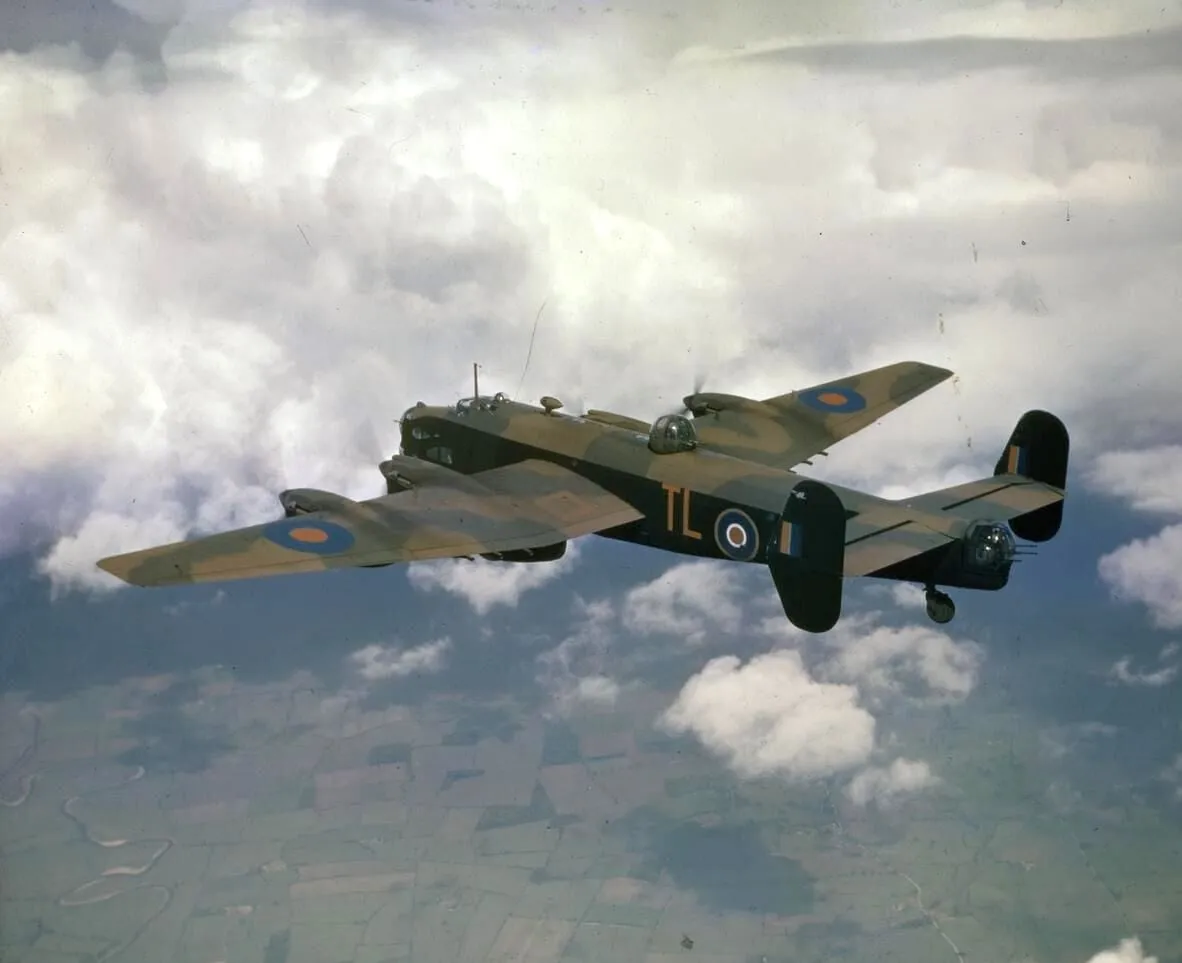
The Handley Page Halifax was the second heavy bomber, alongside the Lancaster, on which the night offensive of RAF Bomber Command against Germany rested. It went into action a year before its rival, long suffered from the faults of its early versions and never won the affection of the head of the bomber force. It proved, however, an aircraft for everything: besides bombing, it patrolled the sea, towed gliders, jammed German radars and dropped agents and arms for resistance movements. For Poles it was above all the aircraft that brought the Cichociemni, the parachuted agents, and supplies for the Home Army into the country.
From a twin-engined design to four Merlins
The London firm of Handley Page (PL) designed the Halifax to the same 1936 requirements that produced the twin-engined Manchester. The original H.P.56 design was to have two Rolls-Royce Vulture engines and was only a reserve order in case Avro failed. Trouble with the Vulture, however, led the ministry in July 1937 to have the aircraft redesigned with four Merlin engines. That decision saved the Halifax from the Manchester’s fate. The prototype L7244 was first flown at Bicester on 25 October 1939 by the firm’s chief test pilot, Jim Cordes.
Production was not left to the parent firm alone. Halifaxes were built by English Electric, Fairey, Rootes and a consortium of several London companies, and the aircraft were assembled from ready-made sections, which sped up both production and repair. According to British figures, Halifaxes made up more than 40 per cent of all heavy bombers built in the country in 1940–1944.
The first years in action (1941–1942)
The first aircraft went to No. 35 Squadron at Linton-on-Ouse in November 1940. In March 1941, a few weeks after the debut of the rival Stirling, six Halifaxes attacked the port of Le Havre. In spring and summer the new types appeared in the raids on Hamburg and Berlin in single squadrons, dogged by faults. The British officially revealed the Halifax’s existence only in July 1941, after a daylight attack on the battleship Scharnhorst at La Pallice. Daylight losses proved so high, however, that at the end of the year the Halifaxes switched to night operations only.
Even then the Halifax had another task, more important for Central Europe. From November 1941 a few Polish crews served in the British special duties squadrons, carrying parachuted agents and supply drops for the underground over occupied Poland. On the night of 28–29 December 1941 a British Halifax dropped Jan Kubiš and Jozef Gabčík, the future assassins of Heydrich, over the Protectorate. In November 1942 Halifaxes towed gliders carrying sappers to Norway in the failed Operation Freshman, the prelude to Operation Gunnerside.
Faults and fixes (1942–1943)
The Merlin-engined Mk II and Mk V were too weak to climb high out of reach of the night fighters, and the early tail made the aircraft fall into a dangerous sideslip in certain manoeuvres. Only new, larger D-shaped fins cured the problem. Arthur Harris made no secret of preferring the Lancaster: it was calculated that an average Halifax would drop about 100 tons of bombs in its service life, and a Lancaster about 154 tons. Even so, Halifaxes flew in every great raid of the period, from the thousand-bomber raid on Cologne to the attack on Peenemünde, and in August 1942 No. 35 Squadron became part of the target-marking Pathfinder Force.
The breakthrough came with the Halifax Mk III, introduced from August 1943, with four Bristol Hercules (PL) radial engines and a longer wing. More than two thousand were built, more than of any other version. In performance it came close to the Lancaster, and according to British analyses the crews of shot-down Halifaxes saved themselves by parachute more often, thanks to a wider hatch. The older versions, however, suffered heavy losses: after the night of 19–20 February 1944 over Leipzig, during Big Week, Harris withdrew them from raids over Germany.
An aircraft for everything (1944–1945)
In the last year of the war the Halifax was used more and more for tasks other than night bombing of cities. It bombed the fortifications of the Atlantic Wall and V-1 launch sites by day, towed gliders during the Normandy landings and Operation Market Garden, patrolled the sea with RAF Coastal Command and jammed German radars in No. 100 Group. As a tug it was better than the Lancaster, because it could take off with a heavier load.
For the Poles the special flights mattered most. The Polish C Flight of No. 138 Squadron became, in November 1943, No. 1586 Special Duties Flight, which flew Halifaxes and Liberators over Poland from airfields near Brindisi. From the night of 4–5 August 1944 its crews, together with British and South African airmen, dropped arms for the Warsaw Uprising, flying by night, depending on the route, some 1,300 to 1,500 kilometres each way. The heavy Halifaxes could not, however, land on Polish meadows; that took the smaller Dakotas, which in Operation Most III flew parts of a V-2 rocket out of Poland.
The balance
According to Bomber Command figures, Halifaxes flew some 82,000–83,000 sorties with it, dropped about 224,000 tons of bombs and lost about 1,830 aircraft missing in action. They flew their last major raid on 25 April 1945, against the coastal batteries on the island of Wangerooge. About 6,170 Halifaxes were built. After the war they served in the transport and meteorological roles until 1952, and civilian Halifaxes flew in the Berlin Airlift of 1948–1949. Only a few examples survive, recovered from water or rebuilt from parts. History long saw the Halifax as “the other” bomber, but without it Bomber Command could not have waged its offensive in 1941–1943, and the resistance in occupied Europe would not have received many of its drops.
Sources
In the chronicle
(27)1941
1942
- 13 March 1942Gee raids on the Ruhr
- 5 April 1942RAF raids on Cologne and Hamburg
- 27 May 1942The assassination of Heydrich
- 30 May 1942The thousand-bomber raid on Cologne
- 2 June 1942The thousand-bomber raid on Essen
- 25 June 1942The thousand-bomber raid on Bremen
- 27 July 1942The RAF raid on Hamburg of 26/27 July
- 10 September 1942The raid on Düsseldorf
- 22 October 1942The raid on Genoa
1943
- 16 January 1943RAF raids on Berlin in January 1943
- 28 February 1943Operation Gunnerside
- 5 March 1943The Battle of the Ruhr begins
- 15 April 1943The raids on Stuttgart and Pilsen
- 29 May 1943The raid on Wuppertal
- 24 June 1943The raid on Elberfeld and the evacuation of the Ruhr
- 17 August 1943Operation Hydra
- 22 October 1943The raid on Kassel
- 18 November 1943The air Battle of Berlin begins
- 27 November 1943Raids on Berlin in November 1943