- Category:
- Military operations
- Front:
- Western Front
- Date:
- 13 February 1945
- Author:
- Natalia
- Tags:
- RAF, Arthur Harris, Third Reich, civilians
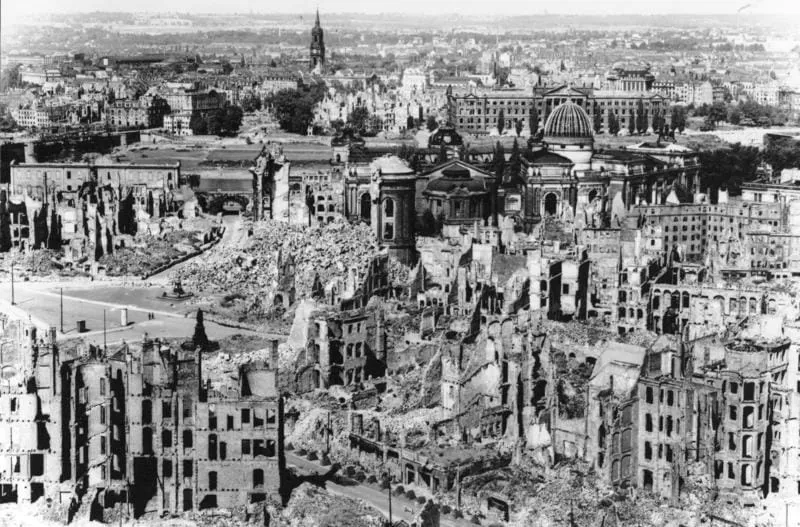
On the evening of 13 February 1945, Shrove Tuesday, the sirens wailed in Dresden at 9.51 p.m. A quarter of an hour or so later the first bombers of RAF Bomber Command appeared over the Saxon capital. In less than two days the city was attacked by two night waves of British Lancasters – some 770 aircraft in all – and by two daylight raids of American B-17s. More than 3,900 tons of high-explosive and incendiary bombs fell on it. The fires merged into a firestorm that consumed the baroque city centre, known as the “Florence on the Elbe”. According to the findings of a commission of historians appointed by the city authorities, up to 25,000 people were killed.
The bombing of Dresden was neither the largest nor the bloodiest air raid of the war in Europe. It nevertheless became the war’s most contested symbol: to some an example of the senseless destruction of a city at a time when the war had already been decided, to others a justified strike against a communications hub behind the Eastern Front. From the outset the dispute was clouded by propaganda – first Nazi, then East German, and finally that of the far right – which inflated the number of victims many times over.
A city behind the front
Before the war Dresden had some 630,000 inhabitants and was one of the largest cities of the Reich. It was famous for its monuments – the Zwinger, the Semper opera house, the Wettin castle and the baroque Church of Our Lady (Frauenkirche) with its stone dome – as well as for its picture gallery and its porcelain. But it was also an industrial centre – for optical, precision and electrical engineering, largely converted to armaments production – the seat of military headquarters and an important railway junction, through which ran the lines from Berlin to Prague and Vienna and from Silesia westwards.
For most of the war the city lay beyond the reach of massed raids. American bombers first attacked its marshalling yards on 7 October 1944, killing more than 400 people, and a second time on 16 January 1945. A belief circulated among the inhabitants that Dresden would be spared. By February 1945, however, the situation looked quite different from that of 1939. After breaking through the front on the Vistula, the Red Army had reached the Oder and seized bridgeheads on its western bank; units of the 1st Ukrainian Front were fighting in Lower Silesia, less than 150 kilometres from Dresden. A tide of refugees from Silesia was pouring through the city – similar to the one that had been fleeing East Prussia since January. Estimates of their number at the time of the raid range from 100,000 to 200,000, and in some accounts even higher; there are no precise figures.
The city’s defences were weak. Most of the anti-aircraft guns had been sent east, the last large battery was removed in January 1945, and the Luftwaffe, starved of fuel, was unable to put up any significant night-fighter force. Shelters were lacking too: the Gauleiter of Saxony, Martin Mutschmann, had bunkers built for himself and party officials, but for the population little more than cellars connected by openings in the walls had been prepared.
The decision
The attack on Dresden grew out of Operation Thunderclap, a plan under consideration at the British Air Ministry since the summer of 1944: a massive strike on Berlin and other large cities that was to shake German society and hasten the collapse of the Reich. In January 1945 the plan resurfaced in a new form. Air staff officers proposed linking raids on the cities of eastern Germany with the Soviet January offensive – they were to paralyse the movement of German reinforcements to the Eastern Front and the evacuation from the east.
Winston Churchill added to the urgency. On the evening of 25 January he asked the Secretary of State for Air, Archibald Sinclair, whether Berlin and “no doubt other large cities in east Germany” should not now be considered especially attractive targets, and the next day he demanded a concrete plan. On 27 January the Deputy Chief of the Air Staff, Norman Bottomley, instructed Arthur Harris, commander of Bomber Command, to attack Berlin, Dresden, Leipzig and Chemnitz as soon as moon and weather allowed, “with the particular object of exploiting the confused conditions” in these cities during the retreat from the east. Harris, an advocate of area bombing since taking up his command in 1942, needed no persuading; after Hamburg and the air Battle of Berlin, this was for his crews another task of the same kind.
The matter came up again at the Yalta Conference. On 4 February the Deputy Chief of the Soviet General Staff, General Aleksei Antonov, asked the Western Allies for air attacks that would hamper German transfers of troops from west to east by paralysing the junctions of Berlin and Leipzig. The Chief of the Air Staff, Charles Portal, who was present at Yalta, asked London for a list of targets to discuss with the Russians; it included Berlin and Dresden. According to the British historian Richard Overy, however, the records of the talks with Antonov mention only Berlin and Leipzig. The claim that Dresden was bombed at Stalin’s express demand therefore finds no support in the documents: it was a Western plan, of which the Russians were notified. An attack on communications behind the Eastern Front was, on the other hand, consistent with what the Soviet side had asked for.
At the pre-flight briefings Dresden was presented to the crews as an important railway junction and industrial centre in which refugees had taken shelter and which could serve as a base for the defence in the east. According to a frequently quoted note for the crews, one of the aims was also, “incidentally”, to show the advancing Russians “what Bomber Command can do”.
The first wave
The operation was to have opened with a daylight raid by the American Eighth Air Force on 13 February, but bad weather over Europe cancelled the American mission. The first blow therefore fell to the British. It was planned as a double strike: the second wave was to arrive three hours after the first, when fire brigades and rescue teams would be at work in the city.
The first to take off was No. 5 Group of Bomber Command, which used its own low-level target-marking method. After 10 p.m. its illuminating aircraft arrived over Dresden, dropping magnesium flares on parachutes, which the Germans called “Christmas trees”. The master bomber, Wing Commander Maurice Smith, circling over the city in a Mosquito, marked the aiming point – the stadium in the Ostragehege, west of the old city – and gave the order. From 10.13 to 10.28 p.m. 244 Lancasters dropped about 880 tons of bombs, more than half of them high explosive, including heavy “blockbusters” that tore off roofs and blew out windows, and hundreds of thousands of incendiaries. The bombed area took the shape of a fan spreading out from the stadium across the whole city centre.
The second wave and the firestorm
The second wave – Lancasters of Nos. 1, 3, 6 and 8 Groups, the last of these as the marking force (Pathfinders) – could see the burning city from more than a hundred kilometres away. Since the centre was shrouded in smoke, the markers extended the area of attack to either side of the fire, taking in the main railway station and the Großer Garten park, which had been untouched in the first raid. The sirens no longer worked – the electricity grid had been destroyed – and the only warning came from hand-operated sirens that could be heard no more than a street away. Between 1.21 and 1.45 a.m. on 14 February, 529 Lancasters dropped more than 1,800 tons of bombs.
The concentration of bombs on a small area, the dry and windy night and the dense buildings of the old city caused the individual fires to merge into a firestorm – similar to the one created in Hamburg a year and a half earlier. The column of superheated air sucked in hurricane-force winds from the surrounding area, which knocked people off their feet and drew them into the flames. Most of the victims, however, died not in the flames but in cellars – from carbon monoxide, lack of oxygen and heat. Many people fled to the banks of the Elbe and into the Großer Garten; it was there that some of the bombs of the second wave fell. At the main station, crammed with refugee trains, hundreds of people were killed. The fires burned for several days.
Among those who survived the night in Dresden was the philologist Victor Klemperer, one of the last Jews in the city, who had until then been protected by his marriage to an “Aryan” woman. On the morning of 13 February Klemperer had had to deliver to other Jews in mixed marriages summonses to report three days later for “departure” – that is, deportation. In the chaos after the raid Klemperer removed his yellow star and made his way west with his wife, towards the approaching Americans; his diary is one of the most important testimonies of those days. Allied prisoners of war also survived the raid in the municipal slaughterhouse, converted into a camp – among them the American soldier Kurt Vonnegut, who years later described the experience in his novel Slaughterhouse-Five (1969).
Bomber Command lost six Lancasters in the raid – three of them hit by bombs dropped by aircraft flying higher – and several more crashed over France and England on the way home. The German defences were practically non-existent.
The Americans on 14 and 15 February
At noon on 14 February bombers of the Eighth Air Force’s 1st Air Division appeared over Dresden. Their target was the marshalling yards in Friedrichstadt. The city was obscured by cloud and smoke, so they bombed with the help of H2X radar; 316 B-17s dropped 771 tons of bombs, which were scattered over a wide area, including districts that were already burning. Some of the 431 bombers sent to Dresden that day lost their way and attacked other cities – about 60 aircraft mistakenly bombed Prague, and others Most (Brüx) and Plzeň. The next day, 15 February, more than 200 B-17s whose primary target, the synthetic fuel plant at Böhlen near Leipzig, was covered by cloud turned to their secondary target – Dresden – and dropped about 460 tons of bombs on it, once again scattered over the suburbs and neighbouring localities as well. Thanks to a strong fighter escort, the Americans lost only one bomber over Germany on 14 February.
After the war accounts were repeated again and again of American fighters strafing people fleeing along the Elbe. The claim appeared as early as March 1945 in the Nazi weekly Das Reich. The historian Götz Bergander, himself a witness of the raids, found no confirmation of it either in the pilots’ reports or in the records of the German military and police, and the commission of historians appointed by the city found it unproven. Some of the accounts probably concerned air combat and the strafing of targets in the surrounding area, which in witnesses’ memories became superimposed on the image of the burning city.
Dresden was bombed several more times – on 2 March and 17 April 1945 the Americans again attacked its railway junctions and industrial plants.
Destruction and casualties
The firestorm and the bombs destroyed – by various calculations – from about 6.5 to more than ten square kilometres of built-up area, including practically the whole of the old city and the neighbouring districts. The castle, the Zwinger, the Semper opera house, the Hofkirche and dozens of other historic buildings were burned out or badly damaged; most of the gallery’s collections had been evacuated from the city earlier. The Frauenkirche survived the raids themselves, but its burned-out interior could not withstand the heat: on the morning of 15 February the dome and pillars collapsed, leaving a heap of rubble that stood in the middle of the city for nearly half a century as a memorial. The damage to the railways proved less lasting – according to some studies, traffic through the Dresden junction partly resumed within a few days.
The death toll was manipulated from the start. The city authorities and police counted the dead carefully: according to a report by the Higher SS and Police Leader (“Tagesbefehl” No. 47) of 22 March 1945, by that date 20,204 bodies had been recovered, of which 6,865 had been cremated on pyres in the Altmarkt square to prevent epidemics; the total number of dead was estimated at about 25,000. Meanwhile Joseph Goebbels’s Propaganda Ministry put about, via the press of neutral countries, a figure of 200,000 victims, and a forged copy of the report with an added zero – 202,040 dead – also went into circulation. The inflated figures, intended to portray the Allies as barbarians, reached the press of neutral countries, Swedish newspapers among them, and from there the House of Commons.
After the war the inflated figures lived on. The East German authorities presented the raid as “Anglo-American terror” without military purpose, and the British writer David Irving, later convicted in Austria of Holocaust denial, gave a figure of 135,000 dead in a much-discussed book of 1963; Vonnegut repeated it after him. Estimates of 250,000 and even half a million victims circulated. In the twenty-first century the German far right called the raid a “bombing holocaust” (“Bombenholocaust”), which caused a scandal in the Saxon state parliament in 2005.
To settle the dispute, in 2004–2005 the Dresden authorities appointed an independent commission of historians headed by Rolf-Dieter Müller of the Bundeswehr’s Military History Research Office. The commission examined the records of cemeteries, registry offices, the police and the military, as well as data on people sought after the raid and on bodies found during later reconstruction. In its report, published in 2010, it concluded that between about 22,700 and at most 25,000 people were killed in the raids of 13–15 February; some 18,000 victims could be documented by name or in registers. The commission also found that the presence of refugees did not fundamentally change this result – deaths were recorded without distinguishing between residents and newcomers, and most victims died of carbon monoxide poisoning, which made it possible to count the bodies. These findings are today accepted by the overwhelming majority of historians, including those critical of the raid itself.
Twenty-odd thousand dead in two days is a tragic toll, comparable to the heaviest raids of the war in Europe – on Hamburg in 1943 and, ten days later, on Pforzheim. It is not, however, exceptional on the scale that propaganda gave it.
The controversy over the raid
Doubts arose on the Allied side almost at once. A few days after the raid a British air officer, Colin McKay Grierson, said at a press conference at Eisenhower’s headquarters that the attacks were aimed primarily at communications, but also mentioned striking at centres into which refugees were streaming. On that basis an Associated Press correspondent wrote that the Allies had adopted a policy of “deliberate terror bombing”; the dispatch went round the American press and caused alarm in Washington and London. In the House of Commons the Labour MP Richard Stokes, a long-standing opponent of area bombing, quoted – unwittingly – the inflated figures of the German news agency.
On 28 March 1945 Churchill sent the chiefs of staff a minute in which he wrote that the time had come to review the bombing of German cities “simply for the sake of increasing the terror, though under other pretexts”, and that the destruction of Dresden remained a serious query against the conduct of Allied bombing. Harris replied that attacks on cities were justified as long as they shortened the war and saved the lives of Allied soldiers, and that he did not personally regard all the remaining cities of Germany as worth the bones of a single British grenadier. Under pressure from the chiefs of staff Churchill withdrew the minute and on 1 April replaced it with a milder one, which spoke of the Allies’ own interest, since they would be taking control of a ruined country. The great area raids were wound down in April 1945, and after the war Harris and Bomber Command waited a long time for public recognition.
Historians still judge the raid differently. An American historical report of 1953 and the British historian Frederick Taylor, in his study of 2004, stress that Dresden was a functioning railway junction and a centre of the armaments industry behind the front, and that the raid itself was in keeping with the bombing practice of the time. Critics such as the British philosopher A. C. Grayling regard the area bombing of German cities in the last months of the war as morally unacceptable, and the German writer Jörg Friedrich, in his much-discussed book Der Brand (2002), described it as the destruction of cities and their inhabitants. This dispute is about the assessment of a strategy, not about the facts: mainstream historians reject both the propaganda figures and comparisons of the raid with the Holocaust. Nor can it be separated from the fact that it was Germany that began the air war against cities – in Warsaw, Rotterdam and Coventry – although for many historians this context explains, but does not settle, the judgement on Dresden.
Place in the war
Dresden was one of the last great area raids of the war in Europe and the last to become a political event. It continued the series of attacks that in February 1945 were meant to support the Soviet offensive – following the American raid on Berlin of 3 February – and its military effects proved limited: the railway junction was soon working again, and the front on the Oder did not change because of it. On 23 February the RAF burned Pforzheim, where some 17,000–20,000 people were killed, and the raids on German cities continued until April. The Red Army occupied the ruins of Dresden on 8 May 1945, the day of Germany’s surrender.
In East Germany the Zwinger was rebuilt, and in 1985 the Semper opera house; the ruin of the Frauenkirche was left as a memorial. After German reunification the church was rebuilt in 1994–2005 with the help of donors from all over the world, Britain among them – the golden cross on the dome was made by a British goldsmith, the son of a Bomber Command airman – and it was consecrated on 30 October 2005. Coventry, destroyed by the Luftwaffe in 1940, has been twinned with Dresden since 1959. Every year the anniversary of 13 February brings residents together to form a human chain around the old town – and also brings out opponents of the far-right marches that have for years tried to appropriate the memory of the victims.
Sources
Meanwhile
(04)Elsewhere, within a week.
- 14 February 1945 · Central and Eastern EuropeThe bombing of PragueOn 14 February 1945 B-17s bound for Dresden bombed Prague by navigational error. 701 people died and the Emmaus Monastery was among the buildings destroyed.
- 15 February 1945 · DiplomacyLatin America declares war on the AxisIn February 1945 Ecuador, Paraguay, Peru, Venezuela and Uruguay declared war on the Axis to become founders of the new organisation in San Francisco.
- 10 February 1945 · Eastern FrontThe East Pomeranian offensive beginsOn 10 February 1945 Rokossovsky’s 2nd Belorussian Front struck into East Pomerania to remove the threat to Zhukov’s flank on the Oder.
- 16 February 1945 · PacificThe landing on CorregidorOn 16 February 1945 US paratroopers dropped on Topside and infantry landed below Malinta Hill. The battle for the fortress lost in 1942 had begun.
Related events
(04)The same battle, people or subject.
- 3 February 1945 · Western FrontThe raid on Berlin of 3 February 1945Around a thousand American B-17s bombed central Berlin. German figures put the dead at nearly 2,900, among them the judge Roland Freisler.
- 22 February 1945 · Western FrontOperation ClarionOn 22–23 February 1945 US and British aircraft struck some 200 transport targets all over Germany, including small towns that had so far been spared.
- 23 February 1945 · Western FrontThe raid on PforzheimOn the evening of 23 February 1945 RAF bombers burned Pforzheim in 22 minutes. Some 17,600 died – proportionally the deadliest single raid on a Reich city.
- 3 March 1945 · Western FrontThe bombing of BezuidenhoutOn 3 March 1945 RAF bombers sent to destroy V-2 sites in The Hague bombed the Bezuidenhout district by mistake. More than 500 civilians were killed.