- Category:
- Military operations
- Front:
- Western Front
- Date:
- 17 September 1944
- Author:
- Natalia
- Battle:
- Operation Market Garden
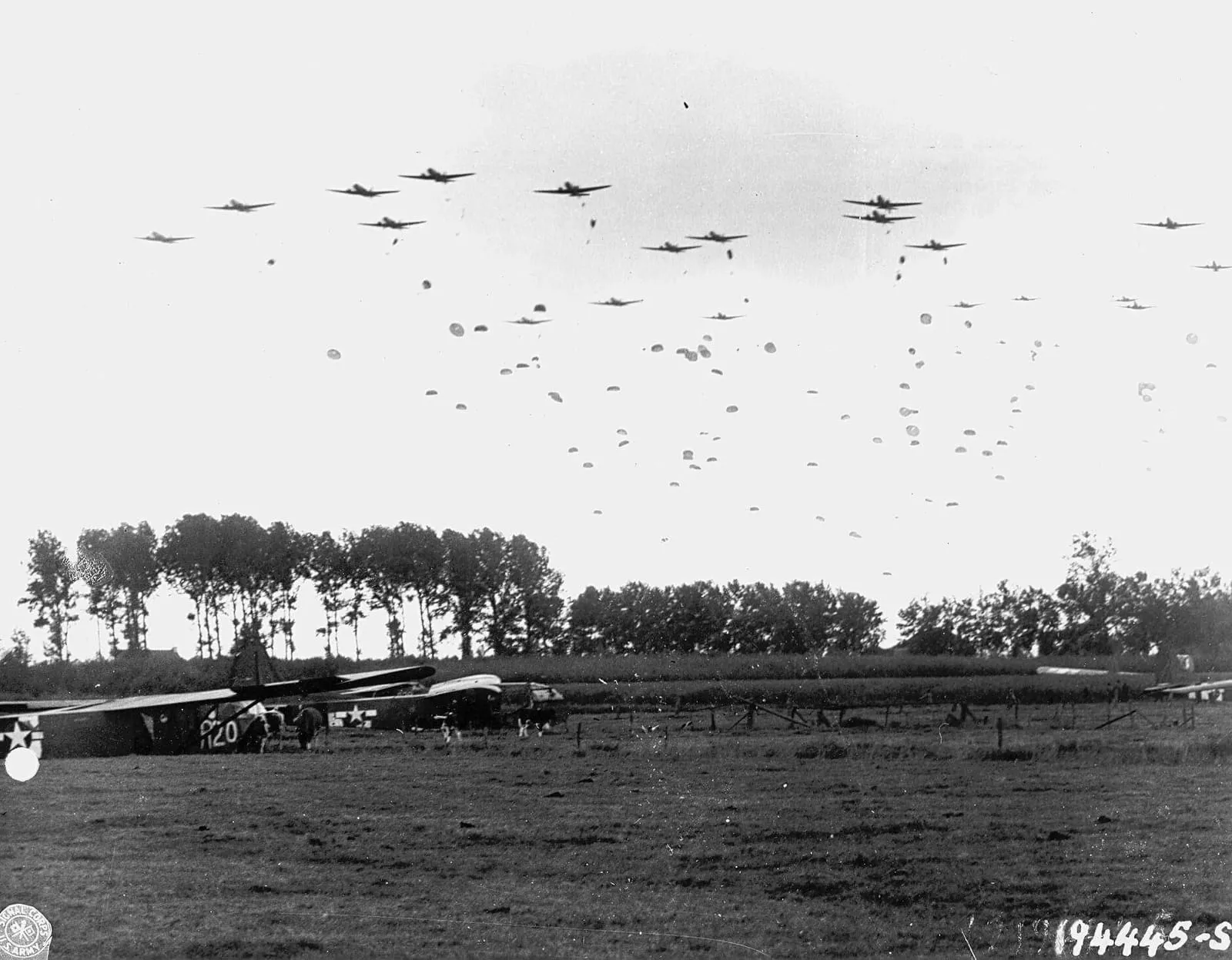
On Sunday 17 September 1944, in the early afternoon sunshine, hundreds of transport aircraft and the gliders they were towing appeared over the occupied Netherlands. Within a few hours nearly twenty thousand Allied soldiers came down on the meadows and heathland between Eindhoven and Arnhem – the first lift of the largest airborne operation in history. At the same time the tanks of the British XXX Corps set off northwards from a bridgehead over the Meuse–Scheldt Canal in northern Belgium. Thus began Operation Market Garden, the brainchild of Field Marshal Bernard Montgomery, which was to open the Allies’ way across the Rhine into the heart of Germany.
The operation was an attempt to liberate Arnhem and outflank the German line, but the town itself was of secondary importance to the planners. What mattered was the road bridge over the Lower Rhine at Arnhem – the last in a chain of bridges that was to carry the British Second Army across the Rhine, north of the fortifications of the Siegfried Line, and on towards the Ruhr.
The dispute over a single thrust
By early September 1944 the Allies had victory in Normandy and the Falaise pocket behind them. The German armies were retreating in haste through France and Belgium; on 3 September the British entered Brussels, and a day later they took the intact port of Antwerp. Many Allied commanders believed that the Wehrmacht was close to collapse and that the war could be ended before Christmas.
The pursuit, however, had its price. Supplies were still coming in through the beaches and ports of Normandy, hundreds of kilometres behind the front line, and the lorries could not keep pace with the demand for fuel. Antwerp could not receive ships as long as the Germans held the estuary of the Scheldt. From 1 September the Supreme Commander, General Dwight Eisenhower, also personally commanded the land forces, and he favoured an advance on a broad front: Montgomery’s army group in the north and that of General Omar Bradley in the south were to move on Germany in parallel. Montgomery demanded the opposite – a single “full-blooded” thrust in the north, to which all supplies would be subordinated. General George Patton thought much the same, except that he saw that thrust being made in his own sector.
Montgomery’s first plan, a limited airborne operation code-named Comet involving the British 1st Airborne Division and the Polish parachute brigade, was repeatedly postponed because of the weather and stiffening resistance, until it was cancelled on 10 September. That same day, at Brussels airfield, Montgomery presented Eisenhower with a far bolder plan. According to those present, the exchange was so heated that Eisenhower had to call the field marshal to order. In the end he agreed to the operation, granting it limited priority in supplies, but only as part of the broad-front advance. Pressure from Washington to make use at last of the First Allied Airborne Army, idle since Normandy, also weighed in the plan’s favour – more than a dozen airborne operations planned for it had been cancelled because the ground forces reached the objectives first. Montgomery also pointed out that the British government wanted the area captured from which, since 8 September, V-2 rockets had been falling on London.
“Market” and “Garden”
The plan had two parts. Market was the airborne assault: the troops of Lieutenant General Lewis Brereton’s First Allied Airborne Army, under the tactical command of Lieutenant General Frederick Browning’s British I Airborne Corps, were to seize the bridges along a road some hundred kilometres long. Major General Maxwell Taylor’s US 101st Airborne Division was to land north of Eindhoven to take the bridges over the canals and rivers at Son and Veghel (PL). Brigadier General James Gavin’s 82nd Airborne Division was to seize the great bridge over the Maas at Grave, the bridges over the Maas–Waal Canal and the road bridge over the Waal at Nijmegen. Furthest away, at Arnhem, Major General Roy Urquhart’s British 1st Airborne Division was to land, with Brigadier General Stanisław Sosabowski’s Polish 1st Independent Parachute Brigade attached to it.
Garden was the ground advance. Lieutenant General Brian Horrocks’s XXX Corps, led by the Guards Armoured Division, was to pass along a “carpet” of airborne troops on the single road from Belgium through Eindhoven, Grave and Nijmegen to Arnhem – within two, at most four days according to the timetable – and then reach the IJsselmeer and turn from there towards the Ruhr. According to official figures, the airborne operation was to involve more than 34,000 soldiers in all, carried in C-47 aircraft and in gliders such as the British Horsa.
The plan’s weaknesses were apparent even then. There were not enough aircraft to carry everyone at once: the air command decided on one lift a day, so the divisions were to arrive in three lifts over three days. The drops were to be made by day, because with moonless nights doctrine forbade large airborne landings in darkness. The airmen, fearing the anti-aircraft guns around Deelen airfield and the marshy ground south of the bridge, assigned the British dropping zones on the heaths west of Oosterbeek, eleven to thirteen kilometres from the objective. Moreover, half of the 1st Division’s first lift had to guard the landing zones for the following lifts, so only one brigade could set off for the bridge. Gavin noted in his diary that the plan looked very risky. Sosabowski – according to memoirs and accounts quoted by Cornelius Ryan – drew attention at the briefing to the distance of the zones from the bridge and to the Germans, about whom the planners had little to say.
The Germans regain their balance
The Allied assumption that the enemy was beaten proved to be the gravest error of the operation. In September the German front in the West began to solidify again. On 5 September Adolf Hitler reinstated Field Marshal Gerd von Rundstedt as Commander-in-Chief West, while Field Marshal Walter Model retained command of Army Group B. On the Albert Canal Colonel General Kurt Student cobbled together the First Parachute Army from parachute regiments, training units, air force and navy personnel and stragglers from Normandy. Tens of thousands of soldiers of the German Fifteenth Army crossed the Scheldt estuary, their escape route left open by the Allies after the capture of Antwerp.
At the beginning of September SS-Obergruppenführer Wilhelm Bittrich’s II SS Panzer Corps – the 9th SS Panzer Division Hohenstaufen and the 10th SS Panzer Division Frundsberg – had also been sent to the Netherlands to rest and refit. After the fighting in Normandy they were shadows of their former selves, with, according to more recent calculations, a few thousand men each and few tanks, but with experienced cadres. By chance their quarters lay precisely to the north and east of Arnhem.
There was no shortage of warnings. German signals decrypted at Bletchley Park (Ultra intelligence) pointed to the presence of both SS divisions in the area; a concerned Eisenhower sent his chief of staff, General Walter Bedell Smith, to Montgomery on 15 September, but the field marshal did not change the plan. The Dutch resistance also passed on reports of armoured units. The intelligence officer of Browning’s corps, Major Brian Urquhart (no relation of the division commander), obtained aerial photographs showing tanks near Arnhem; according to his later account, Browning played down the warning, and Urquhart himself was sent on sick leave suffering from “exhaustion”. Historians note that the surviving photographs more probably show the equipment of a training unit than of an SS division – but the disregard of the warning signs remains a fact. Montgomery himself admitted in his post-war memoirs that the Allies had been wrong to assume that the SS panzer corps was incapable of effective fighting.
Sunday 17 September
During the night and morning Allied aircraft bombed anti-aircraft positions and barracks along the flight routes. The drops began at around 1 p.m. Compared with the night landings in Sicily and Normandy, the landing went almost by the book: most of the men came down on or close to their designated zones, and aircraft losses were light.
In the south the 101st Division quickly took most of its objectives, but as the paratroopers approached the bridge over the Wilhelmina Canal at Son, the Germans blew it up. Eindhoven remained in German hands that day. The 82nd Division seized the bridge over the Maas at Grave on the run – one platoon landed right next to it – as well as the bridge over the Maas–Waal Canal at Heumen. Gavin, however, with Browning’s approval, regarded the capture of the heights near Groesbeek, from which the Germans could strike from the direction of the Reich, as his first task, and the attack on the Nijmegen bridge began only in the evening. In the morning it had been guarded by a handful of soldiers; by the time the Americans approached, the first SS men from Arnhem were already there, and the attack failed. This delay was to weigh on the whole operation.
At Arnhem the first British units landed at around 1.30 p.m. The reconnaissance squadron, which was to seize the bridge by surprise in jeeps, soon ran into a German blocking line. Two battalions of the 1st Parachute Brigade were held up in the woods and suburbs by a hastily organised defensive line formed by SS-Sturmbannführer Sepp Krafft’s SS training battalion and improvised battle groups from the Hohenstaufen division. One patrol shot dead the German town commandant, Generalmajor Friedrich Kussin, in his car. Only Lieutenant Colonel John Frost’s 2nd Parachute Battalion, advancing furthest south along the road beside the Rhine, got through almost without a fight – slowed only by cheering local people. The Germans blew up the railway bridge at Oosterbeek before the eyes of the British. In the evening some 700 of Frost’s men occupied buildings at the northern end of the road bridge; two attempts to take its southern end failed. A few hours earlier the Hohenstaufen reconnaissance battalion had driven across the bridge southwards, towards Nijmegen.
The British were also hit by a failure of communications. The 1st Division’s radio sets did not work over the distances that separated the units on the wide terrain, so division headquarters soon lost contact with the brigades, and Urquhart, who set off in person to find his battalions, got stuck with one of them, was cut off the next day and lost contact with his division for more than twenty-four hours. Model, who had his headquarters in the Tafelberg hotel in Oosterbeek, saw the drop almost from his window; he left his headquarters in haste and that same day ordered Bittrich to hold Arnhem and Nijmegen. A story later circulated that the Germans had found a copy of the operation plan on a dead American officer.
Garden got under way at 2.35 p.m. After a heavy artillery bombardment and attacks by Typhoon fighter-bombers, the tanks of the Irish Guards crossed the Dutch border and ran into an ambush by anti-tank guns concealed along the road. By nightfall they had reached only Valkenswaard – roughly halfway to Eindhoven – and halted there for the night. The first day thus left the corps behind schedule, the bridge at Son destroyed, the bridge at Nijmegen in German hands, and at Arnhem a single battalion at the northern end of the bridge, which was supposed to hold out until relief arrived.
The Polish brigade in reserve
On the first day only a handful of men from the Polish brigade, mainly liaison officers, reached the ground near Arnhem. The 1st Independent Parachute Brigade, formed in Scotland from 1941, had been intended to support a national uprising at home; its soldiers were to return to Poland “by the shortest route” – by parachute. In the spring of 1944 the Polish government, under British pressure, agreed to place it at the disposal of the Allied command. When the Warsaw Uprising broke out on 1 August, General Tadeusz Bór-Komorowski and Sosabowski himself asked for the brigade to be flown to Warsaw, but the British refused – officially because of the distance and the risks of the flight; in the background was also the inter-Allied understanding that Poland lay within the Soviet sphere of operations. As the brigade prepared to fly to the Netherlands, fighting was going on in Warsaw in Śródmieście and Powiśle.
Under the plan the Polish parachute lift was to land on the third day, 19 September, on the south bank of the Rhine opposite Arnhem and cross the bridge already taken by the British. The first Polish gliders carrying anti-tank guns flew in to the north bank on 18 and 19 September; the jump of Sosabowski himself and the main body of the brigade was delayed by fog over the airfields in England, until on 21 September they finally landed near the village of Driel – by then in an entirely different situation.
Significance
The first day of Market Garden ended in partial success, although optimism reigned in London and at Montgomery’s headquarters. The following days showed how much the delays of 17 September had cost. The Americans took Eindhoven on 18 September, engineers put up a new bridge at Son, and the Guards’ tanks reached Nijmegen only on 19 September. The bridge over the Waal was taken on the evening of 20 September after a daring crossing by American paratroopers in canvas boats, but by then Frost’s battalion, after three days of fighting from house to house, had been all but destroyed; on the morning of 21 September resistance at the Arnhem bridge ceased. The remnants of the 1st Division held out encircled at Oosterbeek, the Poles at Driel tried to cross the Rhine to reach them, and on the night of 25–26 September only some of the men were evacuated to the south bank. The Rhine had not been crossed.
On 17 September the Dutch government-in-exile also called on railwaymen to strike in order to paralyse German transport during the operation. The occupiers’ reprisal – halting food supplies – and the stalling of the front on the great rivers condemned the western Netherlands to the “Hunger Winter” of 1944–1945. After the battle the people of Arnhem and the surrounding area were expelled by the Germans and the town was looted. Meanwhile, on the northern flank, the clearing of the Scheldt estuary had been neglected: the first supply ships did not enter Antwerp until the end of November.
Market Garden was the last great attempt to end the war in Europe in 1944. Its failure meant that the Western Allies did not cross the Rhine until the spring of 1945. The dispute over responsibility – over Montgomery’s plan, the decisions of Browning and Gavin, the pace of XXX Corps and the disregarded intelligence warnings – continues to this day; it was popularised by Ryan’s book A Bridge Too Far (1974) and the film based on it.
Sources
Meanwhile
(04)Elsewhere, within a week.
- 17 September 1944 · SocietyThe Dutch railway strikeIn September 1944, at the call of the government in London, some 30,000 Dutch railwaymen walked out. A German food blockade paved the way for the Hunger Winter.
- 18 September 1944 · Eastern FrontThe Otto Tief governmentOn 18 September 1944 Jüri Uluots appointed Otto Tief's government. It proclaimed Estonia's continuity and neutrality, but within days the Red Army crushed it.
- 15 September 1944 · PacificThe landing on PeleliuOn 15 September 1944 the US 1st Marine Division landed on Peleliu in Palau. The fight against defenders hidden in caves lasted two and a half months.
- 15 September 1944 · ScandinaviaThe Lapland War beginsOn 15 September 1944 the deadline for German troops to leave Finland expired and the Kriegsmarine attacked Suursaari. Former allies turned on each other.
Related events
(04)The same battle, people or subject.
- 13 September 1944 · Western FrontThe Allies at the Siegfried LineOn 11 September 1944 the first American patrol crossed the German border; on 12–13 September VII Corps attacked the Siegfried Line near Aachen.
- 25 September 1944 · Western FrontThe end of the Battle of ArnhemOn the night of 25/26 September 1944 the remnants of the British 1st Airborne Division withdrew across the Rhine. Operation Market Garden had failed.
- 16 December 1944 · Western FrontThe Ardennes offensive beginsOn 16 December 1944 three German armies struck a thin American line in the Ardennes. Hitler aimed to retake Antwerp and split the Allies.
- 26 December 1944 · Western FrontThe relief of BastogneOn 26 December 1944 tanks of Patton’s 4th Armored Division broke through to encircled Bastogne, opening a narrow corridor to the 101st Airborne Division.