- Category:
- Military operations
- Front:
- Central and Eastern Europe
- Date:
- 27 May 1942
- Author:
- Natalia
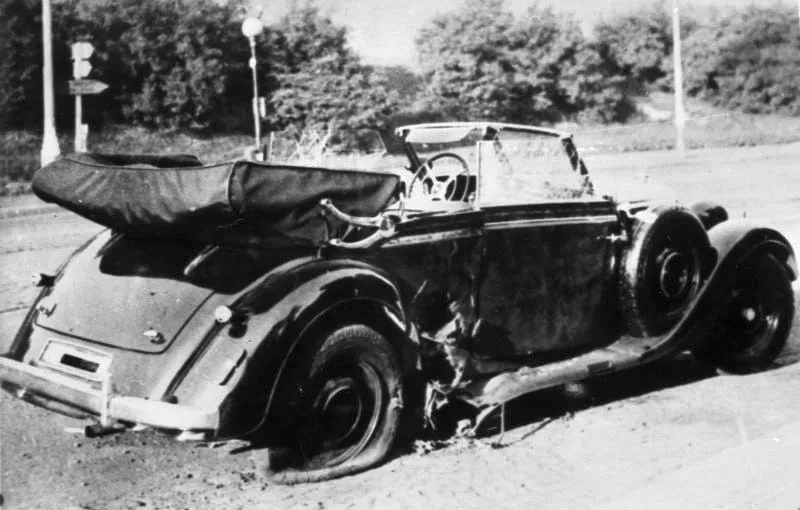
On 27 May 1942, at about half past ten in the morning, on a sharp bend of a street in the Prague district of Libeň, two soldiers of the Czechoslovak army in exile, the Slovak Jozef Gabčík and the Czech Jan Kubiš, attacked the open car in which Reinhard Heydrich was travelling. The head of the Reich Security Main Office (RSHA), Deputy Reich Protector of Bohemia and Moravia and one of the chief organisers of the Holocaust was gravely wounded by grenade fragments. He died in a Prague hospital on 4 June. The operation was code-named Anthropoid and was the work of the intelligence service of the Czechoslovak government-in-exile, prepared with the help of the British Special Operations Executive (SOE). It was the only successful assassination of so senior a dignitary of the Third Reich organised by the government of an Allied state. The Germans responded with a wave of terror whose symbol became Lidice.
Heydrich in Prague
Since March 1939 Bohemia and Moravia had been a Protectorate of the Reich. Formally it had a Czech president, Emil Hácha, and a Protectorate government, but in reality it was ruled by the Reich Protector, Konstantin von Neurath, while the police and the SS were directed by the Secretary of State, Karl Hermann Frank. The occupation was brutal from the outset: after the demonstrations of 28 October 1939 the Germans closed the Czech universities and sent students to a concentration camp. In the summer of 1941, however, after the German attack on the USSR, strikes, acts of sabotage and leaflets multiplied in the Protectorate, and the military underground of Defence of the Nation and the Communists maintained radio contact with London and Moscow. Hitler, Heinrich Himmler and Heydrich judged Neurath too lenient.
On 27 September 1941 Hitler sent Neurath on “sick leave” and entrusted his duties to Heydrich as Deputy Reich Protector. Heydrich remained at the same time head of the RSHA, which directed the Gestapo, the Criminal Police and the Sicherheitsdienst, as well as the Einsatzgruppen that were murdering Jews in the East. Immediately on arriving in Prague he declared a state of emergency. Summary courts sentenced several hundred people to death, and thousands were sent to prisons and camps. The prime minister of the Protectorate government, General Alois Eliáš, who had kept up contacts with the underground and with London, was arrested; the People’s Court sentenced him to death, and the Germans held him as a hostage. The Gestapo smashed a large part of the resistance networks. In October 1941 Heydrich decided to create the Theresienstadt ghetto at Terezín, which from November was filled with Jews from Bohemia and Moravia.
He combined terror with bribery. He raised food rations and benefits for workers in the armaments industry, whose factories were very important to the Reich, while in confidential addresses to German officials he spoke of the future Germanisation of part of the Czechs and the removal of the rest. The state of emergency was lifted in January 1942, and the new Protectorate government became a compliant tool of the occupier. In Berlin Heydrich continued to run his other office: on 20 January 1942 he chaired the Wannsee Conference, at which the Reich’s officials subordinated themselves to the RSHA in the deportation of the Jews of Europe, in accordance with the authorisation given to him in July 1941 by Hermann Göring. In time the Czechs came to call him “the Butcher of Prague”.
The decision in London
The Czechoslovak government-in-exile, headed by President Edvard Beneš, was in a difficult position. The British regarded it coolly, and compared with Poland, Yugoslavia or Greece, where open resistance was going on, the Protectorate looked like a quiet and industrious armaments works of the Reich. Beneš was pressing the Allies to declare the Munich Agreement void and to commit themselves to restoring Czechoslovakia within its former borders. According to most historians he wanted a spectacular deed to show that the Czechs were fighting and to strengthen his government’s position vis-à-vis London and Moscow. Some scholars also ascribe to him the fear that in the event of a compromise peace the Czechoslovak cause would be sacrificed.
The plan for the assassination was drawn up, with Beneš’s knowledge and approval, by the head of Czechoslovak military intelligence, Colonel František Moravec, soon after Heydrich’s arrival in Prague. The target was to be Heydrich rather than Frank, because he was the Reich’s highest representative in the Protectorate and the embodiment of the terror. SOE provided training, equipment and an aircraft. Volunteers were chosen from among some two thousand Czechoslovak soldiers in Britain and trained at SOE centres in Scotland. Originally the attack was to take place on 28 October 1941, Czechoslovak Independence Day. Gabčík and Karel Svoboda were assigned to the operation, and when Svoboda suffered a head injury in training, Kubiš replaced him. The delay put back the date of the drop.
On the night of 28/29 December 1941 a British Halifax dropped Gabčík and Kubiš over the Protectorate together with two other parachute groups, Silver A and Silver B, which were to restore communications with the home country. The crew made a navigational error, and the two men landed not near Plzeň, as planned, but near the village of Nehvizdy east of Prague. Over the following months they hid in Prague with families linked to the underground, among them the Sokol resistance group, and watched the route along which Heydrich drove every day from his country estate at Panenské Břežany to Hradčany. When the leaders of the home resistance realised what the mission’s target was, they asked London, through Silver A’s radio, to call it off or change the target, foreseeing terrible reprisals. London did not call off the operation. After the war Beneš played down his part in that decision.
The bend in Libeň
On the morning of 27 May Heydrich left Panenské Břežany for Prague. He sat beside the driver, SS-Oberscharführer Johannes Klein, in a dark green open-topped Mercedes, without an escort. He often travelled like this, to show that he was not afraid of the Czechs. According to most accounts he was to fly to Berlin that day for a meeting with Hitler. Gabčík and Kubiš were waiting at the corner of what was then Kirchmayerova třída and V Holešovičkách street, by a tram stop not far from Bulovka hospital, where the car had almost to stop on a sharp bend. A few dozen metres further up stood a third parachutist, Josef Valčík of the Silver A group, who was to signal with a mirror that the car was approaching.
At around 10.30 a.m. the Mercedes entered the bend. Gabčík threw off his raincoat, stepped into the road and took aim with a Sten submachine gun, but the weapon jammed. Heydrich, instead of telling the driver to accelerate, stood up and reached for his pistol, and Klein braked. At that moment Kubiš threw a modified British anti-tank grenade, which, instead of landing inside the car, exploded by the right rear wheel. The explosion tore open the bodywork and shattered the windows of a tram standing alongside. Fragments, splinters and horsehair from the upholstery were driven into Heydrich’s left side. Kubiš, slightly wounded in the face, jumped on a bicycle and rode off, firing into the air to scatter the people getting off the tram. Heydrich and Klein leapt out with their pistols. For a moment Heydrich fired at Gabčík, then doubled up in pain and leaned against the car. Gabčík ran off down the street and took refuge in a butcher’s shop, and when the owner, a German sympathiser, fetched Klein, he shot him in the leg and escaped. Both assassins were convinced that the attack had failed.
A delivery van, stopped at random, took the wounded man to the nearby Bulovka hospital. Heydrich wanted to be operated on by a surgeon from the Reich. In the end he was operated on that same day by Josef Hohlbaum, a professor of the German medical faculty of Charles University, and Walter Dick, head of the hospital’s surgical department. They removed the spleen, in which a fragment was lodged, sutured the diaphragm and tried to save the collapsed left lung. In the evening Himmler’s personal physician, Karl Gebhardt, flew in from Berlin and took charge of the treatment.
The first hours of retaliation
The news reached Hitler that same day. According to Frank’s post-war testimony, Hitler flew into a rage, wanted to send Erich von dem Bach-Zelewski to Prague and demanded that ten thousand Czechs be shot. Frank, who flew to Hitler’s headquarters the next day, argued that mass executions would harm the Protectorate’s armaments production, and Hitler agreed to a more “targeted” terror. The running of the Protectorate was taken over by the police general Kurt Daluege, formally appointed Heydrich’s successor after his death.
On the evening of 27 May Frank, signing himself as Deputy Protector, declared a state of emergency throughout the Protectorate. Anyone who sheltered the assassins, or knew of them and failed to report it, was threatened with being shot together with their family. A reward of 10 million crowns was offered for help in capturing the perpetrators, and the Protectorate government doubled it. A curfew was imposed, and that night and in the following days thousands of policemen, soldiers and SS men searched Prague house by house. Executions of people accused of “approving of the assassination” began as early as 28 May, and the newspapers printed list after list of those executed. The assassins were not found: they were hiding with Prague families and later, together with five other parachutists, in the crypt of the Orthodox Cathedral of Saints Cyril and Methodius in the New Town.
Heydrich’s death and the Heydrichiáda
After the operation Heydrich seemed for several days to be recovering, although he had a high fever and severe pain. On 2 June Himmler visited him. At midday on 3 June he suddenly fell into a coma, and he died on 4 June at about 4.30 a.m. The post-mortem pointed to an infection caused by the fragments and remnants of upholstery. Some physicians and historians believe that the immediate cause was a pulmonary embolism. The hypothesis that the grenade had been poisoned with botulinum toxin has not been confirmed. The Germans gave him two funerals, in Prague and in Berlin, where Himmler and Hitler spoke, and the operation to murder the Jews of the General Government in the camps at Bełżec, Sobibór and Treblinka was later named Operation Reinhard – in his honour, according to most scholars.
The reprisals, which the Czechs call the second Heydrichiáda, lasted until the state of emergency was lifted on 3 July 1942, and in part beyond. On 10 June the Germans razed to the ground the village of Lidice, falsely linked with the assassins: they shot all the men, deported the women to the Ravensbrück camp and murdered most of the children at Chełmno (Kulmhof). On 24 June the same fate befell the hamlet of Ležáky, where the Silver A group’s radio transmitter had been hidden. The parachutists were betrayed by one of their own, Karel Čurda, who went to the Gestapo on 16 June. On 18 June several hundred SS men besieged the Cathedral of Saints Cyril and Methodius. After a fight lasting several hours all seven soldiers hiding there were dead, among them Gabčík, Kubiš and Valčík; most of them took their own lives rather than fall into German hands. The next day General Eliáš was shot. According to Czech historians, some 1,600 people were executed during the state of emergency, and later almost three hundred people from the families and circles of the parachutists were murdered at Mauthausen. Estimates of all the victims of the reprisals, including Lidice and Ležáky, range according to different authors from two to five thousand. In the process the Germans applied the principle of collective family punishment (Sippenhaft) on a scale that London had not expected.
Place in the war
The assassination of Heydrich did not change the policy of the Reich. Until January 1943 the RSHA was run by Himmler himself, and then by Ernst Kaltenbrunner. In the summer of 1942 the deportations of Jews to the extermination camps reached an even greater scale. The organised resistance movement in the Protectorate was broken for a long time, and the cost of the assassination was borne above all by the civilian population. The dispute over whether Beneš and Moravec had the right to take such a risk in the face of warnings from home continues to this day.
Politically, however, the assassination brought Beneš what he had wanted. The crime at Lidice stirred public opinion in the Western world, and Winston Churchill was so outraged by the scale of the reprisals that he proposed destroying German villages in response. On 5 August 1942 the British Foreign Secretary, Anthony Eden, declared that Germany by her conduct had destroyed the Munich Agreement and that Britain did not regard herself as bound by it, and in September the French National Committee declared it null and void from the outset. Gabčík, Kubiš and their comrades became national heroes of the Czechs and Slovaks, and Lidice a symbol of German terror against the occupied nations. Neither before nor after did any Allied government organise a successful assassination of a dignitary of this rank. The Polish underground did kill the SS and Police Leader Franz Kutschera in Warsaw, and Soviet partisans in Belarus killed the General Commissioner Wilhelm Kube, but Heydrich stood much higher in the hierarchy of the Third Reich.
Sources
Meanwhile
(04)Elsewhere, within a week.
- 26 May 1942 · MediterraneanThe Battle of Gazala beginsOn 26 May 1942 Rommel struck the Gazala Line. At night his panzer divisions swung round Bir Hakeim and on 27 May smashed 3rd Indian Brigade and 7th Armoured HQ.
- 26 May 1942 · DiplomacyThe Anglo-Soviet TreatyOn 26 May 1942 Eden and Molotov signed in London a treaty of wartime alliance and twenty years of co-operation. It said not a word about the Soviet borders.
- 25 May 1942 · PacificPreparations for MidwayAt the end of May 1942 Japanese forces sailed for the Aleutians and Midway, while the Americans, knowing their plan, repaired the Yorktown in three days.
- 29 May 1942 · Far EastThe Zhejiang–Jiangxi campaignIn reprisal for the Doolittle Raid the Japanese struck in Zhejiang in May 1942 to destroy its airfields. On 28 May they took Jinhua and Lanxi.
Related events
(04)The same battle, people or subject.
- 4 June 1942 · Central and Eastern EuropeThe death of HeydrichOn 4 June 1942 Reinhard Heydrich, wounded eight days earlier, died in a Prague hospital. The Germans gave him two funerals and stepped up the terror.
- 10 June 1942 · Central and Eastern EuropeThe destruction of LidiceOn 10 June 1942 the Germans shot 173 men of the Czech village of Lidice, sent the women to Ravensbrück and the children to Łódź, and razed the village.
- 13 January 1942 · DiplomacyThe St James's Declaration on war crimesOn 13 January 1942, at St James's Palace, nine occupied countries made the punishment of crimes against civilians one of the principal aims of the war.
- 1 September 1941 · Crimes and repressionThe Star of David in the ReichOn 1 September 1941 Heydrich signed a decree requiring Jews aged six and over in the Reich and the Protectorate to wear a yellow “Jude” star from 19 September.