- Category:
- Military operations
- Front:
- Western Front
- Date:
- 6 June 1944
- Author:
- Łukasz
- Battle:
- Battle of Normandy
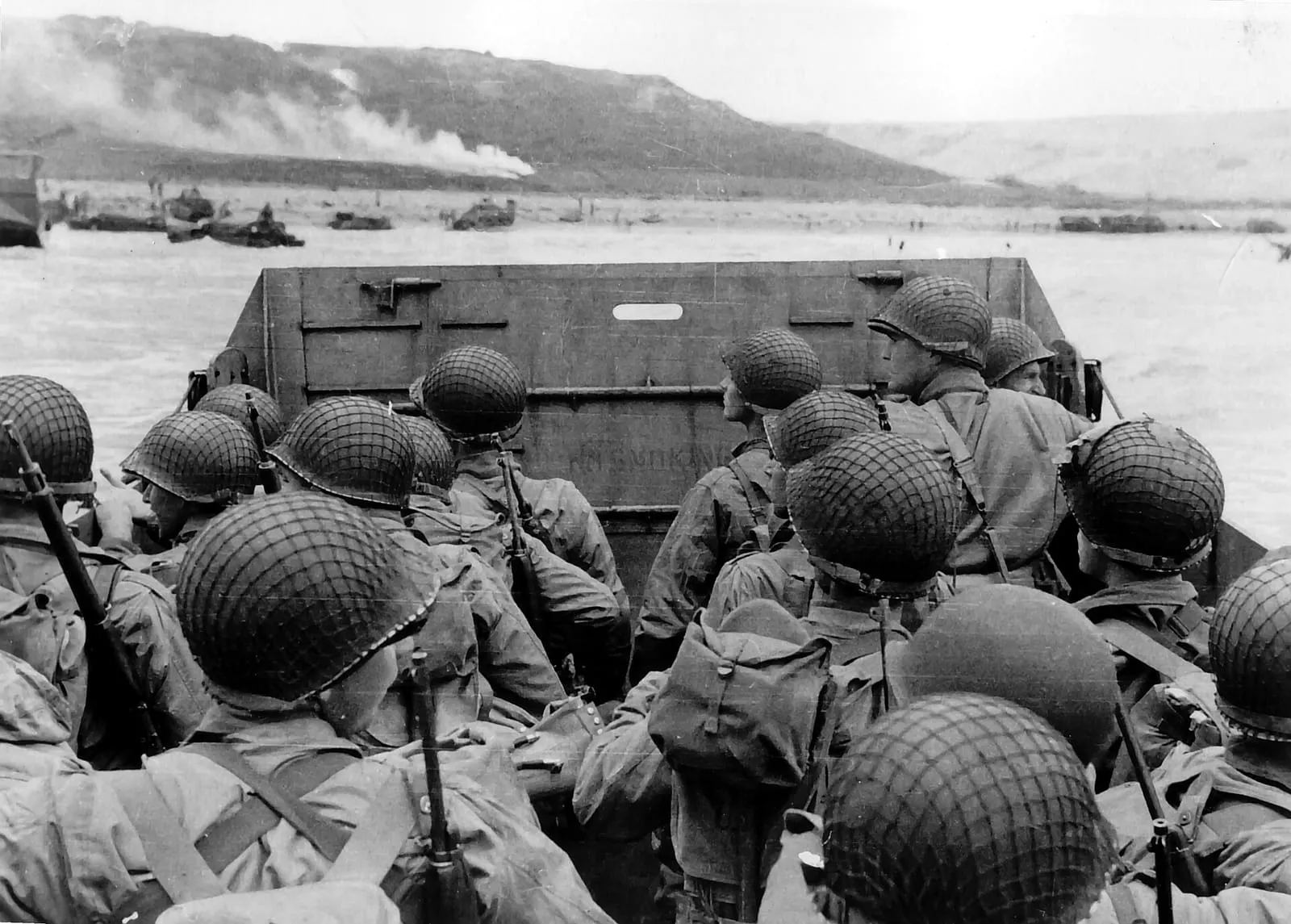
At dawn on 6 June 1944, after a night in which paratroopers and gliders had landed on the flanks of the future front and heavy bombers had dropped thousands of tons of bombs on the coastal batteries, the invasion fleet lay off the coast of Normandy between the mouth of the Orne and the base of the Cotentin peninsula. At 6.30 a.m. the first landing craft grounded on the American beaches, an hour later on the British and Canadian ones. Operation Overlord had begun – the second front in Western Europe, promised for years and prepared for months. The day passed into history under the military term for the day an operation begins: D-Day.
By the end of the day, according to the most commonly cited figures, some 156,000 Allied troops were ashore: more than 130,000 landed from the sea on five sectors – Utah, Omaha, Gold, Juno and Sword – and more than 23,000 paratroopers and glider-borne troops. The claim that the Allies “quickly broke through the Atlantic Wall and pushed inland” needs qualifying, however. On four beaches the defences were broken within a few hours, but on Omaha the landing was close to disaster all morning, and none of the ambitious first-day objectives was achieved: Caen, which according to the plan was to fall on 6 June, was not taken, the beachheads did not join up into a single front, and the deepest penetrations inland reached only a few kilometres, at most a dozen or so. It was nevertheless the largest seaborne landing in history – and a success that the Germans could no longer reverse.
The long road to Normandy
The decision to invade across the English Channel was finally taken at the Tehran Conference at the end of 1943, when Roosevelt and Churchill promised Stalin that a second front would be opened in the spring of 1944. The Dieppe Raid of August 1942 had taught the Allies that a fortified port could not be captured by a frontal assault from the sea – so the open beaches of Normandy were chosen, and ports were to be replaced by Mulberry artificial harbours towed across from England. At the head of the enterprise stood General Dwight Eisenhower, Supreme Commander of the Allied Expeditionary Force, directing SHAEF headquarters; the ground forces in the first phase – 21st Army Group – were commanded by General Bernard Law Montgomery, the navies by Admiral Bertram Ramsay and the tactical air forces by Air Chief Marshal Trafford Leigh-Mallory. Montgomery enlarged the original plan from three to five landing sectors and from three to five divisions in the first wave, with three airborne divisions on the flanks.
In the spring of 1944 southern England became one vast military camp. The exercises were not without casualties: on the night of 27/28 April German E-boats attacked a training convoy in Lyme Bay, killing more than 700 Americans – the Slapton Sands tragedy long remained a secret. On the other side of the Channel Field Marshal Erwin Rommel, who since the turn of 1943 and 1944 had been strengthening the Atlantic Wall and since January had commanded Army Group B, had millions of mines, obstacles and stakes planted on the beaches, convinced that the invasion had to be stopped on the shore, within the first twenty-four hours. His superior, Commander-in-Chief West Field Marshal Gerd von Rundstedt, and the commander of Panzer Group West, Leo Geyr von Schweppenburg, preferred to hold the panzer divisions back inland and smash the landing with a counter-attack. The compromise imposed by Hitler meant that some of the panzer divisions could be committed only with the consent of his headquarters.
The date was decided by the moon, the tides and the weather. The landing, set for 5 June, was postponed by a day because of a storm, and in the early hours of 5 June Eisenhower, relying on a forecast of a break in the weather, gave the final order. On the night of 5/6 June three airborne divisions flew into Normandy: the British 6th east of the Orne, where gliders seized the bridges over the Caen Canal and the river, and the American 82nd and 101st on the Cotentin peninsula. More than a thousand RAF bombers attacked the coastal batteries, while deception operations held German attention on the Pas-de-Calais.
The armada
The naval part of the invasion bore the code name Neptune. According to the most commonly cited figures, nearly 7,000 vessels took part – some 1,200 warships, more than 4,000 landing ships and craft, and hundreds of transports and auxiliaries – most of them British and Canadian, but also American, French, Norwegian, Dutch, Greek and Polish. Five assault forces, designated by the letters of their sectors (U, O, G, J and S), sailed through channels swept overnight in the Channel minefields and took up position off the beaches in a fixed order. From dawn battleships, cruisers and destroyers shelled the batteries and coastal defences, and just before the landings rocket craft joined in. Over the beaches the Allied air forces flew more than 14,000 sorties that day; the Luftwaffe managed to respond with only a few hundred.
The armada included Polish warships. The destroyers ORP Ślązak and ORP Krakowiak were part of Force S and, according to Polish studies, shelled German positions on the eastern part of Sword, around Ouistreham, later supporting British commandos with fire directed by observers. The cruiser ORP Dragon of the bombarding force operated in the same area. The destroyers ORP Błyskawica and ORP Piorun of the 10th Destroyer Flotilla guarded the western approaches to the invasion area against German destroyers and submarines. In the air Polish fighter squadrons were in action – Nos. 302, 308 and 317 of No. 131 Wing, covering the eastern sector of the landings, and, according to Polish studies, also Nos. 306 and 315 flying Mustangs.
Utah and Omaha
On the western flank General Omar Bradley’s US First Army came ashore. On Utah Beach, at the base of the Cotentin, the 4th Infantry Division of VII Corps – carried by the current and disoriented by smoke – landed nearly two kilometres south of its intended spot. It proved a lucky mistake: the defences there were weaker. The assistant division commander, Brigadier General Theodore Roosevelt Jr., son of the former president and the only general in the first wave, reconnoitred the ground and decided to conduct the attack from where the men had landed instead of shifting the following waves. By evening more than 20,000 men had been put ashore on Utah for the loss of fewer than two hundred, and the infantry, advancing along the causeways across the flooded meadows, had made contact with the paratroopers of the 101st Division.
On Omaha Beach, between Vierville and Colleville, the gravest drama of the day unfolded. The heavy bombers, dropping their loads through cloud, delayed their release for fear of hitting their own landing craft, and the bombs fell inland; the brief naval bombardment failed to destroy the bunkers on the bluffs, which in places rose several dozen metres high. Most of the amphibious tanks, launched several kilometres from the shore in a heavy swell, sank. Units of the 1st Infantry Division and the 29th Infantry Division, landing scattered and in the wrong places, came under the crossfire of defences manned not only by the weak 716th Infantry Division but also by regiments of the experienced 352nd Infantry Division – whose presence in this sector Allied intelligence had detected too late. For several hours the men lay behind the stone sea wall at the edge of the beach, while engineers died trying to clear gaps through the obstacles. Bradley, watching from the cruiser USS Augusta, even considered diverting the follow-up waves to Utah or the British beaches.
The breakthrough came before noon and was not the work of any plan. Small groups led by officers and NCOs climbed the bluffs between the fortified draws and attacked the bunkers from behind, while American and British destroyers closed to within a kilometre of the shore and fired directly at the positions. By evening the Americans held a beachhead about two kilometres deep, paid for, by estimates, with more than 2,000 killed, wounded and missing. West of Omaha men of the 2nd Ranger Battalion climbed the cliff at Pointe du Hoc on ropes to destroy a battery that could fire on both beaches. The guns turned out to have been moved inland; the Rangers found and disabled them, and then held off counter-attacks for two days before relief reached them.
Gold, Juno and Sword
The three eastern sectors belonged to General Miles Dempsey’s British Second Army. Because of the later tide, the landings here came an hour after the American ones, but with greater support from the specialised armoured vehicles of Major General Percy Hobart’s 79th Armoured Division – mine-clearing flails, bridge-layers and demolition tanks known as “Hobart’s Funnies”. On Gold Beach the 50th (Northumbrian) Infantry Division fought for several hours for fortified Le Hamel, but by evening its spearheads stood a few kilometres from Bayeux, and Royal Marine Commandos were heading west towards Port-en-Bessin to link up with the Americans. In captured Arromanches the British Mulberry harbour was to be built over the following weeks.
On Juno Beach the 3rd Canadian Infantry Division landed with the 2nd Canadian Armoured Brigade. Rough seas and reefs delayed the landing, craft ran on to mined obstacles, and the first waves at Courseulles, Bernières and Saint-Aubin suffered heavy losses – according to Canadian figures more than 350 Canadians were killed that day. Once the coastal defences had been broken, however, the division advanced further than any other: its spearheads approached Carpiquet airfield outside Caen, and towards evening the Juno beachhead linked up with Gold.
On Sword Beach, furthest east, the British 3rd Infantry Division landed. With it came Lord Lovat’s 1st Special Service Brigade commandos, marching to the sound of Bill Millin’s bagpipes towards the bridges over the Orne, where at about midday they linked up with the paratroopers of the 6th Airborne Division. In their ranks fought the 177 French commandos of Lieutenant Commander Philippe Kieffer – the only French unit in the first wave – who stormed the defences in Ouistreham. The division’s main task, however, was to take Caen, an important road junction and the gateway to the open plains leading towards Paris. The crowded beach, the resistance of fortified positions inland, especially the Hillman bunker complex, and the caution of commanders slowed the advance. In the evening the British infantry halted a few kilometres from the city, on the high ground near Lebisey, where it ran into German tanks.
The Germans taken by surprise
The Germans expected an invasion, but not on that day and not in that place. Luftwaffe meteorologists had concluded that the storm ruled out a landing in early June. Rommel had left on 4 June for his home in Herrlingen near Ulm, to spend 6 June, his wife’s birthday, with his family and to see Hitler; he learned of the landings in the morning by telephone from his chief of staff, Hans Speidel, and got back to Army Group B headquarters at La Roche-Guyon only in the evening. Many commanders of General Friedrich Dollmann’s Seventh Army, which was defending Normandy, had gone to a staff exercise at Rennes; the commander of the 91st Infantry Division was killed during the night by American paratroopers as he was returning to his headquarters. The scattered airborne drops produced contradictory reports throughout the night, and at the higher headquarters many regarded the landing as a diversion before the main blow in the Pas-de-Calais – a conviction fostered by Operation Fortitude, which was to last for weeks.
The most serious consequence of this confusion was the delay in committing the armoured reserves. Before dawn Rundstedt asked for the release of the 12th SS Panzer Division Hitlerjugend and the Panzer Lehr Division, but the Wehrmacht High Command staff, headed by General Alfred Jodl, refused to release them without the consent of Hitler, who was asleep at the Berghof and was not woken. Both divisions were released only in the afternoon; they set off under constant air attack and went into action in the following days.
Only one panzer division stood right next to the beaches: the 21st Panzer Division near Caen. Its commander was away from his headquarters that night, and conflicting orders sent it first against the paratroopers east of the Orne and then back to the west. The counter-attack did not get going until after 4 p.m. and broke on British anti-tank guns near Périers, losing a dozen or more tanks. One battle group did, however, push into the gap between Juno and Sword and at about 8 p.m. reached the coast at Lion-sur-Mer. Soon afterwards hundreds of gliders carrying reinforcements for the 6th Airborne Division passed overhead; threatened with being cut off, the German units withdrew. It was the only moment that day when the Germans might have broken up a beachhead – but they had too few tanks, and it came too late.
Words and numbers
In the morning the troops received Eisenhower’s order of the day, read out aboard ship and in the camps and addressed to the “Soldiers, Sailors and Airmen of the Allied Expeditionary Force”: “You are about to embark upon the Great Crusade, toward which we have striven these many months.” The Supreme Commander also had in his pocket another note, written in case of failure, in which he took all the responsibility upon himself. Before noon Winston Churchill informed the House of Commons that the operation was proceeding according to plan; in the evening King George VI spoke on the radio, calling on his subjects to pray, and so did President Franklin Delano Roosevelt, who read a prayer for the troops. General Charles de Gaulle, president of the Provisional Government of the French Republic, who had been brought to London on 4 June and had quarrelled with Churchill over the role of the French and the administration of the liberated territories, called on his compatriots over the BBC to fight: “The supreme battle has begun.”
The day’s price was thousands of casualties. Allied losses are usually estimated at no fewer than 10,000 killed, wounded and missing; according to research by the US National D-Day Memorial Foundation, which markedly raised earlier estimates, some 4,400 soldiers were killed – nearly 2,500 Americans and more than 1,900 British, Canadians and men of other Allied armies. German losses are not known precisely; estimates range from 4,000 to 9,000 killed, wounded and captured. French people died too. The bombing of coastal towns and of road junctions inland – on the night of 6/7 June including Caen, Saint-Lô and Lisieux – killed, according to French estimates, some 3,000 civilians in the first twenty-four hours of the invasion, and in the whole Normandy campaign between about 14,000 and 20,000 civilians died, according to various estimates.
On the evening of 6 June the Allies held five beachheads, but not a single front. Gold and Juno were linked, a gap of several kilometres remained between Juno and Sword, and Omaha and Utah were separated by the estuary of the Vire and its marshes. The American paratroopers were fighting in scattered groups deep in the Cotentin, while the British held the bridges over the Orne. Caen, Bayeux and Carentan remained in German hands. Yet the Atlantic Wall, into which Rommel had put six months’ work, had been broken in a single morning, and the Germans had failed to drive any of the landings back into the sea.
Its place in the war
D-Day opened the Battle of Normandy, which was to last until the end of August. On 7 June the British entered Bayeux; over the following days the beachheads merged into a single front, and after the great storm of 19–22 June, which wrecked the American Mulberry harbour, Cherbourg fell on 26 June. Caen, which was to have been taken on the first day, was captured by the Allies only in July, after a series of costly attacks by Montgomery, and the breakthrough came with the American Operation Cobra at the end of July. In August the German forces in Normandy were largely trapped in the Falaise pocket, where General Stanisław Maczek’s Polish 1st Armoured Division fought, and Paris was liberated on 25 August. Rommel, badly wounded in an air attack in July, did not see the end of the battle at the front; Rundstedt had already been dismissed at the beginning of July.
The significance of 6 June reached far beyond Normandy. After years of disputes over a second front, the Western Allies had at last put a great army ashore on the Continent – two days after entering Rome and two weeks before the Red Army’s offensive in Belorussia, which Stalin launched in June as agreed at Tehran. From now on Germany had to fight a land war on three fronts at once – in France, in Italy and in the East – against an enemy with total superiority in the air. A week later Hitler responded with the first V-1 flying bombs launched at London, but the “vengeance weapons” could not change the course of the war. Although eleven months of fighting in Europe still lay ahead, the Allied armies that landed in Normandy were to meet the Soviet forces on the Elbe in the spring of 1945, and the day of the landings – with its costly first twenty-four hours, unsuccessful in part of the plan but victorious – became the symbol of the liberation of Western Europe.
Sources
Meanwhile
(04)Elsewhere, within a week.
- 4 June 1944 · MediterraneanThe Allies in RomeOn 4 June 1944 the US Fifth Army entered Rome, which the Germans had left without fighting in the city – the first Axis capital taken by the Allies.
- 4 June 1944 · AtlanticThe capture of U-505On 4 June 1944 a US carrier group led by USS Guadalcanal forced U-505 to surface off Africa. A boarding party seized the boat, its Enigma and codes.
- 3 June 1944 · PoliticsThe Provisional Government of the French RepublicOn 3 June 1944 de Gaulle's committee in Algiers renamed itself the Provisional Government of the French Republic. The United States refused to recognise it.
- 9 June 1944 · ScandinaviaThe Soviet offensive on the Karelian IsthmusOn 9 June 1944 the Leningrad Front opened its offensive against Finland with guns and air raids. Next day its infantry broke the Finnish line at Valkeasaari.
Related events
(04)The same battle, people or subject.
- 30 April 1944 · Western FrontPreparations for D-DayBy late April 1944 southern England was a vast camp. The Allies massed troops, landing craft and artificial harbours and fooled the Germans with a ghost army.
- 8 May 1944 · Western FrontThe D-Day date setOn 8 May 1944 Eisenhower fixed the invasion for 5 June. The date was dictated by the moon, the tides and dawn, and the final word was to rest with the weather.
- 15 May 1944 · Western FrontThe St Paul's School briefingOn 15 May 1944, at St Paul's School in London, the King, Churchill and the invasion commanders heard the last joint presentation of the Normandy landing plan.
- 9 July 1944 · Western FrontThe capture of CaenOn 9 July 1944 British and Canadian troops in Operation Charnwood took ruined northern Caen up to the Orne – a city that was meant to fall on D-Day.