- Category:
- Military operations
- Front:
- Pacific
- Date:
- 20 November 1943
- Author:
- Natalia
- Battle:
- Battle of Tarawa
- Tags:
- United States, Japan, Chester Nimitz, Raymond Spruance
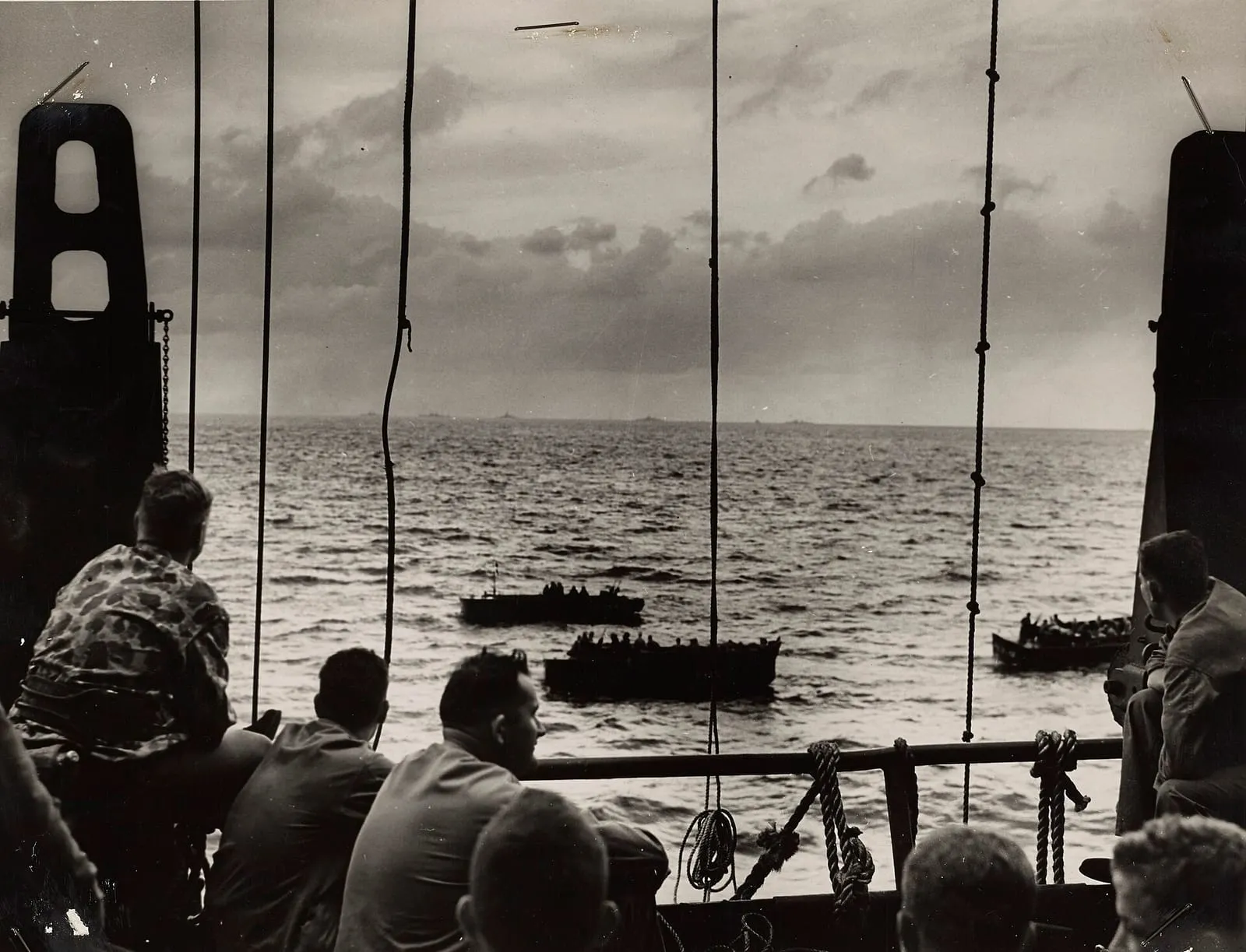
On 20 November 1943 Operation Galvanic began – the American invasion of the Gilbert Islands. At dawn men of the 2nd Marine Division began landing on Betio, the most heavily fortified islet of Tarawa atoll, while a regiment of the US Army’s 27th Infantry Division landed on Makin atoll, about 160 kilometres to the north. The landing had been preceded by, among other things, a raid on 14 November, recorded in war chronologies with the words “heavy bombers attack Tarawa in the Gilbert Islands”. Both events were part of a single operation – the first step of the American offensive across the central Pacific. Three days of fighting for a scrap of coral sand cost the Americans around a thousand dead, and the images from the beach at Betio shocked public opinion in the United States.
Why the Gilberts
In the summer of 1943 the American Chiefs of Staff decided that, alongside General Douglas MacArthur’s advance through New Guinea, a second offensive would be launched – across the central Pacific, under the command of Admiral Chester Nimitz. The British approved this at the Quebec Conference. The intermediate objective was the Marshall Islands, but American aircraft based in Hawaii and the Ellice Islands could not reach them freely. Airfields closer to them were needed – in the Gilbert Islands. The Japanese had occupied the Gilberts in December 1941; American carriers first struck them during the raids on the Marshall and Gilbert Islands in February 1942, and after Carlson’s raid on Makin in August 1942 the Japanese began feverishly fortifying the archipelago.
Command of the operation went to Vice Admiral Raymond Spruance, commander of the Central Pacific Force (the Fifth Fleet from 1944). The amphibious force was led by Rear Admiral Richmond Kelly Turner, and the landing troops by General Holland Smith, commander of V Amphibious Corps. Tarawa was assigned to General Julian C. Smith’s 2nd Marine Division, veterans of Guadalcanal; Makin to the reinforced 165th Infantry Regiment of General Ralph C. Smith’s 27th Division. In all, some 35,000 troops sailed in the transports, covered by more than a dozen carriers, battleships and cruisers. Originally the third objective was to have been the island of Nauru, but it was judged too strongly defended and replaced by Makin.
The Japanese fleet was unable to respond. At the beginning of November Admiral Mineichi Koga had sent heavy cruisers and carrier aircraft to Rabaul to defend Bougainville. The American raids on Rabaul, and in particular the carrier strikes on Rabaul on 5 and 11 November, damaged the cruisers and bled the carrier air groups white. When Galvanic began, the Combined Fleet had nothing with which to defend the Gilberts. The garrisons of Tarawa and Makin were left to fend for themselves.
Bombs before the landing
The air preparation began a week before the landing. According to the official history of the US Army Air Forces, on 13 November eighteen B-24 Liberators of the 11th Bombardment Group of the Seventh Air Force took off from Funafuti atoll in the Ellice Islands (today Tuvalu) and dropped fragmentation and high-explosive bombs on Tarawa; one aircraft failed to return. The Liberators returned over the atoll on 14 November – it is this raid that war chronologies record under that date – and again on 17 and 19 November. They also bombed airfields in the Marshall Islands and on Nauru, from which Japanese aircraft could threaten the invasion fleet. In the last days before the landing Tarawa and Makin were also attacked by carrier aircraft – far more effectively than by the Liberators, according to the same history.
The effect was smaller than expected. The heavy bombers, attacking from high altitude, wrecked the airfield and barracks and started fires visible tens of kilometres away, but they could not destroy bunkers built of concrete, steel rails and palm logs covered with a thick layer of sand. The same was true of the naval gunfire: on the morning of 20 November battleships and cruisers fired some three thousand shells at Betio. It was the heaviest preparatory bombardment for a landing in the history of the war to date, and yet – as the navy itself later admitted – it was not enough. The high-explosive shells burst on the surface before they could penetrate the roofs of the shelters.
Fortress Betio
Betio is a narrow islet about three and a half kilometres long and at most a few hundred metres wide. Its centre was taken up by the airfield. The Japanese had been fortifying it for almost a year, first under the direction of Rear Admiral Saichirō Tomonari, an engineer, and from July 1943 under Rear Admiral Keiji Shibazaki, who had experience of fighting in China. Shibazaki is said to have told his men that a million men could not take Tarawa in a hundred years.
According to American studies the garrison numbered some 4,500–4,800 men: troops of the 3rd Special Base Force and the Sasebo 7th Special Naval Landing Force – Japanese naval infantry, considered by the Americans to be better trained than Army infantry – and labourers from construction units. Around 1,200 of them were Koreans, many of them conscripted for forced labour. The islet held several hundred bunkers and firing positions, dozens of guns of various calibres, fourteen light tanks and fourteen coastal guns, including four British-made 8-inch (203 mm) Vickers guns. Contrary to the legend later repeated, these had not been captured at Singapore – Japan had bought them from Britain decades earlier. The beach on the lagoon side was closed off by a seawall of palm logs a metre or more high, and the approaches from the reef by barbed wire, mines and anti-landing obstacles.
The reef and the tide
The most serious obstacle, however, turned out to be nature. Betio is surrounded by a coral reef that extends several hundred metres from the shore on the lagoon side. The Marine planners reckoned that the tide would raise the water over it to about five feet (one and a half metres) – enough for the flat-bottomed Higgins boats, which needed about four feet, to pass over. Major Frank Holland, a New Zealand liaison officer who had lived on Tarawa for more than a decade, warned that on those days the water might be no more than three feet deep. Colonel David Shoup, commander of the 2nd Marine Regiment, who was to lead the assault, warned his men that the chances they would have to wade ashore were fifty-fifty. The date was not changed. On 20 and 21 November there was a neap tide, during which the water barely rises above the reef.
The only craft capable of crossing the reef were the tracked LVT amphibians known as amtracs – vehicles designed to carry supplies, not for assault, and mostly unarmoured. The division gathered about 125 of them, some only at the last moment. They were enough only for the first three assault waves. The following waves went in by Higgins boat.
The first day
The battle began before dawn with an artillery duel. At around 5 a.m. the Japanese coastal guns opened fire, and the battleships Maryland and Colorado replied with salvoes; within a few dozen minutes the heaviest Japanese batteries had been silenced. A belated carrier air strike and several hours of naval bombardment turned the islet into a cloud of smoke and dust. According to later assessments many defenders were killed at this stage, and Shibazaki’s telephone lines, laid shallowly in the sand, were cut. H-hour was put back from 8.30 to 9 a.m., and the bombardment was lifted while the amphibians were still far from the shore. The Japanese had time to emerge from their shelters.
Many descriptions of the battle speak of heavy fire from “coastal guns”. In reality the big Vickers guns had ceased to matter by dawn. The Marines on the beaches designated Red 1, Red 2 and Red 3 were killed by machine guns, anti-boat guns, field guns and mortars firing from bunkers right at the water’s edge. The amphibians reached the shore, but half of them were destroyed or holed on the first day. The Higgins boats carrying the following waves grounded on the reef several hundred metres from the beach, and the men had to wade through water up to their waists or necks, holding their weapons above their heads, under fire from the front and the flanks. Many were killed or drowned before they reached the shore. Some of the Sherman medium tanks that were to support the infantry sank in shell craters or were knocked out on the beach.
On the shore the Marines clung to the palm-log seawall. Shoup, wounded by a shell fragment soon after reaching the pier, took command of all the units ashore and spent the whole day organising the advance from a shallow beachhead. At the western tip of the islet Major Michael Ryan gathered stragglers from various companies and seized a stretch of shore that became the landing place for reinforcements the next day. General Julian Smith asked Holland Smith to release the corps reserve – the 6th Marine Regiment – and received permission. By evening some five thousand Marines had landed on Betio, of whom roughly 1,500 had been killed or wounded. They held a strip of beach a few dozen metres deep in places and a wedge driven inland by the pier.
The Japanese, too, had suffered heavy losses. According to historical studies, Shibazaki left his command post in the afternoon to make room for the wounded and was killed with his staff while moving to another bunker. Deprived of communications and of their commander, the Japanese units from then on fought each on its own. During the night they did not mount the counter-attack the Marines feared most; they merely harassed them with fire, while individual riflemen swam out to wrecks in the lagoon so that in the morning they could shoot the arriving reinforcements in the back.
Makin
That same morning Army troops landed on Makin – the 165th Infantry Regiment, formerly New York’s “Fighting 69th” of the National Guard, reinforced by a battalion of the 105th Regiment and by tanks. The objective was the island of Butaritari, where after Carlson’s raid the Japanese had set up a seaplane base. By American estimates it was defended by some 700–800 men, of whom only about 300 were combat troops; the rest were labourers, Koreans among them. The landings on two beaches went ahead almost without loss, but the advance then moved slowly through palm groves and swamps, among isolated snipers. On the first day the regimental commander, Colonel Gardiner Conroy, was killed by a sniper’s bullet. Holland Smith sharply criticised the Army’s pace, which began his long feud with the officers of the 27th Division.
General Ralph Smith reported the capture of Makin on the morning of 23 November. The ground forces lost 66 killed and 152 wounded. The navy paid a far higher price. Before dawn on 24 November the Japanese submarine I-175 torpedoed the escort carrier Liscome Bay; the torpedo detonated her bomb store and the ship sank within a few dozen minutes. Some 640 sailors and airmen were killed, among them Rear Admiral Henry Mullinnix – nearly ten times as many as the soldiers who fell on Makin. Earlier, on 20 November, an explosion in a gun turret of the battleship Mississippi had killed 43 sailors.
Shock in America
The fighting on Betio lasted until 23 November. On the second day reinforcements landed on the western tip of the islet and the Marines cut it in two; on the night of 22–23 November the remnants of the garrison launched banzai charges, which were broken up by artillery fire. After 76 hours of fighting the islet was declared secured. According to Marine Corps figures, about a thousand Marines and sailors were killed and about 2,100 wounded. Of the nearly 4,700 defenders, 17 Japanese and 129 Koreans were taken prisoner; the rest died, many by their own hand.
These figures shook America: in three days, on a scrap of sand, the Marine Corps had lost almost as many dead as in the six-month Guadalcanal campaign. Correspondents, among them Robert Sherrod of Time, described the dead floating by the reef and the bodies on the beach. Newspapers asked whether such a price for a small atoll had been necessary, and letters from families poured into headquarters. President Roosevelt agreed to the publication of photographs of the dead, and the documentary With the Marines at Tarawa, which showed the bodies on the beach unflinchingly, won an Oscar in 1945. The military and the government concluded that the public had to know what price victory over Japan would carry.
Significance
Tarawa was the first American landing on a heavily fortified atoll and the first test of the doctrine the Marine Corps had been developing since the 1930s. The lessons were learned quickly: far more armoured amphibians were ordered, the pre-landing bombardment was lengthened and made more precise, armour-piercing shells began to be used against bunkers, teams of underwater swimmers were formed to reconnoitre reefs, and communications between ships and units ashore were improved. The airfields on Tarawa and Makin, swiftly rebuilt by the Americans, were already being used at the turn of 1943 and 1944 to bomb the Marshall Islands.
When at the turn of January and February 1944 the Americans attacked Kwajalein and other atolls of that archipelago (the Marshall Islands campaign), things went far more smoothly and at lower cost. The central Pacific offensive that began on Betio led to the Marianas in the summer of 1944, and from there to the bombing of Japan. Yet Tarawa remained in American memory a symbol of the price of that road – and a foretaste of the even bloodier battles for Iwo Jima and Okinawa.
Sources
Meanwhile
(04)Elsewhere, within a week.
- 18 November 1943 · Western FrontThe air Battle of Berlin beginsOn the night of 18–19 November 1943, 444 RAF aircraft attacked Berlin. Cloud scattered the bombs; about 130–150 died. So began the Battle of Berlin.
- 22 November 1943 · DiplomacyThe Cairo ConferenceOn 22–26 November 1943 Roosevelt, Churchill and Chiang Kai-shek met in Cairo to discuss the war with Japan and agreed to return Manchuria and Taiwan to China.
- 16 November 1943 · ScandinaviaThe raid on VemorkOn 16 November 1943 American bombers attacked the Vemork power station and heavy water plant and the works at Rjukan. More than 20 Norwegians were killed.
- 16 November 1943 · MediterraneanThe attacks in MilanIn mid-November 1943 attacks by communist GAP groups on Germans and Salò Fascists mounted in Milan and other cities of northern Italy.
Related events
(04)The same battle, people or subject.
- 31 January 1944 · PacificThe landing on KwajaleinOn 31 January 1944, after three days of air strikes and shelling, the Americans launched Operation Flintlock: they took Majuro and islets of Kwajalein atoll.
- 4 February 1944 · PacificThe capture of Kwajalein AtollBy 4 February 1944 the Americans had taken Roi-Namur and Kwajalein Island in the heart of the Marshalls; the whole atoll was declared secure a few days later.
- 17 February 1944 · PacificThe landing on EniwetokOn 17 February 1944 the Americans began Operation Catchpole – the landing on Eniwetok, at the western end of the Marshall Islands, taken in a week of fighting.
- 18 February 1944 · PacificOperation Hailstone – the raid on TrukOn 17–18 February 1944 Mitscher's carriers wrecked the Truk base, sinking dozens of ships and destroying over 250 aircraft. Truk was then bypassed.