1943–1944: The Central Pacific offensive
Battle of Tarawa
- Dates:
- 20–23 November 1943
- Front:
- Pacific
- Location:
- Tarawa Atoll in the Gilbert Islands (now Kiribati), above all the islet of Betio with its Japanese airfield; in parallel Makin Atoll (Butaritari), about 170 km to the northOn the battle map →
- Sides:
- United StatesChester Nimitz, Raymond Spruance, Richmond Kelly Turner, Holland Smith, Julian Smith, David ShoupJapanKeiji Shibazaki
- Result:
- American victory. Betio was declared secure at 1.30 p.m. on 23 November 1943, Makin on the morning of the same day; the rest of Tarawa Atoll was cleared by 28 November. The Americans gained an airfield and a base for the advance on the Marshall Islands, but the losses of the 2nd Marine Division – about a thousand dead in 76 hours – shocked American public opinion.
- Author:
- Łukasz
Name and dates
The Battle of Tarawa (also covered as part of the Gilbert Islands campaign) is the name given to the American landing on Tarawa Atoll in the Gilbert Islands and the three and a half days of fighting for its main fortified islet, Betio. It was part of Operation Galvanic – the first large amphibious operation of the US Pacific Fleet in the central Pacific – in which Army troops simultaneously captured Makin Atoll and a small Marine reconnaissance detachment occupied Abemama Atoll.
Following the official history of the US Marine Corps, the battle is dated 20–23 November 1943: from the landing of the first waves of the 2nd Marine Division on Betio at 9.10 a.m. on 20 November to the moment at 1.30 p.m. on 23 November when Major General Julian Smith declared the islet secure. The battle for Makin was fought on the same days and ended with the signal “Makin taken” on the morning of 23 November. Fighting on the remaining islets of Tarawa Atoll – the pursuit of the stragglers by the 2nd Battalion, 6th Marines, which ended in a clash on Buariki on 27 November – went on until 28 November, while the small Japanese garrison of Abemama, according to American accounts, took their own lives around 25 November; these events form the epilogue of the battle.
Betio, where almost the entire battle was fought, is a flat, sandy islet shaped like an elongated triangle, about 3.5–4 km long and at most 800 m wide, rising only a few metres above sea level. It lies in the south-western corner of the atoll, beside the only channel into the lagoon. The whole islet is smaller than many city parks, yet in the space of 76 hours nearly 6,400 men – Japanese, Koreans and Americans – died on it.
Background
The Gilbert Islands, part of the British colony of the Gilbert and Ellice Islands since 1916, were occupied by the Japanese in the first days of the Pacific War, in December 1941, at the same time as Guam. At first they kept only observation posts there and a seaplane base on Makin. Everything changed with Evans Carlson’s Marine raid on Makin in August 1942: the Japanese command took it as a harbinger of a larger offensive and decided to fortify the archipelago. In February 1943 the 6th Yokosuka Special Naval Landing Force arrived on Betio and was redesignated the 3rd Special Base Defence Force, while Rear Admiral Saichirō Tomonari, an engineer by training, began building one of the most heavily fortified positions in the entire Pacific.
On the American side the decision was taken in the summer of 1943. Admiral Ernest King had long argued that the road to Japan ran not only through New Guinea and the Philippines, as General Douglas MacArthur wanted, but also across the central Pacific – through the Marshalls, the Carolines and the Marianas. On 20 July 1943 the Joint Chiefs of Staff instructed Admiral Chester Nimitz to prepare an operation in the Gilbert Islands, and in August the Quebec Conference confirmed the strategy of a dual advance. The Gilberts were to be the first step: from their airfields land-based aircraft could reconnoitre and bomb the Marshall Islands, which in turn were to become the springboard for a leap to the Marianas. The original second objective besides Tarawa was Nauru, but at the end of September, at the request of the Marine commanders, it was replaced by Makin, which was more weakly defended and closer.
Command of the operation went to Vice Admiral Raymond Spruance, the victor of Midway, at the head of the Central Pacific Force created in August (the Fifth Fleet from 1944). The amphibious forces were led by Rear Admiral Richmond Kelly Turner, a veteran of Guadalcanal, who personally commanded the Northern Attack Force off Makin; the Southern Attack Force off Tarawa was under Rear Admiral Harry W. Hill. The landing troops – V Amphibious Corps – were commanded by Major General Holland Smith, known as “Howlin’ Mad”, the architect of American amphibious doctrine, but actual direction of the fighting on Tarawa fell to Major General Julian Smith, commander of the 2nd Marine Division. The division, worn out by the fighting on Guadalcanal, had been resting and training in New Zealand, around Wellington. Makin was to be taken by the reinforced 165th Regimental Combat Team of the Army’s 27th Infantry Division under Major General Ralph C. Smith.
Shibazaki’s fortress
In the summer of 1943 – in September, according to most sources – command in the Gilbert Islands passed to Rear Admiral Keiji Shibazaki, a veteran of landings in China who knew well how hard it is to take a fortified shore. He had about 4,800 men under him. Their core consisted of two naval infantry units of the Imperial Japanese Navy, regarded as better trained and better disciplined than ordinary Army infantry: the 3rd Special Base Defence Force (about 1,100 men) and the 7th Sasebo Special Naval Landing Force (about 1,500 men). The rest were two construction units totalling some 2,200 men, including – according to the American official history – about 1,200 Korean labourers brought from the colony Japan had ruled since 1910. Shibazaki is credited with the boast that a million men could not take Betio in a hundred years; the words, however, are known from accounts rather than from any document.
The defences were designed to stop the landing in the water or pin it down on the beach. A reef several hundred metres wide surrounded the islet, and on and behind it stood concrete obstacles, logs and barbed wire, placed so as to channel the boats into the fire from the shore. On the beach a wooden wall of coconut logs was built, and behind it hundreds of firing positions – bunkers of logs and sand, many reinforced with concrete and steel plate, linked by trenches. The ocean shore was guarded by fourteen coast-defence guns, including four British 203 mm (8-inch) Vickers guns. It was long repeated that the Japanese had captured them at Singapore; most modern authors believe Japan bought them from the British as early as the beginning of the 20th century. To these were added several dozen smaller-calibre guns, anti-tank guns, anti-aircraft guns, machine guns and fourteen Type 95 Ha-Go light tanks. Through the middle of the islet, along almost its entire length, ran the airstrip – the object of the whole operation – and beside it stood a two-storey reinforced-concrete command bunker.
The weakness of the defence was its lack of depth. The large shelters in the interior of the islet protected the men from bombs but had no firing slits, and the telephone lines were laid shallow in the sand. The Japanese were also counting on aircraft and warships arriving from the Marshall Islands in the event of an attack. Yet in October and early November Admiral Mineichi Koga, commander of the Combined Fleet, sent carrier aircraft and heavy cruisers to Rabaul to defend the Solomons – and lost them in the American raids on Rabaul, including the carrier strikes of 5 and 11 November. When the Americans approached the Gilberts, the garrisons of Tarawa and Makin were in practice left to fend for themselves; they could count only on submarines and a handful of aircraft from the Marshalls.
Preparations
Operation Galvanic was the largest undertaking the Americans had yet mounted in the Pacific. Seventeen carriers of various sizes – among them the new Essex-class fleet carriers and Independence-class light carriers – 12 battleships, more than a dozen cruisers, several dozen destroyers and 36 transports carrying about 35,000 troops approached the Gilberts. From 13 November Tarawa and Makin were bombed by B-24 heavy bombers of the Seventh Air Force flying from airfields in the Ellice Islands and on Baker Island; on 18 and 19 November they were joined by carrier aircraft, which also struck the airfields in the Marshalls and on Nauru to cut the garrisons off from air support.
The planners’ greatest worry was the depth of water over the reef. The standard LCVP landing craft, the so-called Higgins boats, drew about 1.2 m when loaded, and the day of the landing fell during a period of neap tides. The tide tables promised about 1.5 m of water over the reef, but Major Frank Holland, a New Zealand liaison officer who had lived on Tarawa for fifteen years, warned that on those days there might be little more than a metre. The answer was tracked amphibious vehicles, LVTs (“amtracs”), which could crawl over the reef. Julian Smith secured 125 of them – 75 older LVT-1s and 50 new LVT-2s, brought in at the last minute via Samoa – but they were enough only for the first three waves. The rest were to go in by boat and, if the water was low, wade across the reef on foot. Colonel David Shoup, who a few days before the landing had taken command of the 2nd Marines, the regiment leading the assault, told his men plainly that the chance of a dry landing was fifty-fifty.
There was also a dispute over the reserves. Holland Smith held back the 6th Marines as corps reserve, earmarked also for Makin, so Julian Smith could commit only two regiments to Betio. The plan provided for an assault from the lagoon side, on the north shore of the islet, divided into three sectors: Red Beach 1 in the west, Red 2 west of the long pier and Red 3 east of it. The ocean shore, considered more strongly defended, was left alone.
The battle: 20 November
Before dawn on 20 November Rear Admiral Hill’s transports took station not where planned – the current had carried them off – and loading into the boats dragged on. Shibazaki, alerted by radar and an air patrol, opened fire with his 203 mm guns at around 5 a.m. The battleships USS Maryland and Colorado quickly silenced the heavy batteries, and one shell blew up an ammunition magazine. Then for nearly three hours warships and aircraft rained thousands of shells and bombs on Betio; to the observers it seemed that nothing on the islet could have survived. The bombardment, however, consisted mainly of high-explosive shells, which tore up the surface but did not penetrate shelters of sand, logs and concrete. Minesweepers entered the lagoon and cleared its approaches, and H-hour was postponed three times. When the fire lifted while the first waves were still far out, the defenders had time to emerge from cover and shift some of their men from the south shore to the north.
The first amtracs reached the shore at around 9.10 a.m. Three waves crossed the reef, though under mounting fire; many of the unarmoured vehicles were riddled or set ablaze, and those that got through could not climb the log wall on the beach. The real disaster befell the following waves. The water over the reef – as Major Holland had warned – did indeed fail to rise; a phrase recurs in Marine accounts that “the ocean just stood still”. The Higgins boats grounded on the edge of the reef several hundred metres from shore, and the men, weighed down with heavy equipment, had to wade waist- or chest-deep under machine-gun fire from the flanks and from wrecks on the reef. On Red Beach 1 the companies of the 3rd Battalion, 2nd Marines were cut to pieces, and the battalion commander was unable to get ashore for many hours. On Red 2 the commander of the 2nd Battalion, Lieutenant Colonel Herbert Amey, was killed. On Red 3 Major Henry Crowe’s 2nd Battalion, 8th Marines seized a beachhead around the base of the pier. Lieutenant William D. Hawkins’s scout-sniper platoon cleared the Japanese from the pier itself, and Hawkins – wounded on the first day and killed on the second – was posthumously awarded the Medal of Honor; the airfield on Betio was later named after him.
Shoup reached the shore near the pier at around noon, wounded by shell fragments, and from there – sheltering against the wall of a Japanese bunker – he directed the entire battle on the islet. The reports reaching the Maryland were so bad that Julian Smith committed the divisional reserve and in the afternoon asked Holland Smith to release the 6th Marines; permission came the same day. On Red 1, at the western end of the islet, Major Michael Ryan gathered survivors from various units, supported them with the surviving M4 Sherman tanks and pushed inland – far enough that the next day his scratch force was able to take the whole western shore. The tanks, which had struggled across the reef, many of them sinking in shell holes, proved invaluable in reducing strongpoints.
By evening the Americans held two narrow, unconnected beachheads, reaching at best about halfway across the islet. Some 5,000 Marines had gone ashore, and roughly one in three had been killed or wounded. The second wave of reserves spent the night in boats on the lagoon. That same afternoon Shibazaki was killed: he left the command bunker to make room for the wounded and died together with most of his staff from a naval shell, probably while moving to the south side of the islet. As the American fire had also cut the telephone lines, the Japanese units fought from then on in isolation. The defenders did not launch the night counter-attack the Americans most feared – and according to many historians this omission saved the beachhead. In the evening Japanese torpedo bombers from the Marshalls hit the light carrier Independence off Tarawa, and she had to withdraw.
The battle: 21–22 November
The second day began as a repeat of the first. In the morning the 1st Battalion, 8th Marines, which had spent the night in boats, was ordered to land on Red Beach 2. The water over the reef was low again, and the men had to wade several hundred metres under flanking fire – from a wrecked ship on the reef and from positions between Red Beaches 1 and 2. The battalion lost a large part of its strength in the crossing. Observers on ships and in aircraft saw dozens of bodies in the water.
Even so, in the course of the day the balance tipped towards the Americans. At the western end Ryan’s men, supported by precise destroyer fire directed by artillery observers, took the whole of Green Beach – the western shore of the islet – in about an hour. From the beachhead on Red 2 and 3 the Marines fought their way across the airfield to the south shore, cutting the defence in two. When it was reported that Japanese were escaping across the shallows to the neighbouring islet of Bairiki, the 2nd Battalion, 6th Marines was landed there. In the late afternoon Major William Jones’s 1st Battalion, 6th Marines came ashore on Green Beach – partly in rubber boats – with practically no losses. That evening Shoup sent the command ship a report that has passed into Marine Corps history: “Casualties: many. Percentage dead: unknown. Combat efficiency: we are winning.”
On 22 November fresh troops and heavy equipment came ashore, and Julian Smith moved his command post onto the islet. Jones’s battalion advanced from the west along the south shore and in the afternoon linked up with the units that had crossed the airfield, at last forming a continuous line. East of Red 3 Marines of the 8th Regiment attacked the largest Japanese shelters – among them a massive air-raid shelter of sand and concrete, onto whose top a party under Lieutenant Alexander Bonnyman forced its way; Bonnyman was killed repelling a counter-attack and was also posthumously awarded the Medal of Honor. By evening the Japanese held only the narrow eastern tail of the islet beyond the airfield and a few isolated pockets, the most dangerous of which was still holding out between Red Beaches 1 and 2.
The battle: 23 November and the end of the fighting
During the night of 22–23 November the Japanese, with no hope of relief, did what they had not done on the first night. First small groups tried to infiltrate the lines, and then at about 4 a.m. several hundred men struck the companies of the 1st Battalion, 6th Marines in a “banzai” charge. The Marines beat it off with the help of the 10th Marines’ howitzers, firing a few dozen metres in front of their own positions, and of fire from the destroyers Schroeder and Sigsbee. In the morning some 325 Japanese dead lay in front of and inside their lines; Jones’s battalion had lost 45 killed and 128 wounded.
At 8 a.m., after an air strike and an artillery barrage, Lieutenant Colonel Kenneth McLeod’s 3rd Battalion, 6th Marines advanced on the eastern end of the islet. Supported by two Shermans and by engineers with flamethrowers and demolition charges, it moved fast, bypassing pockets of resistance and leaving them to follow-on units. At about 1 p.m. it reached the eastern tip. At the same time two battalions, attacking from both sides, wiped out the Japanese pocket between Red Beaches 1 and 2, which had held out since the first day. At 1.30 p.m. on 23 November Julian Smith announced that Betio had been taken. Over the following days the 2nd Battalion, 6th Marines combed the remaining islets of the atoll; on 27 November on Buariki it destroyed the last group of defenders – about 175 men according to American figures – and on 28 November the atoll was declared cleared.
Makin and Abemama
At the same time as Tarawa, on the morning of 20 November, the 165th Regimental Combat Team of the 27th Infantry Division, reinforced by a battalion of the 105th Infantry and by light tanks, landed on the main island of Makin Atoll – Butaritari, familiar to the Americans from Carlson’s raid. By American estimates the garrison numbered 700–800 men, of whom only about 300 were combat troops, the rest construction workers, many of them Korean. The landings from the ocean and the lagoon went off without serious losses, but the advance then proceeded slowly: the inexperienced troops fired blindly at night, and on the first day the regimental commander, Colonel Gardiner Conroy, was killed by a sniper’s bullet. Holland Smith, who watched the fighting, sharply criticised the pace of Ralph Smith’s operations – the beginning of a feud between the Marine Corps and the Army that erupted in full on Saipan in 1944. On the morning of 23 November Ralph Smith reported: “Makin taken.” According to American figures the Army troops lost 66 killed and 152 wounded, and the Japanese about 395 killed in action.
The highest price for Makin, however, was paid by the Navy. As early as 20 November an explosion in a gun turret of the battleship Mississippi killed 43 sailors. Before dawn on 24 November, after the fighting ashore had ended, the Japanese submarine I-175 torpedoed the escort carrier USS Liscome Bay. The torpedo detonated her stock of aircraft bombs and the ship sank within minutes; between about 640 and more than 700 men were killed, depending on the source, among them Rear Admiral Henry Mullinnix. The Navy’s losses off Makin were several times those of the troops fighting ashore and gave ammunition to critics of the slow advance: every day of delay kept the fleet off the island, exposed to submarine attack.
The third objective of the operation was Abemama Atoll, about 150 km south-east of Tarawa. On 21 November the reconnaissance company of V Amphibious Corps landed there from the submarine Nautilus – the same boat that had carried Carlson’s raiders in 1942. The small Japanese garrison held out for a few days, and according to American accounts its last soldiers took their own lives. On Abemama the Americans quickly built an airfield which – like the rebuilt airfield on Betio – served for attacks on the Marshall Islands.
Losses
According to the official history of the US Marine Corps, the 2nd Marine Division lost 894 killed in action and 84 died of wounds on Tarawa, while 2,188 men were wounded; of the roughly 12,000 Marines who went ashore, more than 3,100 were thus lost from the ranks. Other studies, which add the missing, the Navy corpsmen killed and sailors, give about 1,000–1,100 dead and about 2,100–2,300 wounded. Almost all these losses fell within the 76 hours between the landing on 20 November and the capture of the islet on 23 November.
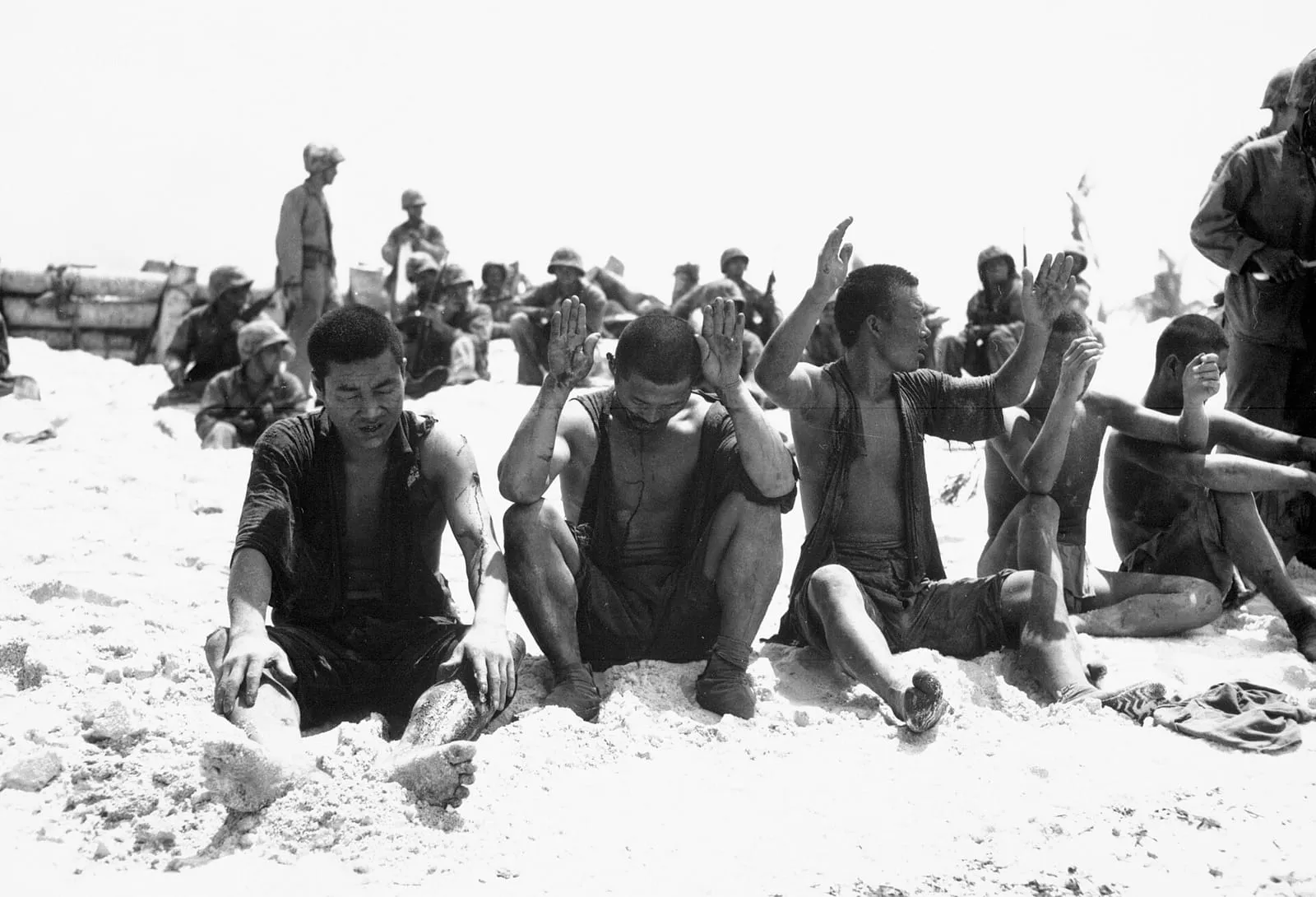
The Japanese side lost almost everyone. Of the roughly 4,700 men on Betio – 4,690 killed according to the most frequently cited figures – only 17 Japanese (one of them an officer) and 129 Korean labourers were taken prisoner. In keeping with their orders and with the conviction, prevalent in both the Army and the Navy, that capture was a disgrace, the defenders fought to the end; many of the last survivors took their own lives. Among the dead were also about a thousand Koreans from the construction units, forcibly conscripted to work on the fortifications – victims of a war in which they had no choice. In all, nearly 6,400 men died in three and a half days on a scrap of land no bigger than a few hundred hectares. The remains of some of the fallen Marines, hastily buried in mass graves, were still being found on Betio in the 21st century.
Significance
Tarawa was the first American landing in the Pacific made directly against a heavily fortified and resolutely defended shore – on Guadalcanal or New Georgia the Marines had landed where there were no enemy troops or only a few. The news of nearly a thousand dead in three days for an islet whose name most Americans had never heard caused a shock at home. Angry letters from the families of the fallen poured in to Admiral Nimitz, and the Time correspondent Robert Sherrod, who had survived the landing on Red Beach, described the slaughter on the reef in his dispatches and in a book published in 1944. Holland Smith later compared the assault to Pickett’s Charge at Gettysburg and wrote in his memoirs that taking Tarawa had been a mistake. Nimitz, Spruance, Julian Smith and Shoup took the opposite view: in Nimitz’s words, the capture of Tarawa “knocked down the front door” to the Japanese defences in the central Pacific. The new Commandant of the Marine Corps, General Alexander Vandegrift, assured Congress that Tarawa had been an assault from start to finish and could not have been taken more cheaply.
Public opinion was also shaped by film. Marine Corps cameramen, among them Sergeant Norman Hatch, filmed the fighting and its aftermath – including the bodies of the dead on the beach and in the water. Whether to release this footage was decided personally by President Franklin Delano Roosevelt, who gave his approval. The documentary With the Marines at Tarawa, shown in cinemas from March 1944, was one of the first American war films to show the bodies of the country’s own dead soldiers; in 1945 it won the Oscar for best documentary short.
Militarily, the lessons proved the most important outcome. The Americans realised that a short bombardment with high-explosive shells does not destroy fortified positions – before later landings they shelled targets for many days, also with armour-piercing rounds, and coordinated naval gunfire more closely with the needs of the infantry. Far more LVTs were ordered, including armoured and armed versions, so that the whole first echelon, not just three waves, could cross the reef. Underwater demolition teams were formed for hydrographic reconnaissance and the clearance of underwater obstacles – the forerunners of the later Navy commandos – and radio communications and air–ground cooperation were improved. The lessons were applied only two months later: at the turn of January and February 1944 the Americans took Kwajalein and Majuro in the Marshall Islands at a cost incomparably lower than on Betio, supported by aircraft from the airfields on Tarawa and Abemama, and in February Eniwetok as well.
The Battle of Tarawa opened the central Pacific offensive which over the following year carried the Americans through the Marshall Islands to the Marianas – Saipan, Guam and Tinian – from where, from the autumn of 1944, B-29 bombers could reach Japan. After Tarawa the 2nd Marine Division rested in Hawaii and in June 1944 landed on Saipan. Shoup, awarded the Medal of Honor, became Commandant of the Marine Corps after the war. On Betio, today the most populous part of South Tarawa, the capital of Kiribati, rusting coast-defence guns and Shibazaki’s concrete bunker still stand.