1941–1942: The Japanese offensive in the Pacific
Attack on Pearl Harbor
- Dates:
- 7 December 1941
- Front:
- Pacific
- Location:
- The Pearl Harbor naval base and the airfields of Oʻahu (Hawaii); the Japanese carriers some 230 nautical miles (about 420 km) north of the islandOn the battle map →
- Sides:
- United StatesHusband E. Kimmel, Walter Short
- Result:
- Tactical Japanese victory. Eight battleships sunk or damaged (Arizona and Oklahoma lost for good), 188 aircraft destroyed, 2,403 Americans killed. The Japanese lost 29 aircraft and five midget submarines. The carriers, the dockyard and the fuel tanks survived, and the United States entered the war.
- Author:
- Natalia
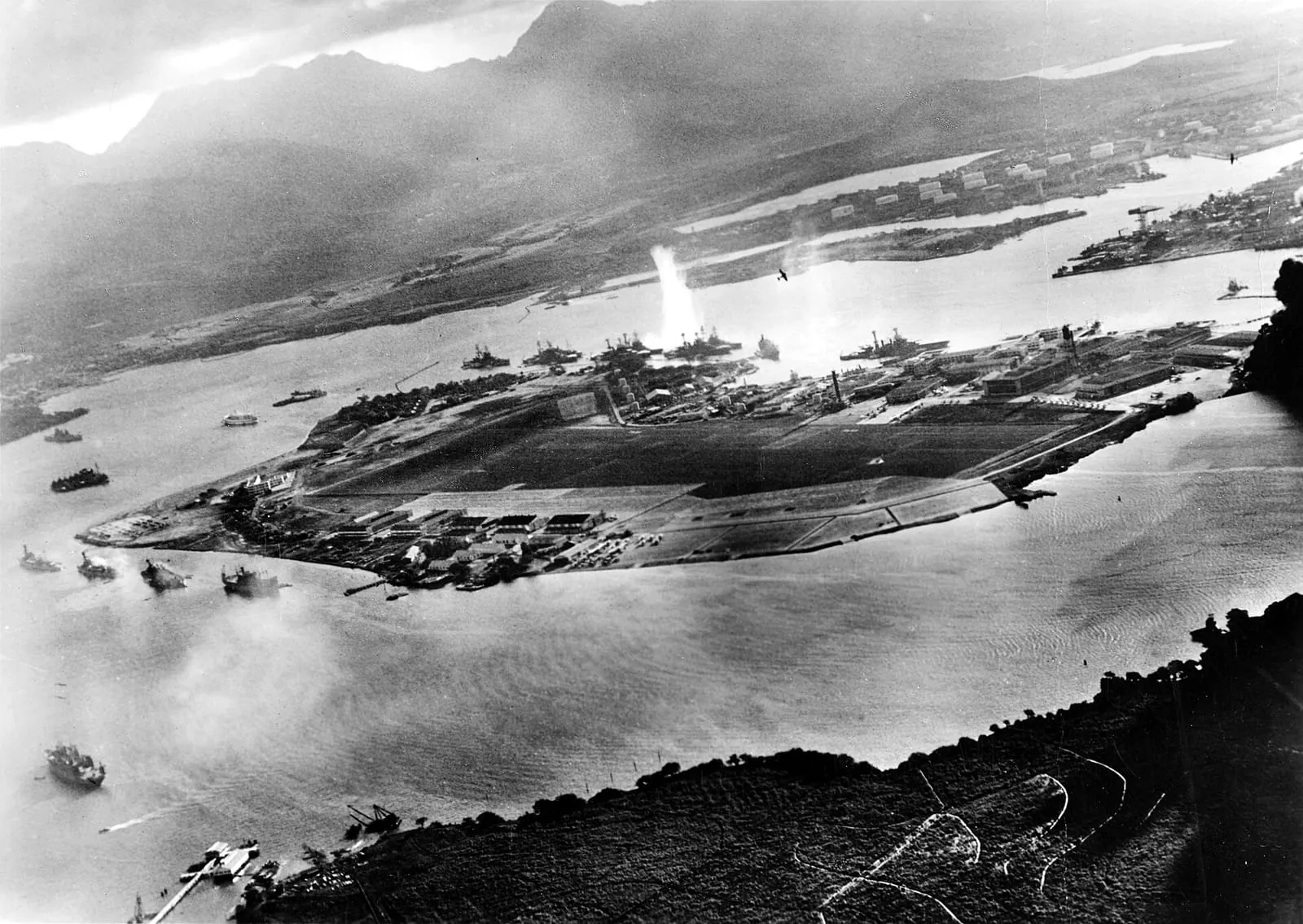
On Sunday 7 December 1941, a few minutes before eight in the morning Hawaiian time, Japanese aircraft appeared over the base of the US Pacific Fleet at Pearl Harbor (PL) on the island of Oʻahu. They had taken off from the six aircraft carriers of Vice Admiral Chūichi Nagumo, which since 26 November had been crossing the North Pacific under radio silence. In two waves, in less than two hours, some 350 aircraft sank or damaged all eight battleships in the harbour, more than a dozen other ships and almost two hundred aircraft on the ground. 2,403 Americans were killed, almost half of them aboard a single ship, the battleship Arizona. The Japanese lost twenty-nine aircraft. The attack, planned by the Commander-in-Chief of the Combined Fleet, Admiral Isoroku Yamamoto, came without a declaration of war and without a breaking-off of the negotiations that Japanese diplomats were still conducting in Washington that morning. It took the commanders in Hawaii, Admiral Husband Kimmel and General Walter Short, by surprise, although there had been no shortage of warnings. It was one of the heaviest defeats in the history of the US Navy and at the same time the moment at which the war in Europe and the war in Asia merged into a single world war.
Name and dates
In Poland and in most languages the event is called the attack, or the raid, on Pearl Harbor, after the bay and naval base on the south coast of Oʻahu. In Japan people speak of the “attack on Hawaii” or the “Hawaii Operation” (Hawai sakusen), and in Western literature the name “Operation Z” is often found. The attack lasted a single day. The times given are Hawaiian time as it then stood, ten and a half hours behind Greenwich.
The date does, however, need explaining, because the attack straddled the International Date Line. The first bombs fell on Pearl Harbor at 7.55 a.m. on Sunday 7 December in Hawaii – that is, at 1.25 p.m. in Washington and at 3.25 a.m. on Monday 8 December in Tokyo. The Japanese ships kept Tokyo time, so in Japanese documents and in Japanese collective memory the Pacific War began on 8 December. On the same day, Asian time, the Japanese struck at Malaya, Thailand, Hong Kong, the Philippines, Guam and Wake. Indeed, by most reckonings the landing at Kota Bharu in Malaya began more than an hour before the air raid on Hawaii. The attack on Pearl Harbor was the Hawaiian part of that offensive alone.
Background
Oil, the embargo and the road south
Since 1937 Japan had been waging a war in China that it could not win, and to wage it needed raw materials it did not have: above all oil, most of which it bought from the United States. When France fell in the summer of 1940 and the Netherlands came under German occupation, Tokyo concluded that the rich colonies of South-East Asia lay open. In September 1940 Japan concluded the Tripartite Pact with Germany and Italy and moved into northern Indochina. Washington responded with ever tighter trade restrictions. The turning point came in July 1941: after Japanese troops occupied southern Indochina, President Franklin D. Roosevelt froze Japanese assets, and in August oil deliveries stopped. Britain and the government of the Netherlands East Indies took similar steps. The Japanese navy reckoned that its fuel stocks would last for roughly eighteen months to two years of war, and every month of delay ate into them.
Japan’s leaders faced a choice: withdraw from China and Indochina, as the Americans demanded, or seize oil by force by occupying the Netherlands East Indies and British Malaya. The Imperial Conference of 6 September resolved to prepare for war if negotiations failed. In October General Hideki Tōjō became prime minister, and the Imperial Conference of 5 November set 1 December as the final deadline for an agreement. When on 26 November Secretary of State Cordell Hull handed the Japanese diplomats a note demanding the withdrawal of troops from China and Indochina, Tokyo regarded it as an ultimatum. On 1 December another conference, held in the presence of Emperor Hirohito, decided on war with the United States, Britain and the Netherlands.
Yamamoto’s plan
Japanese planners knew that a thrust southwards required its flank to be secured. The Pacific Fleet, which Roosevelt had kept in Hawaii since May 1940 as a warning to Japan, could cross the ocean and cut the routes to the East Indies. The traditional doctrine of the Japanese navy held that it should be awaited and a decisive battleship engagement fought close to the home islands. Yamamoto regarded this as an illusion. In January 1941 he proposed that the war should begin with the destruction of the American fleet in its base by a carrier strike. The inspiration was the British attack on Taranto in November 1940, in which torpedo aircraft from a single carrier put three Italian battleships in harbour out of action. The Japanese also remembered a model of their own: the night torpedo-boat attack on the Russian squadron at Port Arthur in February 1904, which opened the Russo-Japanese War without a declaration of war.
The plan was worked out by Rear Admiral Takijirō Ōnishi, Lieutenant Commander Minoru Genda and the Combined Fleet staff. On 10 April 1941 the six large carriers were concentrated in the First Air Fleet under Nagumo, a senior admiral and a specialist in torpedoes and destroyers, who himself considered the plan risky. The Naval General Staff under Admiral Osami Nagano resisted until October, when Yamamoto threatened to resign. The problem of the shallow harbour was solved by fitting wooden fins to the Type 91 torpedoes, and 410 mm armour-piercing shells were converted into aerial bombs capable of piercing battleship decks. Knowledge of the harbour was supplied by naval intelligence, above all by Takeo Yoshikawa, who from March 1941 kept watch on Pearl Harbor from the Japanese consulate in Honolulu.
The aim was not to conquer Hawaii but to immobilise the Pacific Fleet for as long as it would take Japan to occupy South-East Asia and build a defensive ring of bases in the Pacific. Yamamoto also hoped that a heavy defeat would break the Americans’ will and induce them to compromise. The main targets were to be the carriers and the battleships. The plan did not list the dockyard, the docks or the fuel tanks as priorities.
Opposing forces
Nagumo’s striking force, known as the Kidō Butai, sailed from Hitokappu Bay in the Kurils on 26 November 1941, Tokyo time. Its core consisted of six carriers: Akagi (Nagumo’s flagship), Kaga, Sōryū, Hiryū, Shōkaku and Zuikaku, with more than four hundred aircraft: Mitsubishi A6M “Zero” fighters, Aichi D3A dive-bombers and Nakajima B5N torpedo bombers. They were escorted by two fast battleships, two heavy cruisers, a light cruiser with nine destroyers and three submarines, while tankers carried the fuel. Independently of the striking force, more than twenty large submarines of the Sixth Fleet sailed for Hawaii. Five of them carried Ko-hyoteki-class midget submarines, two-man craft with two torpedoes each, which were to slip into the harbour. The whole air strike was led by Commander Mitsuo Fuchida.
The force steamed through the empty, stormy waters of the North Pacific, far from the shipping lanes and out of range of American patrols, in complete radio silence. On 2 December it received from Tokyo the signal “Niitakayama nobore 1208” (“Climb Mount Niitaka 1208”), confirming that the attack would take place on 8 December, Tokyo time. After the last refuelling the warships increased speed, and during the night of 6/7 December they turned south towards the launch point.
That morning about a hundred ships of the Pacific Fleet lay in Pearl Harbor, among them eight battleships: seven moored along Ford Island, on what was called Battleship Row, some of them in pairs side by side, and the eighth, the flagship Pennsylvania, in dry dock. There were no carriers. Vice Admiral William Halsey’s Enterprise was returning from Wake, where she had delivered aircraft for the Marines; Lexington was sailing with a similar cargo towards Midway; and Saratoga was in California. On the airfields of Oʻahu there were some 400 aircraft of the Navy, the Marine Corps and the Army. The defence of the base on land and in the air was the responsibility of the Army – General Short’s Hawaiian Department – while the fleet and long-range air reconnaissance were the responsibility of Admiral Kimmel, who had commanded the Pacific Fleet since 1 February 1941. There was no unified command.
Warnings that went unheeded
Since 1940 the Americans had been reading Japanese diplomatic correspondence, enciphered on a machine they called Purple. MAGIC intelligence allowed Washington to follow the negotiations and the deadlines set by Tokyo, but the diplomatic messages said nothing about the navy’s plans, and its operational codes were not yet being broken. Among the intercepted messages were those in which, from September 1941, Tokyo instructed the consulate in Honolulu to divide the harbour into sectors and report the positions of the ships. Washington regarded them as routine intelligence gathering and did not pass them on to Hawaii. After the war this became one of the chief charges levelled against the authorities in Washington.
On 27 November the Chief of Naval Operations, Admiral Harold Stark, sent Kimmel a message that began with the words: “This dispatch is to be considered a war warning.” It named the Philippines, Thailand, the Kra Isthmus and Borneo as the likely targets of a Japanese strike. On the same day the Army Chief of Staff, General George Marshall, warned Short that hostile action was possible at any moment, but asked him to avoid steps that would alarm the population. Short concluded that the main threat was sabotage by the large Japanese community on the islands and declared the lowest state of alert. The aircraft on the airfields were parked close together, wingtip to wingtip, so that they could be guarded more easily, and ammunition was kept in locked stores. Kimmel, for his part, believed that the fleet in harbour was threatened by submarines, and maintained that he did not have enough aircraft for full long-range air reconnaissance around the islands. Everyone in Washington and Hawaii expected Japan to strike southwards, and many believed that its navy was incapable of conducting two great operations at once.
On the evening of 6 December, Washington time, the cryptanalysts decrypted the first thirteen parts of a long message from Tokyo to the embassy containing the Japanese reply to Hull’s note. According to the officer who delivered it to the White House, Roosevelt said to Harry Hopkins after reading it: “This means war.” The fourteenth part, stating that further negotiations were pointless, arrived on the morning of 7 December, together with an instruction that the ambassadors were to hand the whole text to Hull at exactly 1 p.m. Intelligence officers noticed the time: it would then be 7.30 a.m. in Hawaii. Marshall, who did not reach his office until late morning, sent a warning to the commands in the Pacific. The Army’s radio link with Hawaii was not working properly, so the message to Short was sent by ordinary commercial telegraph. It reached Honolulu about twenty minutes before the attack, but did not reach Short’s headquarters until several hours after it.
Course of the attack
Night and dawn: the submarines and Ward
During the night of 6/7 December the five Japanese submarines released their midget submarines a dozen or so kilometres from the harbour entrance. At 3.42 a.m. the minesweeper Condor sighted a periscope in the restricted zone and notified the patrolling destroyer Ward. The search found nothing. At 6.37 a.m. Ward’s crew spotted the conning tower of a small submarine trying to enter the harbour behind the supply ship Antares, which was under tow. At 6.45 the destroyer opened fire, hit the conning tower and dropped depth charges. These were the first American shots of the Pacific War, fired more than an hour before the air raid. The wreck of the Japanese craft, with its conning tower holed by a shell, was found on the seabed only in 2002. Ward’s commanding officer, Lieutenant William Outerbridge, reported at 6.53 a.m. that he had attacked a submarine in the defensive sea area. The report, however, made its way slowly through official channels, and at fleet headquarters, where reports of alleged submarines were frequent, they waited for confirmation. No alarm was raised.
Meanwhile, at about 6 a.m., in darkness and with the ships rolling heavily, the first wave took off from Nagumo’s carriers, some 230 nautical miles north of Oʻahu. According to Japanese accounts the staff had even considered dropping the torpedo aircraft because of the swell, but the aviators convinced Nagumo that they could take off.
The radar at Opana
At 7.02 a.m. two privates manning the Army’s mobile radar station at Opana, at the northern tip of Oʻahu, Joseph Lockard and George Elliott, saw a huge echo on their screen: more than fifty aircraft some 130 miles away, approaching from the north. The station was due to shut down, and the two men had stayed at the set for practice. They telephoned the temporary information centre at Fort Shafter. The duty officer, Lieutenant Kermit Tyler, an airman with no training for this work, knew that a group of B-17 bombers was due in from California that morning, and told them not to worry about it. According to later testimony, the radar operators did not tell him how large the echo was. The warning system, which had been under construction for several months, operated only a few hours a day and did not yet have working communications with the air force.
The first wave
According to the most commonly cited figures, the first wave numbered 183 aircraft: almost fifty B5Ns with armour-piercing bombs, forty B5Ns with torpedoes, about fifty D3A dive-bombers and more than forty fighters. At about 7.40 a.m. Fuchida sighted the north coast of Oʻahu. At 7.49 he gave the order to attack, and at 7.53, convinced that surprise had been achieved, sent the signal “Tora, tora, tora”. The first blow fell on the naval seaplane base at Kāneʻohe at about 7.48, and a few minutes later on the airfields: Hickam, Wheeler, Ford Island, Ewa and Bellows. Fighters and dive-bombers destroyed the aircraft standing in rows before anyone could reach them. At 7.58 the headquarters of the Navy’s patrol wing sent the message that passed into history: “Air raid Pearl Harbor. This is not drill.”
The torpedo aircraft, coming in low over the water from the direction of the docks and Hickam Field, attacked Battleship Row off Ford Island. Of the forty torpedoes dropped, thirteen hit battleships and several others struck other ships. Oklahoma, hit by torpedo after torpedo, capsized within a quarter of an hour or so, trapping hundreds of sailors inside her hull. West Virginia, struck by seven torpedoes, settled on the bottom upright because her crew managed to counter-flood the compartments on the opposite side and so prevented her from capsizing. Her commanding officer, Captain Mervyn Bennion, mortally wounded by a shell fragment, directed her defence until he lost consciousness. The old battleship Utah, converted into a target ship, capsized on the other side of the island.
At about 8.10 a.m. a bomb converted from a 410 mm shell pierced the deck of Arizona near the forward turrets and set off a magazine. The explosion tore apart the forward part of the ship, and a column of fire and smoke rose hundreds of metres into the air. 1,177 members of her crew were killed, among them the commander of Battleship Division One, Rear Admiral Isaac Kidd, and the ship’s captain. Burning oil from Arizona spread across the water and threatened the neighbouring ships.
The ships’ anti-aircraft guns opened fire within a few minutes, although some guns stood unmanned and ammunition had to be got out of locked boxes. On the battleship West Virginia, Doris Miller, a mess attendant who as a Black sailor was then admitted only to auxiliary duties, carried the wounded to safety and fired a machine gun he had never been trained to use. He became the first Black American to be awarded the Navy Cross. Only a few Army fighters took to the air, from airfields the Japanese had not attacked, and their pilots shot down several Japanese aircraft. Into the middle of the battle also flew the unarmed B-17s from California that Lieutenant Tyler had been expecting, and dive-bombers from Enterprise sent ahead to Ford Island. Some of them were shot down by the Japanese, some by American anti-aircraft fire.
The second wave
The second wave, some 170 aircraft under Lieutenant Commander Shigekazu Shimazaki, took off from the carriers at about 7.15 a.m. and arrived over the island between 8.40 and 9.00. According to the most commonly cited figures it numbered 167 aircraft: more than fifty B5Ns with bombs, almost eighty dive-bombers and over thirty fighters. It carried no torpedoes. It attacked the airfields and the ships in the harbour, but met an alert defence and billowing smoke that hid the targets, and so it was the second wave that suffered most of the Japanese losses.
The only battleship to get under way was Nevada. Hit by a torpedo and by bombs, and commanded by junior officers because her captain was ashore, she cast off and headed for the harbour entrance. The dive-bombers of the second wave concentrated on her, hoping to sink her in the narrow channel and close the harbour for months. Her officers therefore had the ship beached at Hospital Point. In the dry dock bombs hit Pennsylvania and the destroyers Cassin and Downes lying in front of her, which burned out. A magazine explosion destroyed the bow of the destroyer Shaw in the floating dock, and the battleship California, hit by two torpedoes and by bombs, sank slowly over the following days. The light cruisers Helena, Raleigh and Honolulu were also damaged, and the minelayer Oglala capsized from the shock of the hit on Helena.
Shortly before 10 a.m. the last Japanese aircraft flew off to the north. Kimmel, who had reached his headquarters at the submarine base in the first minutes of the attack, watched it from a window. According to his intelligence officer, a spent machine-gun bullet struck him in the chest without seriously injuring him, and he is said to have remarked that it would have been better if it had killed him. Meanwhile anti-aircraft shells were exploding in Honolulu, where they had fallen on the city. According to post-war findings it was these, not Japanese bombs, that killed most of the civilian victims in the city itself.
In Washington, Ambassador Kichisaburō Nomura and the special envoy Saburō Kurusu arrived at the State Department with the fourteen-part message at 2.05 p.m., more than an hour late, because the embassy staff had not managed to decrypt and type it in time. Hull received them at 2.20 p.m. – 8.50 a.m. in Hawaii – already knowing of the attack from Roosevelt. After reading the document he said that in fifty years of public service he had never seen one so crowded with “infamous falsehoods and distortions”. In any case the message itself was not a declaration of war: it merely stated that agreement was impossible. The formal declaration of war was announced in Tokyo several hours after the attack. According to the Japanese scholar of international law Takeo Iguchi, who in 1999 described newly discovered staff documents, the army and navy wanted no advance warning at all, and Yamamoto, who according to his associates pressed for the Americans to be warned beforehand, did not carry his point.
The third wave that never came
Between 10 a.m. and 1 p.m. the aircraft returned to the carriers. On the decks aircraft were readied for another launch, and the commander of the Second Carrier Division, Rear Admiral Tamon Yamaguchi, signalled from Hiryū that he was ready for a further strike. Fuchida, who was one of the last to land, claimed after the war that he had urged Nagumo to attack the dockyard, the docks and the fuel tanks. Some historians question this account, like many of his other later stories, and Genda denied having asked for such an attack. Nagumo and his chief of staff, Rear Admiral Ryūnosuke Kusaka, had from the outset envisaged a single strike. According to Japanese accounts, Nagumo considered that the main objective had been achieved, that the defences had clearly stiffened, that it was not known where the American carriers were or how many aircraft had survived on Oʻahu, and that another attack would mean the returning aircraft landing after dark and a risky stay within the enemy’s reach with fuel running low. At about 1.30 p.m. the force turned away to the north-west. On the Combined Fleet staff some officers wanted to force it to repeat the attack, but Yamamoto is said to have replied that Nagumo would not do it anyway and that the decision should be left to the commander on the spot.
This choice was later judged very differently. The Naval General Staff considered it sensible, since the objective – immobilising the fleet for the duration of the operations in the south – had been achieved without the loss of a single ship. Admiral Chester Nimitz, who took over the Pacific Fleet a few weeks later, took a different view: he believed that destroying the tanks, holding some four and a half million barrels of fuel, and the dockyard workshops would have paralysed the fleet for far longer than the loss of the battleships and would have prolonged the war by two years. Yamamoto himself is said to have later regretted not ordering the attack to be renewed. On the return voyage two carriers, Sōryū and Hiryū, were detached to support the second attack on Wake.
Losses
According to American figures, 2,403 Americans were killed: 2,008 sailors, 109 Marines, 218 soldiers of the Army and its air forces, and 68 civilians. 1,178 were wounded. On Arizona alone 1,177 men died, and on Oklahoma 429. According to the most commonly cited figures, the Japanese sank or damaged 21 ships. Four battleships – Arizona, Oklahoma, West Virginia and California – went to the bottom, Nevada was beached, and Pennsylvania, Maryland and Tennessee were damaged. Of some 400 aircraft on Oʻahu, 188 were destroyed and 159 damaged, most of them on the ground.
The Japanese lost 29 aircraft, 9 in the first wave and 20 in the second, and several dozen more returned damaged. 55 airmen were killed. None of the five midget submarines returned, and of their ten crewmen only Ensign Kazuo Sakamaki, whose craft ran aground on a reef, survived. He struggled ashore and on 8 December became the first Japanese prisoner of the Pacific War.
The material losses proved smaller than they looked that day. The ships had sunk in a shallow harbour, so with the exception of Arizona, Oklahoma and Utah all of them were raised, repaired and returned to service. Most of their crews survived. Left untouched were the carriers, the submarines and their base, the fleet headquarters with its radio intelligence centre, the dockyard with its dry docks, and the fuel tanks.
Inquiries
How such a surprise could have happened was asked from the very first day. Secretary of the Navy Frank Knox flew to Hawaii as early as 9 December. On 17 December Kimmel and Short were relieved of their commands, and the next day Roosevelt appointed a commission chaired by Supreme Court Justice Owen Roberts, on which two admirals and two generals sat. In its report, submitted to the President on 23 January and published the following day, the commission found that Kimmel and Short had been guilty of dereliction of duty: they had not consulted each other and had not prepared a defence appropriate to the warnings they had received. The commission was not a court, and the two commanders could not defend themselves before it as they could before a tribunal. The court martial that Kimmel demanded was impossible in wartime, because it would have revealed that the Americans were reading Japanese codes. Both men retired at the beginning of 1942.
In 1944 the Naval Court of Inquiry and the Army Pearl Harbor Board reached milder conclusions and also placed blame on Washington, and the naval court found Kimmel’s decisions sound in the light of what he knew. The Joint Congressional Committee, which heard witnesses from November 1945 to May 1946, spoke in its majority report of July 1946 of “errors of judgment” rather than dereliction of duty, and criticised failings in the War Department and the Navy Department. The minority, made up of Republicans, also blamed Roosevelt. From this grew theories according to which the President knew of the attack and deliberately allowed it to happen in order to draw the country into the war. Most historians reject them: the decrypted messages did not point to Hawaii, and the disaster resulted from errors, routine and poor cooperation at many levels, from Washington to Oʻahu. In 1999 the Senate, in a non-binding resolution, called for Kimmel and Short to be posthumously restored to their wartime ranks, which no president has done.
Significance
Tactically the attack was almost flawless. Six carriers crossed half an ocean undetected, and in less than two hours their aircraft put the main strength of the American fleet out of action for the loss of less than ten per cent of their machines. It showed the world that from now on carrier aviation, not battleships, would decide command of the sea. In this way the Japanese secured their flank: for the next six months nothing prevented them from taking Malaya, the Philippines, the Netherlands East Indies and Burma.
Strategically Pearl Harbor proved a defeat for Japan. The battleships, lost or damaged, would not have decided the war in the Pacific anyway, while the carriers, submarines, dockyard and fuel that survived allowed the Americans to take up the fight in the very first months of 1942. Six months later four of the six carriers that had struck Pearl Harbor were sunk at the Battle of Midway. Most of the battleships from Battleship Row returned to service, and in October 1944 five of them fought in the Surigao Strait in the last battleship engagement in history.
The political consequences were even more important. An attack without a declaration of war, in the midst of negotiations, united a hitherto divided American society. The isolationist movement, which for years had held back Roosevelt’s policy, fell silent almost overnight, and the Americans went to war determined to fight until Japan surrendered unconditionally. The next day Congress declared war on Japan, and a few days later Germany and Italy declared war on the United States. The European war and the war in the Far East became a single war, in which America’s industrial might ultimately decided the fate of Germany and Japan. The attack also had a dark side within the United States itself: distrust of people of Japanese descent led in 1942 to the removal and internment of more than 110,000 people, most of them American citizens.