Soviet Union
Alexander Pechersky
Red Army officer (1941–1944), leader of the uprising in the Sobibór extermination camp (1943)
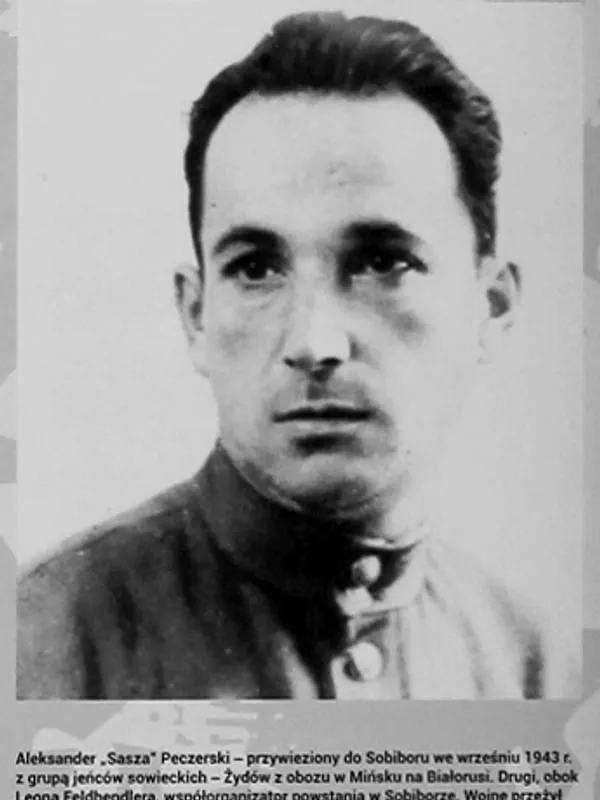
- Born:
- 22 February 1909, Kremenchuk (Russian Empire)
- Died:
- 19 January 1990, Rostov-on-Don (USSR)
- Author:
- Łukasz
- Photo:
- Poeticbent (Crop from photograph uploaded - below), CC BY-SA 4.0, Wikimedia Commons

Alexander “Sasha” Pechersky led the most successful prisoner revolt in any German extermination camp. A Jew from Rostov-on-Don, not a soldier by profession but a clerk and an organiser of amateur arts groups, during the war he was a junior quartermaster officer in the Red Army. He was captured near Vyazma, passed through prisoner-of-war camps and on 23 September 1943 was brought to Sobibór. Three weeks later he led an uprising in which the prisoners killed most of the SS garrison present in the camp and some three hundred of them escaped to the forest. A hero to the survivors and to historians of the Holocaust, in the Soviet Union he was for decades a suspect former prisoner of war and a Jew in a time of official antisemitism, and recognition came to him only after his death.
Kremenchuk and Rostov
He was born on 22 February 1909 (9 February by the Julian calendar) in Kremenchuk on the Dnieper, in the Poltava Governorate, into a Jewish family. His father, Aron Pechersky, was a lawyer’s assistant and his mother kept house; he had a brother and two sisters. In 1915, during the First World War, the family moved to Rostov-on-Don. There Alexander completed a seven-year school and a music school, did his military service in 1931–1933, worked as an electrician at a locomotive repair works and ran amateur arts groups. From 1936 he worked in the administration of the Rostov Institute of Finance and Economics. He married Lyudmila Zamilatskaya; in 1934 they had a daughter, Eleonora.
War and captivity
On 22 June 1941, the day Germany attacked the USSR, he was called up. In September he was given the rank of technician-quartermaster 2nd rank, equivalent to lieutenant, and served as a clerk in an artillery regiment of the 19th Army. In October 1941 his unit was encircled near Vyazma, in the pockets in which the Germans destroyed several Soviet armies at the start of the Battle of Moscow. Pechersky, who according to accounts was trying with others to carry the regiment’s wounded commissar out of the encirclement, was wounded and taken prisoner.
He survived typhus, which killed thousands of Soviet soldiers in German prisoner-of-war camps. In May 1942 he and four comrades tried to escape, but all were caught; he was sent to a penal camp at Borisov and then to a prisoner-of-war camp near Minsk. There, during a medical examination, the Germans discovered that he was a Jew. The Jewish prisoners, who as a rule were murdered, spent ten days in a dark cellar known as the “Jewish grave”. On 20 August 1942 Pechersky was transferred to the SS labour camp on Shirokaya Street in Minsk, where Jews from the Minsk Ghetto and Jewish prisoners of war were held. On 18 September 1943, when the ghetto was liquidated, he was sent to Sobibór together with some two thousand people.
Sobibór
The Sobibór extermination camp, in operation from May 1942 as part of Operation Reinhard, claimed, according to various estimates, from about 170,000 to 250,000 victims. From the Minsk transport a few dozen people, mainly prisoners of war, were selected for work; the rest were gassed on the day of arrival, 23 September 1943. Pechersky was put to work building storehouses in the northern part of the camp. On the very first evening Shlomo Leitman, a Russian-speaking Polish Jew, explained to him what was burning behind the trees.
A few days later Pechersky became known throughout the camp when he stopped working to watch the SS man Karl Frenzel beating an exhausted prisoner, then split a tree stump in the allotted time and refused the cigarettes and bread offered as a reward. He attracted the attention of Leon Feldhendler, leader of a conspiracy of Polish Jews that had been looking for a way to escape for months but had no one with military experience. From 29 September the two met in the women’s barracks, where Pechersky went on the pretext of visiting a woman prisoner known as “Luka”. He told his fellow prisoners about Stalingrad and the partisans; asked why the partisans did not free the camp, he is said to have replied that nobody would do it for them.
At the beginning of October he became head of the Underground Committee, with Feldhendler as his deputy. After rain had flooded a tunnel, on 9 October the committee adopted his plan: to lure the SS men one by one into the workshops and kill them silently, and then to lead all the prisoners out through the main gate before the guards, deprived of their commanders, understood what was happening. Pechersky strictly forbade individual escapes, which would have exposed the rest to reprisals.
14 October 1943
The uprising broke out on the afternoon of 14 October. Pechersky directed it from the carpentry workshop in Camp I, Feldhendler from the storehouses of Camp II. Between 3.30 and 5 p.m. fighting groups made up mainly of prisoners of war killed eleven or twelve SS men with axes and knives – among them the acting commandant, Johann Niemann, who was killed by Pechersky’s closest associate, Alexander Shubayev – as well as several guards. The plan to leave through the main gate failed: as the prisoners were gathering for roll call, the SS man Erich Bauer returned and shots were fired. Pechersky called on everyone to flee; the crowd threw itself at the fence and the minefield under fire from the towers. He himself, with a group of prisoners of war, crossed the wire at a spot he rightly judged to be lightly mined. Some three hundred prisoners reached the forest.
In the forest Pechersky separated from most of the escapees. The Polish Jews later held this against him; years later he explained to Thomas Blatt that a large group of unarmed people who did not know the area had no chance of hiding, and that the prisoners of war wanted to reach the partisans and go on fighting. With eight companions, among them Shubayev, Boris Tsibulsky and Arkady Vaispapir (PL), he crossed the Bug on the night of 19–20 October.
Partisan and soldier of an assault battalion
On 22 October 1943 the group reached a Soviet partisan unit, referred to in Russian sources as the Shchors detachment, operating in Belarus in the Brest area. Pechersky fought in it as a demolition man; his group blew up two German trains. Shubayev was later killed fighting the Germans. When the Red Army took Belarus in the summer of 1944, Pechersky, like every soldier who had been a prisoner of war, was screened by the NKVD at the filtration camp at Podolsk. Under rules derived from Order No. 270, which equated being taken prisoner with treason, he was sent to the 15th Separate Assault Rifle Battalion – a unit of a penal character made up of former prisoners of war and officers.
The battalion commander, Major Andreyev, having heard his story of Sobibór, broke the rules and let him go to Moscow to give an account to the Extraordinary State Commission for the investigation of German crimes. There he was heard by the writers Pavel Antokolsky and Veniamin Kaverin, who on that basis wrote the sketch “The Uprising in Sobibór”. The text later went into the Black Book – a collection of testimonies about the Holocaust of the Jews in the Soviet and Polish lands, edited by Ilya Ehrenburg and Vasily Grossman, whose publication in the USSR the censors banned in 1947.
With the battalion Pechersky fought on the 1st Baltic Front. On 20 August 1944, in an attack near Bauska in Latvia, he was seriously wounded in the thigh by a mortar fragment. After four months in hospitals he was declared an invalid and discharged. In a hospital near Moscow he met Olga Kotova, who in 1945 became his second wife.
After the war: Rostov and the campaign against the “cosmopolitans”
After the war Pechersky returned to Rostov and became an administrator at the musical comedy theatre. In 1945 he published there a small book of reminiscences about the Sobibór uprising. He received no decoration for it; for his fighting in 1944 he was recommended in 1949 for the Order of the Patriotic War, 2nd class, but the regional military commissar changed this to the Medal for Battle Merit, which was presented in 1951.
The years 1948–1953, the time of the antisemitic campaign against “rootless cosmopolitans” and then of the so-called Doctors’ Plot, were the hardest for him. Accounts differ in the details. According to the version repeated by Pechersky himself, his family and some biographers, in 1948 he lost his job and was briefly arrested, and was released under the influence of enquiries from abroad. According to documents cited by more recent Russian researchers, in 1952 criminal proceedings were brought against him for irregularities in the sale of theatre tickets, he was expelled from the party, and in January 1953 he was sentenced to a year of corrective labour with deductions from his pay; he himself regarded the case as part of the anti-Jewish campaign. After his dismissal from the theatre he worked in a picture-frame workshop and then, until he retired, as a labourer in a machine-building factory.
Silence
To the Soviet authorities Pechersky was doubly inconvenient: as a former prisoner of war and as a Jew whose heroism concerned the extermination of the Jews – a subject that official memory dissolved into the overall number of “peaceful Soviet citizens”. He was not allowed to travel to give evidence before the International Military Tribunal at Nuremberg, at the trial of Adolf Eichmann in Jerusalem in 1961 (he gave only a brief statement in Moscow under KGB supervision), or at the trials of members of the Sobibór staff in West Germany. In 1963 he testified as a prosecution witness in Kiev at the trial of eleven former Sobibór guards; most of them were sentenced to death.
He corresponded with Sobibór survivors, journalists and historians, among them Thomas Blatt, who talked with him in 1980. He was unable to attend the American premiere of the British television film Escape from Sobibor (1987), in which he was played by Rutger Hauer, who won a Golden Globe for the role. According to his daughter, the last refusal of permission to travel, when in 1987 he was to testify at a trial in Poland, broke him. He died on 19 January 1990 in Rostov-on-Don and was buried in the city’s Northern Cemetery.
Late recognition
His memory was kept alive by survivors and by Jewish communities in the West: his name appears on the Holocaust memorial in Boston, and there are streets named after him in Safed in Israel and later also in Moscow and Rostov. In Rostov a plaque on the house where he had lived was unveiled only in 2007. In 2013 the President of Poland posthumously awarded him the Knight’s Cross of the Order of Merit of the Republic of Poland, which was presented to his daughter in Rostov in May 2014. In January 2016 the President of Russia posthumously awarded him the Order of Courage; in 2018 the Russian film Sobibor was made by Konstantin Khabensky, who himself played Pechersky. His late recognition in Russia fitted into the state narrative of the Great Patriotic War, which some historians note critically, stressing that for more than forty years after the war the Soviet authorities had kept silent about the leader of the uprising.
Significance
Pechersky did not invent the escape from Sobibór – Feldhendler’s conspiracy existed before he arrived – but he gave it shape and a commander. He brought what the Polish Jews lacked: a military plan, the discipline of a group of prisoners of war prepared to kill, and the decision to act at once, before the camp was liquidated. The uprising he led hastened the camp’s liquidation, and several dozen people who would otherwise have died in the gas chambers or while erasing the traces survived the war and were able to tell what had happened there. His own fate after the escape – a penal battalion for a former prisoner of war, harassment during the antisemitic campaign, the travel bans and the silence of the authorities – shows how the Soviet Union treated both the soldiers who survived captivity and the memory of the Holocaust.