- Category:
- Military operations
- Front:
- Eastern Front
- Date:
- 3 July 1944
- Author:
- Natalia
- Battle:
- Operation Bagration
- Tags:
- Red Army, Wehrmacht, Soviet Union, Holocaust
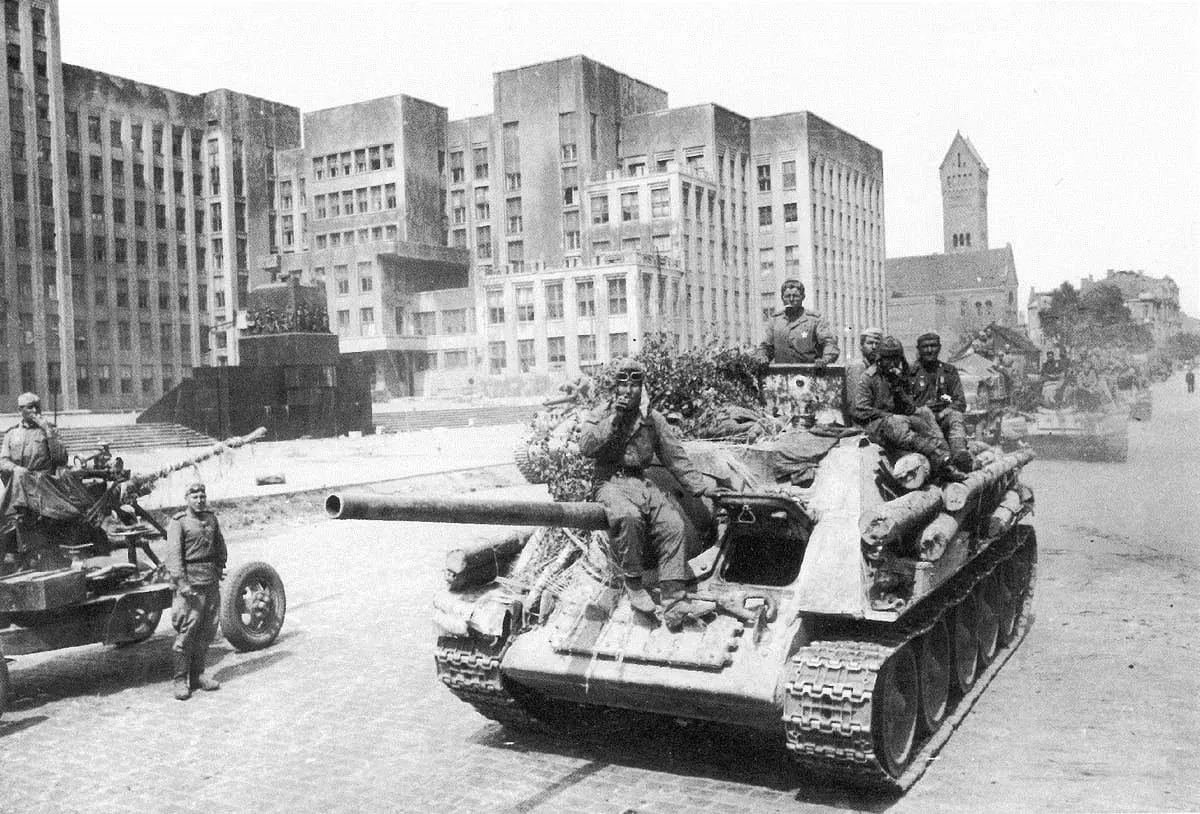
On 3 July 1944 units of the Red Army entered Minsk, the capital of Soviet Belorussia, which had been occupied by the Germans since the turn of June and July 1941. The city fell after only a few hours of fighting, twelve days after the start of Operation Bagration. More important than the capture of the ruins themselves was what was happening to the east of them: in the forests between the Berezina and Minsk the main forces of the German Fourth Army and the remnants of the Ninth Army had been cut off – some 100,000 men, according to various estimates. Army Group Centre, for three years the strongest grouping of the Wehrmacht on the Eastern Front, had ceased to exist as a coherent force.
The road to Minsk
In the first week of the offensive four Soviet fronts shattered both wings of Army Group Centre. At Vitebsk the 1st Baltic Front and the 3rd Belorussian Front encircled and destroyed LIII Army Corps, and at Bobruisk the 1st Belorussian Front trapped a large part of the Ninth Army in a pocket. In the centre the Fourth Army under General Kurt von Tippelskirch, pressed frontally by the 2nd Belorussian Front at Mogilev, received permission to retreat too late. Its columns fell back along a handful of roads and bridges over the Berezina, bombed incessantly by Soviet aircraft and attacked by partisans.
On 28 June Hitler dismissed the commander of Army Group Centre, Field Marshal Ernst Busch, and entrusted it to Field Marshal Walter Model, who at the same time kept command of Army Group North Ukraine. Model, however, had nothing with which to plug a gap several hundred kilometres wide. The only fresh force was the 5th Panzer Division, rushed from Ukraine to the area of Borisov. Its battle group under General Dietrich von Saucken, supported by a battalion of Tiger heavy tanks and by improvised police and SS units of General Curt von Gottberg’s group, for several days held up the 5th Guards Tank Army of Marshal of Armoured Troops Pavel Rotmistrov, inflicting heavy losses on it. In the meantime, however, other Soviet mobile groups – General Nikolai Oslikovsky’s cavalry-mechanised group and General Alexei Burdeyny’s 2nd Guards Tank Corps – forced the Berezina nearby and pressed on westwards. Soviet troops took the crossings at Borisov, where Napoleon’s Grande Armée had crossed in 1812, on 1 July.
From the south the 1st Belorussian Front of Konstantin Rokossovsky, a Marshal of the Soviet Union since 29 June, was advancing on Minsk. General Issa Pliyev’s cavalry-mechanised group took Nieśwież (Nesvizh) on 2 July, cutting the lines of retreat to the south-west, and General Mikhail Panov’s 1st Guards Tank Corps was approaching the city along the highway from Bobruisk. The operations of the 1st Baltic and 3rd Belorussian Fronts were coordinated on behalf of the Stavka by Marshal Aleksandr Vasilevsky, Chief of the General Staff, and those of the 1st and 2nd Belorussian Fronts by Marshal Georgy Zhukov. The German command in Minsk began preparing to evacuate on 1 July, but permission to abandon the city was not given until 2 July; Gottberg withdrew his units towards Lida, and Saucken towards Mołodeczno (Maladzyechna).
3 July in the city
On the morning of 3 July the 2nd Guards Tank Corps, which had bypassed Minsk, burst into the city from the north-west. According to Soviet tradition, the first to enter the city was a platoon of T-34 tanks of the 4th Guards Tank Brigade under Junior Lieutenant Dmitry Frolikov; his tank is commemorated today by a monument on one of Minsk’s squares. At roughly the same time the spearheads of Rokossovsky’s 1st Guards Tank Corps reached the city from the south, the 5th Guards Tank Army from the north-east, and units of the 31st Army from the east. The German rearguards put up resistance only here and there; according to Russian studies, by around 1 p.m. the city centre was in Soviet hands, and the last groups of German soldiers had been driven out of the city or rounded up by 4 July. On the evening of 3 July Moscow celebrated the capture of Minsk with a gun salute from 324 guns.
The city that had been taken was largely a ruin. Much of Minsk had already burned during the German air raids of June 1941, and over three years of occupation and during their retreat the Germans had destroyed industrial plants, bridges, the power station and the railway junction. According to Soviet and Belarusian figures, only a few dozen buildings survived in the centre, and some 80 per cent of houses had been demolished or burned; among the few surviving buildings was the monumental House of Government, which according to Soviet accounts sappers cleared of mines just after the troops entered. Of the more than 250,000 pre-war inhabitants, between about 37,000 and 50,000 remained in the city, according to various sources. Belarusian historians estimate that more than 70,000 inhabitants of Minsk died during the occupation, not counting the Jews deported from the Reich and elsewhere who were murdered in and around Minsk.
The ghetto and Maly Trostenets
The most tragic part of the history of occupied Minsk was the Holocaust. As early as July 1941 the Germans created a ghetto in the city, the largest in the occupied territories of the USSR; according to various estimates, between 80,000 and more than 100,000 people – local Jews and refugees – were confined in it. From November 1941 a separate ghetto was set up alongside it for Jews deported from Germany, Austria and the Protectorate of Bohemia and Moravia, known as the “Hamburg ghetto”. The inhabitants of the ghetto were murdered in successive mass actions in 1941 and 1942; the largest, at the end of July 1942, claimed an estimated 10,000 victims. In September 1943 some of the ghetto’s inhabitants were taken to the Sobibór extermination camp – one of these transports included the prisoner of war Alexander Pechersky, later the leader of the prisoners’ revolt – and on 21–23 October 1943 the ghetto was finally liquidated, the remaining inhabitants being murdered, mostly at Maly Trostenets. Minsk was at the same time one of the places from which the largest numbers of Jews escaped to the forests – an estimated 10,000 reached partisan units and so-called family camps. When the Red Army entered the city on 3 July 1944, only a few Jewish survivors were hiding there.
Some 12 kilometres south-east of the city was the Maly Trostenets camp – a forced-labour camp linked to mass execution sites in the Blagovshchina and Shashkovka forest tracts. From May to October 1942 transports of Jews from Vienna, Theresienstadt, Cologne and other cities were brought there, and they were usually killed on the day of arrival, including in gas vans. Later Jews from the Minsk ghetto were shot there, and from the turn of 1943 and 1944 also prisoners of war, inmates of Minsk prisons and civilians suspected of contacts with the partisans. From the autumn of 1943 a Sonderaktion 1005 unit dug up the mass graves and burned the bodies to cover up the traces. According to findings cited by historians, on 29 and 30 June 1944, as the front approached Minsk, the Germans shot the camp’s last prisoners, locked the bodies in a barn and set it on fire, and then destroyed the camp. The number of victims of Maly Trostenets remains disputed: a Soviet commission gave a figure of more than 200,000, whereas modern historians, among them Christian Gerlach, estimate it at around 60,000; the number of Jewish victims alone is given in various studies as anything from 60,000 to more than 100,000.
The pocket east of Minsk
The closing of the ring around Minsk meant that tens of thousands of German soldiers still marching westwards from the Berezina were trapped. The pocket held mainly XII and XXVII Army Corps and the remnants of the Fourth Army’s XXXIX Panzer Corps, together with stragglers of the Ninth Army from Bobruisk. The Fourth Army’s staff managed to get out, and command of the encircled troops was taken over by the commander of XII Corps, Lieutenant General Vincenz Müller. Without fuel, ammunition or communications, under constant artillery fire and bombing, the columns tried over the following days to break through to the west and north-west. But the Soviet front was moving ever further away from them – after a week the German lines were more than a hundred kilometres off.
The disintegration of the pocket took several days. On 8 July Müller was captured and signed a surrender order, which the Russians broadcast through loudspeakers and in leaflets dropped from aircraft. Some groups fought on or tried to slip through the forests; the last organised fighting died down around 11 July, and the army and the partisans went on rounding up stragglers for weeks. Of the roughly 100,000 men encircled – according to estimates cited in Western literature – some 40,000 were killed and most of the rest were captured; Soviet figures speak of some 35,000 prisoners taken in the pocket itself. Soon afterwards, on 17 July, more than 57,000 prisoners, taken mainly in Belorussia, were marched under escort through the streets of Moscow, with more than a dozen generals at the head of the column – a demonstration of the scale of the Wehrmacht’s defeat, aimed also at the Western Allies. After the columns had passed, the streets were ostentatiously washed down by water trucks.
Partisan Belorussia
In 1941–1944 Belorussia was the main area of Soviet partisan activity. According to Soviet figures, some 140,000 partisans were active there in the summer of 1944, directed from Moscow by the staffs of the partisan movement. The most important figure in the movement was the first secretary of the Belorussian Communist Party, Panteleimon Ponomarenko, who in 1942–1944 headed the Central Staff of the Partisan Movement. On the night of 19/20 June the partisans set off thousands of charges on the railway lines behind Army Group Centre, and in July they helped the army round up shattered German units. The Germans responded to the partisans with so-called anti-partisan operations, whose victims were above all civilians: whole villages were burned together with their inhabitants, like Khatyn in March 1943, and Oskar Dirlewanger’s SS regiment stood out for its particular cruelty in these operations. According to historians’ estimates, Belorussia lost about a quarter of its population during the war, and some studies give an even higher figure. The Soviet partisans were not, moreover, the only force in these forests – in the western, pre-war Polish lands of Belorussia units of the Home Army were also active, and from 1943 relations between them and the Soviet partisans moved from cooperation to open hostility.
On 16 July 1944 a partisan parade was held on the grounds of the former racecourse in Minsk: according to Belarusian and Russian studies, more than 30,000 people from 30 brigades marched past, watched by several tens of thousands of spectators. On the reviewing stand stood Ponomarenko with the authorities of the republic, who had returned to the city as early as 4 July. Many of the parade’s participants were soon drafted into the Red Army and sent to the front.
Place in the war
The fall of Minsk closed the first stage of Operation Bagration. Three years earlier, in the Białystok–Minsk pocket, Army Group Centre had smashed the Soviet Western Front and taken hundreds of thousands of prisoners; in the summer of 1944 the roles were reversed, and in the same place. In the pockets at Vitebsk, Bobruisk and Minsk the Wehrmacht lost within two weeks – depending on the method of counting – between about 25 and 28 divisions, and German military historians, among them Karl-Heinz Frieser, regard the defeat of Army Group Centre as the greatest disaster in the history of the German army. A gap some 400 kilometres wide opened in the Eastern Front, and Model had nothing with which to fill it.
Joseph Stalin and the Stavka exploited it immediately. As early as 4 July the fronts received orders to pursue towards Wilno (Vilnius), Grodno, Białystok, Baranowicze (Baranavichy) and Brześć (Brest). Over the following weeks the Red Army liberated the rest of Belorussia and most of Lithuania, reached the border of East Prussia and the Vistula, and the left wing of the 1st Belorussian Front took Lublin. The offensive moved the war from Soviet soil onto the pre-war territory of Poland – and with it came political settlements in which Moscow was to decide the fate of these lands.
For Belarus 3 July became a symbolic date: celebrated in Soviet times as the day of the liberation of Minsk, since 1996 it has been the Independence Day of the Republic of Belarus. The rebuilding of the city went on throughout the post-war years; its historic centre was largely replaced by monumental Soviet architecture. For decades the memory of the Holocaust of the Jews of Minsk and of the victims of Maly Trostenets was blurred by the Soviet formula of “peaceful Soviet citizens”; a memorial on the site of the camp was not built until 2014–2018.
Sources
Meanwhile
(04)Elsewhere, within a week.
- 3 July 1944 · MediterraneanThe capture of SienaOn 3 July 1944 soldiers of the 3rd Algerian Infantry Division of the French Expeditionary Corps entered Siena, which the Germans had abandoned overnight.
- 7 July 1944 · PolandOperation Ostra BramaOn 7 July 1944 Home Army units attacked Wilno to take it before the Red Army. The same day the spearheads of the 3rd Belorussian Front reached the city.
- 7 July 1944 · PacificThe last attack on SaipanOn 6 July 1944 General Saitō ordered a final attack. Before dawn on 7 July at least 3,000 Japanese struck the Americans on the Tanapag plain.
- 9 July 1944 · Western FrontThe capture of CaenOn 9 July 1944 British and Canadian troops in Operation Charnwood took ruined northern Caen up to the Orne – a city that was meant to fall on D-Day.
Related events
(04)The same battle, people or subject.
- 22 June 1944 · Eastern FrontOperation Bagration beginsOn 22 June 1944, the third anniversary of Germany's attack on the USSR, four Soviet fronts opened an offensive in Belarus against Army Group Centre.
- 1 August 1944 · Eastern FrontThe capture of KaunasOn 1 August 1944 the 5th Army of the 3rd Belorussian Front took Kaunas, Lithuania's former capital, weeks after the Germans liquidated its ghetto camp.
- 17 August 1944 · Eastern FrontThe Red Army at the border of East PrussiaOn 17 August 1944 divisions of the Soviet 5th Army reached the Šešupė on the East Prussian border, standing on the Reich's frontier for the first time.
- 28 July 1944 · PolandThe capture of BrześćOn 28 July 1944 the 1st Belorussian Front took Brześć on the Bug. German divisions encircled near the city were shattered; their remnants escaped west.