Battle of Moscow
- Dates:
- 30 September 1941 – 7 January 1942
- Front:
- Eastern Front
- Location:
- The Moscow axis west, north and south of the Soviet capital: Vyazma, Bryansk and Oryol; the Mozhaisk Line with Volokolamsk, Mozhaisk and Maloyaroslavets; Kalinin (Tver), Klin, Solnechnogorsk and the Moscow Canal in the north; Tula and Kashira in the south; Naro-Fominsk in the centre; and in December a belt from Kalinin to YeletsOn the battle map →
- Sides:
- Nazi GermanyFedor von Bock, Heinz Guderian, Günther von KlugeSoviet UnionGeorgy Zhukov, Ivan Konev, Semyon Timoshenko
- Result:
- Soviet victory. In October Army Group Centre encircled most of the troops defending Moscow at Vyazma and Bryansk but failed to take the capital: its advance bogged down in the autumn mud, and its November offensive came to a halt in early December a few dozen kilometres from the Kremlin. On 5–6 December the Red Army went over to the counter-offensive and by 7 January 1942 had thrown the Germans back 100–250 kilometres. The plan to defeat the USSR in a single campaign collapsed, and Hitler dismissed Brauchitsch and took command of the army himself.
- Author:
- Łukasz
The Battle of Moscow was the Wehrmacht’s first great defeat of the Second World War and the point at which the plan to defeat the Soviet Union in a single lightning campaign collapsed. At the end of September 1941, after the destruction of the Southwestern Front at Kiev, Adolf Hitler turned towards the Soviet capital. Field Marshal Fedor von Bock’s reinforced Army Group Centre, with three panzer groups, set off on 30 September on its southern wing and on 2 October on the main axis. Within a week it had trapped most of the troops of three Soviet fronts in pockets at Vyazma and Bryansk. German propaganda announced that the war in the east had been decided, and panic broke out in Moscow.
Yet the capital survived. The autumn mud, the resistance of the encircled armies and the hastily patched defence lines of General of the Army Georgy Zhukov halted the advance at the end of October. In mid-November, once the frost had set in, the Germans struck again in order to encircle Moscow from the north and south. At the beginning of December their spearheads stood about 30 kilometres from the Kremlin, but their divisions were bled white and lacked winter clothing and supplies. On 5 and 6 December the Red Army, reinforced with reserves brought up from the depths of the country, went over to the counter-offensive and by the beginning of January had thrown the Germans far back from the capital.
Name and dates
In Soviet and Russian historiography the Battle of Moscow (Bitva za Moskvu, Moskovskaya bitva) comprises two periods: the defensive one, that is, the Moscow strategic defensive operation of 30 September to 5 December 1941, and the offensive one. The latter is divided into the counter-offensive of 5 December 1941 to 7 January 1942 and the further winter offensive, in particular the Rzhev–Vyazma operation, which lasted until 20 April 1942. The Germans spoke of Operation Typhoon (Unternehmen Taifun) – the name given on 19 September to the plan for the offensive against Moscow.
The battle may be taken to span the period from 30 September 1941 to 7 January 1942, following most Western studies, among them those of John Erickson and David Glantz. On 30 September Colonel General Heinz Guderian’s 2nd Panzer Group set off, two days ahead of the main forces. On 7 January 1942 the Stavka issued a directive for a new general offensive against Army Group Centre, which was already a separate operation.
Background
After Smolensk and Kiev
Under Directive No. 21, Moscow was to come only after the Red Army had been destroyed west of the Dvina and the Dnieper and Leningrad had been taken. In the summer of 1941 Army Group Centre smashed Soviet armies at Białystok, Minsk and Smolensk, but incessant counter-attacks forced it onto the defensive on 30 July. Bock, the Chief of the Army General Staff, Colonel General Franz Halder, and the Commander-in-Chief of the Army, Field Marshal Walther von Brauchitsch, wanted to march straight on the capital. Hitler judged Ukraine, the Donets Basin and Leningrad more important, and in August he sent Guderian’s tanks south. At the beginning of September Zhukov’s troops recaptured the Yelnya salient, and in September Guderian and Colonel General Ewald von Kleist’s panzer group closed the largest pocket of the war at Kiev.
Even before the Battle of Kiev was over, on 6 September, Hitler issued Directive No. 35. It ordered that, once the Soviet forces at Kiev had been destroyed, the “Timoshenko” group of forces in front of Moscow was to be annihilated in a double envelopment in the direction of Vyazma before winter came. Guderian’s group returned to Army Group Centre, and Colonel General Erich Hoepner’s 4th Panzer Group came from Army Group North with some of the panzer divisions from Leningrad. On 26 September Bock signed the order for the offensive.
Plan and forces
The plan repeated the manoeuvres of Minsk and Smolensk. In the north Colonel General Hermann Hoth’s 3rd Panzer Group (from 5 October under General Georg-Hans Reinhardt) with Colonel General Adolf Strauß’s 9th Army, and from the south Hoepner’s 4th Panzer Group with Field Marshal Günther von Kluge’s 4th Army, were to meet at Vyazma and encircle the troops defending the Smolensk–Moscow highway. Farther south Guderian’s 2nd Panzer Group (from 5 October the 2nd Panzer Army) and Colonel General Maximilian von Weichs’s 2nd Army were to smash the front at Bryansk and advance through Oryol on Tula. The offensive was supported from the air by Field Marshal Albert Kesselring’s Luftflotte 2.
According to the German historian Klaus Reinhardt, the army group numbered 1,929,406 men in 78 divisions, including 14 panzer and 8 motorised divisions. Soviet studies estimate the number of its tanks at about 1,700, Reinhardt at about 1,200 serviceable. By various calculations Kesselring had anything from about 550 serviceable to more than 1,300 aircraft. Many divisions, however, had not made good their losses from the summer.
Facing them stood three Soviet fronts: Colonel General Ivan Konev’s Western Front, Marshal Semyon Budyonny’s Reserve Front and Colonel General Andrei Yeremenko’s Bryansk Front. According to the Russian tally edited by Grigoriy Krivosheev, they numbered about 1.25 million men, fewer than a thousand tanks, most of them light, and a few hundred serviceable aircraft. Many divisions had been raised from the people’s militia (opolcheniye), poorly trained and armed. The main blow was expected along the highway, and the enemy struck beside it.
Course of the battle
The breakthrough (30 September – 7 October)
Guderian, who had the longest way to go, began two days earlier than the rest, which also allowed him to concentrate the air support on his own sector. On 30 September his three motorised corps struck from the area of Glukhov and Shostka at General Arkady Yermakov’s operational group at the junction of the Bryansk Front with its neighbours. Yeremenko took this for an attack by a few divisions and kept his reserves near Bryansk. In two days the Germans penetrated 120 kilometres deep, and on 3 October the 4th Panzer Division burst into Oryol.
At dawn on 2 October the main forces set off. Hitler’s order of the day, read out to the troops, announced “the last great decisive battle of this year”, and the next day Hitler told the Berlin Sportpalast that the enemy “is already broken and will never rise again”. Hoth broke through the front at the junction of the Soviet 30th and 19th Armies north of the highway, while Hoepner smashed the 43rd Army of the Reserve Front south of it, along the Warsaw road. On 5 October German tanks took Yukhnov, less than 200 kilometres from Moscow, before the Stavka understood what had happened.
On 7 October Hoth’s 7th Panzer Division and Hoepner’s 10th Panzer Division met at Vyazma. The headquarters of the 19th, 20th, 24th and 32nd Armies, together with a large part of the 16th Army – several dozen divisions in all – were caught in the pocket. In the south the Germans took Bryansk on 6 October, entering it from the rear, and the 3rd, 13th and 50th Armies of the Bryansk Front were cut up into several pockets.
The Vyazma and Bryansk pockets
The encircled troops fought on. At Vyazma they tried to break out until 11–12 October, and small groups managed to do so even later. The commander of the 24th Army, Major General Konstantin Rakutin, was killed; the commander of the 19th Army, Lieutenant General Mikhail Lukin (PL), was taken prisoner, severely wounded. At Bryansk the commander of the 50th Army, Major General Mikhail Petrov, was killed, and on 13 October Yeremenko himself was wounded. Reducing the pockets tied down 28 German divisions, needed for the march on Moscow, until the second half of October. According to Russian researchers some 85,000 men escaped from the encirclement at Vyazma.
The scale of the defeat was enormous. On 19 October Bock announced in an order of the day 673,098 prisoners, 1,277 tanks and 4,378 guns captured in the two pockets. Some historians consider the number of prisoners inflated and estimate it at a little over half a million. As early as 9 October the Reich press chief, Otto Dietrich, invoking Hitler, announced to foreign journalists that the campaign in the east had been decided and that the Red Army had ceased to exist as a military force. Many Germans believed that the soldiers would be home for Christmas. On 7 October Hitler decreed that a capitulation of Moscow, should one be offered, was not to be accepted: the city was to be encircled and destroyed, like Leningrad.
On the southern wing came the first sign that the campaign would not be easy. At Mtsensk, on the road from Oryol to Tula, Major General Dmitry Lelyushenko’s 1st Guards Rifle Corps, with Colonel Mikhail Katukov’s 4th Tank Brigade, held up the 4th Panzer Division from 6 October. After the war Guderian wrote of the superiority of the T-34 over German tanks; some researchers believe he exaggerated the scale of the reverse, but Mtsensk fell only on 11 October.
Zhukov and the Mozhaisk Line (10–30 October)
Between Vyazma and Moscow there were almost no troops. On 5 October Joseph Stalin telephoned Leningrad, where Zhukov had been directing the defence of the city since September, and summoned him to the capital. Zhukov flew in on 7 October, toured the shattered headquarters, and on 8 October took over the Reserve Front and on 10 October the Western Front, with which it was merged. For Konev, who faced a court martial over the defeat at Vyazma, Zhukov obtained from Stalin the post of his deputy. Budyonny lost his command, and Yeremenko, after being wounded, was replaced by his chief of staff.
The last obstacle was the Mozhaisk Defence Line, built since July by sappers, workers and Muscovites from the Moscow Sea through Volokolamsk, Mozhaisk and Maloyaroslavets to Kaluga. In October it was perhaps 40 per cent complete and manned by some 90,000 men. Zhukov concentrated them on four axes: at Volokolamsk stood the 16th Army of Lieutenant General Konstantin Rokossovsky, who had come out of the Vyazma pocket with his headquarters but without troops; at Mozhaisk the 5th Army of Major General Lelyushenko and, after he was wounded, of Major General Leonid Govorov; at Maloyaroslavets the 43rd Army; and at Kaluga the 49th Army of Lieutenant General Ivan Zakharkin. Divisions were brought in from other fronts, from the Urals and from the Far East.
The first snow fell on 6–7 October and soon melted, and in the second half of the month came the rasputitsa – the autumn thaw, in which dirt roads turned into swamp. On 19 October the war diary of Army Group Centre recorded a “severe crisis” in the supply of food, ammunition and fuel. The mud slowed both sides, but it hit harder the army that depended on lorries and had to keep moving forward.
Even so, the Germans pressed on. On 12–13 October they took Kaluga, on 14 October Borovsk and Rzhev, and the 3rd Panzer Group, having turned north, burst into Kalinin on the Volga on 14 October. At Borodino, on the battlefield of 1812, Colonel Viktor Polosukhin’s 32nd Rifle Division, brought from the Far East, fought off the SS Division Reich from 13 October. On 18 October Mozhaisk and Maloyaroslavets fell; on 21–22 October the Germans broke into Naro-Fominsk, and on 27 October, after heavy fighting with the division of Major General Ivan Panfilov, into Volokolamsk. At the end of the month the front came to a standstill on the River Nara and at Volokolamsk, 60–100 kilometres from Moscow.
Moscow under a state of siege
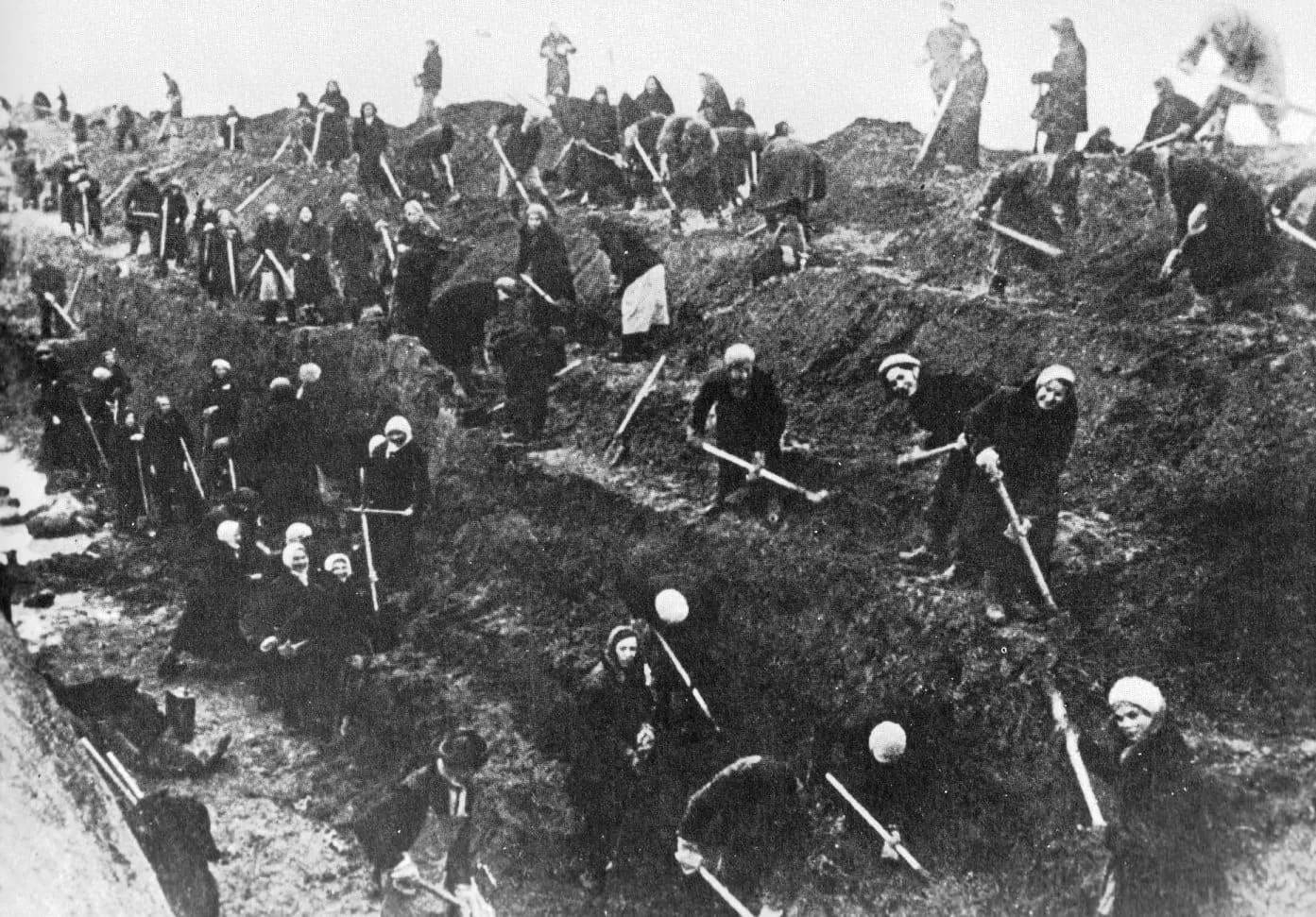
On 15 October the State Defence Committee decided to evacuate the government, the people’s commissariats and the diplomatic corps from Moscow to Kuibyshev (Samara), and factories, bridges and power stations were mined in case the Germans entered. News of the evacuation and of the collapse of the Mozhaisk Line caused panic on 16 and 17 October: crowds stormed the railway stations and fled east along the highway, shops were looted, and some officials abandoned their posts. Stalin stayed in the Kremlin. On 19 October the State Defence Committee declared a state of siege in Moscow and its environs from the following day; the NKVD patrols of Lavrentiy Beria were to shoot “provocateurs, spies and enemy agents” on the spot. Hundreds of thousands of inhabitants, mainly women and young people, dug anti-tank ditches, and barricades and three rings of defences were built in the city.
Kalinin, Tula and the halt
On the flanks, too, the Germans got stuck. On 17 October Konev’s Kalinin Front was formed from the right wing of the Western Front, and its counter-attacks at Kalinin tied down the 3rd Panzer Group; on 23 October Bock halted the advance north-east from the city. In the south Guderian, delayed at Mtsensk and by the mud, reached Tula on 29 October. The city was defended by the remnants of the 50th Army, an NKVD regiment, anti-aircraft artillery and a workers’ volunteer regiment; for three days they beat off assaults, and the attacks of 1–2 November also failed. At the turn of October and November the German advance came to a halt along the whole front.
The pause and the parade (November)
At the beginning of November the frost set in and the roads hardened. Both sides gathered their strength. On 7 November, the anniversary of the revolution, Stalin took the traditional parade on Red Square; the units went straight from it to the front. The day before, at a ceremonial meeting in the hall of Mayakovskaya metro station, he had said that the Germans wanted a war of extermination and would get one, and in his speech from the rostrum of the Mausoleum he invoked Alexander Nevsky, Dmitry Donskoy, Suvorov and Kutuzov. The parade, like the speech of 3 July before it, told the country that the government had stayed and the capital was defending itself.
On 13 November, at Orsha, Halder met the chiefs of staff of the army groups and armies. Despite the doubts of some staff officers, Bock and Halder decided to make a last offensive before winter, reckoning that the Red Army was as exhausted as the Wehrmacht.
The last offensive (15 November – 5 December)
The plan envisaged the encirclement of Moscow: the 3rd and 4th Panzer Groups were to outflank it from the north through Klin and Solnechnogorsk, the 2nd Panzer Army from the south through Kashira and Kolomna, and the pincers were to close at Noginsk, east of the city. Kluge’s 4th Army was to pin down the Soviet forces in the centre. On 15–16 November the northern wing set off. The Germans split the Soviet 30th and 16th Armies and in heavy fighting pushed Rokossovsky back towards Moscow: on 23 November they took Klin, on 23–24 November Solnechnogorsk, and on 26–27 November Istra.
On 27 November the 7th Panzer Division crossed the Moscow Canal, the last great obstacle before the capital, at Yakhroma by a bridge that had not been blown. The next day a counter-attack by units of the new 1st Shock Army threw it back across the canal. On the 16th Army’s sector the Germans reached Krasnaya Polyana, less than 30 kilometres from the Kremlin, and on 2 December a reconnaissance patrol reportedly got as far as the area of the canal bridge at Khimki. The Wehrmacht came no closer to Moscow.
The fighting on the Volokolamsk road gave rise to the most famous legend of the battle: the “28 Panfilov heroes”, who on 16 November at Dubosekovo were said to have destroyed more than a dozen tanks and died to the last man. The story was published by Krasnaya Zvezda at the end of November. An investigation by the Soviet military prosecutor’s office in 1948 established that the episode in that form had been invented by journalists; its conclusions were revealed in the 1990s, and the full report was published in 2015 by the State Archive of the Russian Federation. The heavy fighting of the 316th Rifle Division, renamed the 8th Guards in November, was, by contrast, real; Panfilov was killed on 18 November.
In the south Guderian set off on 18 November. Unable to take Tula, he went round it to the east: on 22 November he took Stalinogorsk (Novomoskovsk), and on 25–26 November his spearheads reached Kashira, through which ran the road to Moscow. On 27 November Major General Pavel Belov’s 1st Guards Cavalry Corps, supported by tanks, threw them back several dozen kilometres. At the beginning of December Guderian almost closed the ring around Tula from the north, but on 5 December, with the frost reaching minus 30 degrees, he halted the advance himself.
The last attempt was made by Kluge. On 1 December the 4th Army struck along the Minsk highway at Naro-Fominsk and penetrated a dozen or so kilometres towards Golitsyno, but counter-attacks by the 33rd and 5th Armies threw it back to its starting positions by 4–5 December.
Frost and reserves
The winter of 1941–1942 was one of the harshest of the 20th century. At the beginning of December the temperature near Moscow fell to minus 30 degrees and below. The German soldiers had no winter greatcoats, boots or gloves, because the command had counted on the war ending before winter, and what had been prepared was stuck on the congested railways in Poland and Belarus. By the end of the winter German hospitals had treated more than a hundred thousand cases of frostbite. The Red Army was better prepared for the cold and was fighting close to its bases.
The decisive factor, however, was new troops. From October the Stavka formed reserve armies in the interior and moved cadre divisions from the Far East, Transbaikalia and Central Asia. Stalin could strip these regions because in the autumn he was increasingly confident that Japan, bound by the neutrality pact and turned southwards after the Imperial Conference of 6 September, would not attack the USSR. This was confirmed by reports from Tokyo by Richard Sorge, although historians argue over how much weight they carried in Stalin’s decisions. The scale is also disputed: the popular image of the “Siberian divisions” that saved Moscow is exaggerated. According to research by Glantz and the Russian historian Alexei Isaev, among others, the Far East sent to the Moscow front in the autumn, depending on how one counts, anything from a few to a dozen or so divisions – valuable, because trained and at full strength, but a minority compared with the dozens of divisions raised in the interior. At the end of November the Stavka gave Zhukov three new armies: the 1st Shock, the 10th and the 20th, the last of these under Major General Andrei Vlasov.
The counter-offensive (5 December 1941 – 7 January 1942)
Zhukov’s plan, approved by Stalin on 30 November, was first to remove the immediate threat to the capital: to strike at both German wedges that were outflanking Moscow from the north and south. According to Soviet figures about 1.1 million men and fewer than 800 tanks took part in the counter-offensive – fewer than Army Group Centre numbered, according to Soviet estimates. Superiority was achieved only on selected sectors, but the enemy was exhausted and had no fortified positions.
On 5 December Konev’s Kalinin Front attacked, and on 6 December Zhukov’s Western Front and the right wing of Marshal Semyon Timoshenko’s Southwestern Front. In the north Lelyushenko’s 30th Army and the 1st Shock Army struck at the forward panzer divisions of Reinhardt and Hoepner. The Germans, taken by surprise, fell back, abandoning frozen tanks, guns and lorries. The Red Army recaptured Solnechnogorsk on 12 December, Klin during the night of 14–15 December, Kalinin on 16 December and Volokolamsk on 20 December. In the south Lieutenant General Filipp Golikov’s 10th Army and Belov’s corps struck at Guderian’s flank; Venev was retaken on 9 December, and by mid-December the threat of Tula’s encirclement had been averted. At Yelets Timoshenko’s troops encircled and by 16 December destroyed two divisions of the German 2nd Army. At the end of December the 50th Army broke into Kaluga, which was cleared on 30 December. In the centre, where the Germans held out longest, Naro-Fominsk was retaken on 26 December and Maloyaroslavets on 2 January 1942.
At the beginning of January the offensive was losing momentum: the Soviet divisions were bled white and supplies could not keep up. On 5 January, at a conference in the Kremlin, Stalin pushed through, against Zhukov’s objections, a general offensive on all fronts from Leningrad to the Crimea. On 7 January the Stavka ordered the Kalinin and Western Fronts to encircle and destroy Army Group Centre in the area of Rzhev and Vyazma. Thus ended the counter-offensive at Moscow: the Germans had been thrown back 100–250 kilometres from the capital, but their front had not collapsed.
Hitler takes command
On 8 December Hitler signed Directive No. 39, which, because of the “surprisingly early winter”, ordered the troops along the whole Eastern Front to go over to the defensive. The retreat, however, was slipping out of control, and commanders, especially Guderian and Hoepner, were falling back on their own authority. On 16 December Hitler issued his stand-fast order (Haltebefehl): the troops were to defend every position “to the last man” and not to retreat without his consent. It is still disputed whether this order saved Army Group Centre from the fate of Napoleon’s Grande Armée, as some German generals claimed after the war, or needlessly bled divisions white in hopeless positions.
The defeat brought a purge of the command. Brauchitsch, who had suffered a heart attack in November, asked several times to be relieved; on 19 December Hitler accepted his resignation and himself took over as Commander-in-Chief of the Army. Bock, who had asked for sick leave, was replaced by Kluge on 18–19 December. Guderian was dismissed on 25–26 December, Hoepner, whom Hitler threw out of the army, on 8 January 1942, and Strauß in mid-January. Within a few weeks several dozen corps and division commanders also lost their posts.
Losses
Soviet losses were enormous. Krivosheev’s tally gives for the Moscow defensive operation (30 September – 5 December) 514,338 killed, missing and captured and 143,941 wounded and sick, and for the counter-offensive (5 December – 7 January) 139,586 and 231,369 respectively – more than a million men in all. The figures for the defensive period are incomplete, because the encircled armies submitted no reports; if the German figures for prisoners from Vyazma and Bryansk are accepted, the real losses were higher.
German losses were many times smaller, but grievous for the Wehrmacht. The official ten-day reports of Army Group Centre give, for the period from 1 October 1941 to 10 January 1942, 35,757 killed, 128,716 wounded and 9,721 missing. Many historians regard these figures as too low. In December alone, according to German data, the army group lost more than 100,000 men and received only about 40,000 replacements. On top of the battle casualties came frostbite and disease, and the loss of most of the tanks, hundreds of guns and tens of thousands of vehicles abandoned during the retreat.
Occupation and crimes
Behind the front, what had been happening since June was repeated. Hundreds of thousands of prisoners from the Vyazma and Bryansk pockets were driven to transit camps, among them those at Vyazma, Smolensk and Bryansk, where in the autumn and winter they died en masse of hunger, cold and disease or were shot. Most of the Soviet prisoners of war taken in 1941 did not survive the war. In the occupied territories the occupiers shot Jews and communists and hanged those suspected of helping partisans; the Soviet troops who entered Volokolamsk in December found gallows there. During the retreat the Germans burned villages, driving the inhabitants out into the frost.
The war was cruel on the Soviet side too. Stavka Order No. 0428 of 17 November ordered the destruction and burning of all inhabited places behind the German lines to a depth of 40–60 kilometres from the front line, to deprive the enemy of shelter from the frost; the inhabitants of those villages were among its victims. Carrying it out, 18-year-old Zoya Kosmodemyanskaya, a member of a sabotage detachment, set fire to buildings in the village of Petrishchevo. Captured, she was hanged by the Germans on 29 November and became one of the most famous heroines of Soviet wartime propaganda.
Significance
The Battle of Moscow decided the fate of Operation Barbarossa. Hitler had wanted to defeat the Soviet Union in a single campaign, before Britain and the United States could throw their strength into the balance. At Moscow it turned out that this was impossible. In October the Wehrmacht won one of the greatest operational victories in history, but it neither destroyed the Red Army nor broke the Soviet state, which even in its worst days kept the capacity to raise new armies. Army Group Centre, thrown back and bled white, never regained its former strength, and Germany was drawn into a long war of attrition with an opponent that had more men and, in time, more equipment as well.
For the USSR it was the first great strategic victory of the war, and for the world proof that the German army was not invincible. The victory had its limits, however. Stalin overestimated his strength: the winter offensive along the whole front dispersed his reserves, and the offensive at Rzhev and Vyazma, begun on 8 January 1942, did not destroy Army Group Centre and cost hundreds of thousands of men. The Germans held the Rzhev salient until March 1943, and in the summer of 1942 they struck again, this time in the south, towards the Volga and the Caucasus.
The battle coincided with a turning point in world politics. On 7 December, the day after the Soviet counter-offensive began, Japan attacked Pearl Harbor, and on 11 December Hitler declared war on the United States. The war that was to have ended in the autumn of 1941 with a German victory in the east became a world war in which three great powers stood against the Reich. At the beginning of December, at the height of the battle, General Władysław Sikorski flew to Moscow and on 4 December signed with Stalin a declaration of friendship and mutual assistance.
The battle raised to the top Zhukov, who from then on was Stalin’s commander for the most difficult tasks, as well as Konev, Rokossovsky and Govorov. In Soviet and Russian memory the defence of Moscow, the parade of 7 November and 5 December – today one of Russia’s days of military glory – are among the most important symbols of the war. In 1944 the Medal “For the Defence of Moscow” was instituted and awarded to more than a million people, and in 1965 Moscow received the title of Hero City.