- Category:
- Crimes and repression
- Front:
- Poland
- Date:
- 14 October 1943
- Author:
- Łukasz
- Tags:
- Holocaust, resistance, Poland, Alexander Pechersky
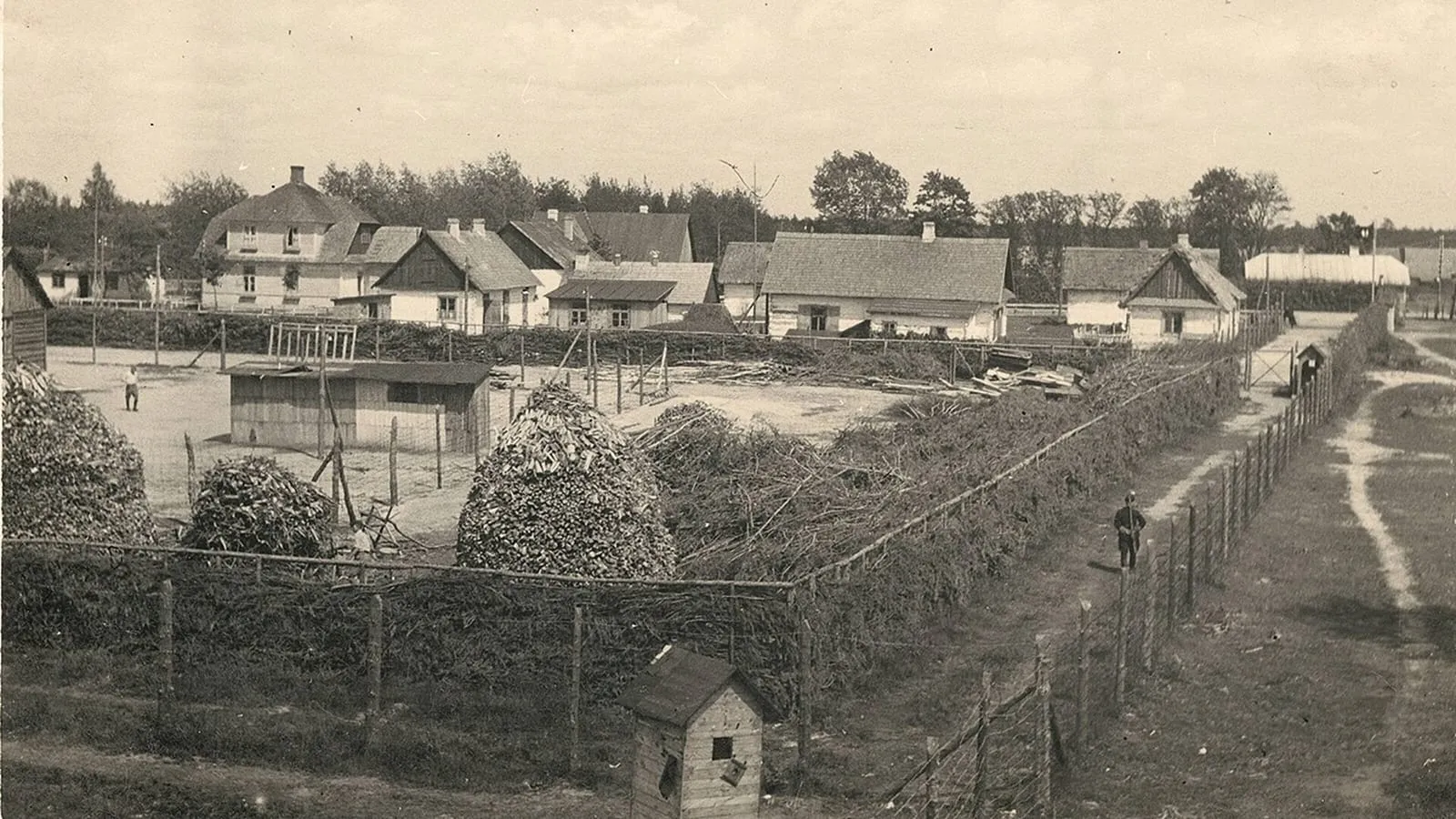
On the afternoon of 14 October 1943, at the German death camp at Sobibór, in the forests by the Bug river between Chełm and Włodawa, Jewish prisoners lured SS men of the camp staff into the camp workshops and storerooms and quietly killed them with axes and knives. When the killings were discovered, several hundred people threw themselves at the fence and the minefield under the guards’ fire. About half of the roughly 600 prisoners reached the forest; a few dozen survived the war. The uprising was led by two men who had known each other for less than three weeks: Leon Feldhendler, a Polish Jew and leader of the camp underground, and a Soviet prisoner of war, Red Army Lieutenant Alexander Pechersky. It was the most successful prisoner escape from a German death camp during the war.
The camp on the Bug
Sobibór was the second of the three death camps built under Operation Reinhard – the plan to murder the Jews of the General Government, directed from Lublin by Odilo Globocnik. The first was Bełżec, where from March 1942 the victims included the Jews of the District of Galicia, among them those of Stanisławów; the third was Treblinka, opened in July 1942. At Sobibór the gas chambers, into which engine exhaust was pumped, began operating at the beginning of May 1942. The commandant was at first Franz Stangl, and from August 1942 Franz Reichleitner.
Jews were brought to Sobibór from the Lublin district and other parts of the General Government, but also from the Reich, Austria, the Protectorate of Bohemia and Moravia, Slovakia, France and the Netherlands – from the last of these, according to surviving transport lists, more than 34,000 people were deported, of whom fewer than twenty survived. Historians’ estimates of the camp’s death toll vary: from about 170,000–180,000 (Jules Schelvis, Robert Kuwałek) to 250,000 (the figure given in 1947 by the Polish examining judge Zbigniew Łukaszkiewicz and long repeated in the literature). Almost everyone who arrived was killed within a few hours.
The camp was run by between a dozen and some two dozen German and Austrian SS men, most of them veterans of Aktion T4, the murder of the mentally ill in the Reich, and about a hundred guards, the so-called Wachmänner. Most of these were former Soviet prisoners of war, chiefly Ukrainians, trained at the SS training camp at Trawniki (PL). The physical work in the camp – from unloading the wagons and sorting the plundered belongings to emptying the gas chambers and burning the bodies – was assigned by the Germans to several hundred Jewish prisoners picked out of the transports. By various estimates there were between about 500 and 650 of them in October 1943.
Feldhendler’s underground
Sobibór’s prisoners knew that they would live only as long as the camp operated. In the winter and spring of 1943 a small group of Polish Jews, including the heads of the carpentry, shoemaking and tailoring workshops, gathered around Leon Feldhendler, a rabbi’s son and former chairman of the Judenrat in Żółkiewka. In the summer their fears became urgent. Several hundred Jews who resisted immediately on arrival were shot on Sobibór’s ramp; from notes found in their clothing the prisoners learned that these were the last workers of the liquidated Bełżec camp, sent to their deaths once its traces had been erased. Transports were growing fewer, and in the northern part of the camp the Germans had begun building the so-called Camp IV, a depot for captured Soviet ammunition. Everything suggested that Sobibór would soon cease to be a death camp, and that its prisoners faced the fate of the Bełżec workers. News also arrived of the Treblinka uprising of 2 August 1943.
The conspirators considered one plan after another: poisoning the SS men, setting fire to the clothing stores, bribing the guards, tunnelling under the fence and the minefield. None came to anything. Above all, they lacked people with military experience who could prepare an operation and lead a crowd of unarmed prisoners. Informers were also a danger, and mistrust divided the Polish Jews from those brought from Western Europe, who knew neither the language nor the surrounding country.
The prisoners from Minsk
On 23 September 1943 a transport of some two thousand people arrived at Sobibór from the ghetto in Minsk, which was being liquidated. Among them were Jewish Red Army soldiers who had until then been held in the SS labour camp in Minsk. Almost all the new arrivals were gassed that same day; a few dozen (sources give from about 60 to 80) were selected for work, mostly prisoners of war, and assigned to building Camp IV. Among them was 34-year-old Lieutenant Alexander Pechersky from Rostov-on-Don, captured in the autumn of 1941 in the Vyazma pocket.
A few days later Pechersky caught the attention of the whole camp. When one of the SS men, Karl Frenzel, was beating a prisoner who was clearing tree stumps, the lieutenant stopped work and watched; Frenzel ordered him to split a stump in five minutes on pain of a flogging, and when Pechersky managed it, he refused the reward – cigarettes, and then bread. Feldhendler invited him to talk through Shlomo Leitman, a Russian-speaking Polish Jew who had come on the same transport. A first attempt, on 28 September, came to nothing; a second, the following evening, succeeded. The meetings took place in the women’s barracks, which Pechersky visited on the pretext of seeing a girlfriend, a prisoner known in the camp as “Luka”.
At the beginning of October an Underground Committee was formed. Pechersky was at its head, Feldhendler became his deputy, and its members included craftsmen from the earlier group and the lieutenant’s closest associates: Leitman, Boris Tsibulsky, a miner from the Donbas, and Alexander Shubayev. The prisoners of war brought combat experience and discipline, the Polish Jews their knowledge of the camp and its people. First, another attempt was made at a tunnel from under the carpentry workshop, but on 8 and 9 October downpours flooded it. On 9 October, Yom Kippur, the committee adopted Pechersky’s plan: an armed revolt.
The plan
Pechersky started from a simple observation: the camp was run by a dozen or so Germans, and the guards, whom the Germans did not trust, were issued ammunition only for their spells of duty and in small quantities. If the SS men were killed, the leaderless guards – so it was assumed – would be unable to organise any defence. The SS men, greedy and self-assured, were to be lured one by one into the workshops and storerooms on the pretext of trying on clothes or boots or inspecting a leather coat, and killed without noise. In the first phase, between 3.30 and 4.30 p.m., six combat teams of several men each, made up mainly of prisoners of war, were to operate in Camp I (the workshops and prisoners’ barracks) and Camp II (the storerooms). Feldhendler was responsible for Camp II and for cutting the telephone line. In the second phase the kapos would summon the prisoners to the evening roll-call, and the conspirators, armed with captured weapons, would lead them in a column to the main gate as if they were going out to work. By nightfall everyone was to be in the forest.
Thirty to forty people knew of the plot. It was decided to tell the rest only at the moment of escape, and there was no way of reaching the completely isolated Camp III, where prisoners worked at the gas chambers and the burning pits. The date was chosen partly because the commandant, Reichleitner, was on leave, together with Gustav Wagner, his deputy, whom the prisoners feared most of all. The conspirators won over two kapos, Szymon Pożycki and Czepik, the first of whom could move people between parts of the camp without arousing suspicion. During the night of 13–14 October knives and axes, made in the camp smithy or hidden in the workshops, were handed out.
14 October
In the morning the prisoners went to work as usual, and the craftsmen booked the SS men for fittings at set times. In the early afternoon several things happened that nearly wrecked the plan: an SS man took the kapo Pożycki off to work in Camp IV, and Frenzel mocked the leader of the carpenters, who had put on his best clothes for the escape. Pechersky rejected a proposal to postpone the action to the next day, because every day increased the risk of betrayal.
The killing began at around 3.30–4 p.m. In the tailoring workshop Shubayev killed SS-Untersturmführer Johann Niemann, who was acting commandant in Reichleitner’s absence, with an axe. Further SS men died in the tailoring and shoemaking workshops, among them the commander of the guard, Siegfried Graetschus, as did the highest-ranking guard, the ethnic German Ivan Klatt. Leitman lured the SS man Friedrich Gaulstich into the carpentry shop and killed him. In Camp II Feldhendler and Tsibulsky killed the SS man Josef Wolf and two others in the sorting shed; Rudolf Beckmann, who would not come to the storeroom, was stabbed to death in his office. An electrician cut the telephone and power lines, and a young goldsmith, Stanisław (Shlomo) Szmajzner, smuggled six rifles out of the guards’ barracks. They failed to kill Frenzel, who did not come to his fitting.
Pechersky ordered the roll-call to be sounded. But no column could be formed: the agitated prisoners, most of whom were only now learning of the revolt, began to press towards the gate. When a guard barred their way, the crowd killed him. At the same moment the SS man Erich Bauer returned from a supply run; the guard accompanying him found a body in the office, and the first shots were fired. Pechersky shouted that the uprising had begun and called on everyone to flee. A group of insurgents attacked the armoury, where the SS man Werner Dubois (PL) was badly wounded, but machine guns opened fire from the watchtowers and Frenzel fired into the crowd with a submachine gun. The way to the main gate was cut off.
The prisoners hurled themselves at the barbed-wire fence: they cut the wire, climbed over and crawled underneath, until at one point the fence collapsed. Beyond it lay a strip of minefield and open ground. The first to flee were killed by mines, others by the guards’ bullets; conspirators who had weapons fired back. Pechersky and a group of prisoners of war crossed the fence near the SS barracks, where – as he had foreseen – there were few mines. By nightfall those who had made it across the field were in the forest.
The toll
Figures differ from author to author. When the uprising broke out there were, according to Marek Bem, about 500 prisoners in Sobibór; according to Yitzhak Arad about 600 (plus a few dozen more in Camp III); according to Jules Schelvis about 650. About 300 people managed to escape (Bem gives 275). Between a few dozen and more than two hundred people, depending on the source, died in the fighting, on the mines and from the bullets in the field. Between 150 and 285 prisoners remained in the camp: everyone in Camp III, who knew nothing of the plan, the Camp IV workers held back at gunpoint by the guards, and some of the Dutch Jews, who saw no chance of escape in a foreign country.
Of the dozen or so SS men present in the camp that day, the insurgents killed eleven (according to Arad) or twelve (according to Bem) and badly wounded one. Several guards were also killed; Bem names two, both ethnic Germans. English-language sources often speak of “eleven SS officers”, but only Niemann was an officer – the others killed were NCOs, although it was they who in practice ran the camp.
The manhunt and the closing of the camp
It took Frenzel, Bauer and the guards several hours to regain control of the camp and lock the remaining prisoners in a barracks. Only in the evening did they call for help, by telephone from the railway station. That same night the Soviet prisoners of war who had stayed in the camp and the Camp IV workers were shot. On 15 October the SS and Police Leader for the Lublin district, Jakob Sporrenberg – successor to Globocnik, who had been transferred to Trieste in September – arrived from Lublin together with the deputy head of Operation Reinhard, Hermann Höfle. All the Jews who had remained in Sobibór were shot that same day.
The manhunt went on for days. SS and police cavalry units, border guards, gendarmerie and the camp staff took part; the Germans posted men at the bridges and fords on the Bug and sent out reconnaissance aircraft. They assumed that the fugitives would head across the river, whereas most of them, being Polish Jews, sought refuge in the General Government. According to German documents, 107 escapees had been caught and killed by 22 October; Bem puts the number killed in the manhunt at 127. Others later died at the hands of local gangs and, according to some accounts, of units of the armed underground; historians dispute the scale of these incidents. There were also Poles who hid and fed the fugitives even though the penalty for doing so was death; several families were honoured after the war as Righteous Among the Nations.
Heinrich Himmler abandoned the plan to turn Sobibór into an ammunition depot and ordered the camp to be liquidated. At the turn of October and November about two hundred Jewish prisoners were brought from Treblinka; they dismantled the barracks and fences and erased the traces of the mass graves, and were then shot. The site was ploughed over and planted with trees. According to many historians, fear of further revolts – after Treblinka, Sobibór and the Białystok Ghetto – was one of the reasons for Operation Harvest Festival (Aktion Erntefest): on 3 and 4 November 1943 the Germans shot about 42,000 Jews, the last forced labourers of the Lublin district, at Majdanek and at the labour camps at Trawniki and Poniatowa.
The fate of the escapees
Pechersky and a group of prisoners of war crossed the Bug and on 22 October joined a Soviet partisan unit in Belarus. Others hid in the forests until the Red Army arrived in the summer of 1944 or found shelter with Poles. Exactly how many survived the war is not known: Bem counts at least 61 surviving escapees from Sobibór, including 57 participants in the uprising; Thomas Blatt gives 62, Schelvis 47, Arad about 50–70. Eight women were among the survivors. Leon Feldhendler survived the occupation in hiding but was fatally shot in his flat in Lublin in April 1945; the circumstances of his killing have never been explained. The last surviving insurgent, the Red Army soldier Semyon Rosenfeld, died in 2019.
Place in the war
News of the revolt quickly reached the Polish Underground State. On 25 October 1943 the Government Delegation for Poland cabled London that “the Jews, in a heroic struggle against the Germans, have destroyed the place of execution”, and the underground press of various political leanings wrote about the uprising. Sobibór joined the series of armed Jewish revolts of 1943 – from the Warsaw Ghetto Uprising through the Treblinka revolt to the fighting in the Białystok Ghetto. It differed from them in its aim: the insurgents sought neither to capture nor to destroy the camp, but to lead as many people out of it as possible – and that more modest aim they largely achieved. Arad attributed this above all to the military preparation of Pechersky and his fellow prisoners of war. The revolt hastened the end of Operation Reinhard: with the closing of Sobibór, the last of its three death camps ceased to exist, and the murder of the Jews shifted almost entirely to Auschwitz-Birkenau.
The leader of the uprising received no recognition at home. Pechersky fought with the partisans and then – as a former prisoner of war, suspect for that reason alone – in a penal battalion, where he was badly wounded. His account formed the basis of one of the first texts about Sobibór, included in The Black Book compiled by Ilya Ehrenburg and Vasily Grossman. After the war, during the antisemitic campaign against “cosmopolitans”, he lost his job and, by his own and his family’s account, was briefly arrested. The Soviet authorities did not allow him to testify at trials abroad; he did, however, give evidence in Kiev in 1963 at the trial of eleven former Sobibór guards. The trial of members of the German staff took place in Hagen, West Germany, in 1965–1966; Frenzel was sentenced there to life imprisonment, while Bauer had been sentenced to death in West Berlin as early as 1950, a sentence commuted to life imprisonment when the death penalty was abolished in West Germany.
For decades Sobibór was remembered mainly by survivors such as Blatt and Schelvis and by their historians. The story of the uprising was brought to a wider audience by the 1987 British television film “Escape from Sobibor”. On 14 October 1993, the 50th anniversary of the revolt, a museum was opened on the site of the camp; it is now a branch of the State Museum at Majdanek. Pechersky was posthumously awarded the Knight’s Cross of the Order of Merit of the Republic of Poland (2013) and the Russian Order of Courage (2016).
Places·Sobibór
Sources
Meanwhile
(04)Elsewhere, within a week.
- 13 October 1943 · MediterraneanItaly declares war on GermanyOn 13 October 1943 Badoglio's government in Brindisi declared war on Germany. The Allies recognised Italy as a co-belligerent, but not as an ally.
- 12 October 1943 · PacificAir raids on RabaulOn 12 October 1943 nearly 350 of General Kenney's aircraft struck Rabaul, opening the air offensive meant to neutralise the Japanese fortress.
- 10 October 1943 · PoliticsChiang Kai-shek becomes Chairman of the National GovernmentOn 10 October 1943 in Chongqing Chiang Kai-shek was sworn in as Chairman of the National Government of China, an office now given real power.
- 9 October 1943 · Western FrontVII Corps in BritainIn October 1943 the headquarters of the US VII Corps arrived in England, part of the build-up of American forces in Britain before the invasion of France.
Related events
(04)The same battle, people or subject.
- 19 November 1943 · PolandThe Janowska camp uprisingOn 19 November 1943 the Germans murdered the Jewish prisoners of the Janowska camp in Lwów. That evening the “Death Brigade” of Sonderkommando 1005 revolted.
- 16 August 1943 · PolandThe Białystok Ghetto UprisingOn 16 August 1943 the Germans began liquidating the Białystok ghetto. Several hundred poorly armed fighters resisted; their leaders died in the ghetto.
- 3 November 1943 · PolandOperation Harvest FestivalOn 3–4 November 1943 the SS and police shot about 42,000 Jews at Majdanek, Trawniki and Poniatowa – the last forced labourers of the Lublin region.
- 16 May 1943 · PolandThe end of the Warsaw Ghetto UprisingOn 16 May 1943 Stroop blew up the Great Synagogue on Tłomackie and declared the Warsaw Ghetto at an end. His report listed 56,065 Jews “caught”.