Germany
Amon Göth
Commandant of the Płaszów labour camp, later concentration camp (1943–1944), SS-Hauptsturmführer
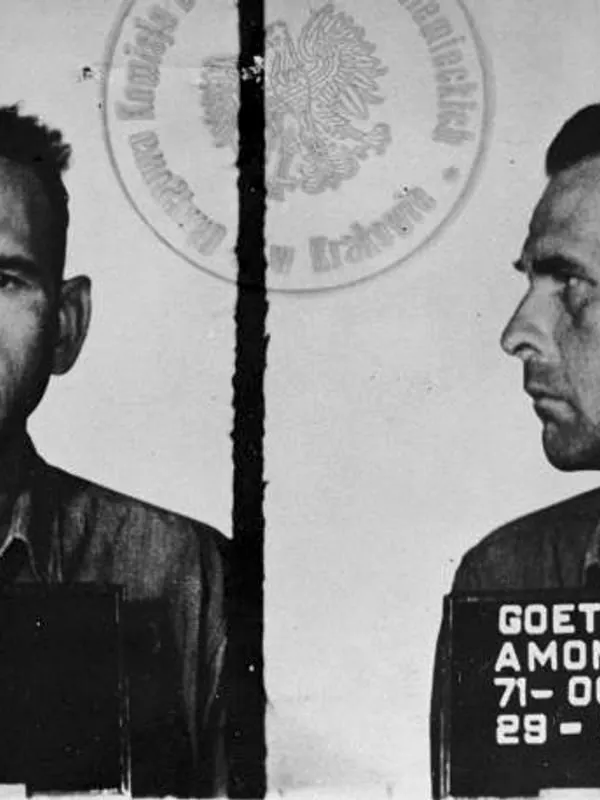
- Born:
- 11 December 1908, Vienna (Austria-Hungary)
- Died:
- 13 September 1946, Kraków
- Author:
- Natalia
- Photo:
- autor nieznany, domena publiczna, Wikimedia Commons

Amon Leopold Göth was an Austrian Nazi and SS officer who went down in history as commandant of the camp at Płaszów near Kraków and one of the cruellest perpetrators of the Holocaust in occupied Poland. In March 1943 he directed the liquidation of the Kraków Ghetto in the streets of Podgórze, and in September of that year the liquidation of the ghetto in Tarnów. The prisoners of Płaszów remembered him as a man who killed personally, on a whim, in front of others. At the same time his was a typical career of a lower-ranking SS functionary: a minor party activist from Vienna who, thanks to the war and the Holocaust, gained power over the lives of thousands of people. After the war the Polish Supreme National Tribunal sentenced him to death.
Youth in Vienna
He was born on 11 December 1908 in Vienna, the capital of Austria-Hungary, the only child of Amon Franz and Bertha Göth, owners of a prosperous bookshop and publishing house that brought out mainly religious writings and military literature. His parents had little time for him; he was brought up largely by an aunt, and from 1920 he attended a strict Catholic boarding school at Waidhofen an der Thaya. He was a poor and unruly pupil; in 1925 he left school without his school-leaving certificate and began training in his parents’ firm. By the age of seventeen he was moving in nationalist and antisemitic circles, and around 1927 he joined the Heimwehr, an Austrian right-wing paramilitary formation. Disillusioned by its moderation and the squabbles of its leaders, around 1930 he went over to the Nazis.
In September 1930 he joined the Austrian NSDAP (membership number 510,764) and its SS. He was active in the party’s local cells in the Viennese districts of Margareten and Mariahilf, and from January 1933 he was an adjutant and platoon leader in the 52nd SS Standarte. When Engelbert Dollfuss’s government banned the Nazi party in June 1933, Göth smuggled weapons, explosives and propaganda from Bavaria into Austria. Arrested in October 1933, he was released in December for lack of evidence. After the failed July Putsch of 1934, in which the Nazis murdered Dollfuss, he fled to Germany and underwent training at the SS centre at Dachau, next to the first concentration camp.
For the next few years he lived in Munich and helped his parents in their business; according to his files, his SS activity was interrupted by a dispute with a superior. In 1934 he married for the first time, to Olga Janauschek, but the marriage, arranged by the families, broke up after two years.
After the Anschluss
After Austria’s annexation to the Reich in March 1938, Göth returned to Vienna and to party work. On 23 October 1938 he married Anna Geiger in an SS ceremony; beforehand the couple had undergone the examinations of “racial suitability” required by the SS. They had three children: their son Peter died in infancy, while a son, Werner, and a daughter, Ingeborg, survived.
After the outbreak of war he served in the 11th SS Standarte. In March 1940 he was formally called up into the Wehrmacht, but his files show that he never actually served in the army. From mid-1941 to May 1942 he worked in Katowice, in the office of the Reich Commissioner for the Consolidation of German Nationhood, which in the territories annexed to the Reich expelled Poles and Jews to make room for German settlers. On 14 July 1941 he received his first officer’s rank, that of SS-Untersturmführer. His superiors praised him as an SS man “ready for sacrifice” with a “racial world view”.
On the staff of Operation Reinhard
In the summer of 1942 Göth was posted to Lublin, to the staff of Odilo Globocnik – the SS and Police Leader in the Lublin District and at the same time head of Operation Reinhard, the murder of the Jews of the General Government in the extermination camps at Bełżec, Sobibór and Treblinka. Little is known about his work during those few months, as those involved in the operation were sworn to strict secrecy. Material from his post-war trial shows that he took part in round-ups and directed transports of Jews to the extermination camps. It was this experience that led his superiors to entrust him with his next task.
Płaszów and the liquidation of the Kraków Ghetto
On 11 February 1943 Göth received orders to complete the construction of, and take command of, the forced labour camp at Płaszów, built on the site of two devastated Jewish cemeteries on the outskirts of Kraków. In the very first weeks he gave the prisoners a demonstration of his methods: when a Jewish engineer, Diana Reiter, who was supervising the construction of a barrack, pointed out a mistake in the foundations, he had her shot on the spot.
On 13 and 14 March 1943 Göth was in field command of the liquidation of the ghetto in Kraków’s Podgórze district, carried out on the orders of the SS and Police Leader in the Kraków District, Julian Scherner, and under the supervision of his chief of staff, Wilhelm Haase (PL). The inhabitants deemed fit for work – between 6,000 and 8,000, according to various sources – were marched to Płaszów. In Ghetto “B”, where the old, the sick and the children lived, about 2,000 people were killed on the spot, and thousands more were deported to Auschwitz. Witnesses testified that Göth himself shot people in the streets. He greeted the new prisoners in the camp, as they remembered, with the words that he was now their god.
In the summer of 1943 he was promoted straight to SS-Hauptsturmführer, skipping the rank of Obersturmführer; German biographical sources give the date as 28 July 1943, while other sources link the promotion to the spring of 1944. In September 1943 he directed the liquidation of the Tarnów Ghetto: some of its inhabitants were marched to Płaszów, most were deported to Auschwitz. He was also responsible for the liquidation of the camp at Szebnie, carried out by his subordinates at the turn of 1943 and 1944.
Commandant
Płaszów kept growing. On 10 January 1944 it became a concentration camp subordinate to the SS Economic and Administrative Main Office. At its peak the camp covered about 80 hectares and at times held up to about 20,000 prisoners, Jews and Poles. According to various estimates, several tens of thousands of people passed through Płaszów; the number murdered on its grounds is estimated at no fewer than several thousand. The main execution site was a hill that the prisoners called Hujowa Górka.
Göth wielded absolute power over the prisoners. For the escape of one prisoner he had every tenth member of the escapee’s work detail shot; smuggling food was punished with flogging or death. He killed personally – with his pistol, during roll calls and rounds of the camp – and his two dogs, Rolf and Ralf, were trained to attack people. Survivors attributed hundreds of killings to him, but the exact number cannot be established. The image fixed in popular culture of the commandant shooting prisoners for amusement from the balcony of his villa is questioned by some historians, since the villa did not afford a good view of the camp square; this does not alter the substance of the testimony about his crimes.
On 14 May 1944, before the arrival of transports of Jews from Hungary, Göth carried out the so-called “children’s action” in the camp: the prisoners’ children were rounded up and the next day deported to Auschwitz, where they were murdered. At the same time Göth was enriching himself with the victims’ property. He kept valuables in a safe, sold looted goods on the black market and did business with Kraków entrepreneurs, among them Oskar Schindler, who through bribes and favours obtained from him a degree of protection for his Jewish workers. His personal secretary and interpreter was a prisoner, Mieczysław Pemper, who secretly memorised and copied documents and later became one of the main prosecution witnesses.
Arrest
The scale of Göth’s plunder and his high-handedness eventually attracted the attention of the SS itself, which formally regarded the victims’ property as belonging to the Reich. In the summer of 1944 his subordinates denounced him, and the case was taken up by the SS judge Konrad Morgen, who was investigating corruption in the camps. On 13 September 1944 the Gestapo arrested Göth at his villa in Płaszów. He was charged with embezzling prisoners’ valuables and money, with mistreating them and with allowing prisoners access to camp records – but not with murder, which in itself was not a crime in the eyes of the SS. He was succeeded at the camp by SS-Obersturmführer Arnold Büscher. Göth appeared before an SS court of honour but was released on bail, although – according to some researchers – he was held for a time at Dachau. In February 1945 he was detained again in Vienna and placed in pre-trial custody in Munich. In the last days of the war he was drafted into an anti-aircraft artillery unit and, being in poor health – he suffered from diabetes and liver disease, among other things – he was sent to a military hospital at Bad Tölz in Bavaria. His case never came to trial before an SS court.
Trial and execution
At the beginning of May 1945 the Americans arrested him there. He was wearing a Wehrmacht uniform and concealing his past; he was sent to a camp for prisoners of war and suspects on the site of the former Dachau camp. Only when testimony from Płaszów survivors confirmed his identity did he admit, in February 1946, that he had been commandant of the camp, while playing down the crimes committed there. In 1946 the Americans handed him over to Poland – according to some sources at the end of May, together with the former commandant of Auschwitz, Rudolf Höss.
The trial before the Supreme National Tribunal took place in Kraków from 27 August to 5 September 1946. He was charged with membership of a criminal organisation, with the liquidation of the ghettos in Kraków and Tarnów and of the camp at Szebnie, and with thousands of killings at Płaszów, including some committed with his own hands. Many survivors testified, among them Pemper. Göth denied everything, pleaded orders and claimed that the executions had involved criminals. The Tribunal sentenced him to death. The verdict is regarded as one of the first in which a court trying a war criminal explicitly attributed killings by his own hand to the defendant. His plea for clemency was rejected. Amon Göth was hanged on 13 September 1946 in Montelupich Prison in Kraków. His body was cremated and his ashes – according to accounts – were thrown into the Vistula.
Family and memory
In Kraków Göth lived openly with Ruth Irene Kalder, a beautician and aspiring actress and a secretary at Schindler’s factory, who moved into his villa at Płaszów. In November 1945 she bore him a daughter, Monika. Kalder defended his memory for the rest of her life and took her own life in 1983. In 2002 Monika Hertwig described her struggle with her father’s legacy in the book Ich muß doch meinen Vater lieben, oder? (“But I have to love my father, don’t I?”), and her daughter Jennifer Teege did the same in a book published in 2013, Amon. Mein Großvater hätte mich erschossen (“Amon: My Grandfather Would Have Shot Me”).
A wide public came to know Göth through Steven Spielberg’s 1993 film Schindler’s List, in which he was played by Ralph Fiennes. The film fixed his figure as the embodiment of the sadism of camp commandants, sometimes at the cost of simplification. For historians something else matters more: Göth was not a madman operating on the fringes of the system, but an ordinary functionary whom ideology, war and impunity allowed to develop his cruelty to the utmost. His superiors rewarded him with promotions until he began to rob the Reich.
His trial was one of the first in Poland to bring the Holocaust before a court. The Supreme National Tribunal later also tried Rudolf Höss and the staff of Auschwitz. The commandant’s villa at Płaszów still stands today, and a memorial site is being created on the grounds of the former camp, which were long neglected.
Sources
Often appears with
People who appear in the same events.