Austria
Engelbert Dollfuss
Minister of Agriculture and Forestry (1931–1934), Federal Chancellor of Austria (1932–1934), leader of the Fatherland Front (1933–1934)
- Born:
- 4 October 1892, Texing (Lower Austria, Austria-Hungary)
- Died:
- 25 July 1934, Vienna
- Author:
- Natalia
- Photo:
- © Knozer (F. Knozer), domena publiczna, Wikimedia Commons

Engelbert Dollfuss, also spelt Dollfuß, was Chancellor of Austria for a little over two years, from May 1932 to July 1934. In that short time he turned a democratic republic into an authoritarian corporate state: he shut down parliament, banned in turn the Communists, the Nazis and the Social Democrats, and in February 1934 ordered the army to turn its guns on the workers’ housing estates of Vienna. Yet he was also the first head of government in Europe to stand up openly to Hitler and his demand that Austria be joined to the Reich, and for that he died at the hands of Austrian SS men. To some he became the “hero chancellor” and a martyr for Austria; to others he was the “murderer of the workers” and the founder of Austrian fascism. Both verdicts concern the same man, and his story shows how weak a small state was, caught between Hitler and Mussolini, in the years that led to the Anschluss and the Second World War.
A peasant’s son from Lower Austria
He was born on 4 October 1892 on the Großmaierhof farm in the municipality of Texing, today Texingtal, in Lower Austria, the illegitimate son of Josefa Dollfuß, a peasant’s daughter, and Josef Weninger, a journeyman miller. He grew up in nearby Kirnberg with his stepfather, the farmer Leopold Schmutz, whom his mother married in 1893. He wanted to become a priest. Thanks to the intercession of the parish priest he won a scholarship to the archiepiscopal minor seminary in Hollabrunn, where he passed his school-leaving examinations in 1913. He studied theology in Vienna for a few months but then switched to law at the University of Vienna, thereby losing the Church’s support. He made his living by private tutoring. He joined Franco-Bavaria, a Catholic student fraternity belonging to the CV federation, which shaped his views and from which he later recruited his associates.
The war and first steps in politics
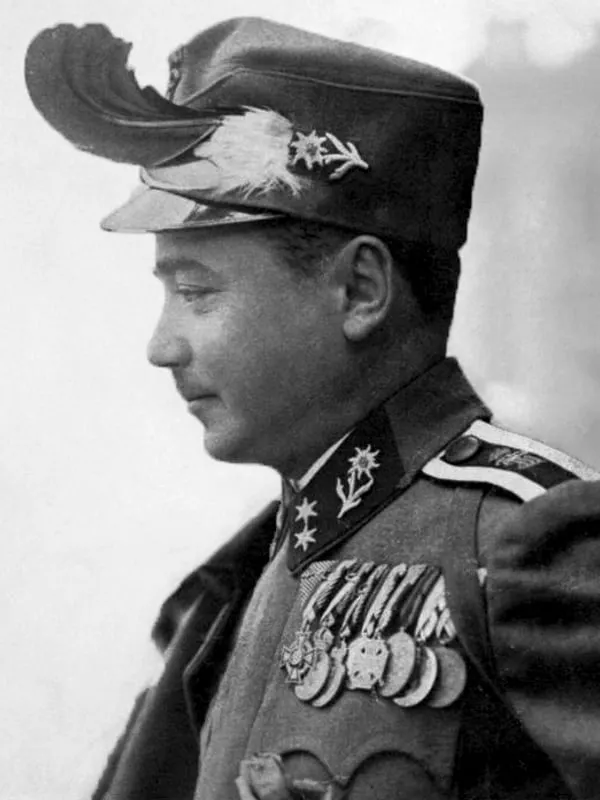
When war broke out he volunteered. In Vienna the medical board turned him down, as he stood little more than one and a half metres tall, but the same day he was passed fit for service in St. Pölten. He chose the Tyrolean riflemen, completed officer school in Brixen and was posted to the 2nd Landesschützen Regiment in Bozen. For over three years he fought on the Italian front in the Tyrolean mountains as commander of a machine-gun detachment, rising to the rank of lieutenant of the reserve. For defending a position in October 1916 he received the Silver Medal for Bravery, followed by several further decorations. For him, as for many of his generation, the Italian front was a formative experience. As chancellor he liked to appear in the uniform of the Kaiserschützen.
After the war he returned to his studies and in 1919 became secretary of the Lower Austrian Peasants’ League. At this time he was also close to Catholic-nationalist circles. At a CV congress in 1920 he tabled a motion that only people of “German-Aryan descent” back to their grandparents’ generation should be admitted to the fraternities – in other words, that people of Jewish origin should be excluded. The motion failed, but it shows that antisemitism was not alien to the Catholic right from which Dollfuss emerged, even though as chancellor he pursued no anti-Jewish policy. The Peasants’ League sent him to study economics in Berlin, where he met his future wife, Alwine Glienke, a German from Pomerania. They married on New Year’s Eve 1921 and had three children. The eldest daughter, Hanna, died in infancy; Eva and Rudolf outlived their father. In 1922 Dollfuss obtained his doctorate in law.
The agricultural expert
In 1922 he became secretary, and in 1927 director, of the Lower Austrian Chamber of Agriculture. He built up agricultural co-operatives and, against part of his own party, pushed through social insurance for farmers and benefits for farm labourers. He attended international agricultural congresses and was regarded as the Christian Social Party’s leading authority on agriculture. On 1 October 1930 the government of Carl Vaugoin put him in charge of the Austrian Federal Railways, the country’s largest enterprise. On 18 March 1931, without ever having been a member of parliament, he joined the government as Minister of Agriculture and Forestry. The Great Depression, which engulfed Austria after the Wall Street Crash and the collapse of the Viennese bank Creditanstalt in May 1931, made the country even poorer and more divided than it had been in the 1920s.
A chancellor with a majority of one
In April 1932 the Nazis won well over ten per cent of the vote in local elections in Vienna, Lower Austria and Salzburg, and the Social Democrats demanded early elections. On 20 May President Wilhelm Miklas appointed the 39-year-old Dollfuss chancellor. The Social Democrats rejected an offer of co-operation, as did the Greater German nationalists. Dollfuss built a coalition with the Landbund farmers’ party and the Heimatblock, the political arm of the Heimwehr, which held 83 of the 165 seats – a majority of one. He was also foreign minister and minister of agriculture.
His first great task was to rescue the public finances. On 15 July 1932 in Lausanne Dollfuss secured a League of Nations loan of 300 million schillings in return for Austria’s renewed undertaking not to unite with Germany for twenty years. Parliament approved the agreement in August by 82 votes to 80. The Social Democrats and the nationalists saw it as a betrayal of the cause of union, which most Austrian politicians had supported since the Constituent Assembly’s resolution of 1919 and the ban imposed by the Treaty of Saint-Germain. As early as October 1932 Dollfuss bypassed parliament for the first time, invoking the wartime Economic Enabling Act of 1917, and he made the leader of the Vienna Heimwehr, Emil Fey, state secretary for security.
Shutting down parliament
On 4 March 1933, during a dispute over a vote on a railway workers’ strike, all three presidents of the National Council resigned one after another, among them the Social Democrat Karl Renner. The procedural crisis could easily have been resolved at the next sitting. Dollfuss, however, declared that parliament had “eliminated itself”. On 7 March he announced that there was “no crisis of the state”, introduced censorship and a ban on public meetings, and on 15 March the police barred deputies from entering the building. In May the government also paralysed the Constitutional Court. From then on Dollfuss ruled by decree. It was a coup d’état carried out piece by piece, at the very time when, in neighbouring Germany, Hitler was acquiring dictatorial power through the Enabling Act.
The chancellor fought a war on two fronts. On 31 March he dissolved the Social Democratic Republican Protection League (Schutzbund), in May he banned the Communist Party, and on 19 June 1933, after a wave of Nazi bomb attacks, the NSDAP as well. Hitler responded with a tourist boycott and support for Austrian Nazis who had fled to Bavaria. On 20 May Dollfuss founded the Fatherland Front, an organisation intended to replace the parties. He sought backing from Mussolini, whom he met in Rome in April and June 1933 and in Riccione in August. The Duce guaranteed Austria’s independence but in return demanded a reckoning with the socialists and the abolition of the party system. On 11 September 1933, at the Trabrennplatz trotting track in Vienna, Dollfuss announced the creation of a “social, Christian, German state of Austria on a corporate basis and under strong authoritarian leadership”. He invoked the encyclical Quadragesimo anno of Pope Pius XI, and the Catholic Church supported him. He also stressed that Austria was the “second German state” and a better, Christian embodiment of Germanness than Hitler’s Reich.
On 3 October 1933 a young Nazi, Rudolf Dertil, who had recently been discharged from the army, fired two shots at him in the parliament building and wounded him slightly. In November the government reintroduced summary courts and the death penalty. The diminutive chancellor, whom his opponents mocked as “Millimetternich”, was at this point at the height of his power.
February 1934 and the corporate state
The reckoning with the Social Democrats came in February 1934. The police were searching party premises for weapons, and when members of the Republican Protection League resisted in Linz on 12 February, a brief civil war broke out. The army shelled Vienna’s municipal housing estates; around 350 people were killed, and the summary courts sentenced 24 people to death, nine of whom were hanged. The Social Democratic Party was banned that same day, 12 February, and the mayor of Vienna, Karl Seitz, was arrested. The party leader, Otto Bauer, fled to Czechoslovakia. From then on, in the language of the Austrian left, Dollfuss was the “murderer of the workers”.
On 17 March 1934 Dollfuss, Mussolini and the Hungarian prime minister Gyula Gömbös signed the Rome Protocols, which bound Austria politically and economically to Italy and Hungary. On 1 May a new constitution came into force, proclaimed “in the name of God Almighty”. The republic became the Federal State of Austria, a corporate state with the Fatherland Front as the only permitted political organisation and Dollfuss as its leader. The same day the concordat with the Holy See, signed in June 1933, also took effect. The Fatherland Front had uniforms, salutes and its own symbol, the crutch cross, which resembled the swastika, but the regime had neither the mass movement nor the racial ideology of the Nazis. Historians therefore disagree whether to call it Austrofascism (PL), as its opponents did, or a corporate dictatorship.
Death in the Chancellery
In the summer of 1934 Dollfuss sought contact with the moderate wing of the nationalist camp. In July he twice met the lawyer Arthur Seyss-Inquart, an acquaintance from his youth. He also removed Fey, whom he no longer trusted, from power. On 25 July 1934, during the July Putsch, some 150 members of the Vienna-based 89th SS Regiment, disguised in uniforms, burst into the Federal Chancellery. Dollfuss, who tried to escape, was shot at close range by Otto Planetta. His attackers refused him a doctor and a priest, and he died almost three hours later. The putsch collapsed because the army and police remained loyal to the government, and Mussolini – with whom the chancellor’s wife and children happened to be staying in Riccione – sent troops to the Brenner Pass. According to contemporary reports, Dollfuss’s funeral in Vienna on 28 July drew several hundred thousand people. He was buried in the cemetery at Hietzing. He was succeeded by Kurt Schuschnigg.
Cult and controversy
The corporate state turned the murdered chancellor into a martyr. 25 July became a day of national mourning; monuments, chapels and crosses to him were put up all over the country, stamps bearing his portrait were printed, and young people sang a song about “the dead man who leads us”. His coffin was moved to the crypt of a new church in Vienna’s 15th district, named the Seipel–Dollfuss Memorial Church. After the Anschluss the Nazis destroyed these sites, moved his remains back to Hietzing and proclaimed his murderers heroes. In Bertolt Brecht’s play The Resistible Rise of Arturo Ui, Dollfuss appears as Ignatius Dullfeet, murdered by Ui’s gangsters.
After 1945 the dispute over him divided Austria for decades. The Christian-democratic Austrian People’s Party long honoured him as a defender of independence, and his portrait hung in its parliamentary club room until 2017. The political scientist Gottfried-Karl Kindermann wrote that Dollfuss matters not as Hitler’s first victim but as his first opponent in Europe. The Social Democrats, and many historians with them, point out that it was he who destroyed Austrian democracy, ordered troops to fire on workers and deprived the country of a force that might have defended it. The later chancellor Bruno Kreisky, who had met him in his youth, wrote that Dollfuss’s path, resting as it did on Fascist Italy, was bound to lead to Hitler.
Significance
Dollfuss was a man of his place and time: Catholic, anti-democratic, hostile both to Marxism and to National Socialism, whose anti-Christian character he feared. His dictatorship was not a Nazi one, and for four years it blocked the Anschluss. But it rested on Mussolini, who could defend Austria only for as long as he did not need Hitler. When the Duce drew closer to Berlin after the war in Abyssinia, Dollfuss’s successor was left on his own. A divided society, in which the workers had no reason to defend a state that had fired on them, offered no resistance in March 1938. The murder of Dollfuss in 1934 and the Anschluss in 1938 were two stages on the same road: the Nazis first tried to take Austria by force, and when that failed, Hitler waited until it was left without defenders.
Sources
Often appears with
People who appear in the same events.