Germany
Odilo Globočnik
Gauleiter of Vienna (1938–1939), SS and Police Leader in the Lublin District (1939–1943), head of Operation Reinhard (1942–1943), Higher SS and Police Leader in Trieste (1943–1945)
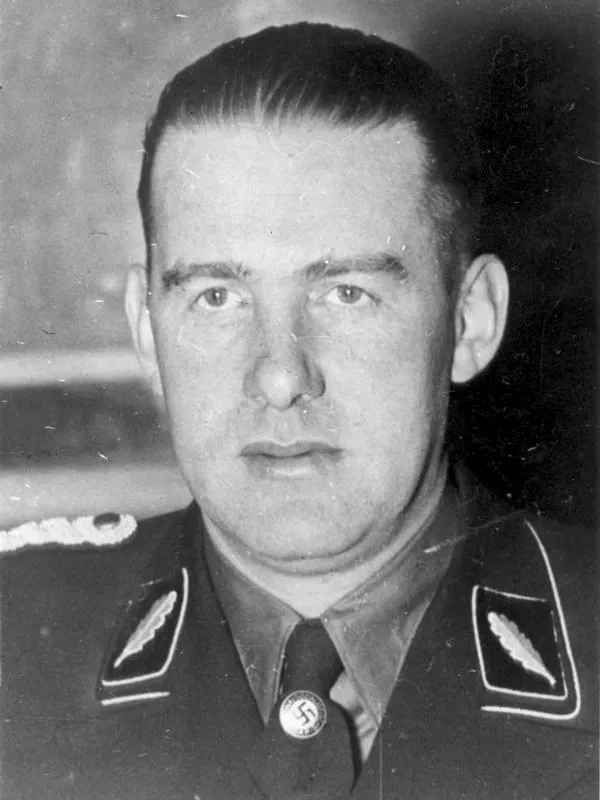
- Born:
- 21 April 1904, Trieste (Austria-Hungary)
- Died:
- 31 May 1945, Paternion (Carinthia, Austria)
- Author:
- Łukasz
- Photo:
- autor nieznany, CC BY-SA 3.0 DE, Wikimedia Commons

Odilo Globočnik was one of the chief perpetrators of the Holocaust and the most hated of the occupiers of the Lublin region. An Austrian nationalist from Carinthia, a street fighter of the illegal Nazi party and an inept Gauleiter of Vienna, he was saved from disgrace by his patron, Heinrich Himmler, and in November 1939 took command of the SS and police in the Lublin District of the General Government. From Lublin he directed Operation Reinhard: in the extermination camps of Bełżec, Sobibór and Treblinka, and in mass shootings, his men murdered, by historians’ estimates, some 1.5–1.8 million Jews. He also initiated the expulsions from the Zamość region and built the camp at Majdanek. He never stood trial: in May 1945, captured by the British in the Alps, he bit into a cyanide capsule.
Trieste and Carinthia
He was born on 21 April 1904 in Trieste, the great port of the Austro-Hungarian monarchy. His father, Franz Globočnik, was a lieutenant in the imperial and royal cavalry who after his marriage transferred to the reserve and worked for the post office; his paternal ancestors came from a German-speaking family in Tržič in Slovene Upper Carniola, and his mother, Anna, née Petschinka, came from Vršac in the Banat. The Slavic ring of his surname followed him all his life and was sometimes used against him by party rivals; he himself regarded himself as a German. During the First World War he attended the military secondary school in St. Pölten, which was to open the way to an officer’s career. The collapse of the monarchy in 1918 thwarted these plans, and when the Italians occupied Trieste the family moved to Klagenfurt in Carinthia.
In 1919 his father died and the family fell into poverty. The teenage Odilo worked as a porter at the railway station to pay for his schooling. Carinthia was at that time the scene of fighting between Austrian volunteers and the forces of the Kingdom of Serbs, Croats and Slovenes, which laid claim to its southern part. Globočnik took part, although Nazi biographies exaggerated his exploits, and later campaigned before the plebiscite of 1920, in which southern Carinthia remained with Austria. At school he belonged to extreme nationalist and antisemitic student fraternities. He passed his school-leaving examinations in 1923 and then worked as a site manager for a hydraulic engineering company and a construction firm.
Street fighter of an illegal party
On 1 March 1931 he joined the Austrian NSDAP and rose quickly; by 1933 he was already deputy Gauleiter of Carinthia. When Engelbert Dollfuss’s government banned the party in June 1933, Globočnik went underground. Between 1933 and 1937 the Austrian police arrested him several times, among other things on suspicion of involvement in bomb attacks, and in 1935 a court convicted him of high treason; each time he was soon released. On 1 September 1934 he joined the SS. He organised the smuggling of people, weapons, money and propaganda between Germany and Austria and built an illegal SS intelligence network in Carinthia. According to German studies, he most probably took no active part in the July Putsch of 1934.
Together with his friend Friedrich Rainer he belonged to the so-called Carinthian group, which after 1936 backed Hitler’s line: instead of terror, legal infiltration of the state and pressure from Berlin. In July 1936 both men were received by Adolf Hitler at the Berghof. Globočnik was one of the go-betweens between Berlin and Arthur Seyss-Inquart in the weeks before the Anschluss, and in March 1938 he took an active part in the seizure of power in Vienna, when Chancellor Kurt Schuschnigg was forced to resign.
Gauleiter of Vienna
After the Anschluss Globočnik became a state secretary in Seyss-Inquart’s short-lived government and a member of the Reichstag, and in May 1938, with the backing of Himmler and Reinhard Heydrich, Hitler appointed him Gauleiter of Vienna. The thirty-four-year-old Carinthian’s rule was a succession of failures. The Viennese regarded him as a pompous demagogue, the city’s economy sank into the chaos of “Aryanisation”, and his campaign against the Church, following the attack by Nazi youths on the palace of Cardinal Theodor Innitzer in October 1938, alienated even moderate Nazis. He also shared responsibility for the persecution of the Jews: he opened the antisemitic exhibition “The Eternal Jew”, and during Kristallnacht dozens of synagogues were burnt in Vienna and thousands of Jews arrested. Party auditors soon discovered that he had been running the finances at his own discretion: secret accounts, loans to protégés and, according to some sources, illegal currency speculation. On 30 January 1939 Hitler removed him from office.
Globočnik’s career ought to have ended there. Himmler, however, took him onto his staff and sent him for training with the SS-Verfügungstruppe. In September 1939 Globočnik, a former Gauleiter, took part in the Polish campaign as an NCO in the SS regiment Germania.
SS and Police Leader in Lublin
In November 1939 Himmler appointed him SS and Police Leader (SS- und Polizeiführer) in the Lublin District; he took up office on 9 November with the rank of SS-Brigadeführer. Under the plans of autumn 1939 this district was to become a “reservation” for Jews from the whole Reich, and Adolf Eichmann had sent the first transports there under the Nisko Plan. Globočnik’s first day in office was also a day of mass arrests of the Lublin intelligentsia. Professors of the Catholic University of Lublin, soon to be closed, as well as teachers, lawyers and clergy, were locked up in the prison at the Castle, and the bishops of Lublin, Marian Fulman (PL) and Władysław Goral, were sentenced to death, commuted after Vatican intervention to imprisonment in Sachsenhausen concentration camp. In 1940, during the AB-Aktion, Globočnik’s men shot several hundred Poles at Rury Jezuickie (PL) near Lublin and more than a hundred in the Kumowa Dolina valley near Chełm.
What interested him most, however, was the “Jewish question”. On his initiative a labour camp on Lipowa Street was set up in Lublin in December 1939, and in 1940 a network of camps in which thousands of Jews dug an anti-tank ditch along the border with the USSR in inhuman conditions; one of them was the camp at Bełżec. In doing so he trampled unceremoniously on the powers of the civil administration, which drew him into a lasting conflict with the district governor, Ernst Zörner (PL), and the Governor-General, Hans Frank. He had the terrace of his Lublin villa paved with matzevot, gravestones taken from a Jewish cemetery.
From 1940 Globočnik dreamt of turning the Lublin region into an area of German settlement. On learning that descendants of German colonists from the time of Joseph II lived near Zamość, he launched a “search for German blood”, and his plans, regarded as fantastical even by Nazi officials, delighted Himmler. After the German invasion of the USSR, Himmler appointed him on 17 July 1941 his plenipotentiary for the construction of SS and police bases in the conquered eastern territories, and on 20 July, during a visit to Lublin, ordered him to build a concentration camp for 25,000–50,000 prisoners and approved his settlement plans. From this order grew the camp at Majdanek, which Soviet prisoners of war began building in murderous conditions in the autumn of 1941. Globočnik’s men also picked out political commissars, communists and Jews from the prisoner-of-war camps in the Lublin region and shot them; several thousand prisoners from the camp at Kaliłów near Biała Podlaska died in this way. At Trawniki (PL) his staff set up a training camp where selected prisoners were formed into SS auxiliary units.
Operation Reinhard
In the autumn of 1941 Globočnik became one of the authors of the murder of the Jews of the General Government. In September he arranged with the heads of the Führer’s Chancellery, Philipp Bouhler and Viktor Brack, to be sent men who had previously murdered the mentally ill under the T4 programme. On 13 October 1941 he met Himmler and the Higher SS and Police Leader in the General Government, Friedrich Wilhelm Krüger, and at the beginning of November construction of the extermination camp at Bełżec began. The historian Bogdan Musiał considers it likely that it was Globočnik who devised the plan to murder the Jews in extermination camps and won Himmler over to it; other scholars believe that at first it concerned only the Jews of the Lublin District itself. Heydrich had held formal authority to coordinate the “Final Solution” since July 1941, and the Wannsee Conference of January 1942 established that the Jews of the General Government would be the first.
On the night of 16–17 March 1942 the liquidation of the Lublin ghetto and the deportations to Bełżec began. In May the extermination camp at Sobibór went into operation, and in July the one at Treblinka. On 19 July 1942 Himmler ordered Krüger and Globočnik to complete the “resettlement” of all the Jews of the General Government by the end of the year. The operation, named after Heydrich following his death (Einsatz Reinhardt), was run from Lublin by the staff of Hermann Höfle, while the camps were managed by Christian Wirth. When in the summer of 1942 interruptions in the transports to Sobibór slowed the pace, Globočnik sent Reserve Police Battalion 101 to Józefów, where the policemen shot the inhabitants of the ghetto. On 3–4 November 1943, after he had already left Lublin, some 42,000 Jews from the labour camps, the last survivors in his district, were shot at Majdanek, Trawniki and Poniatowa in Operation Erntefest (“Harvest Festival”). By historians’ estimates some 1.5–1.8 million Jews died in Operation Reinhard, most of them Polish Jews, but also Jews from Austria, the Czech lands, Slovakia, the Netherlands, France and other countries. The victims’ property went to the Reich, and part of it into the pockets of Globočnik and his subordinates.
At the same time Globočnik pursued his settlement plans. From November 1942 the SS and police cleared Polish villages in the Zamość region: by August 1943 some 110,000 Poles had been driven from their homes, among them about 30,000 children, many of whom died, and some ten to twenty thousand German settlers were brought in to replace them. The resistance of the population and of the partisans was met with pacification operations. The conflict with Frank’s administration, which appealed to Hitler, led Himmler in the summer of 1943 to agree to recall his protégé. In September 1943 Globočnik, promoted to SS-Gruppenführer, left Lublin.
Trieste
After the Italian capitulation Globočnik became Higher SS and Police Leader in the Operational Zone of the Adriatic Littoral, with his headquarters in his native Trieste, where the civil administration was headed by his friend Rainer. He brought with him veterans of Bełżec, Sobibór and Treblinka. In a former rice-husking mill, the Risiera di San Sabba, they set up a camp in which Jews and people suspected of involvement in the resistance were imprisoned, tortured and murdered; the number killed is estimated at 3,000–5,000, and some 20,000 people were deported from there to Auschwitz and other camps. Globočnik also waged a brutal campaign against the Yugoslav and Italian partisans, taking and shooting hostages and burning villages.
Death
At the turn of April and May 1945 he fled from Trieste to Carinthia and went into hiding with a group of associates, among them Rainer, Höfle and Ernst Lerch, in a hut on the Möslacher Alm above the Weissensee. On 31 May 1945 they were surrounded by a detachment of the British 4th Hussars. Globočnik, in civilian clothes and carrying false papers, was taken to Paternion; when one of the officers called out his name and he turned round, he bit into a cyanide capsule hidden in his mouth and died almost instantly. He was buried in an unmarked grave. Rumours that he had survived and was hiding abroad were investigated in the 1960s by the Austrian police at the request of Simon Wiesenthal; the police concluded that his death was highly probable.
Significance
Globočnik exemplifies the middle-ranking Nazi functionary whose own initiative accelerated genocide. He was neither an ideologue nor a capable administrator, but an ambitious, corrupt and ruthless executor whom Himmler forgave every failure, because he was always ready to do more, faster and more brutally. According to the German historian Dieter Pohl, he became one of Himmler’s most important partners in the East. Lublin, in his hands the centre of the SS’s settlement utopias, became in 1942 the headquarters of the largest murder operation in the history of occupied Poland. Because he took his own life, he never answered for his crimes before any court, and most of his closest associates, such as Höfle and Lerch, evaded punishment for years.
Sources
Often appears with
People who appear in the same events.
On the timeline
(20)1939
1941
1942
March
May
June
July
- 22
- Key eventThe Great Deportation in the Warsaw GhettoOn 22 July 1942 the Germans began deporting Jews from the Warsaw Ghetto to Treblinka. By 21 September they had murdered at least 254,000 people there.
- The Treblinka extermination campOn 22 July 1942 the first transport left Warsaw for Treblinka II. The next day the camp began operating; the Germans murdered some 800,000–900,000 Jews there.