- Category:
- Politics
- Date:
- 13 March 1938
- Author:
- Natalia
- Tags:
- Austria, Third Reich, Adolf Hitler, Kurt Schuschnigg
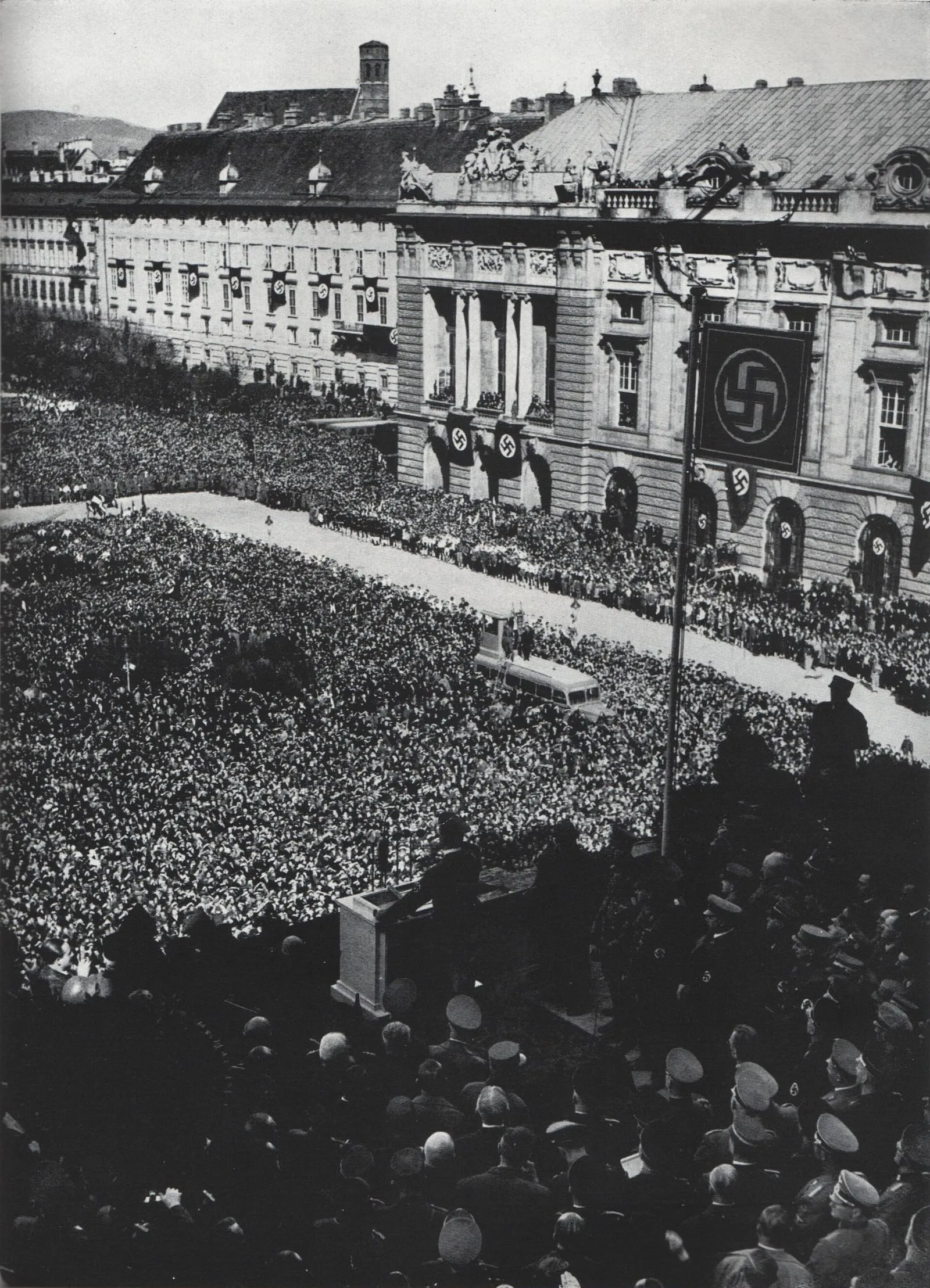
On 13 March 1938 Austria ceased to exist as a state. That day in Linz Adolf Hitler signed the law on the “reunification of Austria with the German Reich”, and in Vienna it was adopted by the government of the Nazi Arthur Seyss-Inquart, who had been chancellor for less than two days. Its first article read: “Austria is a land of the German Reich.” President Wilhelm Miklas refused to sign it and resigned. Seyss-Inquart therefore took over his powers and signed the law himself, as chancellor and acting head of state. The day before, 12 March, German troops had marched into Austria without meeting resistance anywhere, and on the evening of 11 March, under the threat of invasion, Chancellor Kurt Schuschnigg had resigned. These three days are known as the Anschluss, meaning “joining” or “annexation”. 13 March is taken as its legal date.
Put simply, Germany annexed Austria, though this was no ordinary conquest: a seizure of power by the Austrian Nazis, forced through by threats from Berlin, coincided with the entry of the army, and the whole was given a veneer of legality.
A forbidden union
The idea of union with Germany was old in Austria and by no means a Nazi one. After the collapse of the Habsburg monarchy almost every party believed that the truncated republic could not survive on its own, and in March 1919 the freely elected Constituent Assembly confirmed that German-Austria was part of the Reich. The most ardent supporters of union were the Social Democrats of Otto Bauer. The victors would not allow it. The Treaty of Versailles obliged Germany to respect Austria’s independence, and the Treaty of Saint-Germain forbade Austria to give it up without the consent of the Council of the League of Nations. The ban was reaffirmed in 1922 and 1932, when Austria received League loans, and in 1931 France even torpedoed a plan for a customs union between the two countries.
When Hitler became Chancellor of Germany, the Social Democrats struck the Anschluss from their programme, and the Christian Social chancellor Engelbert Dollfuss, who had just sidelined parliament, banned the Austrian NSDAP in June 1933. A year later, after a brief civil war, he crushed the Social Democrats as well and built the authoritarian Federal State of Austria, with a single permitted political organisation, the Fatherland Front. On 25 July 1934 Austrian SS men shot him dead in the Chancellery, but the July Putsch failed and Benito Mussolini sent divisions to the Brenner Pass. Hitler had to back down. The new chancellor was the former minister of justice and education, Kurt Schuschnigg.
Austria without a protector
From then on Austrian independence rested on Italy, which did not want a powerful Germany on the Brenner. This shield did not survive the Italian attack on Ethiopia. League of Nations sanctions set Mussolini at odds with London and Paris and pushed him towards Berlin. In January 1936 the Duce gave the German ambassador to understand that he would not object to Austria becoming a German satellite, provided it kept its formal independence. In March 1936 Hitler remilitarised the Rhineland with impunity, and in the autumn the Rome–Berlin Axis came into being.
Schuschnigg, left without support, sought an accommodation with Germany. On 11 July 1936 he signed an agreement negotiated by the German envoy in Vienna, Franz von Papen. In it Germany recognised Austria’s sovereignty and lifted the “thousand-mark blockade”, which since 1933 had been strangling Austrian tourism. Austria acknowledged itself to be a “German state” and undertook to conduct its foreign policy in harmony with the Reich, and in a secret part of the agreement it promised an amnesty for the Nazis and a share of power for representatives of the so-called national opposition. The military historian Edmund Glaise-Horstenau joined the government, and in 1937 the Viennese lawyer Arthur Seyss-Inquart joined the Council of State, his task being to bring the moderate wing of the national camp closer to the state. In reality both became Berlin’s men, and the banned NSDAP was rebuilding itself within semi-legal structures of the Fatherland Front.
On 5 November 1937, at a secret meeting in the Reich Chancellery, Hitler named Austria and Czechoslovakia as the first targets of German expansion, without ruling out the use of force. He still hoped, however, that Austria would fall into his hands from within. On 4 February 1938, after the affair that removed Werner von Blomberg and Werner von Fritsch, he took personal command of the Wehrmacht and made Joachim von Ribbentrop foreign minister. Papen, recalled from Vienna that same day, still managed to persuade Schuschnigg to meet Hitler.
Berchtesgaden
On the morning of 12 February 1938 Schuschnigg and his state secretary Guido Schmidt arrived at the Berghof, Hitler’s mountain residence above Berchtesgaden. He was expecting a discussion. In the study he was told that the history of Austria was “an unbroken betrayal of the nation”, that Hitler’s patience was exhausted and that nobody – not France, not Britain, not Italy – would lift a finger to defend his country. At lunch the generals Wilhelm Keitel, Walter von Reichenau and Hugo Sperrle, until recently commander of the Condor Legion, sat at the table. Their presence was meant as a warning. In the afternoon Ribbentrop and Papen presented the Austrian with a list of demands. Seyss-Inquart was to become minister of the interior and security, with authority over the police. Imprisoned Nazis were to be amnestied, and party members were to be allowed to operate within the Fatherland Front. The army chief of staff, the author of the plans for defence against Germany, was to go, and economic and foreign policy were to be coordinated with Berlin. When Schuschnigg objected that appointments were a matter for the president, Hitler ostentatiously summoned Keitel. Schuschnigg signed and was given three days to carry out the agreement.
After some hesitation Miklas agreed. On 16 February Seyss-Inquart took over the ministry, and the amnesty opened the prison doors even to participants in the 1934 putsch. On 20 February Hitler declared in the Reichstag that the Reich would no longer tolerate the oppression of ten million Germans living beyond its borders – that is, in Austria and Czechoslovakia. The Austrian Nazis, now protected by a minister of their own, took to the streets, and in Graz the police stood idly by as they hung swastikas on public buildings. On 24 February Schuschnigg replied in a speech to the Federal Diet (Bundestag), the substitute for a parliament in the corporative state. He said that Austria had reached the limit of concessions, and ended with the words: “Until death! Red-white-red! Austria!”
Schuschnigg’s plebiscite
On 9 March, at a Fatherland Front rally in Innsbruck, Schuschnigg announced that a popular vote would be held as early as the following Sunday, 13 March. Austrians were to say whether they wanted “a free and German, independent and social, Christian and united Austria”. It was a risky move, hastily prepared. There were no up-to-date electoral registers; only those aged 24 or over could vote, which kept away from the ballot box the youngest voters, among whom the Nazis had the most supporters; and the votes were to be counted by the Fatherland Front itself. Seyss-Inquart and Glaise-Horstenau immediately declared that a vote in this form was unconstitutional. Schuschnigg, however, was counting on a clear result showing the world that Austrians did not want Hitler. Even the socialists and communists, driven underground, called for a “yes” vote, though in return they demanded freedoms for the labour movement. There was no time to reach an agreement.
Hitler, who feared that the plebiscite might succeed, treated it as a challenge. On 10 March he ordered preparations for the entry into Austria. The 8th Army under General Fedor von Bock, being formed in Bavaria, was assigned to the operation. Seyss-Inquart was instructed to present Schuschnigg with an ultimatum and to mobilise the Austrian Nazis.
11 March
On the morning of 11 March Schuschnigg learned that the Germans had closed the border near Salzburg and that troops were massing beyond it. That day Hitler signed Directive No. 1 for Operation Otto. Seyss-Inquart and Glaise-Horstenau demanded that the plebiscite be called off. Hermann Göring directed the operation from Berlin by telephone. In the early afternoon Schuschnigg gave way on the first point and agreed to postpone the vote. Göring then demanded more: the chancellor’s resignation and the appointment of Seyss-Inquart. Schuschnigg appealed to London and Rome for help. London replied that the British government could not advise any course of action that might expose Austria to dangers against which Britain was unable to guarantee protection. Rome remained silent. In the afternoon Schuschnigg resigned.
For several hours President Miklas refused to appoint Seyss-Inquart and offered the chancellorship to others, without success. Meanwhile the Austrian Nazis, on a signal from Berlin, took over the streets, occupied the corridors of the Chancellery and hoisted swastika flags on public buildings in Vienna and in the capitals of the federal provinces. The seizure of power from below began many hours before the first German soldier crossed the border.
At 7.47 p.m. Schuschnigg made a short radio broadcast. He said that the government was yielding to force and that the army, in order not to shed “German blood”, had been ordered to withdraw without a fight if the Germans marched in. He ended with the words: “God protect Austria!” At 8.45 p.m. Hitler signed the order to march in the following morning. A pretext was still needed. Berlin dictated the text of a telegram in which a provisional Austrian government asked for troops to be sent to restore order. Seyss-Inquart, in whose name it was sent, approved it only after the fact. At around 10.30 p.m. Prince Philipp of Hesse telephoned Hitler from Rome with the news that Mussolini had taken the matter “in a very friendly manner”. Hitler, visibly moved, told him to tell Mussolini that he would never, ever forget this. Around midnight Miklas gave in and appointed Seyss-Inquart chancellor. During the night Seyss-Inquart even asked for the invasion to be halted, since the demands had been met. Hitler refused.
The invasion
At dawn on 12 March Wehrmacht soldiers, SS units and German police – some 65,000 men in all – crossed the border. Even earlier, at around 4.30 a.m., Heinrich Himmler landed at Vienna’s Aspern airfield with Reinhard Heydrich and a group of police officers. Their task was to take over the Austrian police. Not a shot was fired anywhere. People greeted the soldiers with flowers, and their enthusiasm surprised even the Germans. Yet the march was not the display of strength it was meant to seem: many tanks and vehicles of General Heinz Guderian’s armoured corps broke down on the road to Vienna.
In the afternoon Hitler crossed the border at his birthplace, Braunau am Inn, and in the evening he addressed the crowd from the balcony of the town hall in Linz, the city of his youth. He said that Providence had entrusted him with the mission of restoring his homeland to the Reich. Seyss-Inquart had hoped that Austria would keep a separate identity for a time, perhaps as a state linked to the Reich by a personal union. Impressed by his welcome, however, Hitler decided to annex it at once and completely.
The law of 13 March
On 13 March, in the Hotel Weinzinger in Linz, Hitler signed the law on the “reunification of Austria with the German Reich”. The same day in Vienna Seyss-Inquart’s government adopted it as a federal constitutional law, using the enabling powers of 1934, which allowed the government to legislate without parliament. The law announced a “free and secret” vote on the union for 10 April. Miklas refused to sign and resigned. For a few moments Seyss-Inquart became head of state and signed the law that abolished that state. In Berlin the Reich government adopted it at the same time.
On 14 March Hitler entered Vienna, and on 15 March, on the Heldenplatz in front of the Hofburg, he addressed a crowd that most estimates put at around 200,000–250,000. As “Führer and Chancellor of the German nation and Reich” he announced “before history” the entry of his homeland into the German Reich. He avoided the word “Austria”, which soon vanished from official language. The country was henceforth called the Ostmark, the Eastern March, and from 1942 the “Alpine and Danube Reichsgaue”. Seyss-Inquart became Reich Governor (Reichsstatthalter), but more and more power passed to Josef Bürckel, appointed in April as Reich Commissioner for the Reunification and the organiser of the Saar plebiscite. The Austrian army swore an oath of loyalty to Hitler and was absorbed into the Wehrmacht, and in 1939 the former state was divided into seven Reichsgaue. Vienna lost its role as a capital.
Terror and pogrom
The first victims of the Anschluss were the Jews, of whom some 190,000 lived in Austria, the great majority in Vienna. Violence broke out on the night of 11–12 March, before the Germans arrived. Austrian Nazis and ordinary onlookers dragged Jews out of their homes and shops, beat them, robbed them and humiliated them. Jews were made to kneel and scrub from the pavements the slogans painted by supporters of independence before the planned plebiscite. Shops and flats were looted, and party members seized Jewish businesses on their own initiative. The historian Hans Mommsen wrote of an “orgy of violence without precedent”. The Viennese pogrom of March 1938 exceeded in scale and brutality anything that had happened in Germany until then. Within a few weeks hundreds of Viennese Jews had taken their own lives.
Organised violence followed immediately. The Gestapo set up its headquarters in the Hotel Métropole and in the first weeks arrested tens of thousands of people: politicians of the corporative state, legitimists, socialists, communists and Jews. On 1 April 1938 the first transport left Vienna for the Dachau camp. It carried 150 people, among them many future politicians of post-war Austria, such as the later chancellor Leopold Figl. In August the SS began building a concentration camp at Mauthausen near Linz. The Nuremberg Laws were extended to Austria in May. In August 1938 Adolf Eichmann established the Central Office for Jewish Emigration in Vienna, which squeezed the last of their money out of those leaving in exchange for permission to go. By the end of 1941 some 130,000 Jews had left Austria, among them, as early as June 1938, Sigmund Freud. Around 65,000 Austrian Jews were murdered in the Holocaust.
The vote of 10 April
The promised plebiscite was held on 10 April throughout the enlarged Reich. The question combined the Anschluss with support for the dictator: “Do you agree with the reunification of Austria with the German Reich carried out on 13 March 1938, and do you vote for the list of our Führer Adolf Hitler?” Göring, Joseph Goebbels and Hitler himself took part in the campaign. The bishops publicly came out for a “yes”, led by Cardinal Theodor Innitzer, who added “Heil Hitler” to their declaration and was summoned to Rome for it. The former Social Democratic chancellor Karl Renner also announced in a press interview that he would vote “yes”. About 8 per cent of those otherwise eligible were excluded from the vote: above all Jews, people classed as of “mixed blood” and prisoners. In many polling stations people voted openly, in front of officials, because filling in the ballot in the booth aroused suspicion.
According to the official figures, 99.7 per cent of voters in Austria said “yes”. The result was no expression of free will, as the vote took place amid terror and propaganda, after the fact had been accomplished. Historians agree, however, that the Anschluss was popular in Austria in 1938. Some believe that a majority would have backed union even in a free vote; others point to the scale of the intimidation and to Gestapo reports according to which there were far fewer supporters in Vienna. Nobody knows how Schuschnigg’s vote would have ended – which is precisely why Hitler did not allow it to take place.
The world looks on
The Anschluss violated the Treaty of Versailles and the Treaty of Saint-Germain, but no great power did anything beyond words. London and Paris lodged protests in Berlin, which were rejected. Prime Minister Neville Chamberlain, who had been pursuing a policy of appeasement since May 1937, told the House of Commons on 14 March that nothing short of force could have prevented what had happened. In those days France did not even have a government: the cabinet of Camille Chautemps had resigned on 10 March, and Léon Blum formed a new one only on 13 March. Italy accepted the Anschluss without a word, and German and Italian soldiers soon met on the Brenner in a friendly ceremony. On 17 March the Soviet People’s Commissar for Foreign Affairs, Maxim Litvinov, proposed a conference of the powers on joint action against aggression, but nobody responded. The only state to protest formally at the League of Nations was Mexico. The League did not take up the matter.
In Prague the Anschluss was received with the deepest alarm. On the night of 11–12 March Göring assured the Czechoslovak envoy on his “word of honour” that Germany had no hostile intentions towards Czechoslovakia. Poland exploited the confusion for its own ends. After a border incident in which a Polish soldier was killed on 11 March, Foreign Minister Józef Beck on 17 March presented an ultimatum to Lithuania, demanding the establishment of diplomatic relations. Kaunas gave way.
Significance
The Anschluss was the first case since 1919 in which Germany swallowed an entire independent state, a member of the League of Nations. Hitler, who in 1934 had had to retreat before Mussolini, this time got everything without firing a shot. The Reich gained almost seven million inhabitants, the gold and foreign-currency reserves of the Austrian central bank, Styrian iron ore and industry, and, now bordering Yugoslavia and Hungary, it opened a way into the Balkans. Above all, however, Czechoslovakia was caught in a pincer: Reich territory now surrounded it on the north, the west and the south as well, and its fortifications, built mainly along the border with Germany, were bypassed by the new, weakly fortified frontier with former Austria.
For Hitler it was a triumph that confirmed his conviction that the West would not fight. Within a few weeks he launched his next campaign, in defence of the Sudeten Germans. The Sudeten crisis (PL), provoked according to the same pattern – a local Nazi party, demands and the threat of force – ended in September 1938 with the Munich Agreement. For the Austrians the Anschluss meant seven years in the Third Reich, which many of them served zealously, including in the machinery of the Holocaust. In the Moscow Declaration of 1943 the Allies recognised Austria as “the first free country to fall a victim to Hitlerite aggression”, while also reminding it of its share of responsibility for the war. On 27 April 1945 the reborn republic declared the Anschluss “null and void”, and the Austrian State Treaty of 1955 prohibited any renewed union with Germany. For decades Austria presented itself solely as a victim. Only from the 1980s did it begin to speak openly about how many of its citizens had welcomed Hitler in March 1938.
Sources
Related events
(04)The same battle, people or subject.
- 5 November 1937 · PoliticsThe secret meeting at the Reich ChancelleryOn 5 November 1937 Hitler set out to the Wehrmacht chiefs and Neurath a plan to win “living space” by force, starting with Austria and Czechoslovakia.
- 9 November 1938 · Crimes and repressionKristallnachtOn 9–10 November 1938 the Nazis burned synagogues across the Reich, wrecked thousands of shops, killed hundreds of Jews and sent 30,000 men to camps.
- 30 September 1938 · DiplomacyThe Munich AgreementOn 29–30 September 1938 Hitler, Chamberlain, Daladier and Mussolini signed in Munich an agreement giving Germany the Sudetenland. Prague was not consulted.
- 3 April 1939 · MilitaryFall WeissOn 3 April 1939 the OKW chief Wilhelm Keitel issued the Case White directive. The Wehrmacht was to be ready to attack Poland at any time from 1 September.