Germany
Hans Frank
Bavarian Minister of Justice (1933–1934), Reich Minister without Portfolio (1934–1945), Governor-General of the occupied Polish territories (1939–1945)
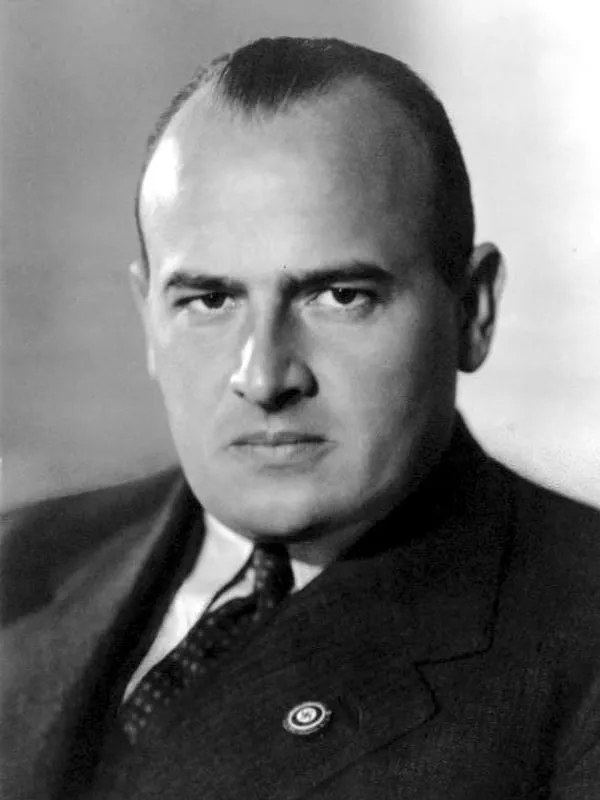
- Born:
- 23 May 1900, Karlsruhe (Grand Duchy of Baden, German Empire)
- Died:
- 16 October 1946, Nuremberg
- Author:
- Łukasz
- Photo:
- autor nieznany, CC BY-SA 3.0 DE, Wikimedia Commons

Hans Frank was a lawyer who served Adolf Hitler for more than twenty years: first as the Nazi movement’s advocate in the courts of the Weimar Republic, then as the architect of the Nazi “renewal of law”, and from October 1939 as Governor-General of occupied Poland. For more than five years he ruled from Wawel Castle over a country that was to be stripped of its elites, plundered and turned into a reservoir of cheap labour. In the territory under his authority the Germans murdered most of Poland’s Jews and hundreds of thousands of Poles. Frank, who competed for power with Himmler and the SS, was not the chief architect of the Holocaust, but he was its conscious and zealous accomplice, as he himself recorded in his official diary. After the war that diary served as evidence against him before the tribunal at Nuremberg, which sentenced him to death.
Youth and the road to Hitler
Hans Michael Frank was born on 23 May 1900 in Karlsruhe, the middle one of the three children of the lawyer Karl Frank. He grew up in Munich, where he finished the Gymnasium. In the last year of the war he served in the army but was never sent to the front. In the spring of 1919 he joined the Freikorps of Franz von Epp and took part in the bloody suppression of the Bavarian Soviet Republic. He also belonged to the racist and antisemitic Thule Society, where he met Anton Drexler, founder of the German Workers’ Party, the forerunner of the NSDAP. By his own account he came into contact with the party as early as 1919 and helped with its programme.
He studied law and economics in Munich and Kiel. He passed his final examination in July 1923 and received his doctorate in 1924. In September 1923 he joined the SA, in October the NSDAP, and on 9 November he took part in the Beer Hall Putsch and the march on the Feldherrnhalle. After the putsch failed he fled abroad, returning to Munich only in 1924, when the proceedings against him were dropped. In 1925 he married Brigitte Herbst, a secretary at the Bavarian Landtag. They had five children.
The movement’s advocate
In the late 1920s Frank became the NSDAP’s in-house lawyer. By his own reckoning, by 1933 he had appeared in more than 2,400 trials as defence counsel for Nazi thugs and activists and as the party’s legal representative. In 1928 he founded the League of National Socialist German Jurists, and in 1929 Hitler appointed him head of the party’s legal department. His greatest notoriety came from the trial of three young Reichswehr officers from Ulm, charged in 1930 before the Reich Court in Leipzig with working for the NSDAP. Frank called Hitler as a witness; Hitler assured the court that he would come to power legally, adding that afterwards “heads will roll”. The trial turned the defendants into heroes in the eyes of part of the officer corps. That same year Frank was elected to the Reichstag, where he sat until the end of the Third Reich.
He knew Hitler closely and also handled his personal affairs. In memoirs written in prison he claimed that around 1930 Hitler had asked him to look into his family’s origins and that Hitler’s grandmother had worked for a Jew named Frankenberger. Historians regard this story as unconfirmed and most probably invented, and the absence of any trace of such a person in Graz in those years undermines its credibility.
Law in the service of the Führer
After Hitler came to power, Frank became commissioner for justice in March 1933 and Bavarian Minister of Justice in April. As Reich Commissioner for the Coordination of Justice he brought the courts, the bar and the legal organisations under Nazi control, and in June 1933 he founded the Academy for German Law, of which he was president. He preached that the foundation of law was National Socialist ideology and the will of the leader, and that the judge’s task was to guard the “racial community” and eliminate “harmful elements”. In 1933 Hitler also made him a Reichsleiter, that is, a member of the party’s top leadership.
In the spring of 1933 Frank made threats against Austria on Bavarian radio, and in May he went to Vienna to agitate against the government of Chancellor Engelbert Dollfuss, who had him expelled. Hitler responded with sanctions and the Austrian Nazis with a wave of bomb attacks, which a year later led to the July Putsch. As Minister of Justice, Frank for a time supported a prosecutor’s investigation into the killings of prisoners at the Dachau camp, and during the Night of the Long Knives in June 1934 he objected to the shooting without trial of SA leaders in Munich’s Stadelheim prison. In both cases he gave way. What he was defending was not the rule of law but the standing of lawyers in a state in which the SS and the police were taking over more and more power. In December 1934 Hitler made him Reich Minister without Portfolio, but Frank had no real influence on policy.
Governor-General
The war gave him power beyond anything he had dreamed of. In mid-September 1939 Hitler appointed him head of the civil administration attached to the German military command in Poland, and by a decree of 12 October Governor-General of the occupied Polish territories. He took up office on 26 October 1939, when the General Government came into being, and on 7 November he moved into Wawel Castle. He filled the castle of the Polish kings with works of art looted in Poland and ruled surrounded by a court, while his wife Brigitte called herself the “Queen of Poland”. Among the Nazis the General Government was mockingly called the “Frank-Reich”.
Frank accepted the aims of the occupation without reservation. The Poles were to be a people without an intelligentsia, without secondary schools or universities, without culture and without a state. As early as 6 November 1939 the SS carried out Sonderaktion Krakau in Kraków, arresting the professors of the city’s universities. In February 1940 Frank told a correspondent of the Völkischer Beobachter that if he wanted to put up a poster for every seven Poles shot, the forests of Poland would not suffice to make the paper. In the spring and summer of 1940 he directed the Extraordinary Pacification Operation (AB-Aktion), in which several thousand members of the Polish intelligentsia, activists and people deemed criminals were murdered, many of them in the forest near Palmiry. He approved the plans to reduce Warsaw to a provincial town, known as the Pabst Plan. He introduced compulsory labour, and hundreds of thousands of people – more than a million by some estimates – were deported from the General Government to work in the Reich. The death penalty applied to an ever-growing list of acts, from resistance to the authorities to failure to deliver compulsory quotas and, from 1942, hiding Jews.
Throughout the occupation Frank fought for power with Heinrich Himmler. The police and SS in the General Government were formally subordinate to him but in practice to the Higher SS and Police Leader, Friedrich Wilhelm Krüger, who took his orders from Himmler. Their disputes concerned powers, resources and methods, not aims. Frank complained to Hitler that the SS was running the General Government on its own account and, according to what he said at Nuremberg, asked more than a dozen times to be dismissed.
The Holocaust
In the autumn of 1939 some one and a half million Jews lived in the General Government, and from the very first weeks the Germans sent more there from the Reich and the annexed territories, among other things under the Nisko Plan organised by Adolf Eichmann. From the outset Frank introduced laws that stripped them of their property, their professions and their freedom of movement. In 1940 he ordered most of the Jews to be expelled from Kraków so that the “capital” would be free of them, and in 1941 the rest were shut in the ghetto in Podgórze. In October 1940 the governor of the Warsaw District established the Warsaw Ghetto, in which more than 400,000 people were crammed together. Starvation rations condemned the inhabitants of the ghettos to death even before the mass killings began.
On 16 December 1941 Frank told his officials in Kraków that he had been told in Berlin to “liquidate” his Jews himself, and that they must cast off all pity and destroy the Jews wherever possible. At the Wannsee Conference on 20 January 1942 his deputy, Josef Bühler, asked that the “Final Solution” begin precisely in the General Government. From March 1942 to the autumn of 1943, in Operation Reinhard, the SS murdered some 1.5–1.8 million Jews, most of them from the General Government, in the extermination camps at Bełżec, Sobibór and Treblinka. The operation was run by the SS, not by Frank’s administration, but his officials registered the Jews, confined them in ghettos, seized their property and assisted in the deportations.
Decline
In the summer of 1942 Frank gave four lectures at the universities of Berlin, Vienna, Munich and Heidelberg in which he defended the independence of the courts and criticised police arbitrariness. It was a defence of his own position, not of the victims, but Hitler took it as disloyalty. Frank lost all his party posts outside the General Government, including those of Reichsleiter and president of the Academy for German Law, though he kept his office in the General Government. In 1943, as the front retreated and Polish resistance grew, he began trying to persuade Hitler that the policy towards the Poles was harmful and that the terror should be eased in order to win them over against the Soviet Union. Little came of it. Mass street executions in Warsaw and other cities continued, and in August 1944 the Warsaw Uprising broke out.
On the night of 29–30 January 1944 soldiers of the Home Army blew up the track beneath a passing train in which Frank was travelling to Lwów. The assassination attempt (PL) failed, and in reprisal the Germans shot about a hundred prisoners. In mid-January 1945, ahead of the Red Army’s arrival, Frank fled from Kraków to Bavaria, taking works of art with him, among them Leonardo da Vinci’s Lady with an Ermine. On 4 May 1945 he was arrested by American soldiers at Neuhaus on the Schliersee. He twice tried to kill himself.
The Nuremberg trial
Before the International Military Tribunal at Nuremberg, Frank was the only defendant apart from Albert Speer to admit part of his guilt. In custody he converted to Catholicism. He himself handed over to the Americans some forty volumes of his official diary, in the hope that its record of his disputes with the SS would exonerate him. The prosecutors quoted it against him. After the testimony of the Auschwitz commandant Rudolf Höss, Frank told the court that “a thousand years will pass and this guilt of Germany will not be erased”. In his final statement he partly retracted this, claiming that the crimes committed against Germans by the victors had already wiped out part of that guilt.
On 1 October 1946 the tribunal acquitted him of conspiracy against peace but found him guilty of war crimes and crimes against humanity and sentenced him to death. The judges stressed that Frank had taken part in the terror against the Poles, in the economic exploitation of the country that led to famine, in deportations for forced labour and in the extermination of the Jews. He was hanged in Nuremberg prison on 16 October 1946. His body, like those of the others executed, was cremated and the ashes scattered.
Significance
Frank was a typical example of the educated Nazi who turned the law into an instrument of lawlessness. First he helped Hitler to win power by legal means, then he constructed a theory of law subordinated to the leader, and in Poland he administered a system in which the law served plunder, terror and genocide. He later presented his disputes with the SS as proof of his moderation, but the diary he himself kept leaves no doubt that he shared the aims of the occupation entirely. The memoir he wrote in his cell, published by his widow in 1953 as Im Angesicht des Galgens (In the Face of the Gallows), was an attempt to settle accounts with Hitler, in whom Frank now saw the seducer of the nation, rather than with his own deeds. The harshest judgement came from his son, the journalist Niklas Frank, who in a book about his father portrayed him as a coward and a fanatic. In Poland the Governor-General’s name became a byword for the German occupation, and his diary, published in Polish in excerpts, is one of the most important sources for its history.
Sources
Mentioned in battles
(01)Often appears with
People who appear in the same events.