- Category:
- Politics
- Date:
- 8 November 1923
- Author:
- Łukasz
- Tags:
- Germany, Adolf Hitler, Nazi Party, Erich Ludendorff
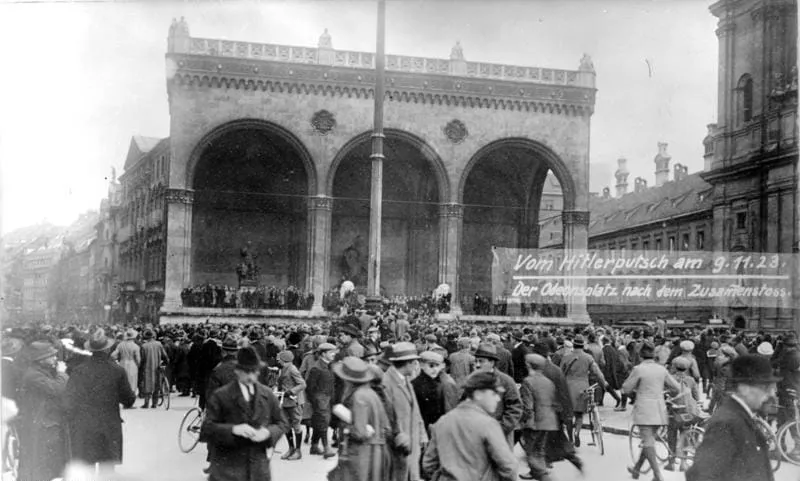
On the evening of 8 November 1923, in the great hall of Munich’s Bürgerbräukeller beer hall, some three thousand people were listening to a speech by Gustav von Kahr, the General State Commissioner, who for several weeks had been ruling Bavaria with dictatorial powers. At around 8.30 p.m. armed men burst into the hall. At their head was Adolf Hitler, leader of the NSDAP. He jumped onto a chair, fired a pistol into the ceiling and announced that the “national revolution” had broken out, that the Bavarian and Reich governments had been overthrown and that six hundred of his men had surrounded the building. So began the Beer Hall Putsch, also known as the Munich Putsch or the Hitler–Ludendorff Putsch. Within little more than half a day it was over. At noon on 9 November the Bavarian State Police broke up the putschists’ march with gunfire at the Feldherrnhalle in the centre of Munich. In the shooting in the city centre and at the military district headquarters occupied by the putschists, four policemen, fifteen putschists and a passer-by were killed. Hitler fled and was arrested two days later. The coup, meant to be the start of a “march on Berlin”, ended in pitiful failure, but Nazi propaganda turned it into a founding myth, and Hitler himself drew from it a lesson that ten years later carried him to power.
Bavaria, the “cell of order”
After the First World War Bavaria was the most turbulent state of the Reich. In November 1918 Munich gave the signal for the revolution that toppled the German monarchies, and in the spring of 1919 it lived through the brief rule of the Bavarian Soviet Republic, which was bloodily crushed by the army and the Freikorps (PL). The middle classes, officials and officers remembered it as the “red terror”. After the Kapp Putsch in March 1920, the commanders of the army and the civic guards forced the Social Democratic government to resign, and a conservative official, Gustav von Kahr, became prime minister. He turned Bavaria into a “cell of order” (Ordnungszelle), the antithesis of “Marxist” Berlin and a refuge for nationalists wanted in other German states. Among those who settled there were General Erich Ludendorff and Captain Hermann Ehrhardt, leader of the secret Organisation Consul, which murdered politicians of the republic.
It was in this climate that the National Socialist German Workers’ Party grew. From July 1921 Hitler was its leader with almost dictatorial authority, and the party had its own strong-arm squad, the Storm Detachment (SA), commanded from early 1923 by the former fighter pilot Hermann Göring. Hitler had helpers inside the state apparatus, such as the former Munich police president Ernst Pöhner and the head of the political police, Wilhelm Frick, and in the army Captain Ernst Röhm, who supplied the paramilitary leagues with weapons. Hitler’s model was Benito Mussolini, who in October 1922 had forced the King of Italy to entrust him with the government by his March on Rome. He was also impressed by Mustafa Kemal, who had defeated the Greeks from provincial Ankara and had just proclaimed the Turkish Republic. According to historians, Bavaria was to play the part of a German Ankara in these plans, from which the nationalists would march on “Jewish” Berlin.
1923
Hitler’s opportunity came with the gravest crisis of the Weimar Republic. In January 1923 France and Belgium occupied the Ruhr, and passive resistance financed by printing money led to hyperinflation. By the autumn a dollar cost billions, and then trillions, of marks. Hitler did not join the national front against the French: he preached that the “November criminals” in Berlin had to be dealt with first. On 1 May 1923 thousands of armed members of the paramilitary leagues, the SA among them, gathered outside Munich to break up the left’s May Day marches, but withdrew in the face of the army and police. At the beginning of September, at the “German Day” in Nuremberg, Hitler and Ludendorff stood together on the platform, and the SA and the radical leagues Bund Oberland and Reichskriegsflagge formed the German Fighting League (Deutscher Kampfbund). On 25 September Hitler assumed its political leadership.
On 26 September 1923 the new Chancellor, Gustav Stresemann, announced the end of passive resistance in the Ruhr. The right called it capitulation. The same day the Bavarian government of Prime Minister Eugen von Knilling declared a state of emergency and appointed Kahr General State Commissioner with dictatorial powers. President Friedrich Ebert responded with a state of emergency throughout the Reich. Kahr suspended in Bavaria the Law for the Protection of the Republic, passed after the murder of Walther Rathenau, and ordered the expulsion of Jewish families originating from Eastern Europe. When the Reichswehr minister, Otto Gessler, ordered the closure of the Nazi daily Völkischer Beobachter, which had insulted Stresemann and the head of the Army Command, Hans von Seeckt, the commander of the Munich military district, General Otto von Lossow, refused. On 20 October Berlin dismissed him, but Kahr kept him in post and on 22 October ordered the Bavarian division of the Reichswehr to swear an oath of loyalty to the Bavarian government. It was open rebellion against the Reich.
Kahr, Lossow and the commander of the Bavarian State Police, Colonel Hans von Seisser, formed a “triumvirate” which was itself contemplating a coup. But they wanted something different from Hitler. They hoped that pressure from Bavaria, the army and the nationalist leagues would produce a “national directorate” in Berlin with emergency powers, preferably without bloodshed and without the involvement of men like Hitler. The monarchist Kahr also dreamt of a Wittelsbach restoration. Their determination was strengthened by fear of the communists. In October Moscow and the Comintern decided to spark a revolution in Germany, the “German October”. In Saxony and Thuringia the communists entered the governments, and on 23 October an uprising broke out in Hamburg, which was crushed after three days. At the end of October Berlin sent troops into Saxony and removed its left-wing government, although it did nothing against rebellious Bavaria. The left accused it of double standards, but Seeckt had no intention of sending soldiers against soldiers.
Hitler feared that the triumvirate would pre-empt him, or that the crisis would pass before he had done anything. His men had been waiting for orders for weeks, and the party had spent all its money on weapons and men. On 30 October, in the Circus Krone, he called for an uprising. On 6 November Kahr warned the leaders of the paramilitary leagues against acting on their own. Hitler and the Kampfbund leaders had planned to strike on 10–11 November, but when they learnt that on 8 November Kahr would address the whole of Bavaria’s conservative elite in the Bürgerbräukeller, they decided to exploit the gathering and force the triumvirate to join them. The date was also symbolic: 9 November was the fifth anniversary of the 1918 revolution, which Hitler wanted to “avenge”.
The evening in the Bürgerbräukeller
Kahr began speaking at around 8 p.m. In the hall sat Lossow, Seisser, Prime Minister Knilling, several ministers and hundreds of prominent Munich citizens. At around 8.30 p.m. lorries carrying men of the SA and of the Adolf Hitler Shock Troop (Stoßtrupp Adolf Hitler) drew up outside the building. Göring, in a steel helmet, rushed in with a group of armed men, a machine gun was set up in the doorway, and Hitler pushed his way through the crowd and fired into the ceiling. He invited – or rather compelled – Kahr, Lossow and Seisser to go into a side room. There, pistol in hand, he demanded that they join the “revolution”. According to witnesses, he threatened that he had four bullets in his pistol: three for them and the last for himself. The three men gave evasive answers. Meanwhile Göring calmed the hall, saying that the action was not directed against Kahr and that the audience had their beer anyway.
Hitler returned to the hall alone and made a short speech which, according to witnesses, changed the mood of the crowd within minutes. The historian Karl Alexander von Müller, a supporter of Kahr, recalled that Hitler turned the audience round “like a glove”. He announced the composition of the new authorities: he himself would take over political leadership, Ludendorff command of the “national army”, Lossow the Reichswehr ministry, Seisser the police, Kahr the powers of regent of Bavaria, and Pöhner the office of Bavarian prime minister. The government of the “November criminals” in Berlin was to be overthrown by a march on the capital. Meanwhile Ludendorff had been fetched from his home. The general was offended that no one had warned him, but he backed the coup and used his authority to win over the triumvirs. Soon they all appeared on the platform, shook hands and assured the audience of their cooperation. Rudolf Hess arrested the ministers and the police chief who were present, and his men took them as hostages to the villa of the publisher Julius Friedrich Lehmann on the edge of the city.
The night everything fell apart
Outside the beer hall the putsch went badly from the start. Röhm’s men from the Reichskriegsflagge, among them a young Heinrich Himmler carrying the banner, occupied the military district headquarters on Schönfeldstraße in the evening. The officer cadets of the infantry school joined the putschists. But they failed to seize the barracks, the railway stations, the post office or the telephone exchange. When Hitler drove off to settle a dispute at the engineers’ barracks, Ludendorff allowed Kahr, Lossow and Seisser to leave the beer hall, trusting their word as officers. Lossow at once began bringing loyal units into Munich from other garrisons, and Seisser put the police on alert. The members of the government who had not been at the Bürgerbräukeller met under Deputy Prime Minister Franz Matt and moved to Regensburg. Kahr hesitated for several hours, but at 2.55 a.m. the triumvirate announced that its declarations had been “extorted at pistol point” and were null and void. The NSDAP, Bund Oberland and Reichskriegsflagge were dissolved. In Berlin that night, President Ebert transferred supreme executive power in the Reich to General Seeckt.
Under cover of darkness the putschists managed to show what kind of state they intended to build. The Shock Troop wrecked the offices of the Social Democratic newspaper Münchener Post. Their thugs dragged people with Jewish-sounding names from their homes and locked them up as hostages in the Bürgerbräukeller, and in the morning they also abducted several Social Democratic city councillors from the town hall. Others requisitioned bundles of freshly printed banknotes from printing works to pay their men. The hostages were freed by the police around noon.
The march to the Feldherrnhalle
By the morning of 9 November the leaders of the putsch in the Bürgerbräukeller knew that the army and police would not support them. Hitler was at a loss. Ludendorff proposed a march through the city centre: he believed that no German soldier or policeman would dare fire on a war hero, and that the sight of the crowds would carry the army with them. At around noon some two thousand men, some of them armed, set off. In the front rank walked Hitler and Ludendorff in civilian clothes, and beside them Göring, the Baltic German activist Max Erwin von Scheubner-Richter and the leaders of the leagues. On the Ludwig Bridge the putschists disarmed a small police detachment, crossed the Marienplatz, where the Franconian antisemite Julius Streicher was speaking, and headed towards the military district headquarters, where Röhm was already surrounded by troops.
On the Odeonsplatz the State Police blocked their way. The column turned into the narrow Residenzstraße, which opens onto the square beside the Feldherrnhalle, and broke through the first cordon. At around 12.45 p.m. a shot was fired. It is still not known who fired first. The exchange of fire lasted less than a minute. Scheubner-Richter, who was walking arm in arm with Hitler, was killed outright and dragged him down onto the cobbles. Hitler dislocated his shoulder. His bodyguard, Ulrich Graf, shielded him with his own body and was seriously wounded. Göring was shot in the thigh and groin. Ludendorff walked on, passed through the line of policemen and allowed himself to be arrested. Hitler let himself be bundled into a car and fled to the country house of his friend Ernst Hanfstaengl at Uffing on the Staffelsee. There, on 11 November, the police arrested him and took him to the prison at Landsberg am Lech. Röhm surrendered in the afternoon.
The dead
At the Feldherrnhalle four policemen were killed – Captain Rudolf Schraut and three NCOs – along with thirteen marchers and a waiter, Karl Kuhn, who had stepped out of a nearby café to watch the commotion. Earlier, two of Röhm’s men had been killed in an exchange of fire with troops at the military district headquarters. The Historisches Lexikon Bayerns therefore gives a total of twenty dead: fifteen members of the fighting leagues, one passer-by and four policemen. The Nazis venerated the “sixteen fallen”, among whom they also counted Kuhn. Hitler dedicated the first volume of Mein Kampf to them. The figure entered most accounts as “sixteen Nazis”, although one of them was not a putschist. Among the wounded was a boy whom, according to a later legend, Hitler had carried out of the line of fire. The legend was debunked as early as the 1920s by people from Ludendorff’s circle.
After the putsch
The putsch collapsed before it had spread beyond Munich. Nobody stirred in the provinces, and only small groups of supporters came to the Bavarian capital from other cities, such as Nuremberg. The NSDAP was banned in Bavaria, and on 23 November Seeckt, using his emergency powers, banned its activity throughout the Reich, as well as that of the communist KPD and of the far-right German Völkisch Freedom Party (Deutschvölkische Freiheitspartei). The party broke up into warring factions. The wounded Göring escaped to Austria with his wife’s help, and in hospital in Innsbruck he was given morphine. Hess hid for several months. In custody at Landsberg Hitler went on hunger strike and contemplated suicide. He was persuaded to eat by his lawyer, Lorenz Roder, and by the party’s founder, Anton Drexler.
The republic weathered the crisis. On 15 November the Rentenmark was introduced, which halted inflation within a few weeks, and 1924 brought the Dawes Plan and several years of relative calm. Kahr, discredited in the eyes of every side, resigned on 17 February 1924, and Lossow and Seisser also lost their posts. The Bavarian authorities, however, did everything they could to conceal their own part in the plotting against the republic. That is why the trial of the putschists, which opened on 26 February 1924 before a Bavarian People’s Court rather than before the Reich court in Leipzig that had jurisdiction in cases of high treason, became a platform for Hitler.
The long shadow of the Feldherrnhalle
For Hitler, the defeat of 9 November was the most important lesson of his career. He realised that the state could not be conquered against the army and the police. After leaving prison he resolved to win power legally, through elections and agreements with the elites, and SA violence was henceforth to accompany politics rather than replace it. That is precisely how he became Chancellor on 30 January 1933. At the same time the 1923 coup made him a figure known throughout Germany and gave his followers a legend of sacrifice and martyrdom. The bloodstained flag carried in the march became, as the “Blood Flag” (Blutfahne), the movement’s most sacred relic, with which Hitler “consecrated” the party’s new banners. After 1933 participants in the putsch received the Blood Order, the highest party decoration. 9 November became a state holiday of the Third Reich. Every year on the evening of 8 November Hitler addressed the “old fighters” in the Bürgerbräukeller, and the next day the march to the Feldherrnhalle was re-enacted; a memorial plaque to the fallen had been set into the building there, and passers-by were required to salute it with a raised arm. In 1935 the coffins of the dead were moved to two “Temples of Honour” on the Königsplatz.
The anniversary of the putsch twice left its mark on the history of the road to war and of the war itself. On the evening of 9 November 1938, at a gathering of Nazi leaders in Munich to mark the anniversary, Joseph Goebbels gave the signal for the pogrom that went down in history as Kristallnacht. On 8 November 1939, two months after Germany’s invasion of Poland, a bomb planted by the carpenter Georg Elser exploded in a pillar of the Bürgerbräukeller hall. Hitler had left some fifteen minutes earlier.
The fates of the men of 8 and 9 November were intertwined with the history of the Third Reich. Göring became the second man in the state, Hess the Deputy Führer, and Himmler head of the SS and the police. Hitler had Röhm murdered during the Night of the Long Knives on 30 June 1934, and in the same operation SS men at Dachau killed the seventy-one-year-old Kahr, whom the Nazis had never forgiven for his “betrayal” of 1923. Ludendorff eventually fell out with Hitler and died in 1937. The most lasting consequence of the putsch, however, lay in what was not done: the Bavarian courts and authorities treated men who had tried to overthrow the state by force of arms so leniently that a few years later those same men could calmly prepare to take power.
Sources
Related events
(04)The same battle, people or subject.
- 1 April 1924 · PoliticsHitler sentencedOn 1 April 1924 a Munich court gave Hitler five years’ fortress confinement for the putsch, the minimum. Ludendorff was acquitted; Hitler was out by December.
- 23 October 1923 · Military operationsThe Hamburg uprisingOn 23 October 1923 communists in Hamburg attacked police stations. It was meant to be the “German October”; it ended in defeat after two days.
- 11 January 1923 · MilitaryThe occupation of the RuhrOn 11 January 1923 French and Belgian troops marched into the Ruhr to force Germany to pay reparations. Berlin responded with passive resistance.
- 14 June 1923 · EconomyHyperinflation in GermanyOn 14 June 1923 the dollar in Berlin passed 100,000 marks for the first time. By autumn it cost trillions, and German savings had been wiped out.