Germany
Erich Ludendorff
First Quartermaster General of the German Army (1916–1918), participant in the Munich Putsch (1923), member of the Reichstag (1924–1928)
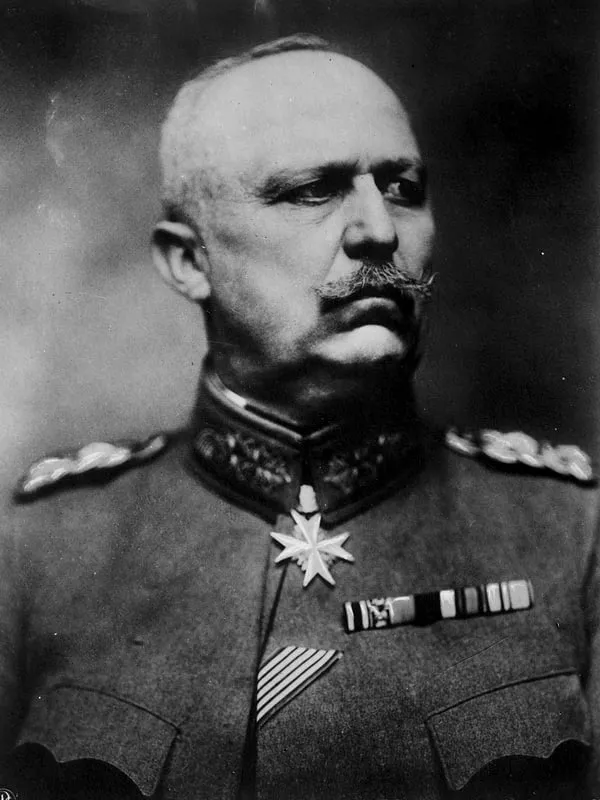
- Born:
- 9 April 1865, Kruszewnia, near Poznań (Prussia)
- Died:
- 20 December 1937, Munich
- Author:
- Natalia
- Photo:
- Alexander Binder, domena publiczna, Wikimedia Commons

Erich Ludendorff was Germany’s most powerful soldier in the First World War. As chief of staff to Paul von Hindenburg he led the German army to victories over the Russians in East Prussia, and from August 1916, as First Quartermaster General, he in effect directed the Reich’s entire war effort and, increasingly, its policy too. In the spring of 1918 he staked everything on the great offensives in the west, and when he lost, he himself demanded an armistice, only to blame the defeat on politicians, socialists and Jews. For the history of the road to the Second World War, however, the post-war Ludendorff matters more: one of the chief authors of the stab-in-the-back myth, a participant in the Kapp Putsch, Adolf Hitler’s companion in the Munich Putsch and the author of the book Total War, in which he described a state wholly subordinated to preparing for the next war.
Youth and the General Staff
He was born on 9 April 1865 in Kruszewnia near Swarzędz in the Province of Posen, the son of the owner of a small estate, of merchant stock and without a noble title. In the Prussian army, where the higher posts were usually held by the nobility, he was thus an outsider who owed everything to hard work. He passed through the cadet corps at Lichterfelde, was commissioned as a second lieutenant of infantry in 1882 and, after the War Academy, was posted to the Great General Staff. From 1904 he worked in the mobilisation and deployment section, which he headed from 1908. He was one of the closest associates of the Chief of the General Staff, Helmuth von Moltke, and co-author of the plan for the rapid capture of the Belgian fortress of Liège at the start of a war with France.
Ludendorff believed the army was too small for a two-front war. Contrary to the custom that required General Staff officers to keep out of politics, he worked with nationalist organisations and pressed the Reichstag to approve a large expansion of the army. The law of 1913 gave him much of what he wanted, but he himself was sent back to regimental duty, to command a regiment in Düsseldorf. In April 1914 he was promoted to Generalmajor and took over an infantry brigade in Strasbourg.
Liège and Tannenberg
At the beginning of August 1914 Ludendorff accompanied the brigades that, after entering Belgium, were to break through between the forts of Liège into the city at night. When the commander of the 14th Brigade was killed, he took command, led it into the city and on 7 August took the citadel. The forts held out for several more days, but the Battle of Liège made him a hero and won him the Pour le Mérite.
Two weeks later the high command needed an energetic officer in East Prussia, where the commander of the Eighth Army wanted to withdraw behind the Vistula after a clash with the Russians. On 22 August Ludendorff became chief of staff of the Eighth Army, with the retired General Paul von Hindenburg as its commander. At the end of August, following a plan largely prepared by Lieutenant Colonel Max Hoffmann, they encircled and destroyed the Russian Second Army at Tannenberg, and in September drove the second Russian army out of East Prussia. Ludendorff was the operational brain behind these victories, but it was Hindenburg who became the national hero. The Hindenburg–Ludendorff partnership lasted the whole war: on the Eastern Front, in constant dispute with the Chief of the General Staff, Erich von Falkenhayn, and later at the head of the entire army.
From the autumn of 1915 Ludendorff ran, from Kaunas (Kowno), the administration of occupied Lithuania, Courland and part of Belarus, known as Ober Ost. There he created a military state that registered the population, regulated trade and travel, requisitioned food, timber and horses, and sent people to forced labour. In letters from this period he wrote of future German settlement in these lands. Historians see Ober Ost as one of the first experiences of German rule in the east, which returned in a different and incomparably more criminal form during the Second World War.
Military dictatorship, 1916–1918
On 29 August 1916, after Romania entered the war, Emperor Wilhelm II dismissed Falkenhayn. Hindenburg became Chief of the General Staff of the Field Army, and Ludendorff demanded the post of First Quartermaster General with joint responsibility for all decisions. From then on it was he who ran the staff and issued the orders, while Hindenburg lent them his authority. This period is spoken of as the “silent dictatorship” of the Third Supreme Army Command (OHL).
Ludendorff wanted to mobilise the whole state for war. The Hindenburg Programme of armaments and the Auxiliary Service Law were meant to subordinate the economy and the workforce to war production. In the east he backed the Act of 5 November 1916 in the hope of Polish recruits, and in the spring of 1917 he agreed to Vladimir Lenin’s passage through Germany to Russia, counting on the Bolsheviks to take Russia out of the war. The calculation paid off: after the Bolshevik coup Russia concluded an armistice, and in March 1918 it signed the Treaty of Brest-Litovsk, which handed Germany control over vast areas of Eastern Europe.
The most important political decisions of 1917–1918 were taken under his pressure. Together with the admirals, he forced through unrestricted submarine warfare at the beginning of 1917, even though he reckoned with the United States entering the war. In July 1917 he and Hindenburg brought about the fall of the Chancellor, Theobald von Bethmann Hollweg, by threatening to resign. Ludendorff rejected a compromise peace and sought a victory that would give Germany mastery of Europe and extensive annexations in the east.
The defeat of 1918
After Russia’s exit from the war Ludendorff had numerical superiority in the west for the first time, but he knew it would vanish once masses of Americans arrived in France. On 21 March 1918 he struck at the British in Operation Michael. The Germans advanced several dozen kilometres, further than at any time since 1914, but they did not split the British from the French. The subsequent offensives in April, May and June gained ground at enormous cost, but none brought a decision. In July the Allies under Ferdinand Foch seized the initiative. On 8 August at Amiens whole German units surrendered without a fight, and Ludendorff called it “the black day of the German Army”.
At the end of September, as the Bulgarian front collapsed and the Allies attacked along the entire Western Front, an exhausted Ludendorff concluded that an armistice must be sought at once. On 29 September at Spa he and Hindenburg put this demand to the emperor. At the same time he called for a government based on a majority in the Reichstag. He told his staff officers that power should pass to those to whom the army owed its present situation: “Let them now eat the soup they have cooked for us.” Many historians see in these words a foretaste of the later myth: responsibility for the lost war was to fall on the politicians, not the generals. The new Chancellor, Prince Max von Baden, asked President Woodrow Wilson for an armistice.
In October Ludendorff changed his mind. The front was falling back but not disintegrating, and Wilson’s notes were growing ever harsher. On 24 October, against the government’s wishes, he issued an order to the army which called the American terms unacceptable and urged continued resistance. The Chancellor presented the emperor with an ultimatum, and on 26 October Wilhelm II accepted Ludendorff’s resignation while keeping Hindenburg. Ludendorff was succeeded by General Wilhelm Groener. Two weeks later, when revolution broke out in Germany and the emperor fled to the Netherlands, a delegation led by Matthias Erzberger signed the Armistice of Compiègne. Ludendorff bore no formal responsibility for that signature, and this mattered for everything that followed.
The stab in the back
In November 1918 Ludendorff, with a false Finnish passport, blue-tinted glasses and a false beard, left via Copenhagen for Sweden, where he wrote his memoirs. He returned to Germany at the end of February 1919. He soon became one of the chief proponents of the claim that the army, undefeated in the field, had been betrayed by the “home front”: by socialists, revolutionaries, pacifists and Jews. Hindenburg repeated it in November 1919 before the committee of inquiry of the National Assembly, and Ludendorff developed it in his 1922 book Warfare and Politics. A well-known anecdote according to which the phrase “stab in the back” was suggested to him in conversation by the British general Neill Malcolm is questioned by some historians, but it does not alter the fact that Ludendorff was one of the most zealous propagators of the myth.
The myth poisoned the politics of the Weimar Republic. The politicians who had signed the armistice and the Treaty of Versailles were branded the “November criminals” by the nationalists. Erzberger was murdered by right-wing assassins in 1921, and the Foreign Minister, Walther Rathenau, in 1922. Nazi propaganda made the “stab in the back” one of its foundations.
Ludendorff drew close to men who wanted to overthrow the republic by force. In March 1920 he backed the Kapp–Lüttwitz Putsch and was in Berlin with the putschists. After the coup failed, broken by a general strike, he moved to Bavaria, which had become a refuge for the far right. He settled near Munich and surrounded himself with activists of the völkisch movement, among them a young agitator called Adolf Hitler.
The Munich Putsch
On the evening of 8 November 1923 Hitler burst into a meeting at the Bürgerbräukeller beer hall in Munich with armed men and proclaimed a “national revolution”. Ludendorff, who was brought to the scene, joined the putsch; Hitler earmarked him for command of a new national army. The next day the general walked beside Hitler at the head of the column that marched through the centre of Munich. At the Feldherrnhalle the Bavarian police opened fire; four policemen, thirteen putschists and a passer-by were killed, and two more putschists fell elsewhere in the city. Ludendorff walked through the police cordon and was arrested, while Hitler fled. The Munich Putsch ended in failure. The force that defended the republic throughout the Reich that autumn was commanded by Ludendorff’s former General Staff colleague, General Hans von Seeckt.
At the trial before the People’s Court in Munich, on 1 April 1924, Ludendorff was acquitted, while Hitler was sentenced to five years’ fortress confinement, from which he was released as early as December 1924. The court’s leniency towards the war hero and his companion was in itself a sign of how weakly the republic defended itself against its enemies.
Far-right politician
In May 1924 Ludendorff was elected to the Reichstag on the list of the National Socialist Freedom Movement, an alliance of the far-right Deutschvölkische Freiheitspartei (DVFP) and the NSDAP, which was then banned. He sat in parliament until 1928. In March 1925, after the death of President Friedrich Ebert, he stood in the presidential election as the candidate of the far right, backed by Hitler. He won about 1.1 per cent of the vote. This humiliation weakened him as Hitler’s rival within the nationalist movement. In the second round his former superior Hindenburg was elected president, something Ludendorff never forgave him. In 1927 he refused to take part in the unveiling of the Tannenberg Memorial alongside the president.
In September 1925 the Tannenberg League (Tannenbergbund) was founded under his patronage, a nationalist organisation hostile to Jews, the Catholic Church and Freemasons. Under the influence of his second wife, the physician and writer Mathilde von Kemnitz, whom he married in 1926, he sank ever deeper into conspiracy theories about “supranational powers” – Jews, Jesuits, Freemasons and Rome – which were supposedly responsible for Germany’s defeat. He published books such as The Destruction of Freemasonry through the Revelation of its Secrets (1927), and the couple created their own pagan “German faith”. Ludendorff fell out with Hitler. He regarded him as a traitor to the movement who, for the sake of power, sought an understanding with the Church and the old elites.
The Third Reich and “total war”
In September 1933, a few months after the Nazis took power, the Tannenberg League and the weekly that Ludendorff published were banned. An often-quoted letter in which Ludendorff supposedly warned Hindenburg at the beginning of 1933 that Hitler would “cast the Reich into the abyss” is known only from later accounts, and historians regard it as dubious or forged. What is certain is that the old general kept his distance from the new regime, while the regime wanted him on its side. In the mid-1930s, according to several accounts, Hitler offered him the rank of field marshal; Ludendorff is said to have refused. In 1937 the two men had a meeting of reconciliation, after which Mathilde Ludendorff’s religious movement was allowed to operate legally.
In 1935 Ludendorff published the book Total War. In it he argued that a future war would involve the whole nation, not just the army, and that politics, the economy, propaganda and social life must be subordinated to it in peacetime already. The state at war should be headed by a military leader, not by politicians. Ludendorff believed that Germany had lost the previous war because it had not fully mobilised its strength. The slogan of total war was taken up by Nazi propaganda; in February 1943, after Stalingrad, Joseph Goebbels called for “total war” in the Berlin Sportpalast.
Ludendorff died of cancer on 20 December 1937 in a hospital in Munich. Against his wishes, Hitler gave him a state funeral with a ceremony in front of the Feldherrnhalle, where shots had been fired during the putsch fourteen years earlier. He was buried at Tutzing on Lake Starnberg. Less than two years remained before the outbreak of the war he had foreshadowed in his book.
Significance
Historians agree in regarding Ludendorff as an outstanding organiser and staff officer, but rate him far lower as a strategist. The offensives of 1918 used up the army’s best forces without a clear objective and hastened the Allied victory. His political role is judged more harshly still. In 1916–1918 it was he, not the emperor or the chancellors, who determined the course of Germany’s war, rejected a compromise peace and chose ever riskier courses of action.
For the road to the Second World War, however, what matters most is what he did after the defeat. Ludendorff, who had lost the war and had himself demanded the armistice, did a great deal to make sure the Germans would not believe it. The stab-in-the-back myth, which he helped to create, allowed the right to portray the republic as the product of treason and prepared the ground for Hitler. His part in the 1923 putsch gave the young Nazi movement publicity and the respect of part of the elite. Finally, his vision of “total war”, in which the whole nation is the leader’s instrument, proved a harbinger of the war that Germany unleashed in 1939.
Sources
Often appears with
People who appear in the same events.