Albania
Enver Hoxha
First Secretary of the Communist Party of Albania (from 1948 the Party of Labour of Albania, 1941–1985), political commissar and commander-in-chief of the National Liberation Army (1943–1944), Prime Minister of Albania (1944–1954)
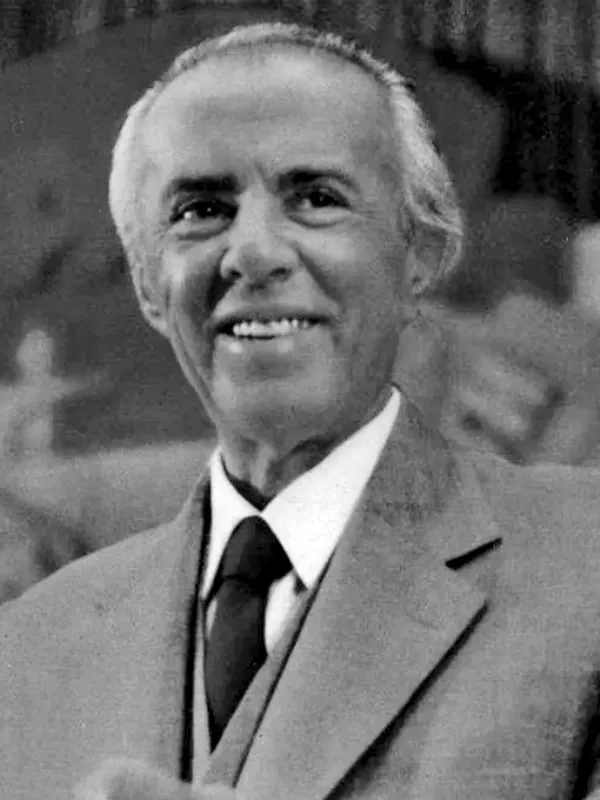
- Born:
- 16 October 1908, Gjirokastër (Ottoman Empire)
- Died:
- 11 April 1985, Tirana
- Author:
- Łukasz
- Photo:
- autor nieznany, domena publiczna, Wikimedia Commons

Enver Hoxha was the son of a merchant from southern Albania who, after studying in France and briefly working as a clerk in Belgium, became a teacher and, during the Italian and German occupations, rose to lead the Albanian communists and the partisan movement they directed. In the autumn of 1944 his partisans took power throughout the country. He ruled Albania for more than forty years, longer than any other leader of a European communist state. His rule meant terror against opponents, real and imagined, successive breaks with his allies of the moment – Yugoslavia, the Soviet Union and China – and an isolation whose symbol became hundreds of thousands of concrete bunkers.
Youth and studies
He was born on 16 October 1908 in Gjirokastër, an old stone-built town in the south of the country, then still within the Ottoman Empire; Albania declared independence four years later. His father, Halil, was a Muslim cloth merchant who often travelled abroad, so the boy grew up largely under the influence of an uncle who was involved in the independence movement and later in the opposition. According to his biographers, as a teenager he already belonged to a pupils’ association in his home town that was dissolved by the authorities. He continued his education at the French lycée in Korçë, which shaped him intellectually: there he discovered French literature and philosophy and, as he later wrote, first read The Communist Manifesto.
In 1930 he went on a state scholarship to the University of Montpellier to study natural sciences. He did not complete the course; he moved to Paris, attended lectures at the Sorbonne and came into contact with the circles of the French Communist Party and with left-leaning Albanian émigrés. In 1933 he lost his scholarship. From 1934 to 1936 he worked as secretary of the Albanian consulate in Brussels, from which – according to a version repeated in his biographies – he was dismissed after Marxist literature was found in his office. After returning home in 1936 he taught French at the lycée in Korçë, a town where one of several rival Albanian communist groups was active.
Occupation and the party
After the Italian ultimatum and the invasion of Albania in April 1939, the country became a protectorate of Benito Mussolini’s Italy, and King Zog I went into exile. Hoxha, who according to his later biographies refused to join the Albanian Fascist Party, lost his teaching post. He moved to Tirana, where he ran a tobacco shop, the “Flora”, which also served as a meeting place for conspirators. During this period Albania became the base for the Italian attack on Greece, and in December 1940 the Greek counter-offensive even reached his home town: the Greeks took Gjirokastër (Argyrokastro) and held it until the spring of 1941.
On 8 November 1941 in Tirana, on the initiative and with the participation of emissaries of the Yugoslav communists, Miladin Popović and Dušan Mugoša, the united communist groups founded the Communist Party of Albania (PL). Hoxha, who represented the Korçë group, became its provisional secretary, and at the first national conference in March 1943 formally its First Secretary. In September 1942 (some studies give 16 September, others 16 October), at a conference in the village of Peza, the National Liberation Front was formed; it was meant to unite opponents of the occupation regardless of their views, but in practice remained under communist control. Its armed wing became the National Liberation Army, in which Hoxha was political commissar.
Partisan war and civil war
The Albanian resistance was divided from the start. Alongside the communists there was the nationalist, republican organisation Balli Kombëtar, led by Midhat Frashëri, and later also the monarchist Legaliteti movement of Abaz Kupi. In August 1943 at Mukje representatives of the communists and of Balli Kombëtar agreed on a joint committee and a common struggle, together with a declaration that the future of Kosovo would be decided by its inhabitants. Under pressure from the Yugoslav communists, for whom the Kosovo clause was unacceptable, the party leadership headed by Hoxha repudiated the agreement and condemned those on its own side who had signed it. From the autumn of 1943 the struggle against the occupier was intertwined with civil war.
After the Italian armistice in September 1943 and Operation Achse, Albania was occupied by the Germans, who ruled through an Albanian Regency Council and the governments it appointed. Some Balli Kombëtar units began to collaborate with the occupier against the partisans, which the communists exploited to portray the whole organisation as collaborationist. In the winter of 1943/1944 a German offensive brought the National Liberation Army to the brink of defeat, but the partisans survived and from the spring of 1944 – supplied with arms and equipment by the British, above all through Special Operations Executive missions – quickly grew in strength. British liaison officers, it should be said, left conflicting assessments: some saw Hoxha’s partisans as the only force genuinely fighting the Germans, while others accused them of devoting more energy to their rivals than to the occupier.
On 24 May 1944 the congress at Përmet set up the Anti-Fascist National Liberation Council and its committee with the powers of a government; Hoxha became head of the committee and commander-in-chief of the army with the rank of Colonel General. In the summer of 1944 partisan divisions, among them one commanded by Mehmet Shehu, crossed the Shkumbin river and entered northern Albania, routing the forces of Balli Kombëtar and Legaliteti. On 20–23 October 1944 in Berat the second session of the Council transformed the committee into the Provisional Democratic Government of Albania; on 23 October Hoxha became Prime Minister and Minister of Defence.
The Germans, withdrawing with Army Group E from Greece through the Balkans, left Albania in the course of the autumn. The battle for Tirana lasted from 29 October (some works give 28 October) to 17 November 1944; on the night of 16/17 November the last German units broke out of the city and the partisans took the capital, an episode known as the liberation of Tirana. On 28 November, the anniversary of the declaration of independence, Hoxha’s government moved to the capital, and on 29 November the partisans entered Shkodër. Communist Albania celebrated that last date as Liberation Day. Albania was the only country in Europe apart from Yugoslavia in which communist partisans took power without the involvement of the Red Army.
Dictatorship
Power was secured quickly and ruthlessly. In 1945 a special court in Tirana sentenced politicians of the occupation period to death and long prison terms, and alongside actual collaborators it condemned pre-war opponents of communism, clergy and members of the intelligentsia. The elections of December 1945 were held with a single list of the Democratic Front, and on 11 January 1946 the People’s Republic of Albania was proclaimed. The main role in the apparatus of repression was played by the political police, the Sigurimi. Relations with the West were broken off after the Corfu Channel incident of October 1946, when 44 British sailors were killed by mines.
In the first post-war years Albania was in effect a satellite of Josip Broz Tito’s Yugoslavia, and the pro-Yugoslav faction of the Interior Minister, Koçi Xoxe, threatened Hoxha’s own position. The Tito–Stalin split of 1948 allowed him to free himself from this dependence: he broke with Belgrade and leaned on Moscow, while Xoxe was arrested and executed in June 1949. This was the beginning of a series of purges in which former comrades-in-arms were killed or imprisoned one after another.
After Stalin’s death Hoxha rejected Nikita Khrushchev’s de-Stalinisation and his rapprochement with Yugoslavia. At the turn of 1960 and 1961 came the Soviet–Albanian split: the Soviet advisers and the warships at the Vlorë base were withdrawn, diplomatic relations were broken off in December 1961, and in 1968, after the intervention in Czechoslovakia, Albania formally left the Warsaw Pact. Mao Zedong’s China became its new ally and source of aid. In 1967, following the example of the Chinese Cultural Revolution, the authorities closed all mosques and churches and Albania was proclaimed the world’s first atheist state; clergy were imprisoned, and some of them died. After Mao’s death and Beijing’s rapprochement with Washington, the Sino-Albanian split followed in 1978. Albania was left almost entirely alone, and the 1976 constitution even forbade taking foreign loans.
Isolation went hand in hand with an obsession with invasion. From the 1970s concrete shelters were built throughout the country; estimates of their number vary widely – most often around 170,000–175,000, in some publications as many as several hundred thousand – and the bunkers of Albania became a symbol of the regime. The regime boasted of eliminating illiteracy, electrifying the countryside and developing industry, which even its critics acknowledge, but Albania remained the poorest country in Europe, and an attempt to flee was punishable by prison or death. The numbers of victims are the subject of research and dispute; according to estimates cited by historians and by Albanian institutions investigating communist crimes, between 1944 and 1991 several thousand people were executed, and tens of thousands passed through prisons and labour camps or were interned together with their families.
Last years and death
From the 1970s Hoxha, who suffered from diabetes and heart disease, appeared in public less and less. In December 1981 his long-time deputy and prime minister, Mehmet Shehu, died in unclear circumstances – officially he committed suicide – and was posthumously declared a traitor and foreign agent; his family was imprisoned. Hoxha designated Ramiz Alia as his successor. He died on 11 April 1985 in Tirana. A few years later the system he had built collapsed: in February 1991 demonstrators toppled his statue in the capital’s main square, and in 1992 the dictator’s remains were moved from the cemetery of national heroes to an ordinary cemetery. His widow, Nexhmije Hoxha, was sentenced to prison.
Place in the history of the war
In the history of the Second World War Hoxha belongs to the group of leaders who used the struggle against the occupier to win power in the post-war state – like Tito in Yugoslavia. His partisans fought the Germans, but at the same time, and in 1944 above all, they waged a civil war against nationalists and monarchists, drawing on British supplies and Yugoslav political backing. The liberation of Albania in the autumn of 1944, celebrated for decades as a triumph of the party, meant for the country both the end of occupation and the beginning of one of the most closed dictatorships in Europe. Opinions of his role remain divided in Albania: part of the older generation remembers him as the builder of a modern state, but historiography is dominated by the image of a dictator responsible for the persecution of tens of thousands of people.