Germany
Franz Stangl
Deputy office manager of the Hartheim “euthanasia” centre (1940–1942), commandant of the Sobibór (1942) and Treblinka (1942–1943) extermination camps, SS-Hauptsturmführer
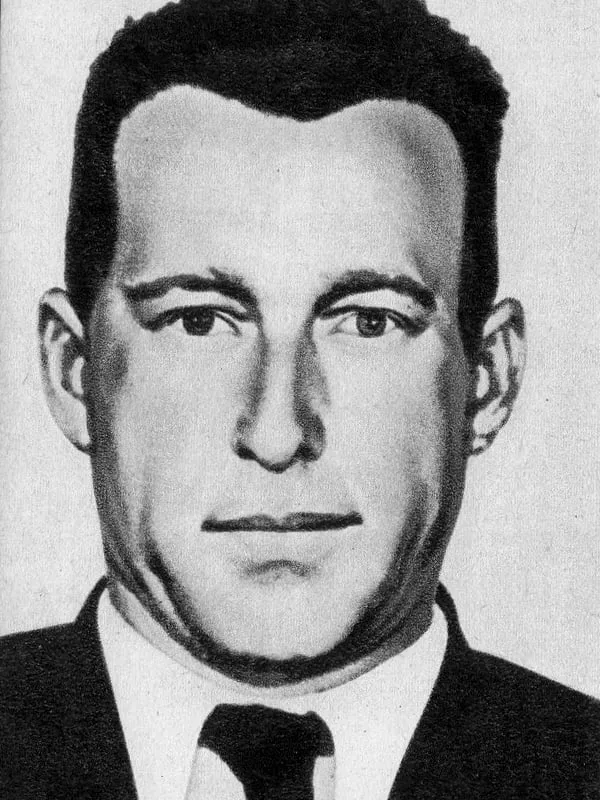
- Born:
- 26 March 1908, Altmünster (Upper Austria, Austria-Hungary)
- Died:
- 28 June 1971, Düsseldorf (West Germany)
- Author:
- Natalia
- Photo:
- autor nieznany, domena publiczna, Wikimedia Commons

Franz Stangl was an Austrian policeman who travelled the road from the Hartheim “euthanasia” centre to running two extermination camps. As the first commandant of Sobibór and then commandant of Treblinka, he was responsible for the deaths of hundreds of thousands of Jews, most of them from occupied Poland. Globočnik valued him as the best commandant of his camps, because Stangl was a meticulous organiser who turned a chaotic Treblinka into a smoothly running death factory. After the war he escaped from an Austrian prison, reached Brazil via Rome and Damascus, and lived there for sixteen years under his own name. Arrested in 1967 and handed over to West Germany, he was sentenced to life imprisonment in Düsseldorf in 1970. The conversations that the journalist Gitta Sereny held with him in prison before his death became one of the most frequently quoted testimonies of how an ordinary official becomes an organiser of mass murder.
Weaver and policeman
He was born on 26 March 1908 in Altmünster in the Salzkammergut, in Upper Austria. His father was a night watchman and died in 1916; years later Stangl spoke of him with fear and dislike. He trained as a weaver and in 1927 became a master weaver, but for health reasons gave up the trade and in 1931 joined the Austrian police. After training in Linz he went into the criminal police, and from 1935 worked in its political department in Wels. In October 1935 he married Theresa Eidenböck; they had three daughters.
When he joined the Nazi Party is uncertain. According to his English biography he had belonged to the NSDAP, illegal in Austria, since 1931; according to the Holocaust Historical Society, since 1936; German studies, including Dieter Pohl’s entry in the Neue Deutsche Biographie, state that he joined the SS and the NSDAP in 1938, after the Anschluss. Stangl himself claimed after the war that he enrolled only then, to avoid arrest. In March 1938 his department was absorbed into the Gestapo in Linz.
Hartheim and Bernburg
In November 1940 Stangl was assigned to Aktion T4, the programme for murdering the mentally ill and disabled. In Berlin he was received by Viktor Brack, who offered him a choice of two centres; Stangl chose Hartheim Castle near Linz. There he was deputy office manager, responsible for the security and secrecy of the institution, first under Christian Wirth, then under Franz Reichleitner. Thousands of patients were gassed at Hartheim. In October 1941, after the programme had officially been halted, he was transferred to the centre at Bernburg, where concentration camp prisoners were now being killed. At the beginning of 1942 he was given a choice: return to the Linz Gestapo or go to Lublin to Odilo Globočnik. He chose Lublin.
Sobibór
In March 1942 Globočnik entrusted him with completing the construction of the camp at Sobibór. Stangl later claimed that Globočnik had spoken of a supply camp for the army, and that he discovered the truth only when he found a gas chamber in the woods. Before taking over the camp he went to Bełżec for instructions from Wirth. According to the USHMM he was commandant of Sobibór from 28 April 1942. In the second half of April or around the turn of April and May, in the presence of Wirth and Stangl, trial gassings of Jewish women from a nearby labour camp were carried out, and at the beginning of May mass extermination at Sobibór began.
Stangl rarely showed himself to the prisoners. He greeted transports in a white linen riding coat and left the violence to his subordinates, among them Gustav Wagner. Instead of killing and replacing the Jewish prisoners forced to work every day, he formed them into permanent work squads under kapos, which made the camp run more smoothly. By the time of his transfer at the end of August 1942, between 90,000 and 100,000 Jews, according to various estimates, had been murdered at Sobibór. Stangl’s successor was his colleague from Hartheim, Reichleitner.
Treblinka
At Treblinka chaos reigned at the time. The commandant Irmfried Eberl was accepting more transports than the camp could “process”, bodies lay unburied and trains from the Warsaw Ghetto waited in the sidings. Globočnik removed Eberl, Wirth spent several weeks putting the camp in order, and on 1 September 1942 Stangl became commandant. He had the paths paved and flowers planted by the SS quarters, and in December 1942 had a dummy railway station with a false timetable set up by the ramp, so that new arrivals would not guess where they were. In the autumn of 1942 a new building with larger gas chambers came into use. Jews from the Warsaw and Radom districts and the Białystok region were brought to Treblinka, as well as from Theresienstadt, Greece and Macedonia.
Stangl wore a white uniform and carried a whip, but – as he claimed – avoided contact with the prisoners. He did not intervene when his subordinates, especially his deputy Kurt Franz (PL), tormented them. He later told Sereny that he saw the victims not as people but as “cargo”; it began, he said, on the day he saw Wirth standing over pits full of bodies. Under his command, according to Pohl, about 600,000 people were murdered at Treblinka; other estimates are higher. On 2 August 1943 the prisoners staged an uprising and set part of the camp on fire. In August Stangl was replaced by Kurt Franz, and the camp began to be dismantled.
Italy and escape
In September 1943 Stangl left with the Operation Reinhard men for the Adriatic, to the Operational Zone of the Adriatic Littoral. According to German studies, within the Einsatz R unit he ran the post at Udine, took part in fighting the partisans and in deporting Jews, and after Wirth’s death in May 1944 took over the detachment at Fiume. Towards the end of the war he returned to Austria.
In 1945 the Americans detained him as an SS man and interned him at the Glasenbach camp near Salzburg; they still knew nothing of his role in the extermination camps. In 1947 he was handed over to the Austrian judicial authorities, who suspected him of involvement in the crimes at Hartheim; under investigation he kept silent about Treblinka. On 30 May 1948 he escaped from custody in Linz together with Gustav Wagner. They crossed the Alps to Rome, where the Austrian bishop Alois Hudal, a Nazi sympathiser, helped him obtain a Red Cross passport. Stangl went to Syria and worked in Damascus in textile works; in 1949 his family joined him.
Brazil, trial and death
In 1951 the Stangls emigrated to Brazil. Stangl worked first as a weaver and technician in São Paulo, and from 1959 at the Volkswagen do Brasil works in São Bernardo do Campo. He lived under his own name and was registered at the Austrian consulate. The Austrian police put him on their wanted list only in 1961. His whereabouts were established by Simon Wiesenthal, to whom an informer is said to have sold the information for 7,000 dollars – “a cent for every Jew murdered at Treblinka”.
On 28 February 1967 the Brazilian police arrested Stangl in São Paulo. Austria, Poland and Israel all sought his extradition, but on 23 June 1967 Brazil handed him over to the Federal Republic of Germany. His trial before the regional court in Düsseldorf, one of the Treblinka trials (PL), began on 13 May 1970. Stangl admitted that he had been at the camp, but claimed that his conscience was clear because he had only done his duty. On 22 December 1970 the court sentenced him to life imprisonment for complicity in the murder of at least 400,000 people.
Stangl appealed against the verdict. In prison Gitta Sereny talked to him many times. In their last conversation, after a long silence, he admitted: “In reality I share the guilt.” He died of heart failure on 28 June 1971 in prison in Düsseldorf, less than a day after that conversation and before the verdict became final. Sereny’s book Into That Darkness (1974; in Polish W stronę ciemności. Rozmowy z komendantem Treblinki) is one of the classics of the literature on the perpetrators of the Holocaust.
Sources
Often appears with
People who appear in the same events.
On the timeline
(05)1941
1942
May
July
- 22
- Key eventThe Great Deportation in the Warsaw GhettoOn 22 July 1942 the Germans began deporting Jews from the Warsaw Ghetto to Treblinka. By 21 September they had murdered at least 254,000 people there.
- The Treblinka extermination campOn 22 July 1942 the first transport left Warsaw for Treblinka II. The next day the camp began operating; the Germans murdered some 800,000–900,000 Jews there.