- Category:
- Crimes and repression
- Front:
- Poland
- Date:
- 22 July 1942
- Author:
- Natalia
- Tags:
- Holocaust, Poland, Third Reich, Adam Czerniaków
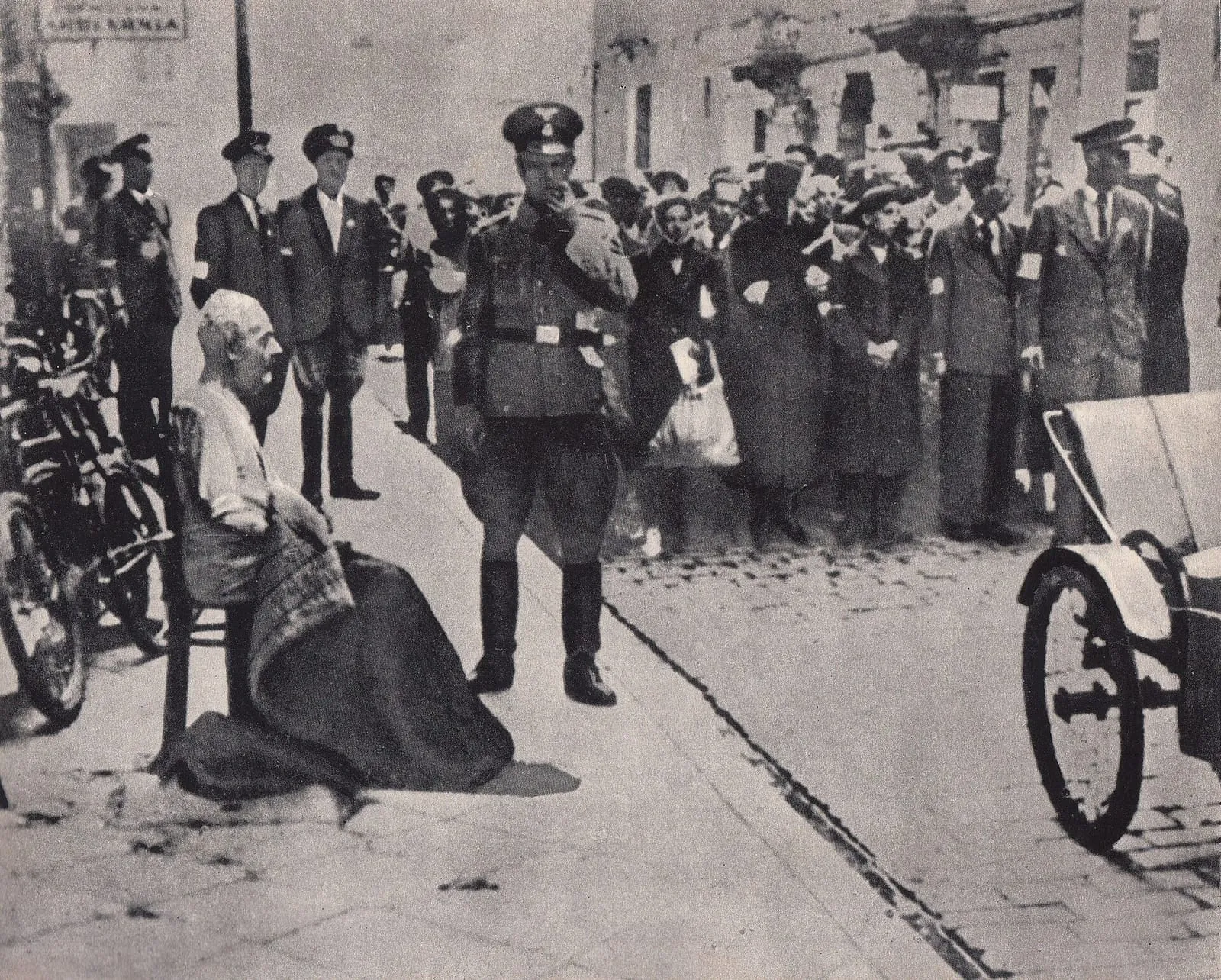
On Wednesday 22 July 1942, at around ten in the morning, SS men from the staff of Operation Reinhard drove up to the headquarters of the Warsaw Judenrat on Grzybowska Street. Their commander, Hermann Höfle, informed the chairman of the Council, Adam Czerniaków, that the Jews of Warsaw were to be “resettled in the East” and that the Council was to deliver 6,000 people every day to the transfer square on Stawki Street. That same day the first train left the Umschlagplatz. Its destination was the newly built extermination camp at Treblinka, where those brought in were killed in gas chambers immediately on arrival.
So began the operation that the Germans called the Grossaktion, and survivors and historians the Great Action, the Great Deportation or the great resettlement. It lasted until 21 September 1942. “Resettlement” was a lie from the very first day: the aim was not to move people somewhere else but to annihilate them. In less than two months the Germans deported to Treblinka and murdered there, according to German figures, 253,742 men, women and children, and according to other estimates between 260,000 and 300,000. It was the largest single act of mass murder in the history of occupied Poland and the deadliest operation of the whole of Operation Reinhard.
The ghetto in the summer of 1942
The Warsaw Ghetto, established in the autumn of 1940 and sealed off by a wall in November, was the largest ghetto in occupied Europe. By July 1942, according to various calculations, between 83,000 and 92,000 people had died in it of hunger and disease. On the eve of the operation it held, depending on the estimate, from about 350,000 to 380,000 Jews, among them tens of thousands of refugees and deportees from the small towns of the Warsaw District and from the Reich.
Paradoxically, in the spring of 1942 the ghetto’s position seemed more stable than a year earlier. The epidemic of typhus was dying down, mortality was falling, and the workshops and German enterprises known in the ghetto as “shops” were expanding production for the Wehrmacht. Many inhabitants believed that the ghetto was too large and too necessary to the German war economy to be liquidated. Yet ever worse news was arriving. Since February the Oyneg Shabes, the underground archive of Emanuel Ringelblum, had possessed the account of an escapee from the camp at Chełmno on the Ner, to which Jews from Łódź had been deported since January. In the spring letters came telling of the liquidation of ghettos in the Lublin region and of Bełżec, and in June London broadcast news from the Bund Report. This information, however, reached only a narrow circle, and not everyone was able to piece it together.
German terror in the ghetto was mounting. On the night of 17/18 April 1942 the Gestapo dragged 52 people from their flats and shot them in the streets, officially for publishing illegal newspapers. Similar executions recurred in May and June, and at the beginning of July 110 prisoners were taken from the jail on Gęsia Street and shot outside Warsaw. Some historians see these killings as preparation for the liquidation of the ghetto: intimidating the population and removing potential leaders of resistance.
The decisions were taken outside Warsaw. Since March 1942 the staff of Odilo Globocnik in Lublin had been conducting Operation Reinhard, the murder of the Jews of the General Government in the camps at Bełżec, Sobibór and Treblinka. It was the practical execution of what had been discussed in January at the Wannsee Conference. On 19 July 1942 Heinrich Himmler ordered the Higher SS and Police Leader in the General Government, Friedrich Wilhelm Krüger, to complete the “resettlement” of the entire Jewish population of the General Government by 31 December 1942. The camp at Treblinka, situated in woodland near Małkinia station, some 80 kilometres north-east of Warsaw, was ready in precisely those days.
22 July
Höfle had arrived in Warsaw with SS men from Lublin as early as 15 July. Also on the spot was the resettlement staff of the Warsaw Security Police under Karl Georg Brandt and Gerhard Mende; formally, responsibility for the operation lay with the SS and Police Leader of the Warsaw District, Ferdinand von Sammern-Frankenegg. As late as 18 and 20 July the Gestapo and the ghetto commissioner Heinz Auerswald assured Czerniaków that talk of resettlement was mere rumour. On 21 July the Germans arrested several dozen prominent people in the ghetto as hostages, among them members of the Council and doctors. During the night of 21/22 July the walls were surrounded by the Polish “Blue” Police and by auxiliary units of Ukrainian, Latvian and Lithuanian collaborators, known in the ghetto as “Hiwis”. In the morning the Germans shot several people in a flat on Chłodna Street, among them a Polish doctor, Franciszek Raszeja, who had come to see a Jewish patient.
Höfle chaired the meeting at the Council’s headquarters. The interpreter was a young Judenrat official, Marcel Reich-Ranicki, later a well-known German literary critic. Czerniaków wrote in his diary: “We were told that, with certain exceptions, the Jews, irrespective of sex and age, are to be deported to the east. By 4 p.m. today 6,000 people are to be delivered. And so it will be (at the least) every day.” Höfle threatened that if the deportation failed, the chairman’s wife would be the first to be shot.
Around midday a notice appeared on the streets of the ghetto signed impersonally “the Jewish Council”, because Czerniaków had refused to put his name to it. It announced that all the Jews of Warsaw, “regardless of age and sex”, would be resettled in the East and might take 15 kilograms of luggage and food for three days. At the same time it listed a long series of exemptions: employees of the Council and its institutions, the Jewish police, those employed in German enterprises, hospital staff, people fit for work and their families. The exemptions created the illusion that the deportation would cover 50,000–70,000 “unproductive” people, the poorest and the unemployed. This was deliberate deception.
The first transport, numbering 6,250 people according to surviving records, took the residents of refugee shelters, including a boarding home for about 200 children on Dzika Street, the street poor and the prisoners of the Gęsia Street jail. It reached Treblinka on 23 July. In the Jewish calendar 22 July was the eve of Tisha B’Av, the day of mourning for the destruction of the Temple.
The death of Czerniaków
Czerniaków tried to negotiate the exemption of children in orphanages from deportation. On the evening of 23 July two SS men demanded of him, most probably, that the daily quota be increased and that children be included in the deportations. After they left, the chairman took potassium cyanide. In a letter to his wife he wrote: “They demand that I kill the children of my nation with my own hands. Nothing remains for me but to die.” His successor was Marek Lichtenbaum, who carried out German orders without resistance. Many ghetto activists at the time judged Czerniaków’s suicide harshly, as a gesture of helplessness that had warned no one; over time the view prevailed that it was a refusal to take part in the crime.
On 24 July a new notice from the Council – the very one Czerniaków had refused to sign – called on people not to hide but to report to the assembly point of their own accord, and assured them that the resettlement “really is to the eastern territories”. The railways worked efficiently: on 28 July the state secretary in the Reich Ministry of Transport, Albert Ganzenmüller, assured the head of Himmler’s personal staff, Karl Wolff, that since 22 July a train carrying 5,000 Warsaw Jews had left every day for Treblinka via Małkinia.
The Umschlagplatz and the blockades
The Umschlagplatz was a fenced square with a railway siding on Stawki and Dzika Streets, through which goods had until then passed between the ghetto and the rest of the city. Now it became a waiting room for death. People were held in school buildings and on the square, sometimes for several days, without water, food or sanitation, on some days more than 10,000 at a time. In the afternoon, usually at around 4 p.m., they were driven into goods wagons, a hundred or more to a wagon meant for a few dozen.
In the first week the quotas were supplied by the Jewish Order Service, the ghetto police of some 2,500 men. Its commander, Józef Szeryński, released from Pawiak prison at the start of the operation, shared power with Jakub Lejkin and the head of the Umschlagplatz, Mieczysław Szmerling (PL). The policemen received certificates protecting their families from deportation. Each day the German staff designated houses or blocks of streets to be cordoned off; the residents were herded into the courtyards, their papers were checked, and those without certificates were led to the square. Then the empty flats were searched.
When people stopped reporting voluntarily, the Germans resorted to a ruse. On 29 July it was announced that anyone who came forward of their own free will would receive 3 kilograms of bread and a kilogram of jam. Thousands of starving people reported; some reasoned that no one would hand out bread to people condemned to death. From the same day SS men and “Hiwis” took part directly in the blockades, and the operation became even more brutal: those in hiding, those trying to flee, the old and the sick were killed on the spot, and random passers-by and people at windows were shot. In mid-August Lejkin, on German orders, required every policeman to deliver five people a day on pain of being deported himself together with his family. Some policemen deserted, a few took their own lives, and some helped people escape from the square; most, however, carried out their orders, and many enriched themselves through bribes and looting. The Jewish police became the most hated institution in the ghetto.
The shops and the “numbers for life”
Employment seemed the only hope. A certificate from a shop – a German tailoring, shoemaking or carpentry works – protected its holder from deportation, at least for a time. People paid for a place of work with money and valuables, and craftsmen with their own sewing machines; at their peak the shops employed about 40,000 people. German entrepreneurs such as Walther Többens made fortunes out of it. Fictitious marriages were contracted, because the exemptions covered families, and older people dyed their hair to look fit for work. Yet one category of the “protected” after another lost its protection: on 9 August the Council itself had to select 7,000 people for deportation, and in August officials of the Judenrat and employees of Jewish Social Self-Help (PL) were taken; of the latter’s 3,000 staff, reportedly 75 survived.
The ghetto shrank from week to week. On 9 and 10 August the so-called small ghetto south of Chłodna Street was liquidated; its inhabitants were given a few hours to move, which forced them to abandon their belongings. Smuggling almost ceased, and black-market bread prices rose several times over. At the Umschlagplatz the young and strong were also selected for labour camps: according to figures cited in the literature, about 11,500 people were sent there.
The children
Children, whom no certificate could help, were doomed from the start. Adolf Berman and his wife Barbara estimated that about 4,000 children from the ghetto’s nearly thirty orphanages and children’s homes were deported to Treblinka. The best known was the transport of 5 or 6 August, on which Janusz Korczak went with Stefania Wilczyńska, the staff and about two hundred children from the Orphans’ Home on Sienna Street. Korczak rejected offers to save himself alone and stayed with his charges to the end. In the same days children from several other institutions were deported together with their carers, some of whom chose to go with them.
Treblinka
The journey to Treblinka sometimes took a few hours and sometimes more than a day, because the “special trains” gave way to military transports. In the sealed wagons, without water or air, in the heat of July and August, hundreds died. On arrival the deportees were driven out of the wagons, ordered to undress and herded into gas chambers, where they were killed with engine exhaust. Only a few men were kept alive to sort belongings and bury the bodies.
The camp commandant, the physician Irmfried Eberl, wanted his camp to surpass the others in the number of victims and accepted more transports than the chambers could absorb. In August Treblinka sank into chaos: trains waited on sidings, some of the people were shot at the ramp, thousands of bodies lay unburied, and the stench could be smelled throughout the area. At the end of August Globocnik removed Eberl; Christian Wirth restored order in the camp and handed it over to Franz Stangl. From 28 August to 3 September the transports from Warsaw were suspended; earlier, between 19 and 24 August, the Germans had halted them for several days in order to liquidate the ghettos in Otwock, Falenica, Mińsk Mazowiecki and other towns near Warsaw.
The cauldron on Miła Street
The final stage began on 6 September. A notice ordered all Jews to report for registration in the block of streets between Smocza, Gęsia, Zamenhofa and Szczęśliwa Streets and Parysowski Square, later called “the cauldron on Miła Street”. Anyone remaining outside it was to be shot. The Germans had decided that 32,000 people would remain in the ghetto and distributed the same number of “numbers for life” among the enterprises and institutions. The selection lasted until 12 September and tore families apart: some abandoned their loved ones, others gave up their numbers in order to go to the Umschlagplatz with them, and parents tried to carry sleeping children through in rucksacks. According to figures cited in the literature, more than 54,000 people were deported to Treblinka during the cauldron, and more than 2,600 were killed on the spot. The Jewish police were allotted only 500 numbers; the rest of the policemen, despite earlier promises, shared the fate of the others.
The hospitals were liquidated too. On 12 September about 900 patients were taken from the buildings on Stawki Street; some doctors went with them of their own free will, and women doctors, among them Adina Blady-Szwajger, gave the youngest patients a lethal dose of morphine to spare them the wagons. That same day Höfle and his men left Warsaw. On 21 September, Yom Kippur, the last train left the Umschlagplatz, carrying the families of discharged policemen. On 24 September the resettlement staff informed the Council that the “resettlement” had been completed.
The toll
The number of victims is not precisely known. German figures, repeated by most historians, give 253,742 people deported to Treblinka; other estimates reach 265,000, 280,000 or even 300,000. According to Barbara Engelking and Israel Gutman, about 10,300 people died or were killed in the ghetto itself during the operation, and several thousand, perhaps around 8,000, managed to escape to the “Aryan side”. In all, the ghetto thus lost more than 300,000 inhabitants. About 60,000 people remained: some 35,000 registered and, by estimates, 20,000–25,000 “wild” ones with no right of residence. The district, cut down to a few fragments separated from one another, was turned into a labour camp serving German enterprises.
Resistance and testimony
The Jewish underground was taken by surprise. At meetings on 22 and 23 July the party leaders mostly concluded that fighting without weapons would be premature and might provoke the liquidation of the entire ghetto, and that the deportation would affect only some of the people. The young did not want to wait. On 24 July activists of Hashomer Hatzair scattered leaflets warning that death awaited the deportees; many dismissed them as a provocation. On 28 July members of Dror (PL), Hashomer Hatzair and Akiva founded the Jewish Combat Organisation (ŻOB), which at the time had a single pistol. Izrael Chaim Wilner, known as “Arie”, was sent to the “Aryan side” to obtain weapons. On 20 August the ŻOB fighter Izrael Kanał seriously wounded Szeryński – the underground’s first armed action in the ghetto. On 3 September the Germans arrested one of the organisation’s leaders, Józef Kapłan, shot another, Szmuel Bresław, and seized its meagre stock of weapons.
Alongside this, the witnesses carried on their work. On 3 August Ringelblum’s people buried the first part of the Oyneg Shabes archive in the cellar of a school at 68 Nowolipki Street. The Bundist Zygmunt Frydrych (PL) left the ghetto and, following the route of the transports, reached the area of Sokołów Podlaski, where he learned from railwaymen and escapees that the deportees were dying in Treblinka. At the end of August an escapee from the camp, Dawid Nowodworski (PL), returned to the ghetto, and the archive recorded his account.
News also travelled beyond Warsaw. On 26 July the head of the Directorate of Civil Resistance, Stefan Korboński, sent London a cable about the deportation of 6,000 people a day from the ghetto, and on 29 July the BBC reported the operation. In August a courier of the Government Delegation brought an eyewitness account to Bern. The Polish underground press wrote about the “resettlement” and about Treblinka, and in August the Catholic Front for the Rebirth of Poland distributed Zofia Kossak’s leaflet “Protest!”. The reactions of the Polish population varied: alongside help and sympathy there was indifference, and there were the szmalcowniks, blackmailers who hunted down escapees. In September, on the initiative of Kossak and Wanda Krahelska-Filipowicz, the Provisional Committee for Aid to Jews was formed; in December it was transformed into the Council to Aid Jews, “Żegota”.
Place in the war
The Great Deportation was the heart of Operation Reinhard. In the summer and autumn of 1942, at the same pace as in Warsaw, the Germans liquidated ghettos throughout the General Government, and a week before it began the Vel d’Hiv round-up had been carried out in Paris, its transports sent to Auschwitz. By the autumn of 1943, according to various estimates, between about 800,000 and 900,000 people had been killed at Treblinka, of whom the Jews of Warsaw formed the largest single group. In 1942 alone about half of all the victims of the Holocaust were murdered.
For those who survived, the great deportation dispelled the last illusions. Survivors reproached themselves for their passivity, and their anger turned against the Judenrat and the Jewish police. Moral authority in what was left of the ghetto passed to the ŻOB, which expanded in the autumn of 1942 and began killing collaborators. When on 18 January 1943 the Germans launched another deportation action, they met armed resistance for the first time and broke it off after a few days. On 19 April 1943 the Warsaw Ghetto Uprising broke out, regarded as the first urban uprising in occupied Europe; it was crushed after several weeks, along with the final destruction of the district. The Ringelblum Archive, dug out of the rubble in 1946 and 1950, preserved the memory of the summer of 1942 in thousands of documents written at the very moment when what no one had previously been able to imagine was happening.
Sources
Meanwhile
(04)Elsewhere, within a week.
- 23 July 1942 · Eastern FrontThe Germans take RostovOn 23–24 July 1942 the Wehrmacht took Rostov-on-Don for a second time. That day Directive No. 45 ordered simultaneous drives on the Caucasus and Stalingrad.
- 19 July 1942 · AtlanticU-boats withdrawn from the US coastOn 19 July 1942 Dönitz recalled the last two U-boats from off Cape Hatteras. Convoys and air patrols had ended the “second happy time” off the US coast.
- 18 July 1942 · MilitaryThe first jet flight of the Me 262On 18 July 1942 at Leipheim Fritz Wendel flew the third Me 262 prototype, for the first time on jet power alone. The aircraft entered service in 1944.
- 26 July 1942 · MediterraneanThe end of the First Battle of El AlameinOn 26–27 July 1942 Auchinleck's last attack at Miteiriya collapsed. On 31 July the Eighth Army went over to the defensive – Rommel was stopped, but not beaten.
Related events
(04)The same battle, people or subject.
- 3 May 1942 · PolandKilling begins at SobibórOn 3 May 1942, according to the USHMM, regular transports of Jews began to reach the Sobibór camp. By autumn 1943 some 170,000–250,000 people were killed there.
- 5 August 1942 · PolandThe deportation of Janusz Korczak's orphanageOn 5 August 1942 the Germans deported Janusz Korczak, Stefania Wilczyńska, their staff and nearly 200 children from the Warsaw Ghetto to Treblinka.
- 17 March 1942 · PolandKilling begins at BełżecOn 17 March 1942 the first transports of Jews from Lublin and Lwów reached the Bełżec camp. They were murdered in the gas chambers soon after arrival.
- 12 September 1942 · PolandThe deportation of Jews from Stanisławów to BełżecOn 12 September 1942, Rosh Hashanah, German police rounded up thousands of Jews in the Stanisławów ghetto and sent them to their deaths at the Bełżec camp.