Denmark
Henrik Kauffmann
Danish Minister in Washington (1939–1947), minister without portfolio (1945), Ambassador to the United States (1947–1958)
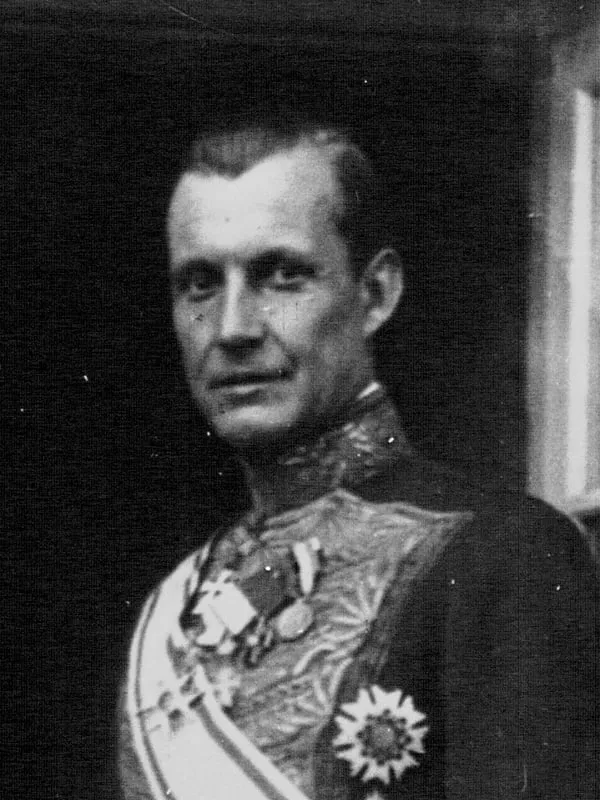
- Born:
- 26 August 1888, Frankfurt am Main (German Empire)
- Died:
- 5 June 1963, Skodsborg (Denmark)
- Author:
- Natalia
- Photo:
- Agence de presse Mondial Photo-Presse, domena publiczna, Wikimedia Commons

Henrik Kauffmann was a Danish diplomat who conducted his own foreign policy during the Second World War. When the Germans occupied Denmark in April 1940, the Minister in Washington declared that he would not carry out the instructions of a government operating under occupation. A year later, without the knowledge or consent of Copenhagen, he signed an agreement with the United States that placed Greenland under American protection and opened it to American bases. The Danish government recalled him and charged him with high treason, Washington continued to recognise him as minister, and after the war Kauffmann returned home as a cabinet minister. His independent decision of 1941 tied Greenland permanently to the American defence system of the North Atlantic and contributed to Denmark’s abandonment of its traditional neutrality.
Youth and first postings
Henrik Louis Hans von Kauffmann was born on 26 August 1888 in Frankfurt am Main. His father, Aage Kauffmann, was a Danish architect from a family with military traditions, working in Germany; his mother, Mathilde von Bernus, came from a Frankfurt noble family. Henrik was nonetheless brought up as a Dane. He completed his secondary education in Copenhagen in 1906 and graduated in law from the University of Copenhagen in 1911. That same year he began working at the Foreign Ministry, first as a volunteer and from 1912 as an official.
From 1913 to 1915 he was secretary at the consulate in New York, and then secretary of the legation in Berlin, where he spent the last years of the First World War. After returning to Copenhagen he headed one of the ministry’s departments. His career advanced exceptionally quickly. Danish historians attribute this to the patronage of Erik Scavenius, Foreign Minister during the First World War – the same man who a quarter of a century later would recall Kauffmann and bring charges against him. In May 1921, not yet 33, Kauffmann became Minister in Rome.
Beijing and Oslo
In 1924 he was transferred to Beijing, from where he was also accredited to Tokyo, and from 1928 to Bangkok as well. He spent eight years in China, which was torn by civil wars and from 1928 unified under the Kuomintang. There he became known for his excellent political reports, his close contacts with Chinese leaders and his extravagance, which the ministry in Copenhagen could see in his travel expenses. In 1926, in Portsmouth, New Hampshire, he married an American, Charlotte MacDougall, daughter of Rear Admiral William D. MacDougall of the US Navy. They had two daughters. His family ties to the American navy and the Washington elite were later to prove very useful.
In 1932 Kauffmann took over the legation in Oslo. Danish–Norwegian relations were strained at the time by the dispute over eastern Greenland: in 1931 Norwegian hunters and the government in Oslo had proclaimed the occupation of part of the coast, which they named Erik the Red’s Land. On 5 April 1933 the Permanent Court of International Justice in The Hague awarded the whole of Greenland to Denmark, and Norway accepted the ruling. For the following years Kauffmann tried to soften the bitterness on the Norwegian side. The affair taught him how important its Arctic colony was to Denmark, and how easily its status could become a matter of dispute.
Minister in Washington
In the summer of 1939, when war in Europe seemed close, Foreign Minister Peter Munch wanted an experienced diplomat in the United States and entrusted the legation to Kauffmann. On 9 April 1940 the Wehrmacht occupied Denmark, and King Christian X and the government remained in the country, accepting the German terms. Kauffmann reacted at once. That same day he told the State Department that he did not regard the government in Copenhagen as free, and on 10 April he declared publicly that he would work solely for the restoration of a free and independent Denmark. He was the first Danish diplomat to dissociate himself in this way from the government operating under occupation. The Americans continued to recognise him as the country’s lawful representative.
Greenland, cut off from the mother country, became the minister’s particular concern. Kauffmann set up a commission to see to supplies for the island and to the sale of its only valuable commodity, cryolite from the mine at Ivittuut, indispensable to the American and Canadian aluminium industries. He regarded himself as Greenland’s spokesman in its relations with the world, which the colony’s two governors, Eske Brun and Aksel Svane, did not accept; the mistrust between them lasted throughout the war. In the summer of 1940 Kauffmann refused to travel to Copenhagen for talks, and the new Foreign Minister, Scavenius, sent an emissary to Washington who smoothed over the dispute for the time being. Kauffmann, however, had already begun to fear that if the United States did not take charge of Greenland, the British and Canadians would – they had already occupied Iceland – and that Danish sovereignty over the island might then not survive.
The Greenland agreement
In the autumn of 1940 the Americans began to consider building airfields in Greenland. At first they wanted to deal with the governors, but in the first months of 1941 Kauffmann persuaded the State Department to conclude the agreement with him, in the name of the King as Greenland’s sovereign. On 9 April 1941, the first anniversary of the German invasion, he and Secretary of State Cordell Hull signed the “Agreement relating to the Defence of Greenland”. The United States took the island under its protection, recognising Danish sovereignty, and obtained the right to build bases, airfields and weather stations. Kauffmann explained to Hull that bringing Greenland into the defence system of the Western Hemisphere was the best way to preserve it for Denmark until the day of its liberation. The governors agreed under pressure, and the government in Copenhagen learned of the agreement only after it was announced on 10 April.
On 12 April the Danish government, after consulting the German minister, declared the agreement void and by royal decree recalled Kauffmann, ordering him to return home immediately. The minister replied that these decisions had been taken under duress and that he therefore did not recognise them, and asked that his action be judged only when Denmark was free. He was supported by all Danish diplomats and consuls in the United States, and Franklin Delano Roosevelt and Hull declared that they continued to recognise him as Denmark’s minister. At home, proceedings for high treason were opened against him and his property was seized; several legation officials who sided with Copenhagen were sent home. Kauffmann’s closest collaborator at the time was a young diplomat, Povl Bang-Jensen.
A “Free Dane” in wartime
From then on Kauffmann acted as the representative of those Danes who were beyond the occupier’s reach. The Americans gave him the right to dispose of part of the Danish assets frozen in the United States and of the revenue from cryolite. On the basis of his agreement, from July 1941 the Americans turned Greenland into an air and naval base, and after the United States entered the war in December 1941 the island found itself on the Allied side. On 3 January 1942 Kauffmann endorsed the Declaration by United Nations. He did not sign it, as that was the prerogative of governments, but declared that Danes in the free world would abide by it as if a free Danish government had signed it. Throughout the war he worked to ensure that after liberation Denmark could take its place among the victors rather than among the states that had come to terms with German occupation.
After liberation
When Denmark regained its freedom in May 1945, Kauffmann was hailed as a hero. The charges against him were withdrawn, and Prime Minister Vilhelm Buhl brought him into the liberation government as minister without portfolio, an office he held until November 1945. As a member of the government and Denmark’s representative, he took part in the San Francisco Conference, at which the United Nations was founded in the spring of 1945, and signed the United Nations Charter on Denmark’s behalf. The Rigsdag, the Danish parliament, approved his Greenland agreement. Kauffmann returned to his post in Washington; in 1946 he chaired the conference of the Food and Agriculture Organization of the United Nations in Copenhagen, and in 1947 the legation was raised to the rank of embassy.
The United States had no intention of leaving Greenland after the war, while Copenhagen wanted to return to a policy of neutrality. Kauffmann, convinced that Denmark’s place was in the Western alliance, again acted on his own: according to Danish historians, he did not fully inform Foreign Minister Gustav Rasmussen of the American demands, thereby undermining the government’s trust in him. In the end his line prevailed. In 1949 Denmark joined NATO, and in 1951 it concluded a new defence agreement on Greenland with the United States, on the basis of which Thule Air Base – today Pituffik Space Base – was built. In 1958 Kauffmann retired and joined the board of the East Asiatic Company (Det Østasiatiske Kompagni).
Death and memory
In 1963 Kauffmann, seriously ill with cancer (sources differ as to the type), was staying with his wife at a sanatorium in Skodsborg near Copenhagen. On 5 June 1963 his wife killed him in his sleep and then took her own life. In her farewell letters she wrote that she had wanted to spare him suffering. The case shocked Denmark.
In Danish memory Kauffmann has remained a controversial but increasingly esteemed figure: a diplomat who, without a mandate and against his own government, chose the Allied side while Copenhagen pursued a policy of collaboration with the occupier. In his lifetime he was called “the King of Greenland”. His biography was written by the historian Bo Lidegaard, and in 2020 a film about him, Vores mand i Amerika (Our Man in America), was made, in which he was played by Ulrich Thomsen. The agreement he signed in April 1941 proved one of the most enduring decisions of the Second World War: the American military presence in Greenland continues to this day.
Sources
Often appears with
People who appear in the same events.