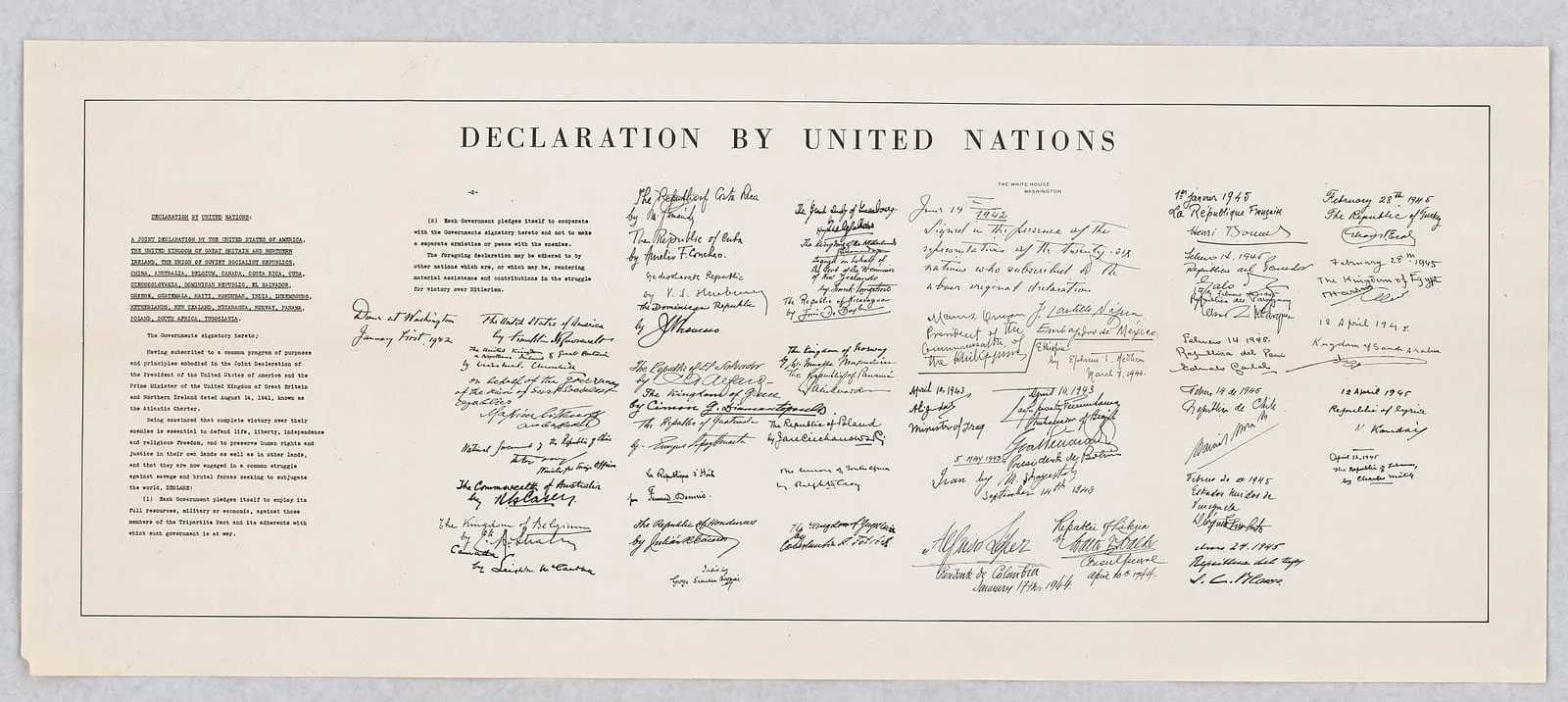
On 1 January 1942, in the President’s study in the White House, four men put their signatures to a short document of barely a dozen or so sentences: President Franklin Delano Roosevelt, Prime Minister Winston Churchill, the Soviet ambassador Maxim Litvinov and the Chinese foreign minister T. V. Soong (Song Ziwen). It was called the “Declaration by United Nations”. The next day, at the State Department, it was signed by the representatives of 22 more governments, among them the Polish ambassador in Washington, Jan Ciechanowski. In this way the states fighting Germany, Italy and Japan adopted a common programme, pledged to employ their full resources against their enemies and undertook not to make a separate peace with them. They also acquired a common name, which a new international organisation would take over three and a half years later.
It is often said that 26 states signed the declaration during the Arcadia Conference. That is true, since the conference lasted until 14 January, but the signatures were added in two stages: by the four great powers on 1 January and by the other 22 states on 2 January. Many accounts, Polish-language ones among them, simplify matters further by stating that all 26 signatures were put to the document on the first day.
From the Atlantic Charter to a wartime alliance
The principles invoked by the declaration had been proclaimed by Roosevelt and Churchill in August 1941 in the Atlantic Charter. The United States was still neutral at the time, and the Charter was a statement of aims, not an alliance. On 24 September 1941, at a conference in St James’s Palace in London, the governments-in-exile of occupied Europe, the Polish one included, the Soviet Union and the Free French subscribed to it. The pledge not to conclude a separate peace had already appeared in the Anglo-Soviet Agreement of 12 July 1941.
The attack on Pearl Harbor and the German and Italian declarations of war on the United States on 11 December changed the picture. America found itself at war with three Axis powers at once, while on the other side stood several dozen states and governments of very different standing: great powers, the British Dominions, governments-in-exile without territory, and the small republics of Central America and the Caribbean that had declared war alongside Washington. Secretary of State Cordell Hull recalled that only a few days after Pearl Harbor he had told his officials to draft a declaration that would bind all these states together until victory and commit them to the principles America was defending. The first versions were drawn up in the State Department between 14 and 19 December. One variant envisaged a separate text for the Soviet Union, which was not at war with Japan, but Hull judged that the declaration would carry more weight if Moscow signed the same document as everyone else.
Drafting the text
The declaration took its final shape during the Arcadia Conference, while Churchill was staying at the White House. Roosevelt revised the draft together with the Prime Minister and his closest adviser, Harry Hopkins. On 27 December the President handed the text to Litvinov to be cabled to Moscow, and then called the heads of several diplomatic missions to the White House and told them that they would be given the opportunity to sign the agreement.
Moscow’s reply brought amendments. One of them left a lasting mark: the Russians proposed that the final paragraph, which dealt with the accession of further states, should refer not to the struggle against the members of the Tripartite Pact but to the “struggle for victory over Hitlerism”. Hull feared that if Hitler were mentioned, Japan could not be left out. Litvinov replied that to his government Hitlerism meant Nazism, Fascism and Japanese militarism alike. The word “Hitlerism” went into the final text. The Soviet Union, which was observing its neutrality pact with Japan, was also given a loophole: each government undertook to fight those members of the Tripartite Pact and its adherents with which it was at war.
The reference to religious freedom caused more trouble. According to Robert Sherwood, Hopkins’s biographer, and to Churchill’s memoirs, Litvinov feared that the Soviet government would not accept such wording and suggested “freedom of conscience” instead. Roosevelt spent a long time persuading him that religious freedom also meant the right to profess no religion at all, and he got his way. Churchill wrote ironically that after this conversation he promised the President to recommend him for the post of Archbishop of Canterbury should he lose the next election. Moscow’s consent arrived in time, and the passage on “religious freedom” stayed in the text.
The British had wishes of their own. On 29 December the ambassador, Lord Halifax, conveyed the Cabinet’s request that Luxembourg, omitted by oversight, and India be added, and that the reference to social security found in the Atlantic Charter be restored. India was added; “social security” was not. London also proposed that the signatories be styled “High Contracting Parties”. The Americans refused, because in their practice this would have meant a treaty, which the President would have had to submit to the Senate. The declaration remained an agreement between governments, concluded under the President’s powers as commander-in-chief of the armed forces.
The sharpest dispute concerned the Free French. The British Cabinet insisted that the National Committee of General Charles de Gaulle, which had fought at Britain’s side since June 1940 and had subscribed to the Atlantic Charter, should be among the signatories. Washington maintained relations with the Vichy government, and the State Department was still angry over the Free French seizure of the islands of Saint-Pierre and Miquelon on Christmas Eve. Roosevelt refused to let the Committee take part. The Free French were not among the signatories.
The smaller states, too, raised objections. On 29 December Ambassador Ciechanowski told the State Department that he had the impression the text was being agreed by a narrow circle of great powers, with the rest merely expected to sign it. He warned that German propaganda in Poland would gladly exploit the fact that the Soviet Union had had a say in drafting the document while Poland had been treated as a second-class state, and asked that the text be shown to the governments concerned before signature. Canada, to which the draft had been sent through the British embassy, proposed drafting amendments. The Americans, however, did not want to reopen the text: as Assistant Secretary of State Adolf Berle explained, the Russians had at first intended not to sign a joint declaration at all but to issue a statement of their own without any pledge against a separate peace, and any change risked fresh demands.
The name
The December drafts were headed “Joint Declaration” and spoke of “Allied” or “Associated” Powers. During the First World War the United States had not formally joined the Entente and had called itself an “Associated Power”. Roosevelt was looking for a term that would not evoke the old alliances and would sound right to American public opinion. He came up with “United Nations”. According to an oft-repeated anecdote, the President had himself wheeled to Churchill’s room to share the idea at once and found the Prime Minister in the bath. Churchill accepted the name and pointed out that Lord Byron had already used it in Childe Harold’s Pilgrimage, in the stanza on Waterloo, “where the sword united nations drew” against Napoleon.
The signing
Churchill returned to Washington from a visit to Canada, where on 30 December he had addressed Parliament in Ottawa. On 1 January 1942, in the President’s study, the representatives of the four great powers signed the declaration. Their order was no accident: at the head of the list, before the alphabetical list of the others, stood the United States, the United Kingdom, the Soviet Union and China. Roosevelt wanted the China of Chiang Kai-shek, which had been fighting Japan alone since 1937, to stand in line with the great powers. Litvinov signed as ambassador, “on behalf of the Government of the Union of Soviet Socialist Republics”.
On the morning of 2 January the document was taken from the White House to the State Department. Berle collected the signatures in his office. According to a note by one of his aides, the first to sign, at 11.07 a.m., was the representative of Australia, while nine American republics – Cuba, Costa Rica, the Dominican Republic, Haiti, Honduras, Nicaragua, Guatemala and El Salvador, followed later by the ailing ambassador of Panama – signed together at around 11.30 a.m. Ciechanowski signed on behalf of the Republic of Poland at 12.15 p.m. On his government’s instructions he stated as he did so that he was recalling the position Poland had taken on 24 September 1941 when subscribing to the Atlantic Charter, and that he would confirm this in a note. The Czechoslovak minister was so moved that for several minutes he could not bring himself to sign, and said it was the most important document of his life. India’s representative, Sir Girja Shankar Bajpai, remarked that he was signing on behalf of four hundred million people, more than anyone except the representative of China. The last to sign, at 2.05 p.m., was the Canadian minister, who had been waiting for approval by telephone from Ottawa.
The signatories of 2 January were the four British Dominions (Australia, Canada, New Zealand and the Union of South Africa), British India, eight governments of occupied Europe (Belgium, Czechoslovakia, Greece, the Netherlands, Yugoslavia, Luxembourg, Norway and Poland) and nine states of Central America and the Caribbean. Denmark was not on the list. The Norwegian minister recalled that his government had decided to fight when the Danish one capitulated, and Berle replied that the government in Copenhagen was not at war and so could not sign the declaration. The Danish minister in Washington, Henrik Kauffmann, who had broken with the occupied government, did not sign. The State Department let it be understood, however, that the final paragraph of the declaration would in future allow representatives of free peoples from countries without a government at liberty to subscribe to its principles as well.
The text
The declaration consisted of two preambular paragraphs, two numbered points and a single closing sentence. The signatory governments stated that they had subscribed to the common programme of purposes and principles embodied in the Atlantic Charter of 14 August 1941, and declared that they were convinced that “complete victory over their enemies is essential to defend life, liberty, independence and religious freedom, and to preserve human rights and justice in their own lands as well as in other lands”, and that they were engaged in a common struggle against “savage and brutal forces seeking to subjugate the world”.
In the first point each government pledged to employ its full resources, military and economic, against those members of the Tripartite Pact and their adherents with which it was at war. In the second it undertook to co-operate with the other signatories and not to make a separate armistice or peace with the enemies. The final sentence stated that the declaration might be adhered to by other nations that were, or might be, rendering material assistance and contributions in the struggle for victory over Hitlerism.
The document created no common institutions, said nothing of frontiers or the post-war order, and was not a treaty of alliance in the strict sense. The State Department even took care that press releases should not call it an alliance, since the President had not used the word. The political weight of the declaration lay elsewhere. The commitment to “complete victory” and the ban on a separate peace bound the powers to one another and foreshadowed the later demand for unconditional surrender. The Soviet Union, which as recently as 1939 had made a pact with Hitler, now formally stood in line with the Western democracies and put its name to the principles of the Atlantic Charter.
Poland among the United Nations
For the Polish government-in-exile, signing the declaration confirmed the standing of a state that had been fighting since the first day of the war. Poland found itself among the founders of the coalition alongside the United States and the Soviet Union, with which Prime Minister Władysław Sikorski had signed a declaration of friendship and mutual assistance in Moscow only a month earlier. Both sides now pledged themselves to a common struggle before all the Allies. Ciechanowski’s reservations, however, revealed Polish anxieties: the governments of the smaller states were to sign a text agreed by others, and as early as December Moscow had been pressing the British to recognise its frontiers of June 1941, and thus the annexation of Poland’s eastern territories. The appeal to the principles of the Charter, which ruled out territorial changes against the wishes of the peoples concerned, became the chief argument of Polish diplomacy in the years that followed.
Further signatories
The name “United Nations” quickly caught on as the official term for the anti-Hitler coalition. Further states acceded to the declaration, usually when they declared war on the Axis powers: in 1942 Mexico (5 June), the Philippines, governed by the exiled government of President Manuel Quezon (10 June), and Ethiopia (28 July); in 1943 Iraq, Brazil, Bolivia, Iran and Colombia; in 1944 Liberia and, on 26 December, France, now represented by General de Gaulle’s provisional government. The largest number joined in February and early March 1945: Ecuador, Peru, Chile, Paraguay, Venezuela, Uruguay, Turkey, Egypt, Saudi Arabia, Lebanon and Syria. By 1 March 1945 a total of 47 states had signed the declaration. Of the Latin American states only Argentina was missing. Germany’s former allies, which changed sides in 1943–1945, were not admitted to the declaration.
Place in the war
The declaration of 1 January 1942 was the first joint document of the whole anti-Hitler coalition and its founding act. It did not settle the disputes between the Allies, but it bound them by a commitment that none of the great powers broke before the end of the war: neither the West nor the Soviet Union made a separate peace with Germany, as Hitler went on expecting until the last months of the war.
The declaration gave rise to the organisation that took over its name. On 30 October 1943, at the Moscow Conference, the foreign ministers of the USA, Britain and the USSR and the Chinese ambassador signed a declaration announcing the creation of a general international organisation. Its blueprint was drawn up in the autumn of 1944 at the Dumbarton Oaks Conference, and in February 1945 at Yalta it was agreed that the founding conference would be attended by the states that had signed the Declaration by United Nations and declared war on the Axis by 1 March – hence the wave of accessions in the final weeks before that deadline. Roosevelt did not live to see the San Francisco Conference: he died on 12 April 1945, and the delegates kept the name he had devised, according to many accounts partly as a tribute to him. On 26 June 1945 the representatives of 50 states signed the Charter of the United Nations, which came into force on 24 October.
Poland was absent from San Francisco because the great powers could not agree on which government should represent it. On 5 July 1945 the United States and Britain withdrew recognition from the government in London, whose ambassador had signed the declaration in 1942, and recognised the Provisional Government of National Unity. It was this government that signed the Charter on 15 October 1945, making Poland the 51st founding member of the United Nations Organization. Yet the state that had been among the first 26 to embrace the principles of the Atlantic Charter in Washington regained neither the frontiers nor the full sovereignty for which its government had been fighting in 1942.
Sources
Meanwhile
(04)Elsewhere, within a week.
- 5 January 1942 · Eastern FrontStalin orders a general offensiveOn 5 January 1942 Stalin, overruling Zhukov, ordered attacks on all fronts. On 7 January the Moscow counter-offensive ended, but the Germans held their front.
- 7 January 1942 · PacificThe siege of Bataan beginsOn 7 January 1942 Luzon's defenders manned the Abucay–Mauban line on Bataan. Hungry, they beat off the first attack but fell back to the Orion–Bagac line.
- 7 January 1942 · MediterraneanMalta under air attack in January 1942In January 1942 the Luftwaffe in Sicily began bombing Malta's airfields systematically. The island had 263 alerts; its Hurricanes were outclassed by Bf 109s.
- 25 December 1941 · Eastern FrontThe Kerch landingOn the night of 25–26 December 1941 the Red Army began landing near Kerch and on 29 December at Feodosia. Manstein had to halt his Sevastopol assault.
Related events
(04)The same battle, people or subject.
- 22 December 1941 · DiplomacyThe Arcadia ConferenceOn 22 December 1941 Churchill arrived in Washington to confer with Roosevelt. They agreed on “Germany first” and set up a joint Allied command.
- 26 May 1942 · DiplomacyThe Anglo-Soviet TreatyOn 26 May 1942 Eden and Molotov signed in London a treaty of wartime alliance and twenty years of co-operation. It said not a word about the Soviet borders.
- 8 December 1941 · DiplomacyThe “Day of Infamy” speechOn 8 December 1941 Roosevelt called Pearl Harbor a day of infamy and Congress declared war on Japan. Within days a dozen or more other states had done the same.
- 26 November 1941 · DiplomacyThe Hull noteOn 26 November 1941 Cordell Hull handed the Japanese a note demanding withdrawal from China and Indochina. It set no deadline, but Tokyo saw it as an ultimatum.