Denmark
Christian X
King of Denmark (1912–1947), King of Iceland (1918–1944)
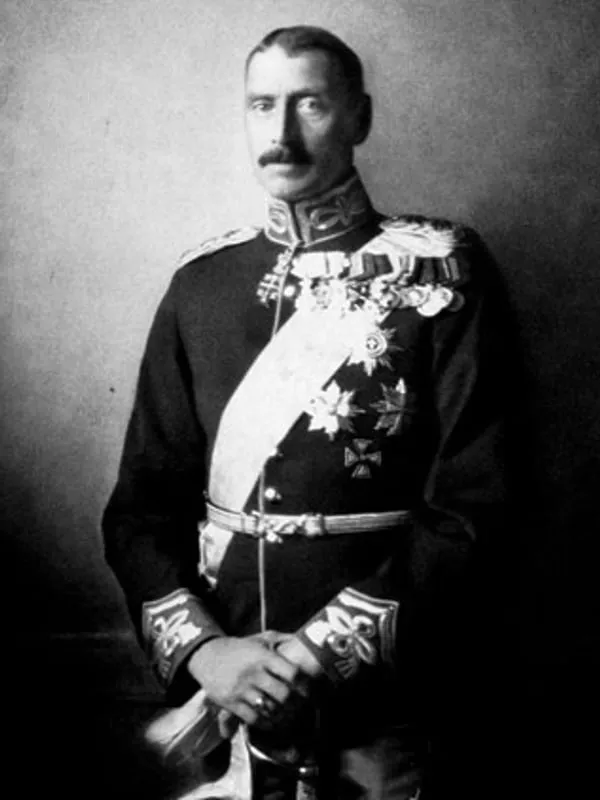
- Born:
- 26 September 1870, Charlottenlund Palace near Copenhagen (Denmark)
- Died:
- 20 April 1947, Copenhagen (Amalienborg Palace)
- Author:
- Łukasz
- Photo:
- autor nieznany, domena publiczna, Wikimedia Commons

Christian X reigned in Denmark for thirty-five years, through both world wars. He was a monarch of conservative convictions and a difficult character who in 1920 almost lost his throne by trying to govern against parliament. Twenty years later, on 9 April 1940, it was he who, together with the government, decided to end a hopeless resistance against the Wehrmacht and to remain in the occupied country. He did not go into exile like his younger brother, King Haakon VII of Norway, yet his solitary daily rides through Copenhagen and his cool distance from the occupiers made him a symbol of Danish steadfastness. His reign traces the path of a small neutral state through an age in which neutrality no longer offered protection.
Grandson of the “father-in-law of Europe”
Christian Carl Frederik Albert Alexander Vilhelm was born on 26 September 1870 at Charlottenlund Palace on the Øresund, north of Copenhagen. He was the eldest son of the heir to the throne, later King Frederik VIII, and of Louise, daughter of Charles XV, King of Sweden and Norway. His grandfather was Christian IX, whose children sat on or beside the thrones of half of Europe, which is why he was called the “father-in-law of Europe”. The young prince’s cousins included King George V of Britain, Tsar Nicholas II of Russia and King Constantine I of Greece. His brother Carl, two years his junior, was elected King of Norway in 1905 and took the name Haakon VII.
The children were brought up by their mother herself, strictly and in a religious spirit. In 1889 Christian became the first member of the Danish royal family to pass the school-leaving examination, after which, as befitted a prince, he embarked on a military career. He served in the dragoons, attended the officers’ school in Randers and later commanded the Royal Life Guards. All his life he thought of himself first and foremost as an officer; he liked to wear uniform and valued order, obedience and form. On 26 April 1898 in Cannes he married Alexandrine of Mecklenburg-Schwerin. They had two sons: Frederik (1899), later King Frederik IX, and Knud (1900). On his grandfather’s death in January 1906 Christian became heir to the throne, and on 14 May 1912, when his father died suddenly in Hamburg, he acceded as Christian X. His motto was “My God, my country, my honour”.
Neutrality in the Great War
When war broke out in 1914, Denmark declared its neutrality, and the King supported it. On 18 and 19 December 1914 he met his brother Haakon VII and King Gustaf V of Sweden in Malmö. The three Scandinavian monarchs, together with their foreign ministers, jointly affirmed the strict neutrality of their states. Denmark maintained it until the end of the war, although under German pressure it mined its own straits. Those years cemented a conviction in Copenhagen that lasted until 1940: that a small country next to a mighty Germany would survive as long as it gave Germany no pretext to intervene.
In domestic politics the King coped badly with change. He clashed with the Radical government of Carl Theodor Zahle. He reluctantly signed the constitution of 1915, which gave women the vote and took away the monarch’s remaining influence over the composition of the upper house. He regarded the sale of the Danish West Indies to the United States in 1917 as a humiliation. He did, however, agree that from 1 December 1918 Iceland should be a sovereign kingdom linked to Denmark only through the person of the monarch. Christian X thus became the first and only king of the Kingdom of Iceland.
The Easter Crisis of 1920
Germany’s defeat reopened the question of Schleswig, which Denmark had lost in 1864. Under the Treaty of Versailles two plebiscites were held in 1920. On 10 February the northern zone voted by three to one for Denmark, but on 14 March the central zone, including Flensburg, voted about 80 per cent for Germany. The Zahle government wanted to accept a border in line with the vote. The King, like some nationalists, believed that Flensburg should return to Denmark and demanded new elections. On 29 March 1920, when the Prime Minister refused, Christian X dismissed him and appointed a caretaker cabinet under his trusted lawyer Otto Liebe.
The step was formally in keeping with the constitution but contrary to the principle, in force since 1901, that the government depended on a majority in parliament. Social Democrats and Radicals spoke of a coup d’état, the trade unions prepared a general strike, there were demonstrations against the King in the streets of Copenhagen and some called for a republic. On 4 April, Easter Sunday, Christian X gave way: he dismissed Liebe and appointed a cabinet of officials, which held the elections. It was the last attempt by a Danish monarch to act politically against parliament. From then on the King accepted the role of a constitutional monarch.
A few months later the reunion of North Schleswig with Denmark brought him the finest moment of his reign. On 10 July 1920 he rode a white horse across the old border near Christiansfeld, and the image of the King lifting a little girl onto his saddle entered national iconography. The border drawn on the basis of the plebiscite was afterwards the only point of contention in relations with Germany.
A constitutional king
Between the wars Christian X withdrew from politics and became widely popular. He worked well with the Social Democratic Prime Minister Thorvald Stauning, who governed in 1924–1926 and from 1929, and who suppressed republican voices in his own party. Together they faced down agrarian discontent when tens of thousands of farmers marched to Amalienborg in July 1935. The King began to broadcast regularly on the radio and travelled with the Queen throughout the country, including Iceland, the Faroe Islands and Greenland. In the 1930s he supported the government and parliament against radicals on both sides and accepted the line of Stauning and the Foreign Minister Peter Munch: limited defence, strict neutrality and avoidance of anything that might provoke Adolf Hitler. Its high point was the non-aggression pact with the Reich, signed on 31 May 1939.
9 April 1940
At dawn on 9 April 1940 the Wehrmacht invaded Denmark. At around 5.30 a.m., to the sound of shooting between the Royal Life Guards and German soldiers beneath the palace windows, the King, the Crown Prince, the Prime Minister, the foreign and defence ministers and the commanders of the army and navy met at Amalienborg. Only the commander of the army, Lieutenant General William Wain Prior, wanted to fight. The others judged resistance hopeless in the face of German superiority and the threat that Copenhagen would be bombed. At around 6 a.m. the King and the government decided to accept the German demands under protest. While the meeting was still in progress, Christian X sent the guardsmen an order to cease fire, and he visited one of the wounded guardsmen in the palace porter’s lodge. That same day he and Stauning signed a proclamation calling on the Danes to remain calm and refrain from resistance.
The decision to stay in the country set him apart from Haakon VII, Queen Wilhelmina of the Netherlands and other rulers who left and headed governments-in-exile. Christian X believed that his place was among his subjects and that the presence of the King and a lawful government protected the country from rule by the occupiers or by local Nazis.
Under occupation
Until 1943 the King officially supported the government’s policy of cooperation, but the Danes saw him as a counterweight to it. Every morning, without escort or guard, he rode through the streets of Copenhagen, and people came out to greet him. His seventieth birthday on 26 September 1940 turned into a great national demonstration. A small badge bearing the royal monogram, the so-called King’s badge, was bought by one Dane in four and worn as a silent protest. In the autumn of 1940 Christian X also rejected the demands of a group of influential industrialists and politicians who wanted to replace the party cabinet with a non-parliamentary government.
In September 1942, on his 72nd birthday, Hitler sent him a long telegram of congratulations. The King replied curtly: “Spreche Meinen besten Dank aus. Chr. Rex” (“My best thanks. Chr. Rex”). Hitler took this as an insult. He recalled his envoy from Copenhagen, expelled the Danish envoy from Berlin and demanded a more compliant government. In November 1942 Werner Best became the Reich Plenipotentiary in Denmark, and the former Foreign Minister Erik Scavenius became Prime Minister at Germany’s wish. This “Telegram Crisis” made the King an even more conspicuous symbol of resistance. On 19 October 1942 Christian X fell from his horse during his morning ride and was seriously injured; he never fully recovered. Many of his duties were taken over by Crown Prince Frederik.
On 29 August 1943, when the government refused to accept new German demands, the occupiers declared a state of emergency. German soldiers also attacked Sorgenfri Palace, where the King was staying. After an exchange of fire with the guard in which men were wounded, Christian X ordered the guardsmen to stop fighting. For several months he was in effect interned in the palace under German guard. From then on Denmark had no government; the country was run by the permanent heads of the ministries.
Several legends became attached to the King’s wartime image, spread mainly by Danes in the United States who wanted to defend their country’s good name. The most famous holds that Christian X pinned on a yellow Star of David as a sign of solidarity with the Jews. This is untrue: Jews in Denmark were never forced to wear the star. The King did, however, write in his diary that if such a demand were made, it would be best for everyone to wear the Star of David. When the Germans prepared the deportation of the Danish Jews in the autumn of 1943, almost all of them managed to escape to Sweden.
The loss of Iceland and liberation
The war severed the link with Iceland. After Denmark was occupied, the Icelandic parliament assumed the King’s powers; in May 1940 the British occupied the island, and in 1941 the regent Sveinn Björnsson became head of state. In May 1944 the Icelanders voted almost unanimously in a referendum to dissolve the union, and on 17 June 1944 a republic was proclaimed. Christian X, who felt deceived, nevertheless sent his good wishes to the new state on the advice of the King of Sweden.
On the evening of 4 May 1945 the BBC announced the surrender of the German forces in Denmark. The next day the King addressed the nation, and on 9 May, in a wheelchair, he opened the session of a free parliament. He died at Amalienborg on 20 April 1947. The armband of the resistance fighters was laid on his coffin. He was buried in Roskilde Cathedral, and his son Frederik IX succeeded him.
Significance
Christian X entered history as a king of two contradictory images. As a politician in 1920 he tried to halt the advance of parliamentary government, and failed. As a constitutional monarch in the 1930s he lent his name to the policy of neutrality and accommodation towards Germany that collapsed on 9 April 1940. Yet it was in his name that the decision to capitulate was taken, sparing Denmark destruction, and his conduct under occupation allowed the Danes to preserve their sense of dignity and unity. By staying in the country he chose a different path from his brother in Norway. Both had their reasons, and the experience of 9 April led Denmark to abandon neutrality after the war and join NATO in 1949.
Sources
Often appears with
People who appear in the same events.