United Kingdom
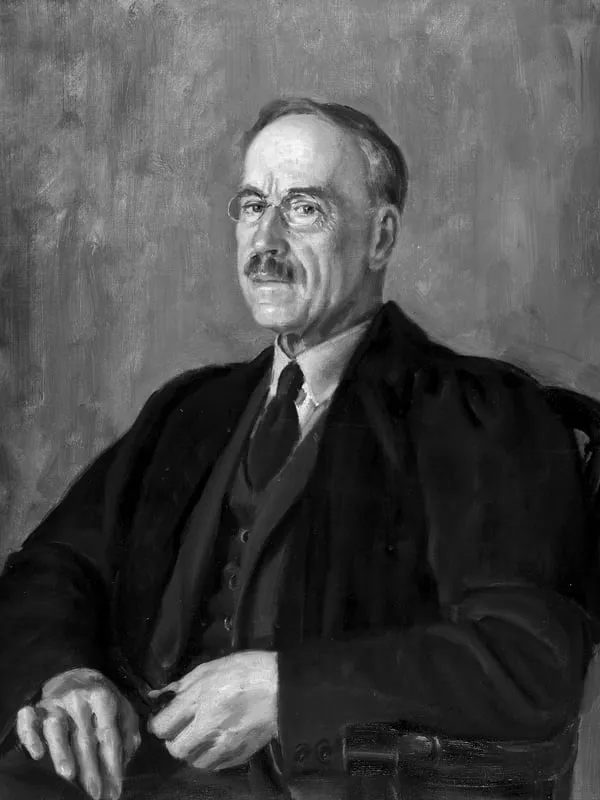
Henry Tizard
Chairman of the Committee for the Scientific Survey of Air Defence (1935–1939), Rector of Imperial College (1929–1942), head of the scientific mission to the US (1940), Chief Scientific Adviser to the Ministry of Defence (until 1952)
- Born:
- 23 August 1885, Gillingham (Kent, England)
- Died:
- 9 October 1959, Fareham (Hampshire, England)
- Author:
- Natalia
- Photo:
- Bernard Hailstone, domena publiczna, Wikimedia Commons

Henry Tizard was a chemist by training, an experimental airman in the First World War and a scientific administrator by vocation. In the mid-1930s he became chairman of a small committee charged with finding a way to defend Britain against bombers. It was under his chairmanship that the decision was taken to build radar and – just as importantly – to teach Fighter Command how to use it. Without this work the RAF would not have won the Battle of Britain in 1940. In the summer of that same year Tizard led a mission that handed Britain’s most valuable military secrets to the still neutral United States and began Anglo-American scientific cooperation. His wartime career, however, was marked by a rivalry with his former friend Frederick Lindemann, adviser to Winston Churchill, which kept him away from the most important decisions.
Youth and science
Henry Thomas Tizard was born on 23 August 1885 in Gillingham, Kent, the only son (he had four sisters) of Thomas Henry Tizard, a naval officer, hydrographer and Fellow of the Royal Society. He dreamed of a career in the navy, but poor eyesight ruled it out. He was educated at Westminster School and then read mathematics and chemistry at Magdalen College, Oxford, graduating in 1908 with first-class honours. On his tutor’s advice he spent a year in Berlin, in the laboratory of the chemist Walther Nernst. There he became friends with a young physicist, Frederick Lindemann, the son of a wealthy German who had settled in England. The friendship lasted more than twenty years before turning into one of the best-known enmities in the history of British science.
On his return Tizard worked in the Davy–Faraday Laboratory at the Royal Institution in London, and in 1911 became a tutor at Oriel College, Oxford. In the summer of 1914 he was sailing to a meeting of the British Association for the Advancement of Science in Australia when war broke out. In April 1915 he married Kathleen Wilson, the daughter of a mining engineer. They had three sons.
Experimental airman
In the autumn of 1914 Tizard was commissioned as a second lieutenant in the artillery, but he soon transferred to the Royal Flying Corps, where he worked on testing aircraft armament and performance. His eyesight having improved, he learned to fly and piloted the aircraft in his own experiments himself: he measured their speeds, ceilings and rates of climb, developing methods for testing aircraft scientifically. He worked at the experimental stations at Upavon, Orfordness and Martlesham Heath, and then at the Ministry of Munitions under the engineer Bertram Hopkinson. After Hopkinson’s death in 1918 he took over his duties. He ended the war as a lieutenant colonel in the newly formed RAF, decorated with the Air Force Cross. This experience made him one of the few scientists who understood both science and the pilots and commanders.
Fuels, offices and Imperial College
After the war he returned to Oxford as Reader in chemical thermodynamics. Working with the Shell company and the engineer Harry Ricardo, he studied the combustion of fuels in engines and their resistance to knocking. The measure they introduced, the so-called toluene number, was the forerunner of the octane rating, which became the world standard. In 1920 he moved into government service, joining the Department of Scientific and Industrial Research, of which he was Permanent Secretary – its most senior official – from 1927 to 1929. In 1926 he was elected a Fellow of the Royal Society. In 1929 he became Rector of Imperial College in London, a post he held until 1942, and from 1933 he also chaired the Aeronautical Research Committee, which advised the Air Ministry.
The Tizard Committee and the birth of radar
In the early 1930s the conviction prevailed in Britain, as Stanley Baldwin put it, that “the bomber will always get through”. At the end of 1934 the Air Ministry’s Director of Scientific Research, Harry Wimperis, proposed setting up a committee of scientists to examine how science could help air defence. Tizard became chairman of the Committee for the Scientific Survey of Air Defence, known thereafter as the Tizard Committee, and its members included the physiologist Archibald Vivian Hill and the physicist Patrick Blackett. The committee met for the first time in January 1935.
Even before that meeting, Wimperis had asked the physicist Robert Watson-Watt whether a “death ray” capable of bringing down an aircraft was possible. Watson-Watt replied that it was not, but that radio waves could be used to detect aircraft. In February 1935 a demonstration near Daventry showed that this could be done. The Tizard Committee immediately backed the work, from which within a few years grew the Chain Home network of coastal stations. Tizard’s achievement lay not so much in the invention itself as in understanding that radar was useless without an efficient system of command. In 1936–1937 he persuaded the RAF to hold a series of exercises over Biggin Hill in which ground controllers directed fighters onto bombers on the basis of reports of their positions. The interception method developed there, which the airmen called the “Tizzy angle”, became part of the defence system that Hugh Dowding built in Fighter Command.
In 1935, with Churchill’s backing, Lindemann joined the committee. From the outset he pushed his own ideas, such as aerial mines suspended from parachutes, and demanded that they be given priority over radar. The disputes became so bitter that in 1936 Hill and Blackett resigned, and the Air Ministry reconstituted the committee without Lindemann. From then on the two former friends were enemies. In 1937 Tizard was knighted (in the Order of the Bath). In 1938 he persuaded Mark Oliphant of the University of Birmingham to have his team work on a source of centimetric waves. The result was the cavity magnetron, built in February 1940 by John Randall and Harry Boot.
War, Lindemann and the mission to America
After the outbreak of war Tizard chaired the scientific committee on air warfare and advised the Chief of the Air Staff. In March 1940 Oliphant brought him the memorandum by Otto Frisch and Rudolf Peierls showing that an atomic bomb might be feasible. Tizard, previously sceptical, brought about the creation of a committee, later known as the MAUD Committee, chaired by the physicist George Thomson.
When Churchill became Prime Minister in May 1940, Lindemann became his closest scientific adviser and Tizard’s position weakened. In June, in the dispute over the German radio beam systems for guiding bombers (described earlier in the Oslo Report), Churchill sided with Lindemann and the young physicist R. V. Jones rather than with the sceptical Tizard. Soon afterwards Tizard resigned as adviser to the Chief of the Air Staff. He remained an adviser to Lord Beaverbrook’s Ministry of Aircraft Production.
Tizard had long believed that Britain should share its inventions with America, which had the industry capable of producing them. When the government finally agreed, he was put at the head of the scientific mission to the United States. On 14 August 1940 he flew to Canada and then on to Washington, where he met Vannevar Bush, head of the National Defense Research Committee. The rest of the delegation brought by ship a box of plans and a magnetron, which was demonstrated to the Americans on 19 September. The demonstration won them over to cooperation, and in November the Radiation Laboratory, the centre that designed most American wartime radars, began work at the Massachusetts Institute of Technology. Tizard returned home at the beginning of October 1940.
The dispute over bombing cities
In the following years Tizard was a member of the Air Council and advised the Ministry of Aircraft Production, but he never returned to the inner circle of decision-makers. In the spring of 1942 he clashed for the last time with Lindemann, by then Lord Cherwell. On 30 March Cherwell presented Churchill with a memorandum according to which mass night bombing could, within little more than a year, make a third of the German population homeless, which was supposed to break their spirit. Tizard showed that the calculation was several times too high: there would be fewer bombers, the new navigational aids would not be ready before 1943, and at most one bomb in four would hit its target. Blackett judged that the memorandum exaggerated sixfold. Both advised diverting more aircraft to the fight against the U-boats. They lost, and in the corridors Tizard was called a defeatist. In the following years RAF bombers destroyed most German cities, although post-war studies acknowledged that the effects on production and morale were much smaller than Cherwell had promised.
In 1942 Tizard left Imperial College and became President of Magdalen College, Oxford, his old college. He headed it until 1946.
After the war
After Labour’s victory in 1945 Tizard returned to favour. From 1946 he chaired the Defence Research Policy Committee, and from 1947 the Advisory Council on Scientific Policy. At the end of the 1940s he also became Chief Scientific Adviser to the Ministry of Defence. He held all these posts until 1952. He was one of the few in the British establishment who said openly that the country could not afford great-power ambitions. In 1949 he wrote that the British persisted in regarding themselves as a great power, capable of anything and only temporarily in economic difficulties; but they were not a great power and never would be again. They were a great nation, he went on, but if they continued to behave like a great power they would soon cease to be a great nation. On his initiative a small working party was set up in the ministry in 1950 to examine reports of “flying saucers”, as he believed they should not be dismissed without investigation.
He was awarded the Grand Cross of the Order of the Bath (1949) and the American Franklin Medal (1946), and in 1948 he was president of the meeting of the British Association for the Advancement of Science. He retired in 1952. He died on 9 October 1959 in Fareham, Hampshire.
Significance
Tizard was not a great discoverer, but he was an outstanding organiser of science. He knew how to ask the right question, bring scientists and servicemen together and persuade both to cooperate. Radar, the fighter control system and the well-prepared fighter force that held off the Luftwaffe in 1940 were to a large extent the fruit of his committee’s work. The 1940 mission helped build trust between Britain and the United States even before America entered the war, and the magnetron it brought became the basis of Allied superiority in radar. Tizard’s quarrel with Lindemann, described after the war by the novelist and physicist C. P. Snow, became a classic example of how personal rivalries between advisers can influence a state’s wartime decisions. A biography of Tizard based on his papers was published in 1965 by Ronald W. Clark.